Category: indie rock

Live Footage: The Dream Eaters “Neanderthals” in Studio

If you were frequenting this site earlier this year, you may recall a couple of posts I wrote about New York-based dream pop duo The Dream Eaters. Comprised of  Boston, MA-born, New York-based composer and songwriter Jake Zavracky and Vancouver Island, BC-born, New York-based vocalist and musician Elizabeth LeBaron, the New York-based dream pop duo can trace their origins together back to 2015. After playing and touring in obscurity both in his hometown and New York, Zavaracky had decided to give up music and for a period of time he was working in a Brooklyn dive bar, where he met LeBaron, a fellow bartender and musician, who had recently relocated to New York. When they both discovered that they were musicians, they found an instant connection and began collaborating together — although the initial arrangement was that Zavaracky had written songs for LeBaron. However, when they realized that their harmonies helped create a truly unique sound, they recognized that the best thing would be to write, record, and perform together. 

Initially writing and performing as Jake and Elizabeth, the duo saw a rapidly growing profile; however, as they began to further refine their sound, they felt that it was necessary to rebrand themselves, eventually taking up the name The Dream Eaters. And as The Dream Eaters, Zavracky and LeBaron released their self-produced debut EP Five Little Pills, an effort which has proven to be the precursor of the bare-bone production and sparse yet hauntingly gorgeous sound of their full-length debut, We Are A Curse and its first single “Dead On The Inside.” Sonically speaking, the duo pairs LeBaron’s lilting and effortless vocals with gently strummed folk-like guitar and chiming percussion with a soaring hook which displays the duo’s stunning harmonizing. And while bearing a resemblance to Moonbabies’ Wizards on the Beach, the song manages to sound as though it nods at Nick Drake and Crosby, Stills, and Nash-era folk. Thematically speaking, the song as the duo explained focuses on becoming unmoored and getting lost, and walking around with the realization that you’re living in a murky, anxious and unforgiving dream, evoking what many of us feel living in this surreal political climate; and while being a gorgeous and understated protest song, there’s an underlying sense of resolve and determination to survive and overcome the dark days ahead.

Interestingly, “Neanderthals,” We Are A Curse‘s second and latest single wasn’t originally meant to be on the album — and according to Zavracky is a revised and altered version of a song that he had originally written towards the end of the Bush Administration. After the 2016 presidential election the song seemed sadly relevant again, and ultimately came together very quickly. As Zavracky explains the song starts with a very pessimistic us vs. them mentality but takes on an optimistic, sort of “Don’t let the bastards grind you down” type of sentiment. “It’s mean to be more inspirational than negative by the end,” Jake Zavracky says. Elizabeth LeBaron adds that over the past couple of months, the song has grown and developed a much deeper meaning, even after they had finished it. “When we decided to record this song, the Women’s March was breaking records all over the world and this song felt like an anthem. ‘They won’t make us crawl / They’re all neanderthals’ are words that I think will resonate with anyone who is against the ‘archaic’ ideologies being pushed by the new administration,” LeBaron says. Sonically,   the duo pairs shuffling, trip hop-inspired beats with their gorgeous harmonies, twinkling keys and a soaring, anthemic hook to craft what may be the most strident and forcefully political song they’ve released to date.

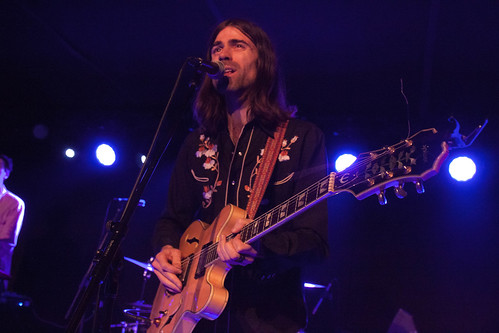
With the assistance of their PR firm, Behind the Curtains Media, the New York-based dream pop duo recently released live footage, performing “Neanderthals” in the studio. Check it out. 
New Video: The Symbolic (and Messy) Visuals for INVSN’s “This Constant War”

Earlier this year, I wrote about the Umea, Sweden-based post-punk quintet INVSN, an act comprised of some of Sweden’s most accomplished musicians — including Dennis Lyxzen (vocals), a founding member and frontman of Refused, and a former member of The (International) Noise Conspiracy, The Lost Patrol Band, AC4, and who has collaborated with The Bloody Beetroots and others; Sara Almgrem (bass, vocals), a member of The Doughnuts, The (International) Noise Conspiracy, The Vicious and Masshysteri; Andres Sternberg (guitar, keyboards), a member of Deportees, The Lost Patrol Band and a member of Lykke Li’s backing band; Andre Sandström (drums, percussion), a member of Ds-13, The Vicious, The Lost Patrol Band, Ux Vileheads and others; and Christina Karlsson (keyboards, vocals), a member of Tiger Forest Cat, Honungsvägen and Frida Serlander‘s backing band. And interestingly enough, the members of the band are five, long-term friends, with Lyxzen in particular being known for a lengthy career incorporating sociopolitical themes into his work; in fact, as Lyxzen has publicly explained, “Music always meant more to me then just entertainment. It has had a profound impact on everything that I am as a person and I see music as art and art as life. We live in a world devoid of meaning where we serve the lowest common denominator at all times. Where politics as an idea has failed us and where art is being reduced to consumerism and clickbait.”

The band’s initial recordings were written and recorded with lyrics in their native Swedish under the name Invasionen, but when the members of the band decided that it was time to take the project and their work internationally, they felt that writing and singing lyrics in English, along with a new name would be necessary — and they settled on INVSN.   Regardless of the name or the language, the post-punk band has always had a political message — and during this particular moment, when humanistic, Enlightenment values and thinking are being challenged by extreme right wing and extreme religious movements across the world, the members of INVSN strongly believe that their music, and the work of other like-minded musicians are part of a necessary and urgent outcry from a counterculture that has yet to give up. And while being righteously angry, their overall approach is rooted in the belief that change is gonna come — and it’s going to come real soon. 

The Swedish band’s latest effort The Beautiful Stories is slated for release on Friday, and the album was recorded and produced by by Adam “Atom” Greenspan, best known for his work with Nick Cave and The Veils at Svenska Grammofonstudion in Gothenburg, Sweden.  Reportedly, the album finds the band experimenting and expanding their aesthetic and songwriting approach with material that possesses elements of post-punk, industrial electronica, indie rock and indie pop, which gives their sociopolitical concerns an accessible, almost radio-friendly vibe. 

Now, as you may recall “I Dreamt Music” was a decidedly post-punk leaning song, sounding as though it drew influence from Joy Division and Gang of Four, thanks to the song’s decided politically charged tone. And as Lyxzen explained in press notes,  “I wanted to write about the longing for resistance to the cultural/political/musical landscape that holds us imprisoned. I wanted to write about the naive, romantic and pretentious notion that music and art should be about ideas that can change and transform and maybe even be the beacon of hope in these dismal times.” And as a result, the song manages to possesses a sense of cynicism and distrust and an equal bit of outrage.”

Interestingly enough, Beautiful Stories’ latest single “This Constant War” finds the band pairing jangling, Country-leaning guitar chords, layers of buzzing electronics and a propulsive rhythm section with boy/girl harmonies and a soaring, swooning hook in a song that sounds a bit like Joshua Tree and Achtung Baby-era U2 but filtered through Primal Scream, New Order and Ministry, while nodding at The Lonely Wild, as the material possesses a cinematic yet yearning quality at its core. 

The recently released video for “This Constant War” features the members of the band passionately singing the song or broodingly staring off into space as the hands of an unseen person smears colored paint onto the faces and bodies of the bandmembers. 

New Video: The Symbolic and Expressive Visuals for Holy Wars’ “I Can’t Feel A Thing”

Kat Leon is a Connecticut-born singer/songwriter, whose musical career started in earnest as one half of the Los Angeles, CA-based indie electro pop act Sad Robot, with Long Beach, CA-born, Los Angeles, CA-based multi-instrumentalist Nick Perez — and throughout her stint with Sad Robot, Leon developed a reputation for crafting material that was largely inspired by death and the occult.

With both of her parents suddenly dying within months of one another, Leon was plunged into a period of profound and heartbreaking grief. And after taking time to grieve the loss of her parents, Leon began her latest solo recording project, Holy Wars, which is deeply and profoundly influenced by some of the darkest days of her life; in fact, the project in many ways is to her an extrapolation of the tumultuous feelings and thoughts she had felt during that period — an the result is her debut double EP Mother, which is slated for a June 30, 2017 release and Father, which is slated for release later on this summer.  Both EPs are dedicated to her respective parents and while being understandably dark, the material isn’t completely nihilistic, and as you’ll hear on Mother‘s first single “I Can’t Feel A Thing,” the material is meant to be a cathartic release paired within a rousingly anthemic, arena rock-friendly sound reminiscent of Paramore — but with a hint of profoundly adult angst, the sort of angst that comes from recognizing  that death is a permanent parting, that there are no real answers, and that the only thing anyone can do is figure out a way to move forward to the best of their ability.

Directed by Jeremy Cordy, the recently released video features Kat Leon dressed in a god bodysuit and two other women, perhaps as representatives of the song’s narrator at various ages, expressively dancing with figures clad entirely in dark — and it’s meant to evoke each character being tugged, pulled, tossed around and in some way being seduced by their darkness, a darkness that overwhelmingly overpowers them. It’s clearly symbolic and yet gorgeously done. 

Comprised of siblings Tim (guitar, vocals) and Lewis Lloyd-Kinnings (bass, keys, vocals) and their best friend and spiritual brother, Cameron Gipp (guitar, vocals), the Brighton, UK/London, UK/York, UK-based indie rock trio  Johnny Kills specialize in a furious, surf rock, garage rock and Brit Pop-inspired indie rock. And with the release of two demos — “Take It Easy” and “Maybe Next Year,” the trio quickly received attention across the blogosphere and elsewhere; in fact, as a result, the trio along with North London-based Fin S. Woolfson (drums), the band recored their latest single “Let’s Talk About Me,” a single which will further develop the young upstarts reputation for crafting songs about being in your early to mid 20s and being absolutely clueless and anxious — about anything and everything. And although it’s been almost two decades since I was in my early 20s, the band’s sound reminds me quite a bit of Blur and others, as it consists of explosive power chords paired with propulsive drumming, and an anthemic, shout worthy hook reminiscent of Blur‘s “Song 2.

As the band’s Tim Lloyd-Kinnings explains “‘Let’s Talk About Me’ is about the frustrations of hanging out with people, who spend the whole evening talking about themselves, before realizing you kinda just want to talk about yourself too.” As a result, the song’s narrator recognizes that he’s had enough and wants to put his foot down; but he also seems to reveal a stunning lack of awareness of the fact that his friends are selfish, hateful pricks. But regardless of how far some of us are removed from our 20s, the song captures a sentiment that should be familiar, especially if at any point you may have been desperate for some kind of friendship/companionship.

Now, if you’ve been frequenting this site over the past three or four years, you may recall that I’ve written a handful of posts featuring the Chicago, IL-based psych rock band Secret Colours. When the band released their self-titled debut and their sophomore album Peach, the band’s initial lineup was a sextet; however, by the time they went into the studio to record Positive Distractions Part 1 and Positive Distractions Part 2, the band went through a massive lineup change that left Tommy Evans (vocals, guitar) and Justin Frederick (drums) as the only members remaining from the original lineup. The duo of Evans and Frederick recruited two long-time Chicago music scene friends Eric Hehr (bass) and Mike Novak (bass) to fill out the band’s second lineup. Naturally, as a quartet, the band went through a decided change in sonic direction, partially out of necessity, and partially as a result of being artists, who do evolve as life pushes them forward; in fact, the band most likely recognized that they had two responses — strip down previously perceived excesses or find an inventive way to recreate their sound with fewer members.

Some time has passed since I’ve written about them, and as it turns out the band has gone through yet another lineup change — and while Evans and Novak have remained, the band has two new members Max Brink (bass) and Matt Yeates (drums), and with their newest lineup the band find themselves subtly pushing their sound in new directions with their latest full-length effort Dream Dream; in fact, the band’s sound draws from psych rock but also from guitar pop and garage rock. And as you’ll hear on their jaunty and jangling new single “Changes in Nature,” the band pairs Evans falsetto with shimmering, pedal effected guitars, a strutting bass line and propulsive drumming with a soaring, rousingly anthemic hook — and this shouldn’t be surprising as the soon is a swooning and sweetly urgent love song, along the lines of XTC‘s “Mayor of Simpleton” but with a subtly lysergic vibe.


.


Last month, I had written about the Leeds, UK-based indie rock/psych rock trio The Boxing, and as you may recall, since their formation in 2014, the trio comprised of  Harrison Warke (vocals, guitar), Henry Chatham (bass) and Charlie Webb (drums) quickly asserted themselves as part of their hometown’s growing, contemporary indie rock and psych rock scenes; in fact, they’ve already drawn some comparisons to the likes of W.H. Lung, Eagulls and JOVM mainstays The Vryll Society.


“One by One,” which I wrote about last month, was a brooding track featuring swirling and shimmering guitar chords and a propulsive, motoric groove, led by a sinuous bass line and steady drumming paired with a soaring hook and a whispered croon reminiscent of The Horrors’ Faris Badwan, complete with a studio sheen. And as the band’s Harrison Warke explained in press notes “One by One” was an elaboration of the sound they developed across their first batch of singles, as it was the first single they recorded in a proper, professional studio. Naturally, the studio recording process  gave the members of the band the freedom and ability to experiment and flesh out the overall arrangement in a way that they were unable to do before.

“Heart of Me,” is essentially the B-side track to “One by One” and while continuing in a similar vein as its lead single, complete with shimmering guitar chords, the track manages to be a foil to its lead single while being able to stand on its own. And while nodding at slow-burning, moody and stormy shoegaze, the track possesses a creepy, existential dread as its core.


Comprised of Stefanie Drootin, best known for stints in The Good Life, Big Harp and in the backing bands of She & Him and Bright Eyes, and her Big Harp bandmate Chris Senseney, the Los Angeles, CA-based indie rock duo Umm specialize in a sound that features fuzzy power chords, plaintive and swooning pop-leaning harmonizing and anthemic hooks reminiscent of The Breeders, The Posies and others as you’ll hear on “I’m in Love,” the latest single off the duo’s forthcoming full-length debut Double Whisper. Certainly, as a child of the 80s, who started to come off age in the 90s, “I’m in Love” reminds me of making mixtapes, dubbing my friends tapes and making dubs for friends and spending countless hours in record stores.


Brad Byrd is a Los Angeles-based indie rock/indie folk singer/songwriter, who after years of suffering through alcohol addiction and depression, started his music career in earnest in 2003. Since then, he’s received attention both locally and nationally for his off-kilter, hook-driven and soulful songwriting over the course of his two full-length efforts, 2005’s The Ever Changing Picture, 2011’s Mental Photograph and a string of singles in which he worked with Warren Huart, who has worked with The Fray and Aerosmith. Adding to a growing profile, Byrd has had his music appear in a number of TV shows including The New Girl, Happy Endings, American Housewife, Ben & Kate, and Keeping Up with the Kardashians — and he’s shared stages with Bobby Long, Mike Doughty, Son Volt‘s Jay Farrar, Jurassic 5 and others.

Byrd’s third full-length album Highest Mountain was co-produced by the Los Angeles, CA based singer/songwriter and Jim Kimbrough, a member of indie rock trio Walt Mink, who has produced Tenacious D, and it’s not only Byrd’s first recorded output in over 6 years, the album may also be among his most personal work to date, as the album thematically focuses on both self-discovery and Byrd reconnecting with his roots. Highest Mountain‘s latest single “1000 Pink Balloons”  is a jangling and achingly soulful and introspective track that focuses on self-discovery and the strength in letting go; but with repeated listens, the single reveals a thoughtful and provocative singer/songwriter, who makes writing a catchy hook seem effortless while nodding at the work of The Church.

Currently comprised of Evan Way, Brette Marie Way, Sam Fowles and Robbie Auspurger along with a rotating cast of collaborators and friends, the Portland, OR-based indie folk/psych rock/indie rock act The Parson Red Heads can trace their origins to when its founding core members met in Eugene OR in 2004, where they all were attending college and studying for degrees that as the band’s frontman Evan Way jokes in the band’s official bio “never used or even completed.” As Way recalls “we would rehearse in the living room of my house for hours and hours until my roommates would be driven crazy — writing songs and playing them over and over again, and generally having as much fun as a group of people can have. We weren’t sure if we were very good, but we were sure that there was a special bond growing between us, a chemistry that you didn’t find often.”
So in 2005, the founding members of the band relocated to Los Angeles, where they hoped that they would take music much more seriously and become a real band, eventually moving into a 1 bedroom apartment in West Los Angeles. “Eventually the population of our 1 bedroom ballooned to 7 — all folks who played in our band at that point, too,” Way explains. But while in Los Angeles, the members of The Parson Red Heads became stalwarts of a growing 60s-inspired folk and psych folk scene based primarily in the Silverlake and Echo Park sections. “We played every show we could lay our collective hands on, which turned out to be a lot of shows. We must have played 300+ shows in our first two years in L.A.  . . . . We practiced non-stop and wrote a ton of songs, and eventually recorded our debut album King Giraffe at a nice little studio in Sunland, with the help of our friends Zack and Jason.
After 3 more years of writing, recording and touring, which resulted in an EP and their sophomore full-length Yearling, which was partially recorded at Red Rockets Glare Studio with Raymond Richards, who had then joined the band to play pedal steel and in North Carolina at Fidelitorium with The dB’s Chris Stamey, the members of the band decided to quit their jobs and their apartments and go on a lengthy tour with their friends in Cotton Jones before relocating to Portland.  But whether they were in Los Angeles or Portland, the band had developed a reputation for an uninhibited live act, with a folk sound that can easily go into rock mode — and in some way, it shouldn’t be surprising that the band’s influences include The Byrds, Teenage Fanclub, Big Star, Crosby, Nash, Stills and Young, Jackson Browne and others. In fact, with the band’s third full-length album Orb Weaver, the band wanted to capture their live, rock-leaning sound on wax. “We’ve always made records that were more thought-out,” says Way. “When we play live, we play more like a rock band. We wanted to show that more aggressive side of us, the more rock-oriented side.”
The psych folk/indie folk/indie rock act’s fourth full-length effort Blurred Harmony derives its name from a Donald Justice poem, and is slated for release next week through Portland-based label Fluff and Gravy Records here in the States, the home of JOVM mainstay Drunken Prayer, acclaimed singer/songwriter Fernando and Richmond Fontaine. And as Way explains, the band intended to do things differently — with the band recording and tracking themselves, setting up drums and amps and furiously recording after everyone had put their kids to sleep and trying to finish before it got too late. He goes on to say that “the record is more a true part of us than any record we have made before — we put ourselves into it, made ourselves fully responsible for it. Even the themes of the songs are more personal than ever — it’s an album dealing with everything that has come before. It’s an album about nostalgia, about time, change, about the hilarious, wonderful, bittersweet, sometimes sad, always incredible experience of living. Sometimes it is about regret or the possibility of regret. These are big topics, and to us, it is a big album, yet somehow still intimate and honest.” And as you’ll hear on Blurred Harmonys latest, jangling and anthemic single “Coming Down,” the wisdom of someone, who’s lived a full, messy life and recognizing that experiencing everything life has to offer is part of the purpose and forms who you are and who you’ll be, but with a sense of awe, joy and gratitude. “I’m alive, I’m okay and those who I cherish and love are alive and okay, and that’s really all that maters,” the song seems to say. But thanks to its jaunty and infectiously upbeat feel, the song also evokes the experiences of being on the road, of seeing things you’d never seen before, of meeting people you’d never met before, of strange languages you can barely pronounce, of an aching loneliness — and it all further cementing yourself and your place in the scheme of things.


New Video: JOVM Mainstays The Veldt Return with Hallucinogenic Sounds and Visuals for “One Day Out of Life”

Now, if you’ve been frequenting this site over the course of the past 12-18 months or so, you’ve likely come across a handful of posts featuring the pioneering, Raleigh, NC/NYC-based sheogazer rock quintet The Veldt. Currently comprised of founding members, primary songwriters and identical twin brothers Daniel Chavis (vocals, guitar) and Danny Chavis (guitar) and Martin Levi (drums), along with along with Hayato Nakao (bass) and Frank Olsen (guitar), the band can trace their origins back to the Chapel Hill, NC music scene of the late 80s and early 90s — a scene that included Superchunk, arguably the most commercially successful and best known of the acts from that region, Polvo, Dillon Fence, and others.

With the band’s initial lineup featuring the Chavis Brothers and Levi, along with Joseph “Hue” Boyle (bass) and later David Burris, the members of The Veldt managed to be a rarity as a shoegazer rock band that prominently featured black men in a place and time, in which it was considered rather unusual, if not extremely uncommon — and they hailed from the South. Interestingly enough, the band quickly attained “must-see” status and with the 1992 release of their full-length debut Marigolds, the band saw a rapidly expanding national profile as the members of the band were profiled by MTV as a buzz-worthy act. And as a result, the then-Chapel Hill-based band earned a much more lucrative recording contact with Polygram Records, who in 1994 released their highly-acclaimed Ray Shulman produced sophomore effort Aphrodisiac. Thanks in part to being on a major label and to a pioneering sound that meshed elements of old-school soul, shoegaze, Brit Pop and early 90s alt rock, the band found themselves on the verge of international and commercial success opening for the likes of The Jesus and Mary Chain, Lush, Oasis, Cocteau Twins, Pixies, Fishbone, Corrosion of Conformity and others; however, the members of the shoegazer quintet experienced embittering difficulties and infighting with both their label and their management, who repeatedly told the band that they found them “too difficult to market.” And as a result, the band was dropped from Polygram and subsequently from two other labels.

While going through a series of lineup changes, the band released two albums, Universe Boat and Love At First Hate before officially going on a lengthy hiatus in 1998. Now, here’s where things get rather interesting: Several years later, the Chavis Brothers had resurfaced in New York with a new project Apollo Heights, which began to receive attention locally for a sound that effortlessly meshed soul, trip-hop and electronica with shoegazer rock — and for their Robin Guthrie (of Cocteau Twins)-produced debut effort, White Music for Black People, which featured the band collaborating with Guthrie, Mos Def, Deee- Lite‘s Lady Kier, TV on the Radio‘s Dave Sitek, and Mike Ladd. And although the members of The Veldt have toiled in varying amounts of relative obscurity over the past 20+ years, the Chavis Brothers’ and their bandmates’ work has managed to quietly reverberate, becoming much more influential than what its creators could have ever imagined as members of internationally renowned acts Bloc Party and TV on the Radio’s Dave Sitek have publicly claimed the band as influencing their own genre defying sound and aesthetic.

Last year may have been arguably one of the bigger years of the band’s history as the members of the recently reformed band released several singles off the first batch of new original material in almost 20 years, The Shocking Fuzz of Your Electric Fur: The Drake Equation Mixtape — in particular the swooning “Sanctified” and the sultry and moody “In A Quiet Room” which revealed a subtle yet noticeable meshing of the early shoegazer sound of The Veldt with the trip-hop and electronic-leaning sound of Apollo Heights. Building upon the buzz of those singles, the members of The Veldt went on several tours, including one in which they opened for The Brian Jonestown Massacre and others — and much like the resurgence of Detroit-based proto-punkers Death, the Chavis Brothers and company firmly reasserted their place within both Black musical history and within musical history in general, making a vital connection between The Jesus and Mary Chain, The Cocteau Twins, The Verve, Fishbone, Marvin Gaye, Prince and TV on the Radio among others.

The Raleigh and New York-based band began 2017 with the “Symmetry”/”Slow Grind” 7 inch vinyl single, which North Carolina-based indie retail store and label Schoolkids Records will be releasing exclusively for Record Store Day. “Symmetry” was a slow-burning Quiet Storm soul meets shimmering and moody shoegaze single in which Daniel Chavis’ ethereal crooning placidly floats over a stormy mix of swirling electronics, stuttering beats, a propulsive bass line and shimmering guitar chords — and throughout the song there’s a urgent and plaintive yearning that’s forcefully visceral. “Slow Grind” was a swaggering yet dreamy and slow-burning bit of shoegaze featuring staccato bursts of stuttering beats, deep low end, swirling electronics, shimmering guitar chords and distorted vocals to create a sound that evokes the sensation of being submerged in a viscous substance — or being enveloped by sound. Building on the growing attention they’ve received, the band released their third single of 2017 and The Drake Equation Mixtape’s third single “One Day Out of Life” continues in a similar vein as its a atmospheric, slow-burning and soulful bit of shoegaze in which live instrumentation — namely effect pedaled guitar is paired with shimmering undulating synths and swirling electronics over which Daniel Chavis’ plaintive falsetto float over. And much like their previously released material since their reformation, their sound seamlessly meshes Quiet Storm-era R&B sentiment with moody shoegaze.

Produced and directed by Neoilluionsist artist Niilarty De Osu is an equally hallucinogenic day in the life of a woman, as she walks through a subway corridor — based on its length, it could be a few stops, 14th and 7th Avenue? 4th Avenue and 9th Street, Brooklyn? 42nd Street? It’s a haunting and trippy visual compliment to the song.

Renowned, iconoclastic and deeply influential filmmaker Jim Jarmusch is best known for his independent films 1984’s Stranger Than Paradise, 1986’s Down by Law, 1989’s Mystery Train, 1995’s Dead Man, 1999’s Ghost Dog: The Way of the Samurai, 2003’s Coffee and Cigarettes, which featured cameos from Bill Murray, The RZA and The GZA and others, 2005’s Broken Flowers, 2013’s Only Lovers Left Alive and 2016’s critically applauded Patterson. And as a musician and composer, Jarmusch has composed music for several films and released two albums with Jozef van Wissem, a Dutch-born, Brooklyn-based minimalist composer and late player. But along with that Jarmusch is the leader of a locally-based stoner rock trio SQÜRL, which features his colleagues/collaborators and friends Carter Logan and sound engineer Shane Stoneback. Interestingly, the members of the trio can trace its origins back to 2009 when Jarmusch, Logan and Stoneback teamed up to write and record the original score for the film The Limits of Control. Echoing the varied Spanish landscapes captured within the film, the three wound up writing and recording a slow-burning set of psych rock, initially released under the band name Bad Rabbit. Following those session and a name change to SQÜRL, the trio wrote and recorded 3 EPS of originals that explored the boundaries of country, noise and psych rock.

In 2013, the members of SQÜRL collaborated with Dutch-born, Brooklyn-based minimalist composer and lutenist Jozef Van Wissem to compose, write and record the critically applauded score for Jarmusch’s Only Lovers Left Alive; in fact, the score earned that year’s Cannes Soundtrack Award from a consortium of film and music critics, and as a result the quartet performed the material off the film at a number of festivals including that year’s inaugural All Tomorrow’s Parties Iceland, Primavera Sound, Big Ears Festival, as well as a set at Jack White‘s Third Man Records, which was recorded and released as a live album.


Jarmusch and Logan followed their work on Only Lovers with performing improvised live scores of four silent films by American Dada and Surrealist artist and filmmaker Man Ray that employed the use of looping machines, synthesizers and pedal effected guitars — and the material drifted heavily towards experimental, ambient and drone-like soundscapes. The trio officially recovered to compose and record the ambient electronic music-based score for Patterson; however, with their forthcoming EP #260 slated for release through July 14th release, the trio reveal a return to form. And as you’ll hear on the EP’s first single “The Dark Rift,” the song features a droning and buzzing power chord-based riff paired with a simple yet propulsive rhythm section, which slowly twists, turns and morphs throughout the tracks four and a half minutes — and interestingly enough, the track manages to sound as though the band had been listening to the Melvins.


New Video: The Playful and Menacing Visuals for Cool Ghouls’ “(If I Can’t Be) The Man”

With the release of 2014’s A Swirling Fire Burning Through the Rye, the San Francisco, CA-based psych rock/indie rock quartet Cool Ghouls, comprised of Pat Thomas, Ryan Wong, Pat McDonald, and Alex Fleshman, received a growing national profile for a sound that’s clearly indebted to The Byrds, Crosby, Stills, and Nash, Neil Young, Creedence Clearwater Revival and classic psych rock as their material is generally comprised of jangling guitar chords, simple yet propulsive percussion and layered, multi-part harmonies. Last year’s Animal Races further cemented their growing profile and reputation for crafting jangling guitar rock straight out of 1966-1970 or so; in fact, you may recall that last year I wrote about album singles “Sundial” and “Spectator.”

Currently, the band is on tour to support Animal Races and a limited release, tour-only cassette Gord’s Horse but interestingly enough, Animal Races’ latest single is the twangy, Grateful Dead and Everybody Says This Is Nowhere-era Neil Young–leaning bit of psych rock “(If I Can’t) Be The Man.”

Directed, shot and edited by Ry Pieri, the recently released video for “(If I Can’t) Be The Man” features the members of Cool Ghouls as cheap beer drinking clowns in a park and it’s all fun and games until the drunkenness turns rather dark.

New Video: Belgian Art Pop/Art Rock Act Warhaus Return with a Moody Rumination on Love

Best known as the frontman and primary songwriter of Belgian rock band Balthazar, Maarten Devoldere has received attention both nationally and internationally for his solo side project, Warhaus which further cements his growing reputation for deftly crafting urbane an hyper-literate material with an accessible, pop-leaning sensibility; in fact, his latest effort We Fucked a Flame Into Being derived its name from a line in DH Lawrence’s classic, erotic novel Lady Chatterly’s Lover — and unsurprisingly, the material on the album thematically focused on lust, desire, love and the profound inscrutability of random encounters, while being intense, decadent, sophisticated. And if you had been following this site earlier this year, you may recall that I wrote about album single “Machinery,” a moody, slow-burning and sensual song that evoked smoke-filled, late night cafes and intimate jazz clubs just off the beaten path, of nights that take a decadent, debaucherous turn and not being completely in control; but with an underlying yearning and aching loneliness, as the song’s narrator desperately wants more than what he has but can’t put it to words.

“Love’s A Stranger” Devoldere’s latest single continues on a similar vein as “Machinery” as it’s a brooding, slow-burning yet wistful rumination on love’s fleeting and impermanent nature, with the perspective of someone who’s loved and lost, loved and fucked up and has recognized more times than what he’d like to admit that love simply doesn’t make a whole lot of sense. Love is indeed a stranger, that comes and goes as it pleases — and you may not know when it’ll return, but it returns as it always does. Sonically, Devoldere’s smoky baritone is paired with a jazz pop sort of arrangement that reminds me a bit of Sting’s The Dream of the Blue Turtles and Nothing Like the Sun as twinkling keys, strummed guitar, gently padded drums and a supple bass line are paired with Devoldere’s husky and expressive baritone.

Directed by filmmaker and screenwriter Wouter Bouvijn, the recently released video for “Love’s A Stranger” is comprised of footage Bouvijn shot while accompanying the band on a week-long tour of France. Initially meant to be B-roll and for background, the Devoldere and his backing band were surprised that Bouvijn’s treatment was cut from intimate on the road, backstage and live footage, but as the Belgian filmmaker explained to Devoldere, “Did you expect me to put you guys with unplugged guitars on a desert hill?” Ultimately, the result is capturing a band at its most unguarded, rarely seen moments and while revealing the personalities, passions and friendships of its members, it also points at the strange, debaucherous loneliness of the artist’s life.