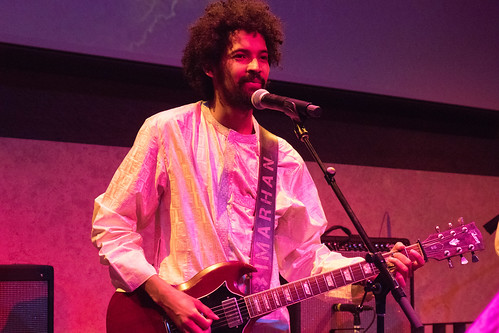
Pioneering Grammy Award-winning, Tuareg musical pioneers and JOVM mainstays Tinariwen just announced that their tenth studio album Hoggar is slated for a March 13, 2026 release through their own label, Wedge. The album derives itself from the Hoggar mountains, a defiant marker of presence visible for miles and a symbol of a homeland for displaced people.
Long known for being fierce advocates for their people’s nomadic culture that exists in the desert borderlands between Mail and Algeria, the acclaimed JOVM mainstays bluesy, guitar-driven music has found global acclaim for its blend of dexterous, Western rock-styled guitar work, Tamasheq language-driven political bent, syncopated rhythms and soaring melodies.
More than 45 years into their lengthy and storied career, Hoggar reportedly sees the acclaimed masters of the desert blues returning to the foundations of their sound with the band returning to their early years of songwriting with acoustic guitars and communal singing around the desert campfire. The album also sees the band staking their claim as elders of the Tuareg musical tradition while also passing the torch onto a younger generation of featured musicians, who can continue to keep their culture’s flame of rebellion and defiance alive.
Known for recording amid the windswept expanse of the Central Saharan desert, the acclaimed JOVM mainstays have long drawn inspiration from the rhythms of nature. With political unrest in Mali prompting the band to seek new spaces, the founding members, who are now based in Algeria recorded the album in studio set up by young Tuareg band and mentees Imarhan in Tamanrasset, which continues their legacy of innovation and collaboration.
While previously released albums like 2023’s Amatssou saw Tinariwen collaborating with acclaimed producer Daniel Lanois, on Hoggar the band looked closer to home. Gathering with the local Tuareg musical community for a month, founding members Ibrahim Ag Alhabib, Abdallah Ag Alhousseyni and Touhami Ag Alhassane began writing songs fueled by political unrest alongside young artists like Imarhan’s Iyad Moussa Ben Abderrahmane, Hicham Bouhasse and Haiballah Akhamouk. The band also collaborated with Terekaft‘s Sanou Ag Hamed and Tinariwen co-founder Liya ag Abill, a.k.a. Diarra for the first time in 25 years.
The album also marks some other firsts: The band’s lead vocalist Ibrahim and Abdallah sing together for the first time in over 30 years, breaking their long-held tradition of each songwriting performing only their own compositions. And there’s a guest spot from acclaimed longtime fan José González.
Lyrically, Hoggar explores urgent and timely themes, addressing the social and political challenges facing the Tuareg people and northern Mali. The band continues their long tradition of bearing witness through their work, balancing the joy of their celebrated lie shows with reflections on community struggles, resilience and the need for cultural preservation.
Hoggar’s first single “Sagherat Assan,” is a gorgeous, soulful rendition of a traditional Sudanese song anchored around shimmering and expressive acoustic guitar, syncopated handclap-driven rhythm and yearning harmonies. The song also features mesmerizing, melismatic vocals from Sudanese artist Sulafa Elyas. Much like the bulk of the JOVM mainstays acclaimed work, at the core of “Sagherat Assan” is a deep sense of longing for the homeland — and a sense of responsibility of passing the culture onward to the next generation, before it disappears.
“Sagherat Assan” is a traditional song carried from Sudan to the Sahara, Japonais (one of the band founders who died in 2021) and I were in Al Kufrah (a city at the border between Sudan and Libya) in 1989, when I was beginning to learn the guitar,” the band’s Abdallah Ag Alhousseyni explains. “We met a musician who was playing this song and loved it so much that Japonais learned it and began performing it again and again, allowing it to travel and endure. This version features Sulafa Elyas, an extraordinary Sudanese singer and oud player now living in exile in France.”
“The female voice is very important in traditional Tuareg music but it is increasingly hard to find female singers today owing to restrictions placed on them being allowed to sing and train,” the band’s longtime collaborator and producer Patrick Votan adds. “We were lucky to find singers like Sulafa as well as Wonou Walet Sidati, who used to record and tour with Tinariwen in the past, and Nounou Kaola, who also feature on this album.”
The equally gorgeous, animated video by Axel Digoix features the band and their collaborators performing and recording the song in the expanse of the Sahara Desert as the sun sets and the stars come out. The video captures deep bonds of friendship and a passing of the torch to a younger generation.