
JOVM pays tribute to MTV on its 37th birthday.
Category: 1980s
New Audio: Mudhoney Releases an Incisive and Furious Single from First Full-length Album in Over 5 Years
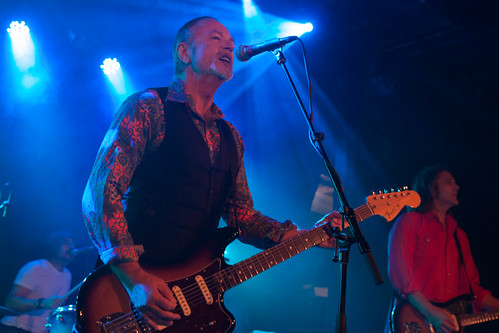
Currently comprised of founding members Mark Arm (vocals, rhythm guitar), Steve Turner (lead guitar) and Guy Maddison (bass), along with Dan Peters (drums), who joined the band in 1999, the Seattle, WA-based alt rock/grunge rock band Mudhoney officially formed back in 1988 although the band can trace its origins to the breakup of Green River, a proto-grunge band that at one point featured Alex Vincent (drums), Jeff Ament (bass), Steve Turner, and Stone Gossard (guitar). After releasing two EPs, and several lineup changes, Green River eventually split up with Bruce Fairweather, Gossard and Ament eventually joining Mother Love Bone. Now, if you know your grunge history, you’d know that after Mother Love Bone’s Andrew Wood died from an overdose, Gossard and Ament went on to form Pearl Jam while Arm and Turner reunited to form Mudhoney.
Mudhoney’s earliest releases through Sub Pop Records — namely “Touch Me I’m Sick” and the Superfuzz Bigmuff EP wound up becoming massively influential with the band being credited as being the godfathers of Seattle’s grunge rock sound, a sound that we all know is generally centered around scuzzy, distortion pedal heavy power chords. But despite their towering influence on alt rock, the band has never really seen much commercial success — although Nirvana covered Mudhoney during their legendary Unplugged, filmed and recorded a few weeks before Kurt Cobain’s suicide.
Slated for a September 28, 2018 through their longtime label home, the beloved Pacific Northwest-based grunge legends tenth full-length album Digital Garbage is reportedly, one of the band’s most sociopolitically incisive and blistering albums they’ve recorded; in fact, Digital Garbage’s first single “Paranoid Core” captures the distrust of experts and facts, the rampant fear-mongering and emotional exploitation and the very primal, lizard brained instinctual response that rules our current zeitgeist. And its all centered around boozy, old school punk rock guitar chords, a propulsive back beat and bass line. Western civilization and American democracy are about to collapse before our very eyes but goddamn it, there’s at least rock ‘n’ roll.
\
Currently comprised of Gilbert Elorreaga, Mark Gonzales, Greg Gonzalez, Josh Levy, Sweet Lou, Beto Martinez, Adrian Quesada, John Speice and Alex Marrero, the Austin, TX-based act Brownout was formed ten years as a side project featuring members of the Grammy Award-winning Latin funk act Grupo Fantasma, but interestingly enough, the project has evolved into its own as a unique effort, separate from the members’ primary gigs. Over the past few years, the act has garnered critical praise — they won their third Austin Music Award last year, while composing and arranging work that’s unflinchingly progressive while evoking the influences of WAR, Cymande and Funkadelic. Unsurprisingly, the members of Brownout have been a highly-sought after backing band, who have collaborated with GZA, Prince, Daniel Johnston and Bernie Worrell, and adding to a growing profile, they’ve made appearances across the major festival circuit, including Bonnaroo, High Sierra Music Festival, Pickathon, Bear Creek Musical Festival, Utopia Festival, Pachanga Fest, and others.
Throughout the course of this site’s history, I’ve written quite a bit about the Austin-based act, and as you may know, the band has released five full-length albums: 2008’s Homenaje, 2009’s Aguilas and Cobras, 2012’s Oozy, 2015’s Brownout Presents: Brown Sabbath and 2016’s Brownout Presents: Brown Sabbath, Vol. II — with their last two albums Latin funk interpretations and re-imaginings of the legendary work of Black Sabbath. Of course, during their run together, Brownout has released a handful of EPs, including 2017’s critically applauded Over the Covers, their first batch of original material in some time.
As a child of the 80s, hip-hop was a nothing short of a revelation to me and countless others. Every day after school, I practically ran home to catch Yo! MTV Raps with Ed Lover and Dr. Dre and BET’s Rap City and during the weekends I’d catch Yo! MTV Raps with the legendary Fab 5 Freddy — all to catch Run DMC, LL Cool J, Big Daddy Kane, MC Lyte, Queen Latifah, Biz Markie, Das EFX, A Tribe Called Quest, X Clan and Public Enemy among an incredibly lengthy list. (Admittedly, I didn’t watch Rap City as much. Even as a kid, I hated their host and I found their overall production values to be incredible cheap. Plus, I really loathed how they almost always managed to either cut to a commercial or the end credits during the middle of a fucking song — and it was always during your favorite jam. Always.) 28 years ago, Public Enemy released their seminal album Fear of a Black Planet, and unsurprisingly, the album wound up profoundly influencing the future founding members of Grupo Fantasma/Brownout. The band’s Greg Gonzalez (bass) remembers how a kid back in junior high school hipped him to the fact that Public Enemy’s “Bring the Noise” was built on James Brown samples. As a teenager, Beto Martinez (guitar) speaks fondly of alternating between hip-hop and metal tapes on his walkman (much like me). And Adrian Quesada remembers falling in love with Public Enemy and their sound at an early age. “When I got into hip-hop, I was looking for this aggressive outlet . . .,” Quesada says in press notes, “and I didn’t even understand what they were pissed off about, because I was twelve and lived in Laredo . . . but I loved it, and I felt angry along with them.”
So as true children of the 80s and 90s, the members of Brownout, with the influence and encouragement of Fat Beats‘ Records Joseph Abajian have tackled Public Enemy’s Fear of a Black Planet — with their own unique take on the legendary material and sound. And although they were eager to get back to work on new, original material, they couldn’t pass up the opportunity to pay homage to one of their favorite acts. As Abajian says in press notes “I thought their sound would work covering Public Enemy songs.” He adds “it was good to know they were P.E. fans . . We came up with a track listing and they went to work.”
Understandably, translating sample-based music to a live band turned out to be more challenging than everyone anticipated. Quesada tried to get into the heads of the legendary production team the Bomb Squad in order to reinterpret Public Enemy’s work. “Imagine the Bomb Squad going back in time and getting the J.B.’s in the studio and setting up a couple analog synths and then playing those songs.” And while some songs closely hew to the original, other songs use the breakbeats as a jumping-off point for Mark “Speedy” Gonzales’ horn arrangements, synth work by Peter Stopchinski and DJ Trackstar‘s turntablism. “Our approach is never in the tribute sense,” Adrian Quesada explains. “We’ve always taken it and made it our own, whether it’s the Brown Sabbath thing or this Public Enemy thing.”
Fear of a Brown Planet comes on the heels of several Brown Sabbath tours, and while being an incredibly tight and funky band, the members of the band are incredibly psyched to bring revolutionary music to the people, especially in light of both the current social climate and that they’re not particularly known for having an overt political agenda. “If there’s any way that we can use the already political and protest nature [of P.E.’s music], we would like to try,” Beto says. “The album’s title, Fear of Brown Planet is definitely a relevant idea today and we’re not afraid to put it out there, because we want to speak out.”
Fear of a Brown Planet‘s first single is Brownout’s take on “Fight the Power,” and while retaining the breakbeats that you’ll remember fondly, their instrumental take is a funky JB’s meets Booker T-like jam, centered around an incredible horn line, bursts of analog synth and sinuous guitar line. As a result, Brownout’s take is warmly familiar but without being a carbon copy; in fact, they manage to breathe a much different life into the song without erasing its revolutionary sound or its righteous fury. Check out how it compares to the original below.
Michelle Blanchard is a Los Angeles, CA-based singer/songwriter, guitarist and alt pop artist, whose recording project Madyx draws from P!nk, Katy Perry, The Distillers‘ Brody Dalle and Melissa Etheridge — although Blanchard has received attention for pairing earnest and socially relevant lyrics with crowd pleasing, infectious production. Adding to a growing profile, her debut EP was recorded with Grammy nominated producer Brian Howes, who has worked with Daughtry, Simple Plan and Hedley among others. Her latest single is a bold cover/re-imagining of Modern English‘s iconic “I Melt With You,” turning the familiar song into a contemporary singer/songwriter guitar pop – and although the melody and the tempo have been slowed down, Blanchard cover manages to reveal a subtly different take, while retaining it’s essence.
The late bluesman Roscoe Chenier was born in the tiny town of Notleyville, LA. And although his sharecropper family were extremely poor, Chenier grew up within a deeply musical family. Although he was related to zydeco legend Clifton Chewier and bluesman Morris “Big” Chenier, his father, Arthur “Bud” Chenier, a cajun accordionist, who was frequently accompanied by his first cousin, fiddler John Stevens (the father of Duke Stevens) was the Roscoe Chenier’s bigger influence; in fact, Bud Chenier and John Stevens were best known for playing at popular weekend house parties, where Roscoe would soak up the music.
In 1958, Roscoe Chenier was invited to join one of the region’s hottest traveling bands in the region — CD and the Blue Runners, which featured Lonesome Sundown on lead guitar and three of the Gradnier brothers on harmonica, drums and bass. Chenier played with CD and the Blue Runners until 1970, finding enough work to survive as a bluesman despite the popularity of the British Invasion acts of the 1960s. However, as tastes changed, Chenier like a lot of the great old bluesman discovered, it was difficult to eke out a living — especially when some gigs paid maybe $6 per man per night. And throughout the better part of the 70s, Chenier began a succession of jobs as a truck driver while picking up the occasional hired gun gig, playing in the backing bands of Good Rockin’ Thomas, Good Rockin’ Bob, his old bandmate Lonesome Sundown, Clarence Randle and Duke Stevens.
By 1980, Chenier was leading his own band and through a combination of reputation, luck and skill, he was able to recruit a number of talented musicians while desperately trying to remain as financial independent as possible, which by the late 90s became increasingly difficult. And yet, Chenier and his band managed to play several of Europe’s most prestigious festivals including Blues Estafette (in 1992, 1993, 1996, 1998 and 2001), North Sea Jazz Festival, toured across Europe several times and released a few albums before his death in February 2013 including 1998’s Roscoe Style and 2006’s Waiting For My Tomorrow. Roscoe Chenier’s last record, featured a haunting and folksy, acapella rendition of the old gospel standby “Will the Circle Be Unbroken” that immediately brings the early Delta Blues to mind — in particular, Son House, Lightnin’ Hopkins, early Muddy Waters and the like.
Interestingly, ElectroBluesSociety, a Dutch blues act, comprised of Japser Mortier (drums, bass) and Jan Mittendorp (guitar, production), who worked with Roscoe Grenier on several releases and several European tours decided to pay tribute to their late friend by adding a spectral and moody arrangement Chenier’s vocal that’s appropriately bluesy yet subtly modern, while retaining the timeless vibe of the original vocal take.
New Audio: Meshell Ndegeocello Releases a Folksy Cover of Force MD’s “Tender Love”
Born Michelle Lynn Johnson to US Army Sergeant Major Jacques Johnson, a saxophonist and Helen Johnson, a health care work, the Berlin, Germany-born, American-based singer/songwriter, rapper and bassist Meshell Ndegeocello was raised in Washington, DC where she attended the Duke Ellington School of the Arts and Oxon Hill High School. When she turned 17, she adopted the name Meshell Ndegeocello, with the surname, as she has explained meaning “free like a bird in Swahili.”
In the late 80s, Ndedgeocello gigged around DC’s go-go circuit, playing with bands like Prophecy, Little Bennie and the Masters, and Rare Essence before unsuccessfully trying out for Living Colour’s bassist spot, after Muzz Skillings left the band. Deciding to go solo, Ndegeocello, has the distinction of being Madonna’s Maverick Records first signings and while achieving a fair amount of commercial success. Her collaborative cover of Van Morrison’s “Wild Night,” with John Mellencamp peaked at #3 on the Billboard Charts in 1994 and “If That’s Your Boyfriend (He Wasn’t Last Night)” peaked at #73 later that year. Adding to a rapidly rising profile, she collaborated with the legendary Herbie Hancock on a track for Red Hot Organization’s AIDS awareness, tribute compilation Stolen Moments: Red Hot + Cool, which was named Time Magazine’s “Album of the Year.” Her cover of Bill Withers’ “Who Is He (And What Is He to You)” was a #1 Dance Hit in 1996 and was briefly featured in the major motion picture Jerry Maguire, and she landed Dance Top 20 hits with “Earth,” “Leviticus: Faggot,” and “Stay.” Along with that she collaborated with Madonna, playing bass on “I’d Rather Be Your Lover,” and contributing a verse at the last minute, after Tupac Shakur had criminal charges filed against him. Additionally, Ndegeocello has collaborated with Chaka Khan, rapping “Never Miss the Water,” a single that landed #1 on Billboard’s Dance Club Charts and peaked at #36 on the Hot R&B/Hip-Hop Singles Chart. Additionally, Ndegeocello has collaborated with the likes of Basement Jaxx, Indigo Girls, Scritti Politti, The Blind Boys of Alabama, The Rolling Stones, Alanis Morrissette and Zap Mama.
Ndeogecello has also had her music featured in the soundtracks of How Stella Got Her Groove Back, Lost & Delirious, Batman & Robin, Love Jones, Love & Basketball, Talk to Me, Tyler Perry’s Daddy’s Little Girls, The Best Man, Higher Learning, Down in the Delta, The Hurricane, Noah’s Arc: Jumping the Broom and Soul Men.
Interestingly, Ndegeocello has managed the rare feat of achieving commercial success while arguably being one of the most uncompromisingly, iconoclastic and unique artists of the past 25 years — and she’s been credited as being at the forefront of the neo-soul movement, thanks in part to a genre defying and difficult to pigeonhole sound that draws from hip-hop, classic soul, rock, reggae, jazz and singer/songwriter pop. Adding to that iconoclastic nature, Ndegeocello has written and composed a musical influenced by James Baldwin’s The Fire Next Time, titled Can I Get a Witness?: The Gospel of James Baldwin and she released a gorgeous tribute album to Nina Simone, which featured collaborations with JOVM mainstay Cody ChesnuTT and others.
The renowned bassist, singer/songwriter and rapper’s latest album Ventriloquism is slated for a March 16, 2018 release and the album will feature covers of songs by TLC, Janet Jackson, Tina Tuner, Prince and others, all of which have been influential to Ndeogeocello’s work — but with a unique take. The album’s first single, her cover of Force MD’s smash hit “Tender Love,” finds Ndegeocello turning the slow-burning 80s piano ballad classic into a folksy, Harvest-era Neil Young/Fleetwood Mac track, complete with shuffling drumming, twinkling Fender Rhodes and harmonica. In my mind, what makes Ndegeocello’s cover truly fascinating is that she manages to completely eschew the 80s pop ballad cheesiness of the song, which makes it endearing 30 years after its release but without doing away with the song’s earnestness — while pointing out that the song manages to possess something that listeners far removed from the song’s initial release can grasp and connect to on a very visceral level. That’s what separates the great, timeless songs from the countless songs that will be forgotten 6 months or more after they’ve been released. And on another level, the song will continue the renowned and iconoclastic Ndegeocello’s commentary on society’s narrow expectations of what black music should sound and be like.
Initially formed in 1978 as a trio featuring founding members Steve Marsh, Doug Murray and his brother Greg Murray with synth player Jack Crow later joining the band, the members of Austin, TX-based punk act Terminal Mind, were influenced by the likes of Pere Ubu, Roxy Music, John Cale, and Wire — and despite a relatively short period of time together, managed to be at the forefront of Austin’s early punk rock scene, managing to quickly build a local profile, sharing bills with The Huns, Standing Waves, The Big Boys and Iggy Pop. As a result, they managed to subtly influence their hometown’s second wave of punk and noise rockers before splitting up to pursue a number of different projects: Marsh relocated to New York with his experimental noise act Miracle Room before returning to Austin to form space/psych rock act Evil Triplet and an experimental solo recording project he dubbed Radarcave; Doug Murray joined The Skunks; Greg Murray joined an iteration of The Big Boys. Unfortunately, Jack Crow died in 1994.
Now, as I’ve mentioned the proliferation of labels across the world of differing sizes has allowed for long lost bands to find their due, and interestingly, Terminal Mind’s retrospective album Recordings, which is slated for a January 19, 2018 release through Sonic Surgery Records features the band’s very rate 4 song 7 inch album (which currently fetches more than $100 on eBay), a number of Live at Raul’s compilation tracks as well as a number of unreleased studio and live recordings. And the album’s first single “Refugee” find the short-lived band walking a tightrope between angular and nerdy post punk and furious punk with the band’s sound seeming like an amalgamation between Talking Heads: 77-era Talking Heads, Pink Flag-era Wire, Entertainment! and Solid Gold-era Gang of Four, and Bad Religion.
Admittedly, while I listened to “Refugee,” there was this this sense that I had heard a band that through the weird machinations of fate and luck could have been much bigger than what they eventually wound up — after all, they were pairing tight hooks and angular power chords with an uncanny sense of melody a few years before Bad Religion even formed! But at the very least, hopefully the Sonic Surgery release will help fill in a necessary gap in the canon.
Throwback: David Bowie/Happy 71st Birthday, David!
JOVM pays tribute to David Bowie on what would have been his 71st birthday.
Throwback: RIP Joe Strummer/Joe Strummer Forever!/The Clash Forever!
Time flies by and it flies by at an incredibly dizzying pace. Just the other day, a Facebook friend mentioned that the 15th anniversary of Joe Strummer’s death had recently passed. I grew up listening to quite a bit of The Clash –and as a music obsessed boy, who spent an unusual amount of time watching MTV and other music related programming, I can clearly remember watching the video for “Rock the Casbah” and others. And when I found out that Strummer died, it felt as though a small part of my music loving childhood was gone; plus it made the seemingly dim possibility of a Clash reunion utterly impossible. Such is life. But this particular week, I thought of The Clash and how much those records had meant to me — and interestingly, I stumbled on live footage of The Clash playing at The Capitol Theatre in Passaic, NJ in 1980 and in Japan in 1982 or so, plus other random things.
As always Joe Strummer forever! The Clash forever!
Throwback: Run DMC’s “Christmas in Hollis”
As I mentioned earlier, over the years, the holidays have become increasingly difficult for me, with the season harboring many more bad memories than good ones as I got older; however, whenever I think of Run DMC’s “Christmas in Hollis,” I think of times that seemed far more easier and brighter, even if they may have been viewed through rose-colored glasses and the hazy nostalgia of adulthood. But along with that, what I can clearly remember was that as a child, I wanted to be like Run DMC because I thought they were the coolest brothers on the face of the earth; plus, they grew up in my home borough of Queens, which made their achievements seem plausible for a music loving black kid.
For those who celebrate, Merry Christmas. Happy Holidays for everyone else. And may there be peace, brotherhood and sisterhood for all.
Throwback: AC/DC Forever!/Malcolm Young Forever!
JOVM pays tribute to AC/DC and Malcolm Young.
Live Footage: Xiu Xiu Covers ZZ Top on AV Club “Undercover”
I’ve long been a fan of The Onion AV Club, as I think they’ve consistently offered some of most incisive and hilarious criticism of movies, movies and pop culture, written by some of the country’s smartest critics and writers. And it shouldn’t be surprising that for a long time I longed to write for them. Now, since moving exclusively to the interwebs, the folks at The Onion AV Club created the Undercover video series. The concept behind the video series is pretty interesting — every season, the website’s writers and editors devise a list of songs that they would love to hear some contemporary artist or band cover.
The website’s staff then invites artists and bands over to their Chicago studio, where the invited band chooses a song from the AV Club’s list for that particular session — and then the band or artist records it in a live session. Here’s where things get truly interesting: Once a song is chosen and then covered, it’s crossed off their list, reducing the number of songs anyone else can cover that season, so if an artist or band is invited later on in their season, their choices may be much more limited than a band that was invited earlier. By doing that, it prevents having several invited artists or bands from covering the same sets of songs over and and over and over again.
And while revealing the influences and tastes of many contemporary acts, it also forces artists out of their confront zones, sometimes to a gloriously weird result — such as They Might Be Giants’ boisterous cover of Chumbawamba’s “Tubthumping” and Screaming Females‘ feral, punk rock cover of Taylor Swift’s “Shake It Off,” Gwar’s thrash punk covers of Billy Ocean’s “Get Outta My Dreams (And Into My Car),” and Pet Shop Boys’ “West End Girls,” which are so fucking awesome, that you need to check them out below) or to the “oh shit, I never thought that artist could pull that song,” like Sharon Van Etten and Shearwater’s collaborative cover of Tom Petty and Stevie Nicks’ “Stop Draggin’ My Heart Around.” And as you can imagine, sometimes the covers are straightforward — and other times, the band or artist brings a unique, never thought of take. Adding to the unpredictability of the series, they’ve had Shearwater cover Bowie’s Lodger in its entirety.
Now, if you’ve been frequenting this site throughout the course of this very strange year, you may recall that to start off the eighth season of Undercover, The A.V. Club invited the Seattle, WA-based indie rock blogosphere darlings Minus the Bear to their newly redesigned Chicago studio, where they played a forceful and lovingly straightforward cover of Fugazi’s “Waiting Room.” Adding to a pretty interesting season of covers, The A.V. Club invited renowned and incredibly prolific experimental indie rock act Xiu Xiu into the studio, where they contributed a tense, manic, almost Devo “(I Can’t Get No) Satisfaction”-like cover of ZZ Top’s smash hit “Sharp Dressed Man,” complete with a wild drum accompaniment that brings new life to an oft covered song.
Along with their John Congleton-produced 11th full-length effort FORGET, which was released earlier this year, the members of Xiu Xiu will be releasing a split 7 inch with Italian band (r) and it’ll feature both bands covering ZZ Top.
As Xiu Xiu’s Jamie Stewart explains in press notes, “It took me a long time to come around to ZZ Top. When I was a kid i thought they were a joke band and their beards and campy sexuality freaked me out. Later on Xiu Xiu tours we would and still do always listen to the Black Flag tour diary Get In The Van wherein Henry Rollins mentions playing ZZ Top to all the punks in England, telling them it was the new Exploited record and watching them cry.
This was funny and I thought hmmm . . .
Then after watching a long jag of music documentaries, Billy Gibbons, of ZZ Top, time and time again was a commentator. He was always incredibly smart, clearly deeply devoted to the history of music and insane looking.
We were asked by the AV Club cover’s series to play a song from a list they had chosen. Everything on the list was a bunch of 90s RnB that I was never into or lame-o indie rock EXCEPT for ‘Sharp Dressed Man.’
The stars had aligned. I had no idea what a radical guitar part it was and what a pleasure it was to learn, by the end of the song I had to have 4 different fuzz and distortion pedals on to make it as zonked out as it needs to be.
Walking down the streets of Torino on tour and talking with dear friend and long time collaborator Fabrizio Palumbo of (r) and his husband Paul Beauchamp. I mentioned we were covering the song. They said very matter of factly, “Xiu Xiu as ZZ Top and (r) as ZZ Bottom. Let’s do a split 7 inch.”
He sent in his perfect minimal, experimental, goth, cabaret version of ‘Gimme All Your Lovin.’ A perversion made in heaven was born. “
For the better part of a decade, Frankie Rose played a significant and vital role in Brooklyn’s indie rock scene, as an original member of several critically applauded and commercially successful acts including Crystal Stilts, Dum Dum Girls, Vivian Girls and Beverly, as well as a solo artist. Now, if you’ve been frequenting this site for some time, you may recall that Rose had briefly relocated back to her hometown of Los Angeles with the intention of establishing a new, creative and professional moment in her career; however, the experience of being down and out, and not quite knowing what to do next wound up inspiring her fourth full-length album Cage Tropical, which was co-written with Jorge Elbrecht, known for his work with Tamaryn, Gang Gang Dance, No Joy and my own personal favorite Violens.
Adding to a run of New Wave-inspired material, Rose is set to release a full-length cover of The Cure‘s critically applauded sophomore effort Seventeen Seconds as part of Turntable Kitchen’s Sounds Delicious vinyl covers series. The first single off Rose’s Seventeen Seconds cover album is a fairly straightforward and moody rendition of one of my favorite Cure songs “A Forest,” but interestingly enough, the cover album’s latest single is a slightly sped up rendition of “At Night,” which retains the original’s moody and foreboding vibe — all while reminding contemporary listeners of how influential and timeless The Cure’s work has been; in fact, you can easily imagine a contemporary band recording something that would have sounded like the material off Seventeen Seconds right now.
This past weekend has been a very busy one for me, as I’ve taken part in a Baby Robot Media hosted Mondo.NYC panel titled “Your First PR Campaign” and I’ve managed to cover some of the festival — while squeezing in my beloved New York Yankees, who have managed to get into the American League Division Series against the Cleveland Indians. There will be more on Mondo.NYC in the future; but in the meantime, let’s get to some music, eh?
For the better part of a decade, Frankie Rose played a significant role in Brooklyn’s indie rock scene, as an original member of several critically applauded and commercially successful acts including Crystal Stilts, Dum Dum Girls, Vivian Girls and Beverly, as well as a solo artist. And interestingly enough, Rose has been considered a controversial and restlessly creative presence, frequently leaving projects, just as they were beginning to attain some measure of success. Now, if you’ve been frequenting this site over the course of the summer, you may recall that Rose relocated back to her birthplace of Los Angeles with the intention of establishing a new, creative and professional moment in her career; however, the experience of being down and out, and not quite knowing what to do next wound up inspiring her fourth full-length album Cage Tropical, which was co-written with Jorge Elbrecht, known for his work with Tamaryn, Gang Gang Dance, No Joy and my own personal favorite Violens. Album single “Dyson Sphere” managed to sound as though it owed a debt to 80s New Wave — in particular A Flock of Seagulls “I Ran (So Far Away),” Siouxsie and The Banshees’ “Israel” and “Happy House,” immediately came to my mind.
Adding to a run of New Wave-inspired material, Rose is set to release a full-length cover of The Cure‘s critically applauded sophomore effort Seventeen Seconds as part of Turntable Kitchen’s Sounds Delicious vinyl covers series. The first single off Rose’s Seventeen Seconds cover album is a fairly straightforward and moody rendition of one of my favorite Cure songs “A Forest.” And if there’s one thing the Frankie Rose cover should do two things: remind contemporary listeners that a great song can truly be timeless and that The Cure should be considered one of the more important bands of the 1980s.