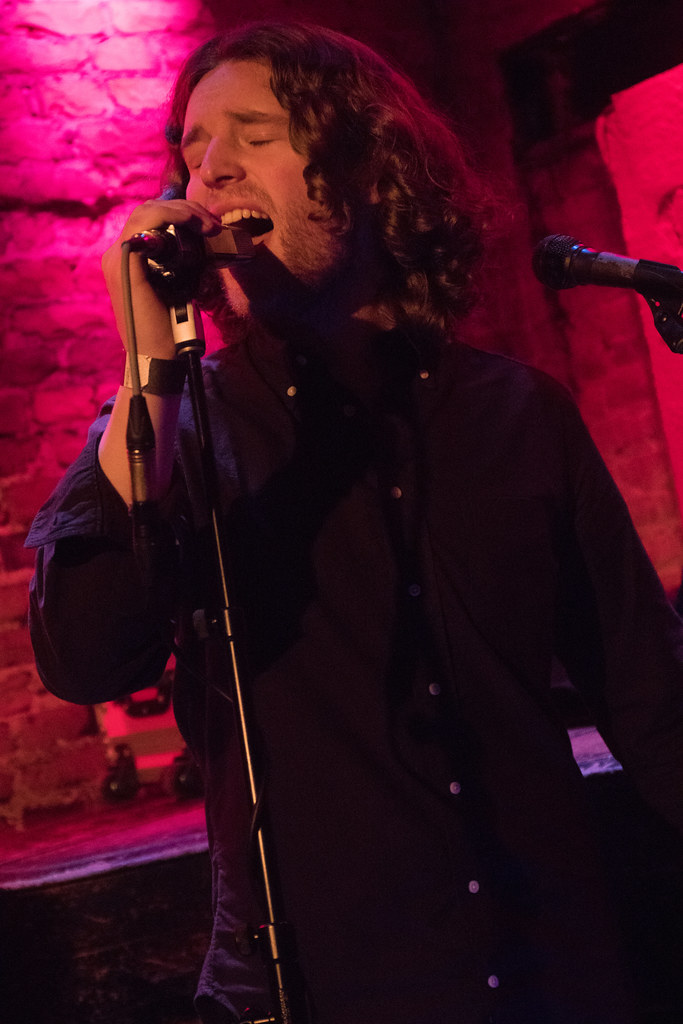
Category: experimental pop

Live Footage: Rafiq Bhatia Performing “Breaking English”

Rafiq Bhatia is a Hickory, NC-born, New York-based composter, guitarist and producer of East African Indian descent. Before joining Ryan Lott and Ian Chang to expand renowned indie act Son Lux from a solo recording project to a fully fleshed out band, Bhatia released two critically applauded solo efforts — 2012’s Yes It Will and Strata. As a guitarist and producer, Bhatia has worked with an impressive and diverse array of artists including Olga Bell, Sam Dew, Marcus Gilmore, Billy Hart, Heems, Helado Negro, Vijay Iyer, Glenn Kotche, Valegir Sigurðsson, Moses Sumney, David Virelles, Lorde, Sufjan Stevens and others. Adding to a growing profile, he’s recored with the chamber ensembles International Contemporary Ensemble, JACK Quartet and Alarm Will Sound, and he’s had work appear on the soundtracks for the major motion pictures The Disappearance of Eleanor Rigby, Air, and Afflicted.  

Bhatia’s third solo album Breaking English is slated for an April 6, 2018 release through ANTI- Records, and the album reportedly finds the renowned composer, producer and guitarist, who has long been influenced by Jimi Hendrix, John Coltrane, Madlib, as well as mentors and collaborators Vijay Iyer and Billy Hart, meshing avant-garde jazz with textured and sculptured electronic composition and production. Because of his experience as a first-generation son of East African-born, Indian Muslim immigrant parents, who can trace their ancestry back to India, and the influence of mentors like Vijay Iyer and Billy Hart, Bhatia sees music as a way to actively shape and represent his own identity, not limited by anyone else’s prescribed perspective.  Interestingly, the album’s overall theme and its title were inspired by a 2008 trip to India that Bhatia took with his sister and parents — the first time he had ever seen the ancestral homeland. “We were driving towards the Taj Mahal, and noticed as we approached that there was an alarming number of signs advertising ‘Shooting Ranges.’ We grew increasingly curious and concerned about why these signs, which were written in English, were so prevalent — could they be targeted towards American tourists and their obsession with guns?” Bhatia recalled in press notes. “But eventually, we realized that ‘shooting’ was intended in the photographic sense. We had a good laugh about it, but then my dad turned to me quite seriously and asked ‘Eventually there will be likely more English speakers out here than there are in the West. At that point, who will get to decide what constitutes a proper use of English?’”

“’Breaking English’ is a ceremony of a song,” Bhatia continues. “Its central theme revealed itself to me in an improvised performance, fully formed, as though it had always existed. The cyclical form of the piece allows it to shed its skin and present itself anew in successive iterations, even as the core idea — or problem, or experience — stubbornly persists.”

Breaking English‘s latest single, album title track, the atmospheric and soulful “Breaking English” which features skittering drums, a sinuous bass line, blasts of bluesy guitar and a wailing chorus — and in some way, the composition nods at an incredible synthesis of the work of JOVM mainstay Nick Hakim, J. Dilla and Flying Lotus but with a soulful weariness and ache.

Live Footage: Hearts Hearts Perform “Sugar/Money” at Hotel am Brillantengrund, Vienna

With the release of “I Am In” and “AAA” off their critically applauded debut album Young, the  Vienna, Austria-based quartet Hearts Hearts, comprised of  David Österle, Daniel Hämmerle, Johannes Mandorfer, and Peter Paul Aufreitet, initially developed a reputation for crafting brooding, slow-burning and elegiac electro pop that drew comparisons Sigur Ros, Flying Lotus, The Darcys and Radiohead. Thematically, Young focused on tension and release — in the sense of someone desperately attempting to break through and out of the familiar and debilitating patterns of their own life. 

As the story goes, after the release of Young, the band’s Peter Paul Aufreiter and Johannes Mandorfer sent two radically different sound snippets to their bandmate David Österle — an aggressive and jazzy piano loop titled “Phantom” and an electronic drum take recorded overseas titled “Island,” which interestingly enough is the German word for the country of Iceland. Upon receiving those two sound snippets from his bandmates, Österle frantically began attempting to put these disparate pieces together; to synchronise what was never meant to be unified, and start singing over the results. Goods/Gods, the Austrian act’s genre-defying sophomore album reportedly draws from the work of Bon Iver, Jamie XX and Son Lux while taking its thematic cues from the in between spaces and undefined borderlines in meaning, symbolized by the slash in every title on the album. And as a result, the material finds the band exploring emotional and moral ambiguities, and the ineffectiveness and confusions that the dichotomies and borderlines that define modern society. As the band’s Hämmerle says, the band prefers to think “think in options,” seeing the slash as representing an openness and flexibility in meaning; in similarities as much as in difference.

Now, as you may recall, I wrote about the trippy album single “Phantom/Island,” a genre-mashing and genre-defying track that possessed elements of jazz, electronica, indie rock and experimental pop in a way that brings to mind Kid A and Amnesiac-era Radiohead Flying Lotus and Kamasi Washington — but while conjuring a mix of anguish and ecstasy, yearning and desire within a turn of a musical phrase. “Sugar/Money,” the soon-to-be released album’s latest single is a bit more straightforward as the song finds the band drawing from early 80s New Wave, ambient electronica and indie rock in a way that feels dimly familiar but not quite, while focusing on an accessible and infectious hook. 

Currently comprised of frontman and primary songwriter TOBACCO (born Thomas Fec), keyboardist The Seven Fields of Aphelion (born Maureen “Maux” Boyle), guitarist Ryan Graveface and bassist Pony Driver, the Pittsburgh, PA-based experimental electronic act Black Moth Super Rainbow can trace their origins back to two previous projects that featured BMSR’s TOBACCO — Allegheny White Fish, which was active from 1996-2000 and satanstompingcaterpillars, which was active from 2000-2002 and released three albums, including their last album under that name, The Most Wonderfulest Thing before the addition of three new members Father Hummingbird, The Seven Fields of Aphelion and Iffernaut. And with the addition of new members, the band renamed themselves Black Moth Super Rainbow in 2003.


Over the past decade both Black Moth Super Rainbow and TOBACCO have recorded material that explored the periphery of evil and extreme color, rapidly alternating between absurdly bright beauty and murderously sinister with the end result being a woozy, psychedelic uneasiness.  TOBACCO (a.k.a Thomas Fec) throughout his career has been a rather mysterious figure; in fact, if you Google images of him, most of them have his face obscured by a mask, a ball cap or a hood.  Interestingly though, he’s known for patient and thoughtful interviews where he breaks down his creative process and the ideas espoused throughout his work while never revealing much about his personal life or about him. And in that sense, he’s been periodically visible but opaque, emotional but unwilling to exploit self-mythology; however, Black Moth Super Rainbow’s Panic Blooms, the first album from the band in six years, finds TOBACCO reportedly writing what may arguably be the most raw and direct lyrics of his entire career, inspired in some way by the current sociopolitical climate. As a result, the material is an account of depression and human frailty paired with their unique sound featuring gorgeous yet warped melodies. . .

The album’s first single “Mr. No One” features shimmering and twinkling synths, boom-bap drums and heavily vocodered vocals and while the song initially seems as though it has a dreamy and ethereal air, the song possesses an underlying murky and sinister vibe, which the band has long been known for, giving the song a desperate yet hopeful ache, a pleasant reverie within a feverish, waking nightmare.

Black Moth Super Rainbow will be on tour to support their new effort, and it’ll include a June 2, 2018 stop at Music Hall of Williamsburg. Check out the rest of the tour dates below.

TOUR DATES

THU 5/31 WASHINGTON, DC Black Cat
FRI 6/1 PHILADELPHIA, PA Union Transfer
SAT 6/2 NEW YORK, NY Music Hall of Williamsburg
SUN 6/3 BOSTON, MA Brighton Music Hall
THU 6/14 CINCINNATI, OH Urban Artifact
FRI 6/15 DETROIT, MI El Club
SAT 6/16 CHICAGO, IL Metro
SUN 6/17 COLUMBUS, OH Skully’s Music Diner
FRI 8/10 PITTSBURGH, PA Mr. Smalls
SAT 8/11 LOUISVILLE, KY Headliners
SUN 8/12 ASHEVILLE, NC Orange Peel
TUE 8/14 AUSTIN, TX Mohawk
WED 8/15 HOUSTON, TX White Oak Music Hall
FRI 8/17 ATLANTA, GA Masquerade (Hell)
SAT 8/18 NASHVILLE, TN Mercy Lounge

New Audio: Rafiq Bhatia’s Atmospheric and Soulful New Single

Rafiq Bhatia is a Hickory, NC-born, New York-based composter, guitarist and producer of East African Indian descent. Before joining Ryan Lott and Ian Chang to expand renowned indie act Son Lux from a solo recording project to a fully fleshed out band, Bhatia released two critically applauded solo efforts — 2012’s Yes It Will and Strata. As a guitarist and producer, Bhatia has worked with an impressive and diverse array of artists including Olga Bell, Sam Dew, Marcus Gilmore, Billy Hart, Heems, Helado Negro, Vijay Iyer, Glenn Kotche, Valegir Sigurðsson, Moses Sumney, David Virelles, Lorde, Sufjan Stevens and others. Adding to a growing profile, he’s recored with the chamber ensembles International Contemporary Ensemble, JACK Quartet and Alarm Will Sound, and he’s had work appear on the soundtracks for the major motion pictures The Disappearance of Eleanor Rigby, Air, and Afflicted.  

Bhatia’s third solo album Breaking English is slated for an April 6, 2018 release through ANTI- Records, and the album reportedly finds the renowned composer, producer and guitarist, who has long been influenced by Jimi Hendrix, John Coltrane, Madlib, as well as mentors and collaborators Vijay Iyer and Billy Hart, meshing avant-garde jazz with textured and sculptured electronic composition and production. Because of his experience as a first-generation son of East African-born, Indian Muslim immigrant parents, who can trace their ancestry back to India, and the influence of mentors like Vijay Iyer and Billy Hart, Bhatia sees music as a way to actively shape and represent his own identity, not limited by anyone else’s prescribed perspective.  Interestingly, the album’s overall theme and its title were inspired by a 2008 trip to India that Bhatia took with his sister and parents — the first time he had ever seen the ancestral homeland. “We were driving towards the Taj Mahal, and noticed as we approached that there was an alarming number of signs advertising ‘Shooting Ranges.’ We grew increasingly curious and concerned about why these signs, which were written in English, were so prevalent — could they be targeted towards American tourists and their obsession with guns?” Bhatia recalled in press notes. “But eventually, we realized that ‘shooting’ was intended in the photographic sense. We had a good laugh about it, but then my dad turned to me quite seriously and asked ‘Eventually there will be likely more English speakers out here than there are in the West. At that point, who will get to decide what constitutes a proper use of English?'”

“’Breaking English’ is a ceremony of a song,” Bhatia continues. “Its central theme revealed itself to me in an improvised performance, fully formed, as though it had always existed. The cyclical form of the piece allows it to shed its skin and present itself anew in successive iterations, even as the core idea — or problem, or experience — stubbornly persists.”

Breaking English’s latest single, album title track, the atmospheric and soulful “Breaking English” which features skittering drums, a sinuous bass line, blasts of bluesy guitar and a wailing chorus — and in some way, the composition nods at an incredible synthesis of the work of JOVM mainstay Nick Hakim, J. Dilla and Flying Lotus but with a soulful weariness and ache.

New Video: Congolese DIY Collective KOKOKO! Returns with a Raunchy Club Banger

Bordered by Central African Republic and South Sudan to its north; Uganda, Rwanda, Burundi and Tanzania to its east; Zambia and Angola to the south; the Republic of the Congo to its west; and the Atlantic Ocean to its southwest, the Democratic Republic of the Congo is the second largest country by area in Africa and the eleventh largest by area in the entire world — and by with a population of 78 million people, the most populated officially Francophone country in the entire world, the fourth most populated nation in African and the seventeenth most populated country in the world.

Humans first settled within the expansive territory of the Democratic Republic of the Congo roughly 90,000 years ago, although various Bantu speaking tribes began migrating into the region in the 5th century and again in the 10th century. From the 14th to the 19th century, the territory was split into three different territories — to the West, the Kingdom of Kongo ruled for close to 500 years; while the central and Eastern sections were ruled by the Luba and Lunda kingdoms, which ruled from roughly the 16th century to the 19th century.

In the 1870s, European exploration of the Congo region was first carried out and led by Henry Morton Stanley, who was sponsored by King Leopold II of Belgium and by 1885, Leopold had formally acquired the rights to the Congo territory, making the land his private property. Ironically naming the territory the Congo Free State, the colonial military unit the Force Publique forced much of the local population into producing rubber and from 1885-1908 millions of Congolese died from exploitation and disease. Despite initial reluctance, the Belgian government formally annexed the Free State and the territory became the Belgian Congo.

Between the late 1950s and mid 1960s, revolutionary movements swept much of Africa, reshaping the map; in fact, The Democratic Republic of the Congo achieved independence in June 1960 as the Republic of the Congo, with Patrice Lumumba, a Congolese nationalist, becoming the country’s first Prime Minister and Joseph Kasa-Vubu, becoming the country’s first president. Within a few months, the provinces of Katanga, Moise-Tshombe and South Kasai attempted to secede and by September 1960, Lumumba was dismissed from office by Kasa-Vubu with encouragement by the US and Belgium after Lumumba sought assistance from the Soviet Union with what has since been known as the Congo Crisis. By mid September of that year, Lumumba was arrested by forces loyal to Army Chief of Staff Joseph-Desire Mobutu, who gained de facto control of the country through a coup d’etat. By early 1961 Lumumba was executed by Belgian-led Katangese forces.

In 1965 Mobutu, who later renamed himself Mobutu Sese Seko, officially came into power through a second coup d’etat, running the country, which he renamed as Zaire as a one-party state, with his Popular Movement of the Revolution as the country’s sole legal party for more than 30 years. By the early 1990s, Sese Seko’s government had begun to weaken and by the middle of the decade, growing disenfranchisement among the country’s eastern Congolese Tutsi population led to Zaire’s invasion by their Tutsi-ruled neighbor Rwanda, which began the First Congo War and eventually led to the end of Mobutu Sese Seko’s 32 year stranglehold on the country.

In May 1997, Laurent-Desire Kabila, a leader of South Kivu province-based Tutsi forces became President of the country and reverted the nation’s name to the Democratic Republic of the Congo. Unfortunately, tensions between Kabila and the Rwandan and Tutsi presence led to the Second Congo War from 1998-2003, which involved nine different African nations and 20 different armed groups and eventually resulted in the deaths of 5.4 million people. Naturally, the decade long period of civil war and instability devastated the country and the larger region. And if you add several centuries of commercial and colonial exploitation, which continues to this very day, extreme poverty, inequality and inequity and a lack of infrastructure, you understandably wind up with a population that’s desperate and struggling to survive.

Led by Makara Bianco and featuring production from prolific French producer débruit, KOKOKO! is a pioneering Kinshasa, Democratic Republic of the Congo-based DIY electronic collective inspired by a growing spirit of protest and unrest among Kinshasa’s young people, who have begun to both openly question centuries-old norms and taboos and or openly denounce a society that they perceived as paralyzed by fear. In fact, the collective’s name literally means KNOCK KNOCK KNOCK! with the collective viewing themselves as the sound of a new generation boldly, loudly and defiantly banging on the doors and walls, yelling “OUR TIME IS NOW!” The members of the collective operate in a wildly inventive DIY fashion, creating self-designed and self-made instruments from recycled junk and claptrap — and they built a recording studio out of old mattresses, found wood and a ping pong table. (If that isn’t punk as fuck, I don’t know what is.) Fueled by the underlying notion that desperate survival fuels creativity, the collective received international attention with their Tokoliana EP, an urgent, forward-thinking, way out in left field effort featuring a sound that nodded at disco, post-punk, hip-hop, reggae, retro-futuristic funk, Afro-futurism and traditional regional music — but from a sweaty, grimy, post-apocalyptic future in which the ghetto and club are one and the same. 

ICI released the Congolese collective’s second EP TONGOS’A late last year, and the EP finds the collective further exploring themes of survival in the desperate and uneasy political and social climate of their homeland — sometimes focusing on small, deeply human pleasures and concerns; in fact, the EP’s first track, title track “Tongos’a (which translates roughly into ’til the morning light”) is a sweaty and raunchy club banger on the necessity of getting laid properly, rooted around skittering drum programming, thumping beats and a looped guitar and bass line that’s derived from the Mongo tribe repertoire, making the song a mischievous mix of the old and the new. 

Directed by débruit, Markus Hofko, Renaud Barret, the recently released video for “Tongos’a” stars a local dance act “l’homme capote” comprised of Mbuyi Tickson, Makoka, and Riyana sweaty and grinding seductively to the song, capturing the song’s raunchy, club-friendly vibe. 

New Audio: No Joy’s Jasamine White-Gluz and Spacemen 3’s Sonic Boom Team Up for an Atmospheric and Eerie Single off Collaborative EP

Over the past year, I’ve written quite a bit about the Montreal, Quebec, Canada-based shogeaze duo No Joy. Interestingly, the duo, which is comprised of primary songwriter Jasamine White-Gluz and Laura Lloyd can trace their origins to when White-Gluz, who was then living in Los Angeles began collaborating with the Montreal-based Lloyd via email — and their collaboration eventually lead to White-Gluz returning to Montreal, so that they could play their first show, with Husker Du’s Grant Hart. As the story goes, after that show, White and Gluz continued collaborating, playing a number of shows locally, including with Best Coast, who’s frontwoman Bethany Cosentino became an early champion of the duo.
Building upon the growing buzz surround the Montreal-based duo, White-Gluz and Lloyd signed to renowned indie label Mexican Summer, who released their debut 7 inch single “No Summer”/”No Joy,” an effort that allowed them to book their own national headlining tour with Katy Goodman’s, La Sera. The 7 inch quickly sold out, and by November 2010, the duo released their full-length debut Ghost Blonde to critical praise from the likes of Pitchfork, AllMusic.com, The New York Times, Brooklyn Vegan, The Guardian and others. No Joy followed that with the British release of the “Hawaii” 7 in, a release that featured a remix of “Indigo Child,” by Stereolab‘s Tim Gane, which they supported with a UK tour with  Surfer Blood, an opening spot in London for Wire, and an appearance at Barcelona’s Primavera Sound Festival.
The  members of No Joy spent the better part of 2011 touring across North America — and it included a busy SXSW schedule, a tour with Vivian Girls, and a co-headling tour with Marnie Stern with whom they released a split single, which featured No Joy’s cover of the Shangri-La’s “He Cried.” Since then, the band has released 2012’s Negaverse EP and Wait to Pleasure, 2013’s Pastel and Pass Out EP, 2015’s More Faithful, 2016’s Drool Sucker, the first of a planned series of EPs and last year’s Creep, which was released through the band’s new label Grey Market Records.

Interestingly, this year finds No Joy’s White-Gluz collaborating with Spacemen 3’s and E.A.R.’s Sonic Boom (a.k.a. Pete Kember), and although the collaborators can’t accurately remember how they met or when they met, but what they do clearly recall is that the idea of collaborating together was brought up in an email exchange back in 2015. At the time, No Joy had finishing touring to support their third album More Faithful, an album that the duo has considered one of their most difficult and demanding efforts they’ve worked on together, and White-Gluz was eager to try new ideas and do something different. “No Joy functioned as a four-piece ‘rock band’ for so long,” White-Gluz explains in press notes. “I wanted to pursue something solo where I collaborated with someone else who could help me approach my songs from a completely different angle. Pete is a legend and someone I’ve admired for a long time. Being able to work with him on this was incredible.”

Initially, the collaboration began as a bit of exploration between two friends, who admired each other’s work with each one passing songs back and and forth with White-Gluz writing and producing songs in her hometown of Montreal and Kember writing, arranging and producing in Portugal. The end result was their collaborative EP together — four tracks that reportedly walk the tightrope between electronica, trip hop and experimental noise.  As White-Gluz says in press notes, “I wrote some songs that were intended for a full band and handed them off to Pete, who helped transform them. I barely knew how to use MIDI so I was just throwing him these experiments I was working on and he fine-tuned my ideas. There are barely any guitars on this album, because I was focused on trying to find new ways to create sounds.”

Now, as you may recall, the EP’s first single “Obsession” featured a Giorgio Moroder meets Evil Heat-era Primal Scream-like production featuring shimmering and undulating club friendly synths and a mesmerizing, trance-like groove. “Slorb,” the EP’s latest single is a slow-burning and atmospheric track which features a minimalist production consisting of wobbling synths and electronics, brief bursts of guitar, and skittering beats within a highly unusual song structure — and interestingly enough, the song finds the collaborators nodding at experimental pop, ambient electronica and noise pop simultaneously. 

Deriving their name from a Vladimir Nabokov short story about a voyager, who finds a place so beautiful that he wants to spent his life there, before being cruelly dragged back to reality, the Dublin, Ireland-based act Cloud Castle Lake, currently comprised of Daniel McAuley (vocals, synths), Brendan William Jenkinson (guitar, piano), Rory O’Connor (bass), Brendan Doherty (drums), and a rotating cast of collaborators, friends and associates received attention with their 2014 self-released debut EP Dandelion, an effort that found the Irish pop act juxtaposing dark, despairing lyrics with a euphoric catharsis that’s largely influenced by the work of  Alice Coltrane and Pharaoh Sanders. Adding to a growing profile, the band has opened for touring acts such as GlasserLisa Hanningan and Ultraisa.

Late last year, I wrote about their breathtakingly gorgeous Amnesiac-era Radiohead-like single “Bonfire,” and the cinematic, Tales of Us-era Goldfrapp and Ennio Morricone soundtrack-like “Twins” off the band’s forthcoming, highly anticipated-Rob Kirwan-produced debut album, Malingerer both of which prominently feature McAuley’s achingly tender falsetto. Slated for an April 20, 2018 release through Bright Antenna Records, Cloud Castle Lake’s full-length debut reveals an act writing their most ambitious and thought provoking material to date, making the album a gorgeous and transcendent statement of intent, and the album’s first official single, album title track “Malingerer,” is a cinematic and expansive track that draws from the cosmic jazz explorations of John Coltrane, Pharaoh Sanders and Sun RaAmnesiac-era Radiohead and Sigur Ros — but with an unusual song structure that features several sections that manage to simultaneously be discordant yet flow into each other, while being an otherworldly experience.

As the band’s Daniel McAuley says impress notes, “’Malingerer’ started out as a recording of Brendan J[enkinson] just messing around on a piano through a cool echo effect. There was a mood to it that was instantly very inspiring. As we fleshed it out into a song we constantly referred back to the early recordings to make sure we maintained that feeling. One of the reasons it has such a bonkers structure is that we wanted each section to flow into the next and progress without losing that initial spark. A big goal of the album was to get closer to our most honest and original sound together. We consider it the one that best articulates that. I did that textbook thing and went off to a remote cabin to try write. It was in the middle of nowhere in Donegal, no running water or electricity and at the tail end of a January storm so I went a little bit crazy there and the lyrics absorbed a lot of that.”

New Video: Hearts Hearts Returns with Feverish and Surreal Visuals for Genre-Defying Single “Phantom/Island”

Comprised of David Österle, Daniel Hämmerle, Johannes Mandorfer and Peter Paul Aufreitet, the Vienna, Austria-based quartet Hearts Hearts developed a reputation for crafting brooding, slow-burning and elegiac music indebted to classic musical and electro pop that drew comparisons to Sigur Ros, Flying Lotus, The Darcys and Radiohead as you would have heard on “I Am In” and “AAA” off their critically applauded debut album Young, an effort that thematically focused on tension and release — in the sense of someone desperately trying to break through and out of the familiar and debilitating patterns of their own life. 

During the release of the Austrian act’s debut Young, the band’s Peter Paul Aufreiter and Johannes Mandorfer sent two radically different sound snippets to their bandmate David Österle — an aggressive and jazzy piano loop titled “Phantom” and an electronic drum take recorded overseas titled “Island,” which interestingly enough is the German word for the country of Iceland. And as the story goes, Österle frantically began attempting to put these disparate pieces together; to synchronise what was never meant to be unified, and start singing over the results. The genre-defying album reportedly draws from the work of Bon Iver, Jamie XX and Son Lux while taking its thematic cues from the in between spaces and undefined borderlines in meaning, symbolized by the slash in every title on the album — with the band exploring both emotional and moral ambiguities, the ineffectiveness and confusions that the dichotomies and borderlines that define modern society. As the band’s Hämmerle says, the band prefers to think “think in options,” seeing the slash as representing an openness and flexibility in meaning; in similarities as much as in difference. 

The album’s first single “Phantom/Island” offers a heady and trippy taste of the overall aesthetic and sound of the album, as the band draws from jazz, electronica, indie rock, experimental pop in a way that immediately brings Kid A-era Radiohead, Flying Lotus and Kamasi Washington — and while being at their most sonically expansive and genre-defying, the track finds the band conjuring a mix of anguish and ecstasy, yearning and desire within a turn of a musical phrase, as you’ll hear a propulsive, almost dance floor friendly motorik groove during the song’s verses and a soaring, cinematic hook that conveys yearning and ache. The song finds the band at their most intimate yet cinematic,  experimental yet accessible, feverish and frenetic in what is arguably one of the most gorgeous and transcendent songs I’ve heard this year. 

Filmed and directed by Austrian artist Gabriel Hyden, the breathtakingly gorgeous visuals are a surreal and feverish dream inspired by Iceland’s equally surreal and gorgeous landscapes.  


Comprised of Dean Rodney, Jr. (vocals, rapping, songwriting), Matthew Howe (guitar),   Charles Stuart (bass, co-songwriter, background vocals), best known for being a member of Grace Jones‘ touring band, and Andrew Mclean (drums) with Felipe Pagani (guitar) joining in on live shows, the London-based indie act The Fish Police formed back in 2010 and is a unique and pioneering act, as it features neurodiverse personnel — Rodney, Jr., Howe and Mclean are all on the autistic spectrum, with Howe and Mclean being trained by the band’s Stuart at the London creative arts charity and label Heart n Soul.  Sonically, the neurodiverse act have developed a reputation for an electronic-based sound that draws from hip-hop, soul, 16 bit era computer game soundtracks and Afro-punk among others

The Fish Police’s forthcoming EP Edging Myself to the Middle reportedly sees Dean Rodney, Jr. taking on a slightly bigger role in terms of bringing musical ideas to the creative table.  Interestingly, because of his autism, Rodney, Jr. sees life through a very different angle and consequently, the lyrical themes and concepts he explores in his lyrics are humorously surreal while possessing a deceptive, childlike simplicity. After all, along with the aforementioned influences of hip-hop, soul, computer game soundtracks and Afro-punk, the band is influences by cartoons, fast food and Japanese culture — and as a result they band has built up quite a bit of buzz; in fact, the band will be playing sets at this year’s SXSW.  Edging Myself to the Middle‘s latest single “Cactus” is inspired by one of the cacti in the meeting room of their label’s offices, and the song finds the band pairing Rodney, Jr’s inventively surreal and childlike lyrics with glitchy electronics and funky and propulsive groove reminiscent of Fear of Music-era Talking Heads. But the bigger point is that this band should remind the listener of the inherent value of everyone — and that everyone has a story that should be told that respects their dignity and humanity.


New Video: New JOVM Mainstay Miles Francis Returns with a Tender Meditation on Love

Last week, Miles Francis, released his highly anticipated debut EP, Swimmers and as you may know, the EP finds the 26 year-old, New York-based multi-instrumentalist and singer/songwriter, who has had stints as a member of Superhuman Happiness, and Antibalas, fronting Afrobeat/Afropop collective EMEFE, as well as collaborating with an impressive array of artists including Mark Ronson, Sharon Jones, Amber Mark, Angelique Kidjo, Allen Toussaint, TV on the Radio’s Tunde Adebimpe, Arcade Fire’s Will Butler and others, stepping out on his own. 

Written in the back of our vans and various hotel rooms while on the road and then recorded in his basement studio, the material reportedly captures the mood and vibe of someone in their early to mid 20s figuring out themselves, the extremely complicated and ambivalent world they’re confronting as an adult, how they fit into that world, their purpose and the meaning of their own lives. As Miles Francis explains in press notes, “These five songs captured a raw time for me, when life seemed to be coming to a head. I made an effort not to touch or edit them too much once I had recorded them. I wanted to keep that intimacy in there,” he says. Interestingly, the EP’s first official single “Take It” featured a swaggering and self-assured arrangement featuring arpeggiated synths, a sinuous, funky bass line, boom bap-like drumming and an incredibly infectious hook; but despite that, the song’s narrator seemingly finds himself fighting through crippling self-doubt and uncertainty, which gave the song a tense and conflicted vibe. The EP’s second official single “Complex” featured a slowly strutting groove, undulating synths, a sinuous bass line, boom bap-like beats and a slow-burning, unexpected sultry hook — and that single will further cement the young artist’s growing reputation for crafting danceable, left field pop. 

“Deserve Your Love” is an emotionally ambivalent track — and it someway that shouldn’t be surprising as Miles Francis explains that the song “deals with the complexities and risks in a new romance. Where there’s overconfidence, there’s deep insecurity; where there’s a sweet exterior, there’s evil brewing underneath — all within one person. It’s sung from the perspective of either a self-conscious, wounded lover or an unemotional jerk.” And if there’s one rare thing in our lives that’s certain it’s the fact that love is a strange thing that can bring out both the very best of us and the very worst of us — simultaneously and without warning or comprehension. Despite the song’s emotional ambivalence, it’s a swooning and intimate song, a confession of sorts of one’s sense of worth or lack thereof in which the New York-based multi-instrumentalist and singer/songwriter sings the songs’ lyrics with a tender falsetto before the song’s soaring hook. Throughout, he’s accompanied by gently billowing guitar chords and metronomic-like drum programming, which gives the song it’s achingly lonely vibe; but oddly enough, the song is arguably one of the more Beatles-like songs he’s released to date. 

The recently released video continues Miles Francis’ ongiong collaboration with director and filmmaker Charles Billot and as the New York-based pop artist explains, the video’s protagonist is depicted as an unemotional jerk, who has a terrible night. The threesome he enters ends unexpectedly with a slap in the face. And as he’s driving back to his place, the video switches between shots of Miles and an older man (who turns out to be Miles’ father). Perhaps the older man is an older manifestation of the young protagonist, full of his own regrets and mistakes? In any case, Miles stops suddenly when he sees a body in the middle of the road, and he gets roughed up by a gang and has his car stolen. The video ends with the protagonist stopping for an ice cream cone, and returning home seemingly unfazed over everything that’s just happened to him. 

New Video: Miles Francis Returns with Hypnotic and Sultry Visuals for New Single “Complex”

Miles Francis is a 26 year-old, New York-based multi-instrumentalist and singer/songwriter, who may be one of the city’s most best kept and accomplished secrets; he’s best known for stints as a member of JOVM mainstays Superhuman Happiness, and Antibalas , as the frontman for sadly defunct, local Afrobeat/Afropop collective EMEFE, and as a working musician, he has collaborated and performed with an impressive array of artists including Mark Ronson, Sharon Jones, Amber Mark, Angelique Kidjo, Allen Toussaint, TV on the Radio’s Tunde Adebimpe, Arcade Fire’s Will Butler and others. 
Now, if you’ve been frequenting this site over the past year, you’d recall that the New York-based multi-instrumentalist and singer/songwriter released his glitchy and jerky debut single “You’re a Star,” which featured  propulsive polyrhythm and, 8 bit Nintendo-like synths wrapped around cooed vocals. And while the track finds Miles’ sound still drawing from the Afropop and Afrobeat that has been at the core of most of his work. but while nodding at Fear of Music and Remain in Light-era Talking Heads.

Building upon a growing profile as a solo artist, Miles Francis debut EP Swimmers is slated for a February 2, 2018 release. Written in the back of our vans and various hotel rooms while on the road and then recorded in his basement studio, the material reportedly captures the mood and vibe of someone in their early to mid 20s figuring out themselves, the extremely complicated and ambivalent world they’re confronting as adults, how they fit into that world, their purpose and the meaning of their own lives. As Miles Francis explains in press notes, “These five songs captured a raw time for me, when life seemed to be coming to a head. I made an effort not to touch or edit them too much once I had recorded them. I wanted to keep that intimacy in there,” he says. Interestingly, the EP’s first official single “Take It” featured a swaggering and self-assured arrangement featuring arpeggiated synths, a sinuous, funky bass line, boom bap-like drumming and an incredibly infectious hook; but despite that, the song’s narrator seemingly finds himself fighting through crippling self-doubt and uncertainty, which give step song a tense and conflicted vibe. 

The EP’s second and latest single “Complex” features a slowly strutting grove, gently undulating synths, a sinuous bass line, boom bap-like beats and a slow-burning, unexpected sultry hook — and much like his preceding singles, “Complex” will further cement the New York-based multi-instrumentalist and singer/songwriter’s growing reputation for crafting thoughtful, out of left field pop. 

The recently released video for “Complex” continues Miles Francis’ ongoing collaboration with director  Charles Billot features the New York-based multi-instrumentalist and singer/songwriter submerged underwater as plumes of colored smoke gently drift over him and the water, before he slowly pulls his head above water. Interestingly, the visuals manage to be dream-like while further emphasizing the song’s sultry and hypnotic quality. 

Comprised of Troels Abrahamsen (vocals, synth), David Krough Andersen (guitar), Mark Lee (guitar, synth), Jens Skov Thomsen (bass, backing vocals) and Mads Hasager (drums), the Danish indie rock quintet VETO formed back in 2004 — and with the release of their 2005 debut EP, I Will Not Listen and their 2006 full-length debut, There’s A Beat In All Machines, the quintet quickly developed a reputation as one of Denmark’s hottest, up-and-coming acts; in fact, the the band won Best New Act and Best Danish Music Video at the 2007 Danish Music Awards. Interestingly, album track “You Are A Knife” was briefly featured on an episode of NCIS.

Building upon a growing profile, 2008’s Crushing Digits featured album single “Built to Fail,” which received heavy radio airplay on Danish radio station DR P3, and as a result, the band won the Danish Band of the Year at the 2009 Danish Music Awards.  The band released two more full-length albums, 2011’s Everything is Amplified and 2013’s Point Break, both of which were recored and released during an intense touring schedule that according to the members of the band had them constantly on the road over the course of a 3 year period. In fact, the Danish indie quintet initially began recording their fifth, full-length effort 16 Colors back in 2014, after taking a year off from touring. “We had to retrieve our drive, and creativity demanded both time and space in order to flourish once more. This saw us parting ways with our record label and business partners, and granted us with a calmer, freer approach to the creative process. We worked alongside producer Mikel Bolding over a two-year period, influencing our sound by introducing us to the world of analogue recording. ”

“A Pit,” the first single off 16 Colors is a gorgeous and moody track that balances being both cinematic and intimate as it features Abrahmsen’s soaring and operatic falsetto paired with of jangling guitar, propulsive drumming and a lush string arrangement, and while reminding me a bit of Coco Beware-era CavemanFlora-era Fredrik and Antony and the Johnsons, the song’s lyrics possess a novelist’s attention to detail. As the band explains “‘A Pit’ circles the psychological problem around one only having symbols available to understand – experiencing a sort of alienation against the world, as a result. There is a reality that we cannot reach which is outside of our language, our symbols. We can’t get a pure reprieve from the constant stream of news that floods us daily. Could it be that the stream alters to ‘fit’ us? Or do we involuntarily see all impressions through a prism that transforms to our symbols, languages and interpretations?”


New Video: The Swooning and Nostalgic Sounds and Visuals for Lake Jons’ “Call Me”

Now, if you’ve been frequenting this site over the past 5 or 6 months, you may recall that with the release of their first two EPs, Explore and Explode released in 2016, the up-and-coming Helsinki, Finland-based indie act Lake Jons quickly developed a reputation for  crating forward thinking material with a delicate and atmospheric sound, rooted around driving rhythms, delicate guitar progressions, lush vocals and incredibly hook driven songs that frequently found the act effortlessly blending elements of ambient electronica, lo-fi pop, psych pop, soul, and folk.

As the story goes, the Helsinki-based pop act retreated to a cabin deep in the Finnish forest to record their recently released self-titled debut album, and as a result the album’s material touches upon the introspection that comes about in severe isolation and a deep, quiet and almost mystical connection with the natural world, as well as existentialism and human relationships. Album singles such as  “Breathe Out The Fumes” reminded me of Caveman‘s Coco Beware, Fredrik‘s Flora with sleek, contemporary electro pop, while “Lake Family” was lush and percussive track that balanced a difficult tightrope of deliberate introspection and swooning euphoria, which gave the song a tense push and pull between nostalgia, regret, longing and devotion  — and those two singles further cemented their growing reputation for a sound that’s both warmly familiar and yet uniquely theirs.

“Call Me” manages to be even more euphoric as its immediate predecessor as it’s a swooning love song rooted around industrial clang and clatter, swirling electronics, jangling guitars, and a plaintive, aching melody — but as the recently released video, featuring old Super 8-styled film suggests, underneath the surface is bittersweet nostalgia over something that has long passed and the narrator can’t quite recapture in the same fashion.