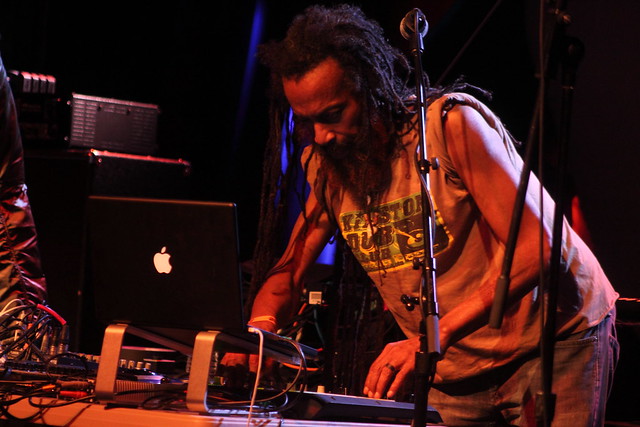
Comprised of the internationally renowned founding and primary members, the Washington, DC-based DJ and production duo Rob Garza and Eric Hilton, Thievery Corporation have developed a reputation for a sound that meshes elements of electronic music, dub, bossa nova, acid jazz, reggae, Indian classical musical, hip-hop and Middle Eastern music, as well as for collaborating with an diverse array of artists including Rob Myers, Loulou Ghelichkhani, Natalia Clavier, Frank ‘Booty Lock’ Mitchell, Mr. Lif, Jeff Franca, Ashish Vyas and others, who have contributed lyrics in English, Spanish, French, Italian, Persian, Portuguese, Romanian and Hindi.
The duo’s forthcoming full-length effort, The Temple of I & I is slated for a February 10, 2017 release through the duo’s ESL Music and the album is deeply influenced by the sounds and riddims of Jamaica, making it arguably their most dub and reggae-influenced effort to date. And the album’s latest single “Let the Chalice Blaze” is a breezy and atmospheric bit of dub that subtly owes a debt to drum ‘n’ bass, smooth jazz and minimalist electronic — and they do so in a trippy yet funky fashion.
Born in Ogidi, a small village in Eastern Nigeria, as the youngest of 10 sons in a traditional Igbo family, Charleston Okafor moved to the US in 1985 with the intention of becoming a doctor and enrolled as a pre-med student at Western Kentucky University — although he had long dreamt of pursuing a musical career. In fact, some of his earliest memories involved longing to be involved in the traditional church naming and death ceremonies that his mother, Christina Akuadi Okafor led as a musical director of the woman’s acapella church group. As Okafor fondly recounts in press notes “As was the case in those days, and still is with the youths in my village today, young boys like me longed for the days when we could participate in our own masquerade or nkpokiti dance groups.”
While studying at Western Kentucky University, Okafor had two experiences that altered the course of his adult life — he discovered MTV and began two, deeply influential and lifelong musical friendships with bassist Bryan House, who has worked with Robert Plant’s backing band Band of Joy, Emmylou Harris, Sam Bush and Dolly Parton and engineer Bill Bitner, the first engineer to work with Okafor. The Nigerian-born singer/songwriter’s friendships with House and Bitner helped him begin his pursuit of a musical career — and interestingly enough paved the road for Okafor to eventually collaborate with renowned producers like Ticlah, who has worked with Easy Star All-Stars, Antibalas and Amy Winehouse and DJ Spooky, both of whom have also remixed some of Okafor’s work.
Some 11 years after moving to the States, Okafar began his musical career in earnest as the frontperson and musical director of the Cleveland, OH-based collective Asante Groove, a project that featured a rotating cast of friends and collaborators that received attention locally and regionally for a sound that possessed elements of dancehall reggae and smooth jazz. He’s also received attention for his WCSB radio program African Abstract, which started in 1992 and is one of Cleveland’s longest running radio shows, as well as a staple of WCSB’s Sunday afternoon programming. Interestingly, Asante Groove along with Okafor’s current backing band Hybrid Shakedown have opened for many of the acts he’s played on his radio program including The Meditations, Chaka Demus and Pliers, Black Uhuru’s Michael Rose, Oliver Mtukudzi and others. Oh and I must add that Okafor is also a high-school math teacher, which may arguably make him both the coolest math teacher you’ve ever heard of, as well as an extremely busy man.
Adding to the Nigerian-born, Cleveland-based singer/songwriter’s unusual background and career trajectory, instead of going about the prototypical music industry route of following a release of original material with a remix album, he recently released the remix EP in advance of his second album America, an album that thematically focuses on power and oppression, love and partnership while looking at his adopted homeland with a sense of promise and hope — even in light of one of the bitterest and most divisive election cycles in recent memory.
For the remix album, Okafor turned to some old friends — Dub Trio founder Joe Tomino, who Okafar has known since the late 90s; Dubmatrix, who Okafor has long supported on his radio show and was a dear friend of Okafor’s producer Ecodek; and Ray Lugo and Kokolo Afrobeat Orchestra’s Jake Fader, who recently started their own project together Los Terrificos. The album’s first single is Dubmatrix’s skittering and subtly psychedelic yet dance-floor friendly remix of “Rama Rama.”
The recently released music video for the Dubmatrix remix manages to be both psychedelic and flirtatious — all while capturing the infectious joy that Okafor seems to spread far and wide. Lord knows, in this world, we definitely need it.
Led by its founding member, composer and bassist Ezra Gale and featuring Rick Parker (trombone), Alex Asher (trombone), Jon Lipscomb (guitar) and Madhu Siddappa, the Brooklyn-based trombone-led dub quintet Super Hi-Fi can trace their origins to a rather unlikely beginning. Gale, who was a founding member of acclaimed San Francisco-based Afrobeat act Aphrodisia, an act that once played at Fela Kuti‘s famed Lagos, Nigeria-based night club The Shrine, had relocated to Brooklyn and was collaborating with Quoc Pham in Sound Liberation Front when Gale was asked to get a band together for Pham and Gale’s then-monthly Afro-Dub Sessions parties in Williamsburg. Much like DJ Turmix’s Boogaloo Party, the Afro-Dub Sessions Party would pair the live band fronted by Gale with the dub’s top-flight producers and DJs including Victor Rice, Prince Polo, Subatomic Sound System, the Beverley Road All-Stars and others.
When Gale founded Super Hi-Fi, the project was initially intended to translate the improvisatory mixing process of dub to the live show; however, with the 2012 release of their critically applauded debut effort Dub to the Bone, a busy touring schedule in which they opened for nationally known acts like Rubblebucket, Beats Antique and John Brown’s Body, followed by the release of their Yule Analog Vol. 1 and Vol. 2, the project began to cement its growing reputation for crafting a unique and expansive take on dub and reggae.
With the recent release of Super Hi-Fi Plays Nirvana, the Brooklyn-based dub quintet push the boundaries of reggae and dub by paying tribute to Nirvana. And in typical Super Hi-Fi fashion, the members of the band manage to create their own take on the iconic Seattle-based trio’s material with renowned dub producers, Sao Paulo, Brazil‘s Victor Rice; Venice, Italy‘s Doctor Sub; and Brooklyn’s Prince Polo — all of whom are frequent collaborators with the band — assisting to further bend and morph the band’s sound in trippy and psychedelic ways, which help take fairly familiar songs into bold, new territory.
Adding to the uniqueness of the release, Very Special Recordings, a small, boutique Brooklyn-based label founded by Super Hi-Fi’s Ezra Gale, that specializes in releases cassettes that showcase the diverse of their borough’s and city’s music scene. Interestingly, while we all live in a world of Spotify playlists and streamable music that one never really owns, cassettes have seen something of a renaissance of late with several artists and labels releasing cassette only releases — and in some way, it’s a response against not just streaming services but against the trend towards technophilia for the sake of technophilia. While being relatively cheap to make and sell, a cassette tape does require a bit of effort — you’d have to go to a physical record store to purchase your favorite band’s new record and then bring it home to play; have a label or friend mail or give you a tape; and at the very least, you’ll probably listen to the whole tape, if not an entire side once. Plus, let’s not forget, that unless your favorite song is the first song or last song of a side, finding it can be a frustrating and time-consuming experience. And yet, if you remember buying cassettes at your local record store, as I do, it’s an experience that frankly I sometimes miss very dearly.
I recently spoke to Super Hi-Fi’s Ezra Gale about Super Hi Fi Plays Nirvana, how the arranging and re-arranging process differs from Gale’s normal songwriting process, the band’s upcoming releases and more. Check it out below.
__________________
WRH: In the Q&As for The Joy of Violent Movement, we almost always begin with some fairly introductory stuff for readers. So let’s begin, shall we?
WRH: How did the members of the band meet?
Ezra Gale: I had an idea for a two trombone band and placed a Craigslist ad for trombone players which got exactly two responses, from Alex Asher and Ryan Snow, who became our first two trombone players. Everybody else I just met through other musicians.
WRH: How would you describe your sound?
EG: It’s dub, but I don’t know if it’s reggae.
WRH: Who are you listening to right now?
EG: The last album I bought was Bowie‘s last album, Blackstar, which is just incredible.
WRH: Seminal albums like Nirvana’s Nevermind, U2’s Achtung Baby, A Tribe Called Quest’s The Low End Theory and Midnight Marauders, R.E.M.’s Automatic For The People, Soundgarden’s Badmotorfinger, Superunknown and Down On The Upside, Pearl Jam’s Ten, Vs. and Vitalogy and others reaching important milestone anniversaries, it’s a bit surprising to me that to my knowledge more bands haven’t seriously begun to tackle them with more covers and more tribute albums, especially if you consider how many Led Zeppelin, Pink Floyd, and Beatles tribute albums have been released over the years. Why haven’t there been more Pearl Jam, U2, R.E.M. tributes and covers? And how did you come upon paying tribute to Nirvana?
EG: I really don’t know about those other bands, for us we started playing a version of “Something In the Way” a couple years ago, and we all sort of got the idea that maybe a whole album of Nirvana tunes could be interesting.
WRH: Much like your fantastic Christmas albums, Super Hi-Fi Plays Nirvana features a couple of very well-known songs such as In Utereo’s “Heart Shaped Box,” and their famous Unplugged cover of “Where Did You Sleep Last Night?” as well as some rather deeper cuts such as “Verse Chorus Verse,” their Incesticide cover of “Love Buzz” Nevermind’s “Something In The Way” and “Polly.” What inspired you to choose those songs to tackle instead of something more tried and true?
EG: Well, initially I wanted to do all really obscure ones. Nirvana is a band whose famous songs have been played to death and I don’t know if anyone really needs to hear another version of “Smells Like Teen Spirit”, for example. But I know them from when Bleach came out and they were just this really great, intense band from Seattle that not many people knew- my college band even opened for them then, randomly. So I wanted to spotlight some of those lesser-known songs of theirs. But then, I think i was riding my bike and I suddenly started hearing “Heart Shaped Box” in this really slow, weird way, so we ended up doing that one. Ultimately it’s just about giving each song a different treatment and finding something new to do with it, no matter how many times you’ve heard it before.
WRH: How do you go about re-arranging material that’s fairly familiar in a way that adds your particular spin to it — while maintaining something familiar? And how does the process of re-arranging material differ from your normal songwriting process?
EG: It is different than a normal songwriting process. This album was very similar to our two Christmas albums (“Yule Analog” Vols. I and II), in that the goal was to take familiar material and make it sound different. And like in arranging those Christmas songs, I made some rules for myself doing it, which were that the melody line had to be the same, but everything else around it could change. So the rhythms are obviously very different, but also, Nirvana was a band with only one singer and we have two trombones, so in a lot of these versions the second trombone part is made up- like in “Verse Chorus Verse”, “Heart Shaped Box” and “Where Did You Sleep” especially. And also the chords are quite different in some of these, “Polly” and “Where Did You Sleep” especially are pretty different chord changes than the Nirvana versions.
My attitude towards cover versions is just that there’s no point in doing them if all you’re doing is to play it like the original version. No matter how great the original song is, I don’t ever want to regurgitate what someone else has done- go listen to the original if you want that. At the same time, I think it should be recognizable as the original song, somehow. So the challenge of taking material and sort of shaping it into something different that still has echoes of the original song is something I really enjoy doing.
WRH: While doing a little research for this interview, I learned that you’re currently working on your sophomore full-length effort, as well as Beatles/Police 45 for Record Store Day. Could you tell us a little bit about those projects?
EG: Yes, we are about 80% done with the mixing for the new full-length album, which is going to be called “The Blue and White” and it will be our second LP of all-original music. It’s quite different I think, there are lots of vocals and different sounds for us. It was recorded and mixed all onto tape too, which has been a real pain in some ways (!) but is so, so worth it- it sounds amazing I think. It will be out in the springtime sometime I think, on vinyl, somehow or other, we haven’t figured out yet.
And then the single is done and will be released on Electric Cowbell Records for Record Store Day in April, it’s the Beatles’ “I’m Only Sleeping,” which was actually recorded for our “Dub to the Bone” album but left off it, and a version of The Police‘s “Hole In My Life” which we recorded for the new album, both extremely whacked-out and different versions, I can’t wait to play it for people.
WRH What’s next for the band?
EG: We haven’t been playing live that much the last few months because I’ve been so focused on finishing these albums, so once we’re done completely with the new LP I’m looking forward to playing a lot more in the new year.
“Nothing More To Say” has an old school sound and feel, and will likely remind those New Yorkers of Dahved Levy‘s WBLS radio show back in the day. And although the song possesses an upbeat, bouncy riddim, the song is ironically enough an achingly bitter lament from the song’s narrator about being devoted to a fickle, deceitful and difficult lover, who probably never loved him anyway, and as the narrator recognizes the awful truth that his relationship was a lie, he vows to pack up his stuff and go — and go as quickly as possible while nursing a broken heart. Love is a strange and confusing thing even in the best of circumstances and the song captures the sense of foolishness we’ve had in trusting someone we maybe shouldn’t have; the regret over waiting valuable time with someone not quite worth our time and attention; the strange balance of love and hate being shifted; and the sense of uncertainty — both of one’s future and if they’d be able to trust someone else again.
The recently released video for the song is a fitting tribute to Dan Klein, as it captures him with the band performing in clubs, recording material at Daptone Records and at a makeshift home studio, and captures the band goofing off. At one point as a sad tribute, the video focuses on the band recording the song with an empty microphone at the center of the room. Some of of the footage is taken from iPhones while the rest of its professionally shot and edited but more importantly, it captures Dan Klein’s life and his sorely missing presence — while capturing the lives of everyday musicians.
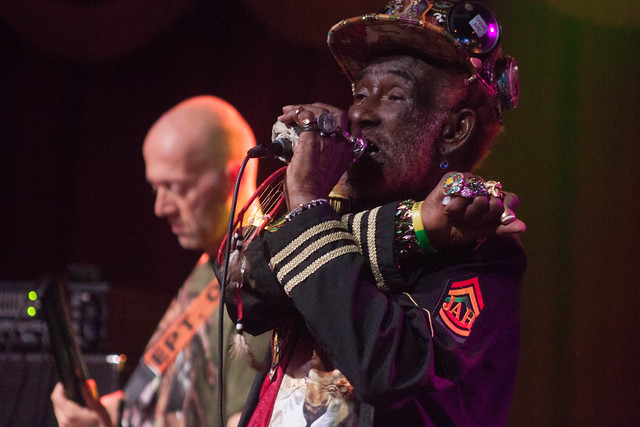
Perry turned 80 in March, and remarkably the man has managed to remain youthful, vital, challenging, forward-thinking, innovative, eccentric and imitable as ever as over the past decade or so he’s collaborated with the likes of The Beastie Boys, The Orb, Felix Da Housecat and several others while keeping a fairly busy touring schedule.
The reggae legend returns for the annual Dub Champions Festival at Brooklyn Bowl and this year’s appearance continues Perry’s continued tour with Subatomic Sound System to celebrate the 40th anniversary of the release of Super Ape — and to celebrate the legend’s 80th birthday. Of course, in honor of that occasion check out some live footage of the great and incredibly eccentric Mr. Perry.
Initially comprised of Dan Klein (vocals), Chuck Patel (organ, piano), Rich Terrana (drums, vocals) and Preet (bass, vocals), along with Norihiro Kikuta (guitar) and Mike Torres (percussion), Queens-based act The Frightnrs have developed a reputation across the city’s DIY and soundsystem scenes for an aesthetic that draws from Jamaican Rocksteady, a revered genre that took over Jamaican airwaves in 1967 and yielding some of the country’s most beloved and popular songs before petering out by the end of 1968, 80s Rub A Dub, punk rock, ska and reggae in a way that’s a subtle redefinition of what a contemporary reggae act can sound like. In fact, the act’s debut effort received airplay from reggae and radio legend David “Ram Jam” Roddigan and Mad Decent’s Diplo, who later released the band’s EP last year.
After the release of their EP, renowned New York-based funk and soul label Daptone Records released the band’s critically acclaimed cover of Etta James‘ “I’d Rather Go Blind” before officially signing the band as their first reggae signing based on two things — the strength of their local reputation and on the fact that they stumbled on to the perfect band to a long desired Rocksteady album, with Victor Axelrod, best known as Ticklah behind the dials and knobs. As the band’s Chuck Patel explains in press notes “Rocksteady was the first style of Jamaican music that Dan [Klein] and me fell in love with, and the idea of making a classic album for a classic label like Daptone was a dream come true.” As soon as the band was officially signed, the members of the band immediately went to work with the understanding that they had to work within Daptone Records’ tight frame and constraints — mainly they had to write only Rocksteady songs, which forced the band to display a singular focus. In fact, as Axelrod adds “The fact that the direction of the album was determined by it being a Daptone record was crucial. We wanted to make a solid and cohesive record and so chose songs that most fit the Daptone aesthetic and the result was the best music that Dan and the Frightnrs had ever made with truly expanded levels of creativity.”
Sadly as the band was recording their full-length debut effort Nothing Left to Say, which is slated for a September 2, 2016 release, the band’s frontman and co-founding member Dan Klein was diagnosed with ALS in last November and although he was able to finish the major work during the recording sessions, Klein tragically died last month making the recorded effort a testament to their friend and founder. As for the album’s first single, album title track “Nothing More To Say,” the track reminds me of the sort of stuff I’d hear during Dahved Levy‘s WBLS radio show. And although the song possesses an upbeat, bouncy riddim, the song is actually a bitter and aching lament from the song’s narrator about being devoted to a fickle and difficult lover, who may not have even loved him anyway — and as you can imagine the song’s narrator quickly recognizes that his relationship with this person was a lie. So he vows to pack up his stuff and go — and go as quickly as possible. Certainly, I’ve been there a couple of times as you have, and the song voices the bitter sense of confusion, heartache, regret and foolishness we’ve all felt at some point or another because of love.
If you’ve been frequenting JOVM over the past month or so, you may be familiar with the neo-soul act, The Main Squeeze. The band which consists of of Corey Frye (vocals), Max Newman (guitar), Ben “Smiley” Silverstein (keyboards), […]
Much ink has been spilled over the length of Lee “Scratch” Perry’s incredible, 50 plus-year music career, and that should be unsurprising as Perry has held a towering and instrumental influence on both modern and contemporary Jamaican reggae […]