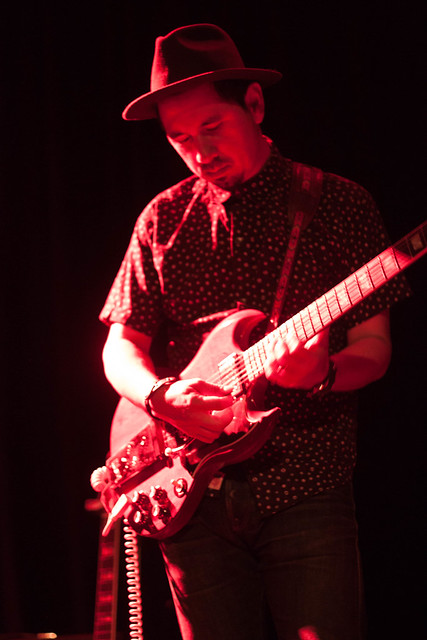
With the release of his 2016 self-produced, debut EP Dreamhouse, the Los Angeles, CA-based electronic, garage pop artist DENM quickly saw a rapidly growing national and international profile as the material off his debut EP received over 1o million combined streams across Spotify, Soundcloud, Apple Music and YouTube. And although he’s currently in the studio recording his much-anticipated follow up EP, the Los Angeles, CA-based electronic music artist released a swooning, slow-burning, piano-based R&B take on Outkast‘s smash hit “Hey Ya,” which was recently featured as the number 1 single in Spotify’s Friday Cratediggers playlist. Certainly, by turning the dance floor friendly tune into a slow-burning piano ballad DENM manages to craft a rather inventive reinterpretation of a song you’ve likely heard 400 million times by now, and it pulls out the song’s bittersweet and uncertain sentiment at the heart of the song.
If you’ve been frequenting this site over the last two months or so, you’d recall that the Brooklyn-based singer/songwriter BETS came to attention last year with the release of her critical applauded debut, Days Hours Night. Building upon the buzz of her debut, the Brooklyn-based singer/songwriter and her producer were set to write and record new, original material when the duo discovered that they shared a mutual love of Violent Femmes 1983 self-titled breakout debut effort. Reportedly, within a few minutes, BETS and her producer decided to put the sophomore effort of original material on hold to work on a Violent Femmes cover album in which she reimagines the familiar and beloved material.
In fact, as you’ll hear on BETS’ slow-burning, shoegazer rework of “Blister in the Sun” guitars are fed through layers of distortion, fuzz and feedback paired with gentle drumming and BETS’ dreamily distracted vocals, while pulling apart the song’s melody and chorus to the point of it being dimly recognizable and giving her version an ethereal moodiness.
Directed by Valerie Sute, the recently released video for BETS’ gauzy and dreamy rendition of “Blister in the Sun” begins with some glorious footage of New York City before following a young woman wandering through the desert brush — both by car and by foot with a brooding moodiness.
Now if you had been frequenting this site towards the end of last year, you might remember that I wrote about the Brooklyn-based singer/songwriter BETS, who quickly came to attention with the release of her critically applauded debut effort Days Hours Night. In the blogosphere age, artists have to strike quickly and while the iron is hot — and building upon the buzz she had received, the Brooklyn-based singer/songwriter and producer initially planned to write and record new, original material when the two collaborators discovered that they shared a mutual fondness of Violent Femmes‘ 1983 self-titled, breakthrough debut. And reportedly, within a few minutes, BETS along with her producer decided that the album of original material should be put on hold for a bit, to allow them some time to write and record an her soon-to-be released Violent Femmes tribute album, in which she re-imagined and reworked the original material into haunting and dreamy shoegaze.
BETS’ Violent Femmes album’s first single was a slow-burning rework of “Blister in the Sun“in which guitars were fed through layers of distortion, fuzz and feedback paired with gently padded drumming and BETS’ dreamily distracted vocals to craft a version of the song that slowly pulls apart the song’s familiar melody and chorus in a way that’s both ethereal and moody. The album’s latest single is a radically different rendition of “Gone Daddy Gone”/”I Just Want to Make Love to You” that nods at David Lynch and 60s bubblegum pop as twinkling percussion, shuffling drumming and dramatic bursts of guitar are paired with BETS’ coquettish and bratty vocals. Whereas the original possessed a neurotic and urgent need, BETS’ rendition sounds how I would imagine someone like Nancy Sinatra doing it — swinging and sensual as hell.
Sofia Kourtesis is a Berlin, Germany-based DJ, producer and activist, who as a producer and DJ has developed a reputation for a sound that possesses elements of tech house, dream-pop, new wave and others while frequently using anything at her fingertips to create something unique — and interestingly enough has been described by some as falling somewhere between the minimalism of Aphex Twin and the ambiance of Jai Paul.
Over the holidays, Kourtesis released a sensual and atmospheric remix of Me Succeeds‘ “Cool Kids” in which she uses a chopped and reversed sample of her uncle’s voice, skittering drum programming and layers of shimmering and gently undulating synths which gives the original a mischievous yet hopeful air — and a result, a completely different air from the slow-burning and industrial-leaning original.
As Kourtesis explains of her remix “The Cool Kids remix is really energetic and playful, I thought about our new generation, these people who are young and cool on their own special unique form. Kids wanna change things and maybe save the world someday.”
Led by its founding member, composer and bassist Ezra Gale and featuring Rick Parker (trombone), Alex Asher (trombone), Jon Lipscomb (guitar) and Madhu Siddappa, the Brooklyn-based trombone-led dub quintet Super Hi-Fi can trace their origins to a rather unlikely beginning. Gale, who was a founding member of acclaimed San Francisco-based Afrobeat act Aphrodisia, an act that once played at Fela Kuti‘s famed Lagos, Nigeria-based night club The Shrine, had relocated to Brooklyn and was collaborating with Quoc Pham in Sound Liberation Front when Gale was asked to get a band together for Pham and Gale’s then-monthly Afro-Dub Sessions parties in Williamsburg. Much like DJ Turmix’s Boogaloo Party, the Afro-Dub Sessions Party would pair the live band fronted by Gale with the dub’s top-flight producers and DJs including Victor Rice, Prince Polo, Subatomic Sound System, the Beverley Road All-Stars and others.
When Gale founded Super Hi-Fi, the project was initially intended to translate the improvisatory mixing process of dub to the live show; however, with the 2012 release of their critically applauded debut effort Dub to the Bone, a busy touring schedule in which they opened for nationally known acts like Rubblebucket, Beats Antique and John Brown’s Body, followed by the release of their Yule Analog Vol. 1 and Vol. 2, the project began to cement its growing reputation for crafting a unique and expansive take on dub and reggae.
With the recent release of Super Hi-Fi Plays Nirvana, the Brooklyn-based dub quintet push the boundaries of reggae and dub by paying tribute to Nirvana. And in typical Super Hi-Fi fashion, the members of the band manage to create their own take on the iconic Seattle-based trio’s material with renowned dub producers, Sao Paulo, Brazil‘s Victor Rice; Venice, Italy‘s Doctor Sub; and Brooklyn’s Prince Polo — all of whom are frequent collaborators with the band — assisting to further bend and morph the band’s sound in trippy and psychedelic ways, which help take fairly familiar songs into bold, new territory.
Adding to the uniqueness of the release, Very Special Recordings, a small, boutique Brooklyn-based label founded by Super Hi-Fi’s Ezra Gale, that specializes in releases cassettes that showcase the diverse of their borough’s and city’s music scene. Interestingly, while we all live in a world of Spotify playlists and streamable music that one never really owns, cassettes have seen something of a renaissance of late with several artists and labels releasing cassette only releases — and in some way, it’s a response against not just streaming services but against the trend towards technophilia for the sake of technophilia. While being relatively cheap to make and sell, a cassette tape does require a bit of effort — you’d have to go to a physical record store to purchase your favorite band’s new record and then bring it home to play; have a label or friend mail or give you a tape; and at the very least, you’ll probably listen to the whole tape, if not an entire side once. Plus, let’s not forget, that unless your favorite song is the first song or last song of a side, finding it can be a frustrating and time-consuming experience. And yet, if you remember buying cassettes at your local record store, as I do, it’s an experience that frankly I sometimes miss very dearly.
I recently spoke to Super Hi-Fi’s Ezra Gale about Super Hi Fi Plays Nirvana, how the arranging and re-arranging process differs from Gale’s normal songwriting process, the band’s upcoming releases and more. Check it out below.
__________________
WRH: In the Q&As for The Joy of Violent Movement, we almost always begin with some fairly introductory stuff for readers. So let’s begin, shall we?
WRH: How did the members of the band meet?
Ezra Gale: I had an idea for a two trombone band and placed a Craigslist ad for trombone players which got exactly two responses, from Alex Asher and Ryan Snow, who became our first two trombone players. Everybody else I just met through other musicians.
WRH: How would you describe your sound?
EG: It’s dub, but I don’t know if it’s reggae.
WRH: Who are you listening to right now?
EG: The last album I bought was Bowie‘s last album, Blackstar, which is just incredible.
WRH: Seminal albums like Nirvana’s Nevermind, U2’s Achtung Baby, A Tribe Called Quest’s The Low End Theory and Midnight Marauders, R.E.M.’s Automatic For The People, Soundgarden’s Badmotorfinger, Superunknown and Down On The Upside, Pearl Jam’s Ten, Vs. and Vitalogy and others reaching important milestone anniversaries, it’s a bit surprising to me that to my knowledge more bands haven’t seriously begun to tackle them with more covers and more tribute albums, especially if you consider how many Led Zeppelin, Pink Floyd, and Beatles tribute albums have been released over the years. Why haven’t there been more Pearl Jam, U2, R.E.M. tributes and covers? And how did you come upon paying tribute to Nirvana?
EG: I really don’t know about those other bands, for us we started playing a version of “Something In the Way” a couple years ago, and we all sort of got the idea that maybe a whole album of Nirvana tunes could be interesting.
WRH: Much like your fantastic Christmas albums, Super Hi-Fi Plays Nirvana features a couple of very well-known songs such as In Utereo’s “Heart Shaped Box,” and their famous Unplugged cover of “Where Did You Sleep Last Night?” as well as some rather deeper cuts such as “Verse Chorus Verse,” their Incesticide cover of “Love Buzz” Nevermind’s “Something In The Way” and “Polly.” What inspired you to choose those songs to tackle instead of something more tried and true?
EG: Well, initially I wanted to do all really obscure ones. Nirvana is a band whose famous songs have been played to death and I don’t know if anyone really needs to hear another version of “Smells Like Teen Spirit”, for example. But I know them from when Bleach came out and they were just this really great, intense band from Seattle that not many people knew- my college band even opened for them then, randomly. So I wanted to spotlight some of those lesser-known songs of theirs. But then, I think i was riding my bike and I suddenly started hearing “Heart Shaped Box” in this really slow, weird way, so we ended up doing that one. Ultimately it’s just about giving each song a different treatment and finding something new to do with it, no matter how many times you’ve heard it before.
WRH: How do you go about re-arranging material that’s fairly familiar in a way that adds your particular spin to it — while maintaining something familiar? And how does the process of re-arranging material differ from your normal songwriting process?
EG: It is different than a normal songwriting process. This album was very similar to our two Christmas albums (“Yule Analog” Vols. I and II), in that the goal was to take familiar material and make it sound different. And like in arranging those Christmas songs, I made some rules for myself doing it, which were that the melody line had to be the same, but everything else around it could change. So the rhythms are obviously very different, but also, Nirvana was a band with only one singer and we have two trombones, so in a lot of these versions the second trombone part is made up- like in “Verse Chorus Verse”, “Heart Shaped Box” and “Where Did You Sleep” especially. And also the chords are quite different in some of these, “Polly” and “Where Did You Sleep” especially are pretty different chord changes than the Nirvana versions.
My attitude towards cover versions is just that there’s no point in doing them if all you’re doing is to play it like the original version. No matter how great the original song is, I don’t ever want to regurgitate what someone else has done- go listen to the original if you want that. At the same time, I think it should be recognizable as the original song, somehow. So the challenge of taking material and sort of shaping it into something different that still has echoes of the original song is something I really enjoy doing.
WRH: While doing a little research for this interview, I learned that you’re currently working on your sophomore full-length effort, as well as Beatles/Police 45 for Record Store Day. Could you tell us a little bit about those projects?
EG: Yes, we are about 80% done with the mixing for the new full-length album, which is going to be called “The Blue and White” and it will be our second LP of all-original music. It’s quite different I think, there are lots of vocals and different sounds for us. It was recorded and mixed all onto tape too, which has been a real pain in some ways (!) but is so, so worth it- it sounds amazing I think. It will be out in the springtime sometime I think, on vinyl, somehow or other, we haven’t figured out yet.
And then the single is done and will be released on Electric Cowbell Records for Record Store Day in April, it’s the Beatles’ “I’m Only Sleeping,” which was actually recorded for our “Dub to the Bone” album but left off it, and a version of The Police‘s “Hole In My Life” which we recorded for the new album, both extremely whacked-out and different versions, I can’t wait to play it for people.
WRH What’s next for the band?
EG: We haven’t been playing live that much the last few months because I’ve been so focused on finishing these albums, so once we’re done completely with the new LP I’m looking forward to playing a lot more in the new year.
Brooklyn based singer/songwriter BETS came to attention earlier this year with the release of her critically applauded debut effort Days Hours Night. Interestingly, building upon the buzz of her debut, the Brooklyn-based singer/songwriter and her producer were set to write and record new material when the duo discovered that they shared a mutual love of Violent Femmes 1983 self-titled breakout debut effort. Reportedly, within a few minutes, BETS and her producer decided to put the sophomore effort of original material on hold to work on a Violent Femmes cover album in which she reimagines the familiar and beloved material.
In fact, as you’ll hear on BETS’ slow-burning, shoegazer rework of “Blister in the Sun” guitars are fed through layers of distortion, fuzz and feedback paired with gentle drumming and BETS’ dreamily distracted vocals, while pulling apart the song’s melody and chorus to the point of it being dimly recognizable and giving her version an ethereal moodiness.
Comprised of OWSLA’s Phonat, The Young Punx‘s Hal Ritson and Ali Jamieson, the production and electronic music artist trio Heavy Disco Soundystem recently released a slick and glittering Italo-disco remix of Kyle Dixon’s and Michael Stein’s “Kids,” off the Stranger ThingsSoundtrack that retains a portion of the original’s analog synth melody but adds propulsive drum beat, cascading layers of shimmering synths turning the moody, John Carpenter-like original into a thumping, club-friendly track that sounds indebted to Giorgio Moroder and 90s house music.
G. Know is an up-and-coming San Diego, CA-based producer, who began producing when he had turned 17. Influenced by artists like Flume, Medasin and Rustie, G. Know delved into sampling vinyl and drumbreaks on an MPC; but over the last few years, the San Diego-based producer has received attention for a sound that he feels aligns with his love of emotional bass music, which has resulted in the release of his debut EP Left Brain and a series of follow-up singles, including a reworking of French house music act, Stardust’s classic “Music Sounds Better With You,” that he has titled “YOU.” as G. Know explains in press notes “‘You’ is my little interpretation of the classic tune ‘Music Sounds Better With You’ by Stardust. This tune gave me heavy feels from a young age and I always wanted to flip it into something a little more relevant. For nostalgia’s sake I kept the vocal the same while adding some fun wobbly synths and a thick sub to convey a deeper emotion than the original and wrapped it up with a funky jersey club style breakdown. ”
The result is a stomping club banger with stuttering drum programming, wobbling synths and tweeter and woofer rocking low-end that swoons with an urgent Romanticism.
Brownout, a relentlessly touring, Latin funk and rock act side project of Grupo Fantasma has become something of an independent act of its own since the 2014 release of Brownout Presents Brown Sabbath, which featured Latin funk interpretations of beloved Black Sabbath songs such as “Iron Man,” “Planet Caravan,” “N.I.B” and others.
October 28, 2016 will mark the release of Brownout Presents Brown Sabbath’s highly-anticipated follow up, Brownout Presents Brown Sabbath, Vol II through Ubiquity Records. And the second collection will feature the band putting their unique spin on deeper Sabbath catalog cuts including “Fairies Wear Boots,” “Snowblind,” “Supernaught,” and “Sabbath Bloody Sabbath,” featuring Ghostland Observatory’s Aaron Behrens. Just in time for the announcement of their forthcoming sophomore effort, the band (through their publicist) put folks on to this 2014 live segment they did for KEXP, which features the band’s impressive and funky takes on “Iron Man,” “Planet Caravan,” “The Wizard,” and “N.I.B” and members of the band talking about touring life, the response they’ve received from Latin funk fans and Sabbath fans alike and more.
Now, if you’ve been frequenting this site over the past couple of years, you’ve likely come across several points on JOVM mainstay artist Rhythm Scholar. And over that period of time. the New York-based DJ, producer and remixer has developed a reputation of being both wildly prolific and for a continuing series of genre-mashing remixes stuffed to the gills with both obscure and recognizable samples, reminiscent of Paul’s Boutique-era Beastie Boys and Girl Talk — and for a series of more straightforward remixes, as well.
The JOVM mainstay artist returns with a breezy and jazzy remix of A Tribe Called Quest’s “Can I Kick It” consisting of cascading organs, strummed guitar, double bass, warm blasts of funky horn and swirling electronics. And Rhythm Scholar’s remix is a throughout re-imagining and reworking of the song, it manages to retain the original’s mischievous and inventive spirit.
If you’ve been frequenting this site over the past couple of months, you might recall that a couple of months ago, I wrote about the Bath, UK-based indie pop quintet Bad Sounds. With the December 2015 release of their debut single “I Feel,” the British quintet quickly emerged into the British scene as the single received praise from the likes of The Line of Best Fit and Vice Noisey, and received airplay from BBC Radio personalities Zane Lowe, Phil Taggert, Annie Mac and Huw Stephens. The Bath, UK-based quintet’s second single “Avalanche,” which I wrote about a couple of months ago, had the band pairing fuzzy guitar chords, angular bass chords, electronic bleeps and bloops, a motorik-like groove, and a rousingly infectious hook in a song that sounds as though it was indebted to Damon Albarn‘s work with Blur and Gorillaz, complete with a similar wry, self-effacing irony.
Recently, British electronic music artist and producer ThisisDA recently released a wildly inventive rework of Bad Sounds’ “Avalanche” that retains only a small but recognizable portion the song’s hook through the use of a subtly chopped up vocal sample paired with enormous, tweeter and woofer rattling boom bap beats, swirling electronics, shimmering synth cascades, a sinuous bass line and a couple of emcees spitting fire over a swaggering, funky and trippy production that manages to sound equally inspired by the aforementioned Gorillaz and others.
If you’ve been been frequenting this site over the course of the last several years, you’d be extremely familiar with JOVM mainstay Rhythm Scholar. And over the years, the wildly prolific New York-based DJ, producer and remixer has developed a reputation for a continuing series of genre-mashing remixes packed with both obscure and recognizable samples in a way that’s reminiscent of Paul’s Boutique-era Beastie Boys. Last year, Rhythm Scholar released an incredible Girl Talk-like mashup of Herbie Hancock‘s “Rockit” and Michael Jackson‘s “Bad,” that the producer, DJ and remixer has dubbed “Bad Rockit” and sonically the mashup possessed a club-banging, retro-futuristic feel with a larger-than-life, I’m going to kick ass, take names and kick more ass-like swagger.
This year, Rhythm Scholar returns to his signature genre-mashing remixes — this time with a shimmering and dance floor-friendly remix of Tears For Fears‘ mega-hit “Everybody Wants to Rule the World” that also meshes “Mother’s Milk” “Memories Fade” and “Mad World” with an additional bit of funk from Locksmith while retaining elements of their beloved sound.
Fronted by its founding member, primary arranger and pianist Scott Bradlee, Postmodern Jukebox is a collective of rotating musicians and collaborators, who specialize in re-working and re-arranging modern popular music into genres popular in the […]