Category: World Music

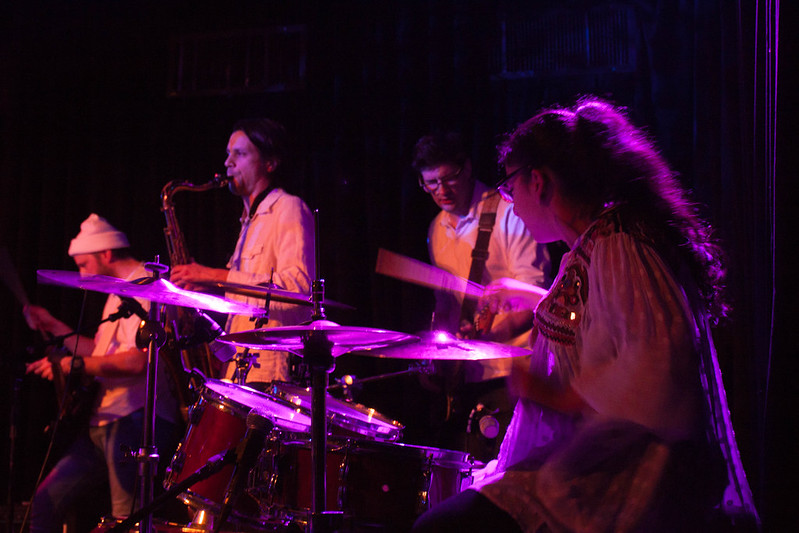
Comprised of Brooklyn-based musicians Elenna Canlas and Peter Mason, best known for their primary gig Underground System, the duo have stepped out into their own with a side project, Big Everything, which the duo have described as possessing a sound that’s “equal parts NYC club culture, freaky funk and R&B sty liens and electronic reckless abandon.”

The duo released their self-titled debut mixtape earlier this month and it features guest spots from Tierra Whack, Awkwafina, Bajah and others, and interestingly enough the mixtape has started to receive quite a bit of attention across the blogosphere. And when you hear the mixtape’s latest single “Killer Bee”you’ll see why, as the duo along pair enormous, blasts of enormous brass, boom-bap beats, stuttering drum programming, deft sampling, buzzing synths and an emcee spitting bars towards the song’s last third. Sonically and aesthetically speaking, the song manages to mesh several disparate genres — in particular, hip-hop, Eastern/Gypsy funk, funk, electronic dance music, brass bands and others — in a seamless fashion that only seems possible in a truly global world.


.”

Congolese-born, Minneapolis, MN-based guitarist, singer/songwriter and composer Siama Matuzungidi has had a lengthy, decades long prolific career that began in earnest when he left his home in rural Democratic Republic of the Congo, then Zaire with a guitar strapped to his back. He then travelled to Kinshasa and Uganda before eventually landing in Nairobi, Kenya. And during those travels a young Matuzungidi was a studio musician, songwriter and or cowriter with some of soukous’ biggest and brightest names including Kanda Bongo Man, Sam Mangwana, Moni Mambo with Shika Shika, Lovy Longomba, Tshala Muana and Samba Mapangala with Virunga; in fact, Matuzungidi has played on more than 100 singles, including some of soukous’ most beloved radio hits while developing a reputation for material based around tales of love, desire and betrayal paired with catchy hooks and a wry and ironic sense of humor — although on many of those songs he wasn’t officially credited.


As a result of his prolific songwriting and incredible guitar work, Matuzungidi became considered one of soukous’ legends — and in a highly competitive genre in which writing catchy song just wasn’t enough to stay relevant. During the genre’s golden age during the 70s and 8os, it took more than writing a catchy song to keep listeners ears and fans buying albums, and the genre’s songwriters and musicians began writing songs with a deeper complexity and nuance, so you’d hear intricate hooks, complex scales an more. And interestingly enough, that period of experimentation may arguably have prepared and influenced the Congolese soukous legend’s future interest in experimenting with his sound.

Now as the story goes, after spending time performing in Japan and Dubai, Matuzungidi relocated to Minneapolis, the soukous legend quickly realized that he was in for a rather big professional and personal change — “for the first time there wasn’t anyone to play soukous with. I was worried I might have to stop playing but another voice told me to try new things,” Matuzungidi explains in press notes. So the Congolese singer/songwriter and guitarist decided to invite a number of local and locally-based emigre musicians to collaborate with him including Carnatic Indian singer and veena virtuoso Nirmala Rajasekar, renowned gospel singer JD Steele, master Tibetan multi-instrumentalist Tenzen Ngawang, classical cellist Jacqueline Ultan and Joe Savage on pedal steel. As Matuzungidi continues “I invited musicians to share what they feel when they hear my music. I didn’t tell them what to play. I just encouraged them to express themselves in their own way. The music still sounds like home but they’ve added so many cool ideas to it.”

And as a result Matuzungidi’s recently released full-length Rivers is a bit of a modern and highly global take on traditional Congolese music. I have the unique privilege of premiering Rivers‘ opening single, the upbeat 6/8 “Jungle Zombie” which pairs a twisting and looping guitar line with bright blasts of horn, playful polyrhythm and a jazz-leaning bridge in a loose composition that allows room for each of the musicians a few brilliant moments to show off in a brilliant solos, along with call and response vocals. Reportedly, the song is loosely inspired by and is meant to channel the imagery of Matuzungidi and his family walking through the bush to get to their farm, where they grew their own food. Interestingly, as the press notes mention the song’s lyrics translated from Lingala simply say “Bring me water. Bring me food . . ” But the main thing is that the song is so joyous, so fun that you can’t help but want to dance along.


With the release of their critically acclaimed full-length debut La Allianza Profana and its follow-up, Serpiente Dorada, Peruvian electronic duo Dengue Dengue Dengue quickly received international attention for a sound that possessed elements of traditional cumbia, dub, dancehall and techno — and for being at the forefront of an expanding electro cumbia movement.

Siete Raices, the duo’s long-awaited sophomore, full-length effort is slated for release later this month through Enchufada Records, and the effort takes its name from a traditional Peruvian liquor — a potent beverage brewed from several jungle plants with mystical, aphrodisiac properties. Now, if you stumbled upon this page over the past couple of weeks, you may recall that I wrote about “Guarida,” a single that had the renowned Peruvian duo collaborating with vocalist Sarah Van. And the single revealed an act that has expanded upon the sound that first captured attention as the Peruvian duo paired hauntingly ambient production consisting of gentle layers of shimmering and undulating synths and skittering drum programming —  nodding at the fact that the Peruvian duo methodically carefully craft and shape their work to evoke particular moods while drawing equally from ancient traditions and contemporary production; in fact, it shouldn’t be surprising that their material doesn’t sound like anything you’ve heard on contemporary radio — or anyplace else really.

Siete Raices‘ second and latest single “The Enemy” consists of a production that subtly hints at El Dusty’s nu-cumbia as the song consists of a glitchy and distorted vocal sample paired with a cowbell-led percussion, a languid, looped keyboard sample  that twists and turns around the song’s hook while being subtly danceable. But just under the surface, there’s something that feels subtly menacing and uneasy.


Perhaps best known as a touring and session guitarist for Charli XCX and BØRNS, Los Angeles, CA-based guitarist and vocalist Cecilia Della Peruti is also the creative mastermind behind up-and-coming act Gothic Tropic, a band whose New Wave-leaning sound is indebted to the likes of the Go-Gos The B52s and others as angular and punchy guitar chords are paired with a propulsive rhythm section, Peruti’s sultry vocals and an infectious hook as you’ll hear on their latest single “Stronger.”


Next year will mark the 20th anniversary of Afrobeat godfather and pioneer Fela Kuti‘s tragic and untimely death from AIDS, and in that time Kuti’s influence has managed to loom rather largely over contemporary music from Africa and elsewhere as countless bands have expanded upon the sound and aesthetic that the influential and controversial Nigerian created. And I suspect that if Kuti were alive today, the 78 year old would likely be amazed at the diverse nationalities and ethnicities, who have adopted his sound, aesthetic and message to their own particular situations, while picking up on the larger, global context that Kuti always managed to write about. But if there’s one thing I’m certain that Fela would never have imagined actually existing it would be this — Swedish Afrobeat.

Comprised of Frida Eleonore Winlöf (trumpet),  Christopher Ali Thorén (tenor sax), Jonas ‘Finland’ Rönnqvist (alto sax), Fredrik Brändström (keys), Jesper Lundquist (guitar), Tobias Alpadie (guitar), Vilhelm Bromander (bass), Wille Alin (drums), Celso Paco (congas and vocals), Jon Olofsson (percussion), and Mattias Hidemo (claves, fiddle), the twelve-member Stockholm, Sweden-based collective Music is the Weapon may arguably be Sweden’s best (and seemingly only) Afrobeat outfit. Although Sweden isn’t particularly known for a funk scene, as the band’s co-founder Christopher Ali Thorén explains in press notes “We’re not fighting the same fight in Sweden as Fela did in Nigeria, of course, but I feel that in some way it’s political to play this kind of music in clubs here. We give people the experience of big live band playing raw funk. For me it’s an act of resistance all its own.” Of course, as Thorén and   the rest of the band have also discovered, their fellow countrymen are starving for Kuti’s particular brand of funk.

The Stockholm-based collective’s latest full-length effort Sweet Choral Motion was released through Fashionpolice Records and from the album’s opening track “Black Hole,” the Swedish collective reveals an inventive take on Fela’s signature sound as the composition employs the use of complex polyrhythm that sounds as though it owes a debt to the Caribbean, enormous horns and an equally complex song structure that would make the legendary Nigerian godfather of the genre proud while gently expanding what contemporary Afrobeat can sound like, as the Swedish act’s sound also seems to employ elements of hip-hop and cosmic funk to the mix.


Holy Bouncer is a Barcelona, Spain-based indie rock quintet, who will be releasing their full-length debut later this year, and from the album’s second and latest single “Hippie Girl Lover,” the band specializes in a sound that clearly draws from early era The Doors (their self-titled album in particular), Steppenwolf‘s “Magic Carpet Ride” and the incredible Brown Acid proto-metal/proto-stoner rock compilations released by the folks at RidingEasy Records, complete with a gritty, primal, and grungy self-assuredness. Certainly, if it wasn’t for the subtle, contemporary production sheen — you’ll notice it with a pair of good headphones or a good speaker — the song sounds as though it could have been released in 1966, and some devoted record collector or blogger stumbled upon this one in a dusty, used record store in Milwaukee or Albany. But perhaps much more important, is that Holy Bouncer along with Madrid‘s The Parrots should prove that Spain has a vital and burgeoning indie rock scene that’s worthy of international attention.

New Video: The Gorgeous, Surreal and Ancient Mythology-based Visuals for Dengue Dengue Dengue’s “Guarida”

With the release of their critically acclaimed full-length debut La Allianza Profana and its follow-up, Serpiente Dorada through Enchufada Records, Peruvian electronic duo Dengue Dengue Dengue quickly received international attention for a sound that possessed elements of traditional […]

Live Footage: Joe Driscoll and Sekou Kouyate Performing “Tokira” on KEXP

Over the last couple of years, Syracuse, NY-born and UK-based singer/songwriter and beatboxer Joe Driscoll and Sekou Kouyate, the Guinea-born kora player have become JOVM mainstay artists for a sound that effortlessly meshes elements of traditional Western […]

Comprised of Keko (vocals), Oscar Poncell (vocals, tiple), Robert Douglas Sola (bass), Lazaro Ernesto Pompa (bass), Lachlan McLean (sax), Jethro Negron (drums), Nick Ryan Glennie (trumpet), and Marcelo La Greca (guiro and vocals), Melbourne, Australia-based Latin music nonet San Lazaro features bandmembers, who claim heritage from all over the Spanish speaking world — including Chile, Cuba, Catalonia and elsewhere. And as a result, the Australian act have developed a reputation for a sound that draws from reggaeton, salsa, Cuban son, 70s New York salsa, 60s Peruvian cumbia and seamlessly meshes them in a way that feels and sounds both familiar and alien. In fact, the act have developed a reputation for being one of Melbourne’s preeminent Latin music acts, as the band’s 2012 release Clave contra Clave helped the band win Best Australian Latin Band, and their single “Muchacho Tranquilo” was included on the 2014 Rough Guide to Psychedelic Salsa compilation.

The band’s latest effort La Despedida (translated from Spanish to English as “The Farewell”) thematically focuses on breakups, loss, insomnia, protests and more,  and interestingly enough, the band has broken up and reconvened several times, which gives the material a deeper, more personal weight.  La Despedida’s latest single “Amor De Despedida” is a propulsive song that swoons with heartache while being a bit of a kiss of towards a partner, who the narrator is glad to see leave. But most important, the band plays with a cool, self-assuredness through a song that structurally goes through a trippy tempo change at its bridge before returning to its dance floor-ready sound.


New Audio: El Dusty’s Anthemic and Club Banging, Cinco De Mayo-Inspired, New Single

Corpus Christi, TX-based producer, DJ and electronic music artist, Horacio Olivera, best known as  El Dusty has a long-held reputation as the pioneer of a revolutionary, new subgenre that he’s dubbed “nu-cumbia” as it possesses elements of […]