Country Line Runner is the solo recording project of singer/songwriter and multi-instrumentalist Adam Day — and with the release of the Bill Ryder-Jones-produced single “Hard to Find,” Day has received attention across the blogosphere for his unique songwriting approach. Interestingly, Day’s latest single is the incredibly cinematic “Wide Eyes,” which manages to nod at Joy Division and Brothers in Arms-era Dire Straits, complete with a carefully crafted and anthemic hook that reveals an ambitious songwriter with hopes to take over the world.
Tag: Dire Straits
New Audio: Introducing the Breezy Synth Funk of Switzerland’s Klaus Johan Grobe
With the release of their Basel Prize-winning Spagat der Liebe, the Swiss electro pop duo Klaus Johann Grobe, comprised of Sevi Landolt and Dani Bachmann quickly received national and international attention for a difficult to pigeonhole, genre-defying sound that meshes elements of electro pop, electronic dance music, komische and others while centered around slinky jazz fusion-like grooves. Adding to a growing profile, the duo with their live backing band have toured with Unknown Mortal Orchestra, The Growers and Temples, and have made festival stops in the US, The Netherlands, Luxembourg, Germany, France, Spain and their native Switzerland.
Interestingly, the Swiss duo’s forthcoming album Du Bist So Symmetrisch is slated for an October 26, 2018 release through Chicago-based Trouble in Mind Records — and the album reportedly continues in a similar vein as its predecessor. The album’s second and latest single “Discodanken” is a breezy arpeggiated synth-led track centered around a sinuous motorik groove and metronomic beats to create a hypnotic, dance floor friendly yet lysergic feel that brings to mind Vinyl Williams, Kraftwerk, Air and Phoenix; but with a retro-futuristic quality.
The recently released video by Jonas Baumann is equally retro-futuristic, featuring visuals that remind me quite a bit of the classic computer animated video for Dire Straits’ “Money for Nothing,” but while also appearing like cells growing and attacking it other.
New Video: JOVM Mainstays Tinariwen Return with a Mournful Meditation on Time, Friendship, and the Tuareg Way of Life in Visuals for Album Single “Nannuflay”
Over the past few years, I’ve written quite a bit about the internationally renowned Algerian Tuareg pioneers of the Desert Blues, Tinariwen, and as you may recall the act can trace their origins back to the late 1970s when the band’s founding member, guitarist Ibrahim Ag Alhabib, joined a small group of Tuareg rebels living in refugee camps in Libya and Algeria. The group of rebels Ag Alhabib hooked up with had been influenced by radical chaabi protest music of Moroccan groups like Nass El Ghiwane and Jil Jilala, Algerian pop rai, and western artists like Elvis Presley, Led Zeppelin, Carlos Santana, Dire Straits, Jimi Hendrix, Boney M, and Bob Marley — and they started writing music that meshed the traditional folk music of their people with Western rock, reggae and blues-leaning arrangements. Upon relocating to Tamanrasset, Algeria, Ag Alhabib started a band with Alhassane Ag Touhami and brothers Inteyeden Ag Ablil and Liya Ag Ablil that had played traditional Taureg music at various weddings, parties and other occasions across both Algeria and Libya. Interestingly, as the story goes, when the quartet had started, they didn’t have a name; but people across the region, who had seen them play had begun calling them Kel Tinariwen, which in the Tamashek language (the tongue of the Taureg people) translates roughly as “The People of the Deserts” or “The Desert Boys.”
In 1980, Libyan dictator, Muammar Gaddafi issued a decree inviting all young Tuareg men, who were living illegally in Libya to receive full military training, as part of his dream of forming a Saharan regiment, comprised of the best young Tuareg fighters to further his territorial ambitions in Chad, Niger, and elsewhere across Northern Africa. Al Alhabib and his bandmates answered the call and received military training. Whether or not the founding members of the band truly believed in Gaddafi’s military ambitions would be difficult to say — but on a practical level, a steady paycheck to support yourself and your family certainly is an enticement. Five years later, Ag Alhabib, Ag Touhami and the Ag Ablil brothers answered a similar call by leaders of the Libyan Tuareg movement, who desired an autonomous homeland for their people, and wound up meeting fellow musicians Keddou Ag Ossade, Mohammed Ag Itlale (a.k.a “Japonais”), Sweiloum Ag Alhousseyni, Abouhadid Ag Alhousseyni, and Abdallah Ag Alhousseyni — all who had sang and played guitar. At this point, the lineup of Tinariwen was completed and the members of the collective began writing songs about the issues and concerns of their people.
The members of the band built a makeshift studio and then vowed to record and distribute music for free for anyone who supplied them a blank cassette tape. And within a short period of time, their cassettes were a highly sought-after item, and were traded throughout Saharan Africa.
In 1989 the collective had left Libya and relocated to Ag Alhabib’s birthplace of Tessalit, Mali; but by the next year, Mail’s Tuareg population revolted against the Malian government — with some members of the collective participating as rebel fighters in that conflict. After the Tamanrasset Accords were reached and agreed upon in early 1991, the members of Tinariwen, who had fought in the conflict had left the military and devoted themselves to their music full-time. By 1992, some of the members of the band went to Abidjan, Ivory Coast to record a cassette at JBZ Studios, which they followed up with extensive gigs for their fellow Tuaregs across Saharan Africa, which helped furthered the reputation they had developed primarily by word-of-mouth.
A collaboration with renowned French, world music ensemble Lo’Jo helped the members of Tinariwen receive a growing international profile, which included their a live set at Africa Oye, one of the UK’s largest African music/African Diaspora festival. Building on the increasing buzz, the band released their full-length debut The Radio Tisdas Sessions, which was their first recorded effort to be released outside of Saharan Africa. Since their formation, the collective has gone through a series of lineup changes, incorporating a younger generation of Tuareg musicians, who haven’t fought during the military conflicts of the elders, including bassist Eyadou Ag Leche, percussionist Said Ag Ayad, guitarist Elaga Ag Hamid, guitarist Abdallah Ag Lamida, and vocalists Wonou Walet Sidati and the Walet Oumar sisters.
Despite their lineup changes, Tinariwen has received international acclaim, particularly over the past decade, as they’ve regularly toured across the European Union, North America, Japan and Australia, frequently playing sets at some of the world’s biggest music festivals — including Glastonbury, Coachella, Roskilde, Les Vieilles Charrues, WOMAD, FMM Sines, Printemps de Bourges and others, as well as some of the world’s best known music venues, as they continued with a sound that evokes the harsh and surreal beauty of their homeland, centered around the poetry and wisdom of a rough and tumble, proud and rebellious people, whose old-fashioned way of life is rapidly disappearing as a result of technology and encroaching Westernization. Along with that, a bloody and contentious series of religious and ethnic wars have splintered several nations across the region — including most recently Mali and Libya, where members of Tinariwen have proudly called home at various points of the band’s existence. Unsurprisingly, Tinariwen’s latest album Elwan (which translates into English as The Elephants) thematically focuses on the impact of Westernization and technology has had on their people, the band’s life of forced exile, and their longing for their ancestral homeland.
Elwan’s latest single “Nannuflay” is an atmospheric and shuffling blues centered around a hypnotic groove and a gorgeous, looping guitar line that features the renowned pioneers of the Desert Blues collaborating with guitar god Kurt Vile and the imitable, grunge rock pioneer Mark Lanegan, that manages to be a powerful connection between Saharan Africa and the West, and a mournful longing for a past that the song’s narrator knows he cannot have back; but along with that, there’s a tacit acknowledgement that time is passing by — sometimes faster than anyone wants to admit.
Directed by Axel Digoix, the animated video for “Nannuflay” follows an older Tuareg man, who returns to the camp where he grew up for a party. The man remembers both the joys and torments of the nomadic life, he once lived with a friend, who has since died, including childhood memories of life in the sand dunes, the adventures they had as teenagers, the fights, dramas and responsibilities of their adult lives. Throughout the video, the two men’s friendship details the lives of the Tauregs and the duty and obligation they feel towards each other and to passing along as much of the old traditions as humanly possible.
Comprised of Rob Withem (guitar, vocals), Greg Markov (bass) and Thom Walsh (drums), the Phoenix, AZ-based indie rock trio Fine China can trace their origins back to 1997. And soon after their formation, the trio released their first two EPs and a 7 inch through the Southern California-based indie label Velvet Blue Music. The Phoenix-based indie rock act went on to release three more full-length efforts, including 2005’s critically applauded The Jaws of Life, which also had material featured in several TV shows.
Late 2016 saw the 12′ vinyl re-issue of their critically acclaimed The Jaws of Life, which interestingly enough saw the release of a bonus track to coincide with a 10 year reunion show; in fact, the bonus was met with critical applause and as a result, the vinyl re-issue quickly sold out. Building upon the growing buzz that surrounded the band again, the band’s first release in 12 years Not Thrilled finds the band returning to their original label home, Velvet Blue Music, who released their debut effort over 20 years ago. Slated for a February 23, 2018 release, the material on their forthcoming album was recorded in Rob Withem’s home studio and mixed by Bob Hoag, their longtime producer and engineer at Flying Blanket Recording in Mesa, AZ.
“Anyone Else,” the first official single off the new album will further cement the band’s long-held reputation for crafting a warmly familiar, shimmering, 120 Minutes-era guitar pop sound with an anthemic hook — and although the band’s Withem says in press notes that “I wanted a sound that harkened back to singles from the mid to late 80s that I heard on the radio as a kid — stuff like Don Henley and Dire Straights. But root it in an elegant guitar pop sound, like XTC or Crowded House,” the song (to my ears, at least) reminds me quite a bit more of The Smiths, which isn’t a bad thing to go for.

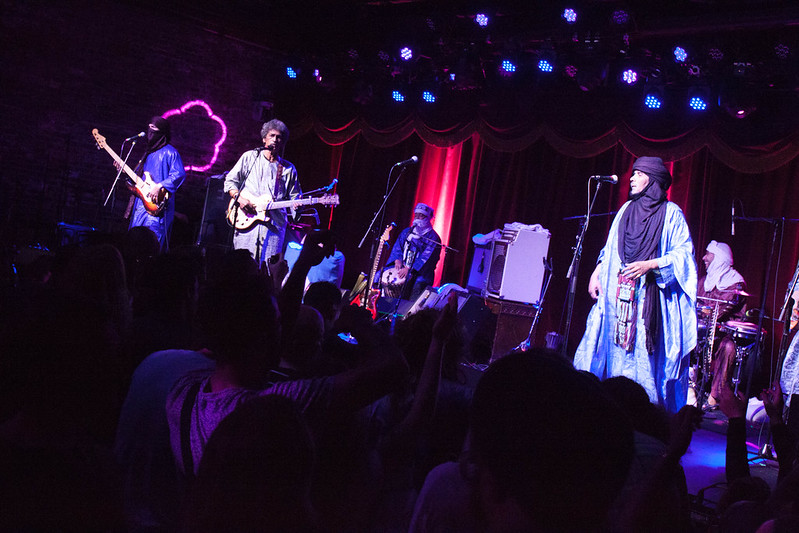
Live Concert Photography: Tinariwen with Dengue Fever at Brooklyn Bowl 4/16/17
Throwback: Tinariwen Live at the Bataclan, November 2016
Over the past few days, as 2016 was coming to a close, I had been looking a bit back at the past when I stumbled across this live footage of Tinariwen performing at the Bataclan in Paris, back in November.
New Video: The Dali-esque, Dire Straits “Money For Nothing” Inspired Visuals for Jordan Burchel’s “Coffee Breath”
Vowel Sounds’ latest single “Coffee Breath” will further cement the Gainesville, FL-based multi-instrumentalist and producer’s burgeoning reputation for carefully crated rock with deeply introspective lyrics that sonically draws from psych rock and dream pop — although in this case, “Coffee Breath” much like the work of Drakkar Nowhere sounds as though it also draws from 70s AM rock as Burchel’s crooning is paired with shuffling drumming and subtly bluesy psych rock guitar chords. But just underneath the surface is a subtly mischievous sense of irony.
Animated by Tristan Whitehall at Squiggle Dot, the recently released video for “Coffee Breath” playfully nods at Dire Straits’ legendary and envelope pushing “Money for Nothing” but with an insouciance to the proceedings as the video follows an anthropomorphic coffee cup as it journeys through a Dali-esque desert to a surrealist living room and back to the desert — and during the journey, the coffee cup encounters a snake seductively wrapping itself around an anthropomorphic apple, an hourglass with a skull from it as the coffee cup holds another coffee cup and later drinks from it. It’s surreal but with a gloriously mischievous glee.
Although very little is currently known about them, the London-based indie rock act Le Clientele, their latest single “Strats and Precisions” as the band describes is a “Dire Straits, Ariel Pink inspired workout” and was recorded in Softhouse Studios using a Studer A827 tape recorder, which helps to give the proceedings a jangling, old-timey feel but with a subtly contemporary take.
New Audio: Tinariwen Return with a Hypnotic and Triumphant New Single
Last month, I wrote about Elwan’s first single “Tenere Taqqal,” a slow-burning and hauntingly gorgeous song that possessed an understated yet aching longing for a way of life and for a home, which as Thomas Wolfe once wrote and the members of the band recognize, they may never be able to return to and will never have again. And certainly while there’s a tacit acknowledgement within the song that life continues onward as it always does, there’s also a brooding and pensive urgency within the song that comes from the members of the band recognizing that they have a sacred and profound duty of ensuring that something of the old traditions could be preserved and passed on to future generations. The album’s second single “Sastanàqqàm” is as the band’s Abdallah Ag Alhousseyni explains “an ode to the Sahara and its Nomads. It expresses the needs of the traveller as he crosses the desert on his mount. Essential needs: find water and a way to preserve it, find a good mode of transport. But also the love-hate relationship with the desert, the natural elements and the certainty that we will always go back to it.” Pairing those sentiments with a shuffling and deeply hypnotic groove and a propulsive and stomping percussion give the song a hopeful and downright joyous feel. At it’s core it’s the hope and promise of returning to the ancestral homeland — of its smell, of seeing beloved sights, of returning to the place where your ancestors have lived, played, prayed, wandered, hunted and died.
The band and their label have done a kind favor by providing an English translation of the song’s lyrics, which you can check out below.
Sastanàqqàm Lyrics
SASTANÀQQÀM
I QUESTION YOU
TÉNÉRÉ, CAN YOU TELL ME OF ANYTHING BETTER THAN TO HAVE YOUR FRIENDS AND YOUR MOUNT,
AND A BRAND NEW GOATSKIN, WATERTIGHT,
TO FIND YOUR WAY
BY THE LIGHT
OF THE FOUR BRIGHT STARS OF HEAVEN,
TO KNOW HOW
TO FIND WATER IN
THE UNLIKELIEST OF PLACES, AND ENLIST THE MOMENTUM OF THE WIND
TO HELP YOU MOVE FORWARD
TELL ME, TÉNÉRÉ
HOW YOU AND I
CAN REMAIN UNITED,
WITH NO HATE FOR EACH OTHER.
TÉNÉRÉ, I CAN NOW ADMIT THAT
I HAVE TRAVELLED FAR THROUGH THIS WIDE WORLD.
TÉNÉRÉ, I GIVE YOU MY OATH
THAT AS LONG AS I’M ALIVE,
I WILL ALWAYS COME BACK
New Video: Haunting Visuals and Sounds of Tinariwen’s “Tenere Taqqal” Captures a Rapidly Disappearing Way of Life
Interestingly, Tinariwen’s forthcoming full-length effort Elwan (which translates into English as The Elephants) is slated for a February 10, 2017 release, and the album thematically focuses both on the disappearing traditions of the Tuareg people and of being forced into exile — oddly enough as the members of the band were touring the world. And the album’s gorgeous first single “Tenere Taqqal” possesses an understated longing for a way of life and for a home, which as Thomas Wolfe wisely suggested they can never return to and will never get back. And yet there’s a tacit acknowledgment that life must continue onward and that they have a profoundly important duty of ensuring that something of the old traditions can be preserved and passed on to future generations. As a result, the single while being slow-burning and brooding also manages to possess an understated, quiet urgency — all while feeling older than time itself. Every time, I’ve listened to this track I can picture sitting among the Tuareg or the Bedouins at a campfire, as they tell tales of creation or of the great mystics and teachers, who have led flocks of faithful . .
The recently released animated video was directed by Axel Digoix and it vividly depicts the desert’s harshness, cruelty and beauty, and the profound spiritual and physical connection that the Tuareg people have towards it, while pointing out that their traditions and their world is being violently torn apart.
Founded by Ibrahim Ag Alhabib, Tinariwen can trace their origins back to the mid and late 1970s when Alhabib, who had been inspired to learn the guitar from an old Western film, in which a cowboy played a guitar, joined other Tuareg rebels living in refugee camps in Libya and Algeria, who were exploring the radical chaabi protest music of Moroccan groups like Nass El Ghiwane and Jil Jilala; Algerian pop rai; and western artists like Elvis Presley, Led Zeppelin, Carlos Santana, Dire Straits, Jimi Hendrix, Boney M, and Bob Marley.
While in Tamanrasset, Algeria, Ag Alhabib started a band with Alhassane Ag Touhami and brothers Inteyeden Ag Ablil and Liya Ag Ablil, and they began playing the traditional sounds of the Taureg people at weddings and parties across Algeria and Libya. Interestingly, when they started, the band had no official name but people began calling them Kel Tinariwen, which in the Tamashek language translates roughly as “The People of the Deserts” or “The Desert Boys.”
In 1980, Libyan dictator, Muammar Gaddafi released a decree inviting all young Tuareg men, who were living illegally in Libya to receive full military training, as part of his dream of forming a Saharan regiment, comprised of the best young Tuareg fighters to further his territorial ambitions in Chad, Niger, and elsewhere across Northern Africa. Al Alhabib and his bandmates answered the call and received military training. They answered a similar call in 1985, by leaders of the Libyan Tuareg movement and wound up meeting fellow musicians Keddou Ag Ossade, Mohammed Ag Itlale (aka “Japonais”), Sweiloum Ag Alhousseyni, Abouhadid Ag Alhousseyni, and Abdallah Ag Alhousseyni — all who had sang and played guitar. The musicians joined together in a collective — now known across the world as Tinariwen — in order to write songs about the issues facing their people, built a makeshift stood and vowed to record music for free for anyone who supplied a blank cassette tape. And naturally, as a result their homemade cassette tape series were highly sought after, and were traded throughout Saharan Africa. (It’s also incredibly punk — perhaps more punk, than anything most Western artists could ever come up with.)
In 1989. the members of the collective had left Libya and relocated to Ag Alhabib’s birthplace of Tessalit, Mali; however, by the next year Mail’s Tuareg population revolted against the Malian government, with some members of the collective participating as rebel fighters. After a peace agreement known as the Tamanrasset Accords were reached in early 1991, the members of Tinariwen left the military and devoted themselves to music full-time — and by 1992, some of the members of the collective were to Abidjan, Ivory Coast to record a cassette at JBZ Studios, and they occasionally played gigs for far-flung Tuareg communities throughout Saharan Africa, which helped the band gain word-of-mouth popularity among their people.
Tinariwen started to receive international attention after they had began collaborating with the renowned French world music ensemble Lo’Jo — with the result being the highly acclaimed 2001 Festival au Desert in Essakane, Mali. Greater attention came to the band when the play their first UK performance at that country’s largest, free African festival, Africa Oye. And the year was topped by the release of their full-length debut, The Radio Tisdas Sessions, their first recording to be released outside of their native Northern Africa. Coincidentally, this has gone on as the collective has gone through some lineup changes, incorporating a younger generation of Tuareg musicians, musicians who didn’t live during some of the military conflicts of the older generation, including bassist Eyadou Ag Leche, percussionist Said Ag Ayad, guitarist Elaga Ag Hamid, guitarist Abdallah Ag Lamida, and vocalists Wonou Walet Sidati and the Walet Oumar sisters.
As the collective has started to see greater international attention, they’ve toured regularly across the European Union, North America, Japan and Australia, often playing at some of the world’s biggest and highly renowend music festivals including Glastonbury, Coachella, Roskilde, Les Vieilles Charrues, WOMAD, FMM Sines and Printemps de Bourges. And they’ve won over an incredible list of celebrity fans and champions including Carlos Santana, Led Zeppelin’s Robert Plant, U2‘s Bono and The Edge, Radiohead‘s Thom Yorke, Coldplay‘s Chris Martin, Henry Rollins, Brian Eno, and TV on the Radio, among others. And it shouldn’t be surprising because of their hauntingly gorgeous music rooted in the poetry and traditions of the tough, rebellious people of Northern Africa — and in some way, the material captures the vast expanse of the desert as their sound seems to arch heavenward . . .
At the end of last year, the members of Tinariwen played a show in Paris and invited the legendary grand dame of Tamashek culture, Lalla Badi, one of Tuareg culture’s beloved master of the tinde, which is both a percussive instrument covered by taut goatskin, played by women and a poetic repertoire sung at ceremonies and special and intimate occasions. Not only is she considered the paradigm of Tuareg femininity, she has also long been an outspoken advocate for Tuareg culture and causes, as well as being a mentor to the members of Tinariwen in their early incarnation. The end result was a live recording of their Paris show, Live in Paris slated for a November 20 release through Anti- Records.
The first single off the live album “Tinde Final Tinariwen” is a hauntingly gorgeous track that begins with droning guitar chords, propulsive percussion and a collection of male vocals crying and chanting before Badi’s regal vocals joining in on a composition that marries ancient traditions with contemporary sound. Indeed, there’s a forcefulness to the composition but it arches heavenward with lilting, trance inducing beauty that’s awe-inspiring.
New Audio: Nashville’s Los Colognes’ Sound Channels 70s AM Rock
Comprised of founding members Jay Rutherford (guitar, vocals), Aaron Mortenson (drums, percussions) and Gordon Persha (bass), along with Micah Hulscher (keyboards), Chuck Foster (keyboards) and Wojtek Krupka (guitar), the Nashville, TN-based sextet Los Colognes can trace […]