Tag: Grammy Award

New Video: Montréal’s Diamond Day Shares Breezy “Fiction Feel”

Montréal-based duo Diamond Day features two highly acclaimed musicians in their own right:

  • Vermont-born Béatrix Méthé was raised with the traditional music of rural Québec. Her family moved to Canada when she was baby, and she grew up acquiring Lanaudiere’s regional repertoire from her father, the founder of legendary folk-trad group Le Rêve du Diable. Her mother, a singer-songwriter and fine arts graduate versed in early digital media, inspired Méthé’s own aesthetic. After spending some time venturing deeper into visual art, Béthé moved to Montréal to study filmmaking, but wound up discovering indie and psychedelic folk music along the way. She cut her studies short in 2015 to pursue music full-time, fronting acclaimed outfit Rosier, whose unique fusion of Québécois folk and indie rock garnered multiple nominations and awards — and lead them to tour across 15 countries with stops at SXSWNPR’s Mountain Stage and the BBC
  • Western Canada-born Quinn Bachand grew up in a home where art was omnipresent and the family’s 40-year-old record collection was on an omnipresent loop. As the son of a luthier, Bachand began playing guitars handmade by his father and was touring internationally by the time he turned 12. After graduating from Berklee College of Music back in 2019 on a presidential scholarship, the Western Canadian-born multi-instrumentalist spent time in the Grammy-nominated band Kittel & Co. His involvement in the US folk scene prompted collaborations with a number of like-minded artists, including Chris Thile. In 2019, Bachand began collaborating with Méthé and Rosier, quickly establishing himself as an influential, genre-bending producer.

That initial successful collaboration with Rosier lead to the duo’s forthcoming full-length debut as Diamond Day, Connect the Dots Slated for a fall 2023 release, the Canadian duo’s full-length debut reportedly sees them crafting a sound that weaves elements of folk, indie rock, electronica, shoegaze and dream pop into a unique take on alt-pop.

Earlier this year, I wrote about Connect the Dots‘ first single “Noisemaker,” which was built around tape-saturated organ echo, fluttering synths, blown out beats, a sinuous bass line and lush, painterly sheogazer-like guitar textures paired with Méthé’s gorgeous vocals. The result — to my ears at least — reminded me of a mix of Beach House and Souvlaki-era Slowdive with a subtle amount of glitchiness.

The album’s second and latest single “Fiction Feel” is a breezy, summertime dream of a song built around a glitch pop soundscape featuring vintage tape recordings, glistening synths and a shuffling organ drum machine before quickly morphing into a lush New Wave/post-punk anthem that brings Cocteau Twins and Violens to mind.

Directed by Natan B. Foisy, the accompanying video is shot in a gorgeous, cinematic black and white an features a collection of Montréal area theater club teens in a school auditorium. We see the teens as they cycle through a series of different emotions in an oddly bipolar yet playful fashion.

“We recorded ‘Fiction Feel’ a few times over the past year or so. Initially, it was very ‘post-punk,'” Diamond Day’s Quinn Bachand explains in press notes. ” I had just watched Converse PURPLE video which featured ‘Cries and Whispers’ by New Order and I was getting into a lot of newer stuff in that vein, especially Cate le Bon’s latest album. Ultimately, we don’t sound anything like that, so the arrangement turned into a bit of a frankenstein. We re-wrote melodies, and added and muted stuff. Before we sent it out to get mixed by Elijah [Marrett-Hitch], we removed tons of unused tracks and weird outdated plugins that were constantly making Pro Tools crash.”

“The song ended up being a little glitchy. Lo-fi thrift store keyboards, cheap classical guitars, archived speech recordings and arena-rocky drums,” the duo’s Béatrix Méthé says.  

“One of our mix notes to Elijah was, ‘Make the drums a bit more douchey, like Eric Valentine,” Bachand adds.

“We wanted it to evolve from tiny and creepy like The Books to big and bombastic like Depeche Mode. But we wanted it to remain catchy and dancey,” Méthé says.

“We love how The Books use extremely edited found sounds to intensify emotional moments and create a really unique feel. There’s so much subtle information–both melodic and rhythmic–packed into speech and these dated home recordings have so much depth,” says Bachand.

“We’re both folk musicians. Slightly jaded ones… [when it comes to folk music] we really only listen to archives now–rare home recordings of musicians in rural areas. There are tons of old reel-to-reel and cassette recordings across the country with this material, anyone can find them, you just have to dig. Quinn and I have a lot of that digitized now. Listening to everything around the music, the stuff the interviewer or engineer didn’t mean to record; that’s the weird stuff,” Méthé explains. “Quinn and I heard an argument on one tape, there was so much tension and urge in their speech. It was perfect… we had to include it in ‘Fiction Feel.’ Connect the Dots (the full record) has a bunch of awkward little archive-chestnuts sprinkled in.”

“Natan B. Foisy also directed this visualizer. He and Béatrix (and most of the video team) are from a region north of Montreal called Lanaudière,” Bachand says of the video. “Last winter, we were able to utilize a local high school in the region for some video.”

“The song is a little nerdy and bipolar and Natan did a great job of capturing that in the visualizer. He got teenagers from the school to play with the camera, cycling through different emotions and expressions as the song develops. And it’s all in black & white to contrast those dynamics,” Méthé says of the video.
Live Footage: Cypress Hill Perform “Insane in the Brain” and “I Ain’t Goin’ Out LIke That” on Vevo, Celebrate 30th Anniversary of “Black Sunday”

Pioneering South Gate, CA-based hip-hop outfit Cypress Hill — B. Real, Sen Dog, DJ Muggs and Eric Bobo — have been instrumental in boldly pushing the genre in new directions both sonically and linguistically while shifting the overall culture: The members of Cypress Hill championed cannabis and cannabis culture — before it was fashionable. They were instrumental in pushing the sonic boundaries of the genre — on multiple occasions: Along with acts like Public Enemy, Run DMC, Boo-Ya T.R.I.B.E, De La Soul, Onyx, Ice-T and a lengthy list of others, Cypress Hill collaborated with metal and rock acts — on record and live, helping to usher in rap metal.

When hip-hop acts were having a difficult time getting booked for live gigs both nationally and internationally, Cypress Hill played thousands of shows both nationally and globally. And they helped pave the way for rappers to use Spanish — or spit rhymes entirely in Spanish.

Throughout their 30-plus year history, their accomplishments place them as among one of the most successful hip-hop acts ever:

  • 1991’s self-titled full-length debut sold over two-million copies
  • 1993’s Black Sunday, which featured two of their most commercially successful hits “Insane in the Brain” and “I Ain’t Goin’ Out Like That” sold over three-million copies.
  • Overall, they’ve sold over nine-million units — globally.
  • They’ve received three Grammy Award nominations.
  • They’ve released ten albums, including their self-titled debut, 1993’s Black Sunday and last year’s Back in Black.
  • And they have a star on the Hollywood Walk of Fame.

So if you were a child of the late 70s and early 80s, as I was, I have to mention something that will make you feel old: Cypress Hill’s sophomore album Black Sunday celebrates the 30th anniversary of its release today –that’s right 30 years ago, today — with the release of a deluxe edition of the album.

And to celebrate the occasion, Vevo invited the pioneering hip-hop act to perform “Insane in the Brain” and “I Ain’t Going Out Like That.” We may be all getting older and a bit more gray, but the live footage is a reminder that in every way, those two songs still hold up — and are still hard.

New Video: Montréal’s Diamond Day Shares Lush and Bittersweet “Noisemaker”

Montréal-based duo Diamond Day features two highly acclaimed musicians in their own right:

  • Vermont-born Béatrix Méthé was raised with the traditional music of rural Québec. Her family moved to Canada when she was baby, and she grew up acquiring Lanaudiere’s regional repertoire from her father, the founder of legendary folk-trad group Le Rêve du Diable. Her mother, a singer-songwriter and fine arts graduate versed in early digital media, inspired Méthé’s own aesthetic. After spending some time venturing deeper into visual art, Béthé moved to Montréal to study filmmaking, but wound up discovering indie and psychedelic folk music along the way. She cut her studies short in 2015 to pursue music full-time, fronting acclaimed outfit Rosier. Rosier’s unique fusion of Québécois folk and indie rock garnered multiple nominations and awards — and lead them to tour across 15 countries with stops at SXSW, NPR’s Mountain Stage and the BBC.
  • Western Canada-born Quinn Bachand grew up in a home where art was omnipresent and the family’s 40-year-old record collection was on an omnipresent loop. As the son of a luthier, Bachand began playing guitars handmade by his father and was touring internationally by the time he turned 12. After graduating from Berklee College of Music back in 2019 on a presidential scholarship, the Western Canadian-born multi-instrumentalist spent time in the Grammy-nominated band Kittel & Co. His involvement in the US folk scene prompted collaborations with a number of like-minded artists, including Chris Thile. In 2019, Bachand began collaborating with Méthé and Rosier, quickly establishing himself as an influential, genre-bending producer.

That initial successful collaboration together led to the duo’s forthcoming full-length debut as Diamond Day, Connect the Dots. Connect the Dots is slated for a Fall 2023 release and reportedly sees the Montréal-based duo crafting a sound that weaves elements of folk, indie rock, electronica, shoegaze and dream pop into a unique take on alt-pop.

Connect the Dots‘ first single, “Noisemaker” is built around tape-saturated organ echo, fluttering synths, blown out beats, a sinuous bass line and lush, painterly shoegazer textured guitars paired with Méthé’s gorgeous vocal. Sonically, the song reminds me a bit of a mix of Beach House and Souvlaki-era Slowdive with a subtle amount of glitchiness.

Directed by Natan B. Foisy, the accompanying video captures the angst, frustration and boredom of rural Québéc with an uncanny, lived-in specificity. “Our friend Natan B. Foisy directed the music video. He grew up in Joliette, Québec, close to me,” Diamond Day’s Béatrix Méthé says. “When we were teenagers, the ‘cool’ thing to do in the winter was ‘drifting’ – ‘faire de la drift’ we call it in French. Natan heard those floating synths and imagined cars drifting in a high school parking lot, at least the slightly trashy Québec version. . . ” Diamond Day’s Quinn Bachand adds “It’s actually illegal, so they had to be pretty low profile when filming it all.” “The video is based around that type of rural angst. And so is the song, in some ways,” Méthé adds. “It’s about detecting parts and patterns in yourself that are ‘not fine.'”

Image

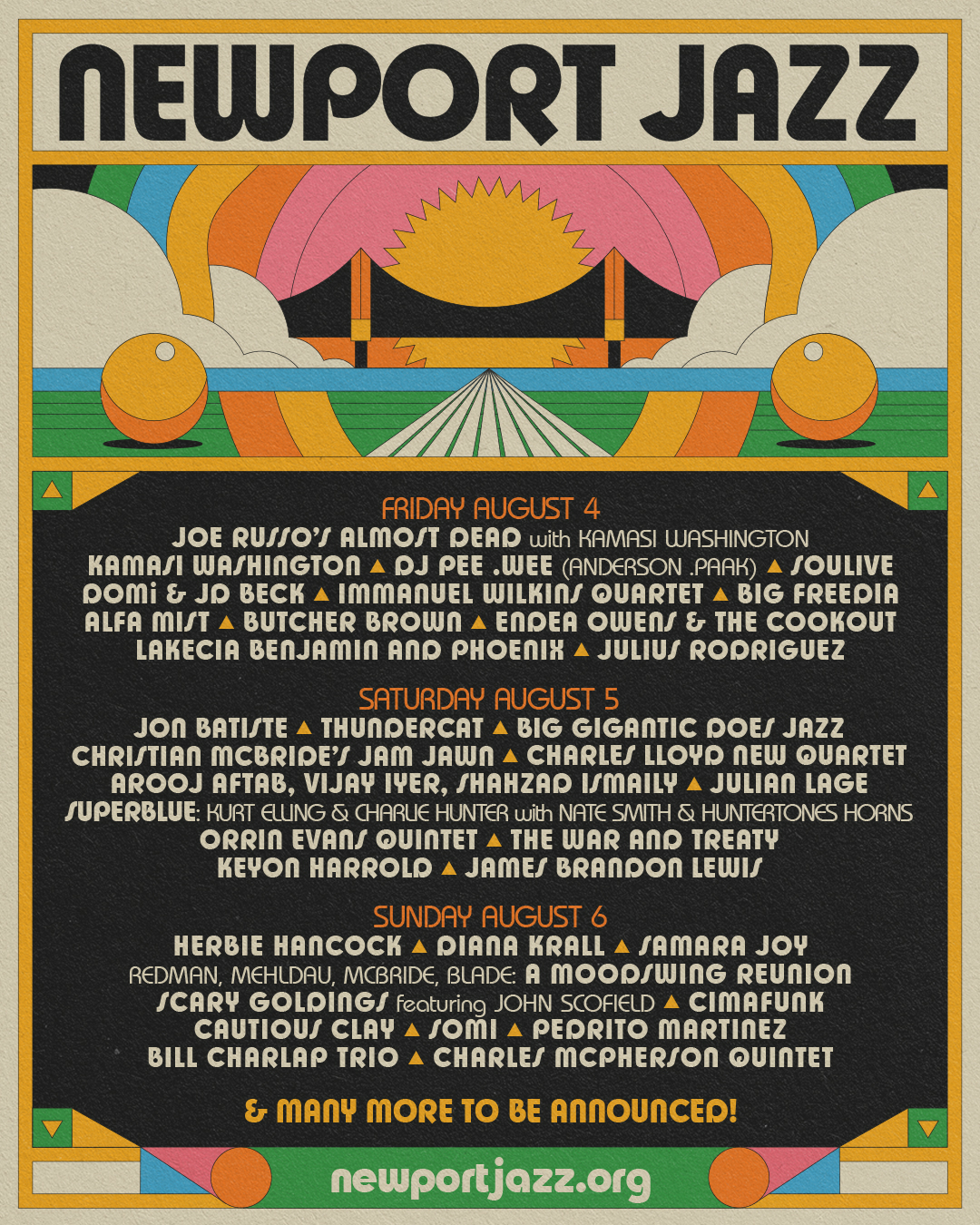
Summer Festival season is coming, y’all! And that means festival announcements. So let’s get to it, right? 

Newport Jazz Festival will be returning to Rhode Island’s Fort Adams State Park for its 69th edition. This year’s edition will continue the festival’s long-held tradition of hosting once in a lifetime performances that can only come as a result of Newport’s unique alchemy of intimacy and artistic community. 

The 69th Edition will take place August 4, 2023 – August 6, 2023 and will feature an eclectic and acclaimed lineup of artists including the legendary Herbie HancockDiana KrallCharles LloydVijay IyerJon Batiste, and Kamasi Washington, as well as a collection of Grammy-nominated and-winning artists including Samara JoyDOMi and JD Beck. The lineup also includes Big FreediaThundercatDJ Pee .Wee (a.k.a. Anderson .Paak), Big Gigantic, Alfa MistCautious ClayDurand Jones, and The War and Treaty

It’s an annual tradition for the festival to host special ensembles. And this year’s festival will include Newport Jazz artistic director Christian McBride’s annual Jam Dawn, MoodSwing, Scary Goldings featuring John ScofieldSuperblueOrrin Evans Quintet and the Bill Charlap Trio

With Memorial Day Weekend right around the corner, Newport Jazz Festival organizers announced some exciting new additions to the lineup that include JOVM mainstays The Soul Rebels featuring Rakim and Talib Kweli, Adi Oasis, Angel Bat Dawid & Tha Brothahood, Claudia Acuña, and more. A full list of the complete lineup is below.

3-day, 2-day and single-day tickets, as well as 3-day, 2-day and single-day parking passes are currently available through DICE. Full pricing is listed below. Children under 10 are free with a maximum of 2 children attending per ticketed adult. Children 10 and over will need to purchase a full priced admission ticket. For more information go to https://dice.fm/promoters/3gng

TICKET PRICING

3-Day Full Price General Admission: $281.19 (includes fees)

2-Day Saturday & Sunday General Admission: $193.64 (includes fees)

Single-Day General Admission: $100.94 (includes fees)

3-Day Parking: $69.01 (includes fees)

2-Day Parking: $46.35 (includes fees)

Single-Day Parking: $25.75 (includes fees)

NEWPORT JAZZ 2023 LINEUP

Friday

Joe Russo’s Almost Dead with Kamasi Washington

Kamasi Washington 

DJ Pee .Wee (Anderson .Paak)

Soulive  

DOMi & JD Beck

Immanuel Wilkins Quartet 

Big Freedia 

Alfa Mist 

Butcher Brown 

Endea Owens & The Cookout 

Lakecia Benjamin and Phoenix 

Julius Rodriguez 

Saturday 

Jon Batiste 

Thundercat 

Big Gigantic Does Jazz 

Christian McBride’s Jam Jawn 

Charles Lloyd New Quartet 

Arooj Aftab, Vijay Iyer, Shahzad Ismaily 

Julian Lage

Superblue: Kurt Elling & Charlie Hunter with Nate Smith & Huntertones Horns 

Orrin Evans Quintet

The War and Treaty 

Keyon Harrold 

James Brandon Lewis 

Sunday 

Herbie Hancock 

Diana Krall 

Samara Joy 

Redman, Mehldau, McBride, Blade: A Moodswing Reunion 

Scary Goldings featuring John Scofield 

Cimafunk

Cautious Clay 

Somi 

Pedrito Martinez 

Bill Charlap Trio

Charles McPherson Quintet

NEW ADDITIONS

The Soul Rebels featuring Rakim & Talib Kweli

Marcus Miller

Dave Holland New Quartet

Adi Oasis

Derrick Hodge

Armstrong Now: Louis at Newport

Angel Bat Dawid & Tha Brothahood

Bobby Watson All-Star Quintet

Jennifer Hartswick & Nick Cassarino Duo

Claudia Acuna

Melvis Santa & Jazz Orishas

Lauren Sevian’s LSQ

Camille Thurman with The Darrell Green Quartet

Matthew Whitaker

Ticket information is available here.

New Video: Acclaimed Inuk Artist Elisapie Shares a Gorgeous Adaptation OF Cyndi Lauper’s “Time After Time”

Acclaimed Montréal-based singer/songwriter, musician, actor and activist Elisapie Issac (best known as the mononymic Elisapie) was born and raised in Salluit, a small village in Nunavik, Québec’s northernmost region. In this extremely remote community, accessible only by plane, Issac was raised by an extended, yet slightly dysfunctional adoptive family. Growing up in Salliut, she lived through the loss of cousins who ended their lives. experienced young love, danced the night away at the village’s community center and witnessed first hand, the effects of colonialism — i.e., poverty, hopelessness, alcoholism, suicide, and more.

A teenaged Issac began performing on stage with her uncles, who were members of Sugluk (also known as Salliut Band), a famous and well-regarded Inuit rock band. She also worked at TNI, the village’s radio station, which broadcast across the region. And while working for the radio station, the teenaged Issac managed to secure an interview with Metallica.

Much like countless bright and ambitious young people across the world, Issac moved to the big city — in this case, Montréal to study and, ultimately, pursue a career in music. Since then, her work, whether within the confines of a band or as a solo artist, her unconditional attachment to her native territory, its people, and to her language, Inuktitut is at the core of her work. Spoken for millennia, Inuktitut embodies the harshness of its environment and the wild yet breathtaking beauty of the Inuit territory. Thematically, her work frequently pairs Intuit themes and concerns with modern rock music, mixing tradition with modernity in a deft fashion.

She won her first Juno Award as a member of Taima, and since then Issac’s work has received rapturous critical acclaim: 2018’s The Ballad of the Runaway Girl was shortlisted for the Polaris Music Prize, earned her a number of Association du disque, de l’industrie du spectacle Québeécois (ADISQ) Felix Awards and a Juno Award nod. She followed up with a performance with the Orchestre Métropolitain de Montréal — at the invitation of Grammy Award-winning maestro Yannick Nézet Séguin — at Central Park SummerStage, a NPR Tiny Desk Session and headlining or festival sets both locally and internationally.

In her native Canada, Issac is also known as an actor, starting in the TV series Motel Paradis and C.S. Roy’s experimental indie film VFC, which was released earlier this year. She’s also graced the cover of a number of nationally known magazines including Châtelaine, Elle Québec and a long list of others. And as a devoted activist, she created and produced the first nation-wide broadcast TV show to celebrate National Indigenous People’s Day.

Slated for a September 15, 2023 release through Bonsound, Issac’s forthcoming album Inuktiut features inventive re-imaginings of songs by Led Zeppelin, Pink Floyd, Blondie, Fleetwood Mac, Metallica and more. These are all acts and artists that the acclaimed Inuk artist received permission from. Elisapie has imbued each song with both depth and purpose, an act of cultural reappropriation that reinvigorates the poetry of these 10 classics by placing them within Inuit traditions. The album’s first single “Uummati Attanarsimat (Heart of Glass),” caught the attention of the legendary Debbie Harry.

The album’s second and latest single is a gorgeous and fairly faithful Inuktiut adaptation of Cyndi Lauper‘s 1983 Rob Hyman co-written smash hit “Time After Time” that retains the familiar beloved melody of the original paired with a percussive yet atmospheric arrangement and Issac’s gorgeous, achingly tender delivery.

Much like her previous single, “Taimangalimaaq (Time After Time)” was inspired by a childhood memory of Elisapie’s aunt Alasie and her cousin Susie:
 
“I was able to get through my pre-teen years, thanks to my Aunt Alasie, as my mother had neither the knowledge nor the experience to give me a crash course on puberty, fashion or social relationships,” Isaac recalls. “In addition to entering a new chapter in my life, we were in the midst of the 80’s and modernity was shaking up our traditional methods. My mother’s generation had lived in Igloos, and the cultural changes were too swift. 
 
Despite her struggles, my aunt ensured I felt accepted and exposed me to new and modern things like TV, clothes, dancing, Kraft Dinner and make-up! 
 
Whenever I went to my aunt’s house, I was in awe of my older girl cousins. They were all so cool and stylish, and they loved pop music and the crazy makeup of the 80s and early 90s.  One of my favorite memories is listening to the radio with them and hearing Cyndi Lauper’s ‘Time After Time’ for the first time. It was like a lightning bolt, and I couldn’t separate the song or the artist from my older cousin Susie. For me, the song was all about her search for beauty, connection, love, and rising above pain.”

Directed by Philippe Léonard and edited by Omar Elhamy, the accompanying video for “Taimangalimaaq (Time After Time)” features home video-shot footage of dances, performances and games at her beloved community center, of kids just being kids and a slow yet steady encroachment of modernity as we see at least one kid popping and locking like Crazylegzs or least trying to do so. The video is a lovingly nostalgic look at the acclaimed Inuk’s community and of her childhood, making the video a meditation on the passing of time, and in some way the impact of pop culture on a young person trying to find their place in a changing world.

New Audio: Altin Gün Shares Groovy “Su Siziyor”

Acclaimed Amsterdam-based Turkish psych pop outfit and JOVM mainstays Altin Gün — founder Jasper Verhulst (bass) with Ben Rider (guitar), Erdinç Ecevit Yildiz (keys, saz, vocals), Gino Groneveld (percussion), Merve Dasdemir (vocals, keys) and Nic Mauskovic (drums) — can trace their origins to Japser Verhulst’s repeated tour stops to Istanbul with a previous band, which led to a deep and abiding passion for ’60s and ’70s Turkish psych pop and folk, and fueled by music discoveries Verhlust couldn’t find in his native The Netherlands. 

Verhlust wasn’t just content to listen to the sounds he loved as an ardent fan; he had a vision of where he could potentially take that sound. “We do have a weak spot for the music of the late ’60s and ’70s,” Verhulst admitted in press notes. “With all the instruments and effects that arrived then, it was an exciting time. Everything was new, and it still feels fresh. We’re not trying to copy it, but these are the sounds we like and we’re trying to make them our own.” 

The Amsterdam-based JOVM mainstays’ sophomore album, 2020’s critically applauded,  Grammy Award-nominated Gece helped to further establish their reputation for re-imagining traditional Turkish folk through the lens of modern psych rock and psych pop. 

2021’s Yol, their third album, in three years, found the band continuing to draw from the rich and diverse traditions of Anatolian and Turkish folk but because of pandemic-related restrictions and lockdowns, the members of Altin Gün were forced to write in a completely new fashion for them: virtually — through the trading demos and ideas built around Omnichord808 and other elements, including field recordings and New Age-like ideas by email. “We were basically stuck at home for three months making home demos, with everybody adding their parts,” Altin Gün’s Merve Dasdemir explained in press notes. “The transnational feeling maybe comes from that process of swapping demos over the internet, some of the music we did in the studio, but lockdown meant we had to follow a different approach.”

The new songwriting approach, which featured arrangements built around Omnichord and 808s resulted in a bold, new sonic direction for the JOVM mainstays: sleek, synth-based retro-futuristic Europop with a dreamy quality, seemingly informed by an enforced period of uneasy reflection. Along with the change in sound and approach, Yol was the first album of the band’s growing catalog that saw them working with outside producers, Ghent, Belgium-based production duo Asa Moto — Oliver Geerts and Gilles Noë — to co-produce and mix the album.

Just before the acclaimed JOVM mainstays went on an extensive North American tour, which included a two-night run Music Hall of Williamsburg last year, they shared the two-song digital single “Badu Sabah Olmadan”/”Cips Kola Kilit.” Both songs originally appeared in some fashion or another on the previous year’s Bandcamp-only album Âlem.

  • “Badu Sabah Olmadon” may arguably be one of the harder rocking songs the Dutch JOVM mainstays have released in some time, featuring a relentless motorik groove, some scorching guitar work, glistening synths and yearning vocals. “‘Badİ Sabah Olmadan’ is a traditional love song from the town of Kırşehir, where the poet begs his lover to come to him before the night ends,” the band explains in press notes. “We recorded an electronic version for our charity album Âlem, and then started to play it live with the band. We liked it so much that we decided to record a live band version. Happy to play it for our fans this spring!”
  • “Clips Kola Kilit” is a dance floor friendly, decidedly 80s synth bop centered around 808-like beats, glistening synth washes and wobbling bass synth paired with a coquettish and sultrily delivered spoken word/rap-like vocal. For those children of the 80s — like me — “Clips Kola Kilit” brings back memories of acts like WhodiniThe Human LeagueNu ShoozCherelle, and others. And interestingly enough, it sound as though it could have been on Yol but was cut from the album.

Slated for a Friday release through ATO Records, Altin Gün’s highly-anticipated album, Aşk reportedly is a return to the ’70s Anatolian folk rock sound that characterized their first two groundbreaking albums while capturing the urgency and power of their famously propulsive live show. Recorded using vintage equipment and techniques, the album’s ten songs feature visionary new interpretations and readings of traditional Turkish folk tunes, revealing how these old, beloved songs remain eternally resonant and ripe for constant reinterpretation. 

“These songs have been covered so many times, always,” Altin Gün’s Merve Dasdemir says. ““But not really in psychedelic pop versions,” Jasper Verhulst adds. “It’s definitely connecting more with a live sound – almost like a live album. We, as a band, just going into a rehearsal space together and creating music together instead of demoing at home.”

Aşk will include:

  • The band’s dazzling reinvention of “Lelim Ley,” a classic song of lost love and exile, which features lyrics written by the late Turkish novelist, short-story writer, poet, and journalist Sabahattin Ali (1907–1948), taken from Ali’s 1937 short story “Ses.” Lelim Ley” was joined by music composed by Livaneli and released in 1975. Since then, the song has been lovingly embraced as one of the most well-known and beloved songs among Turkish people across the world. 
  • Rakiya Su Katamam” is a kaleidoscopic, space rock/psych rock-like take on the folk standard composed by Turkish writer/theologian Mustafa Öztürk, featuring a relentless motorik groove paired with wah-wah pedaled guitar, Dasdemir’s plaintive yet sultry delivery, and a scorching guitar solo paired with the band’s unerring knack for razor sharp hooks.

Aşk‘s latest single “Su Siziyor” is built around a sinuous and propulsive disco-tinged groove, Merve Dasdemir’s plaintive and yearning delivery paired with looping, glistening guitar and the JOVM mainstays unerring knack for crafting ridiculous hooks. And much like their previously released material, the new single manages to be simultaneously lysergic and wildly anachronistic.

Live Footage: Claritzel Miyares and Adrian Ghiardo Team Up to Cover Bad Bunny’s “Amorfoda”

Claritzel Miyares is a Cuban-Spanish singer/songwriter, who first made waves with a 2012 appearance on La Voz (the Spanish version of The Voice), where she impressed the show’s judges with a unique blend of traditional Cuban music, Reggaeton and modern pop. Since her appearance on La Voz, the Cuban-Spanish artist has been busy: She has spent the past few years touring across the world, her native Spain and the Canary Islands with a 10-to-11 member backing band.

Last year, the Cuban-Spanish artist celebrated her tenth anniversary as a musician and performer with the release of two singles last year:

  • “Te Equivocaste,” a single released to widespread acclaim.
  • “Vive Y Deja Vivir,” which derives its title from a familiar phrase in Spanish and English — live and let live. The song, which features a highly accomplished cast of collaborators including her brother, Grammy Award– winning Carlos Miyares (sax), Alejandro Delgado (trumpet), Eduardo Sandoval (trombone) and Carlos Reyes Compota (percussion). Naturally, the song is rooted in a much-needed message of peace, respect and understanding. “It really is an honour for me to collaborate with such impressive award winning musicians. I feel we have formed a dream team for this single and have produced a masterpiece with this record. The message is very important too,” Claritizel Miyares said in press notes at the time. “Most Cuban songs are about love and relationships but this has a much wider meaning. I want to encourage people to ‘live and let live’ and stop fighting about things in the world.”

Miyares closed out last year with a piano-led cover of Bad Bunny‘s “Amorfado” with master pianist and producer Adrián Ghiardo that retains the swagger and heartache of the original but paired with an old school pop/jazz feel and the Cuban-Spanish artist’s incredibly expressive and soulful delivery. While further continuing upon her unique blend of Cuban traditional music, pop and Reggaeton, Miyares’ rendition of the Bad Bunny hit is a perfect vehicle to introduce her soulful and expressive vocal to North American audiences.

New Video: Altin Gün Shares Kaleidoscopic Visual for Expansive and Anthemic “Rakiya Su Katamam”

Acclaimed Amsterdam-based Turkish psych pop outfit and JOVM mainstays Altin Gün — founder Jasper Verhulst (bass) with Ben Rider (guitar), Erdinç Ecevit Yildiz (keys, saz, vocals), Gino Groneveld (percussion), Merve Dasdemir (vocals, keys) and Nic Mauskovic (drums) — can trace their origins to Japser Verhulst’s repeated tour stops to Istanbul with a previous band, which led to a deep and abiding passion for ’60s and ’70s Turkish psych pop and folk, and fueled by music discoveries Verhlust couldn’t find in his native The Netherlands.

Verhlust wasn’t just content to listen to the sounds he loved as an ardent fan; he had a vision of where he could potentially take that sound. “We do have a weak spot for the music of the late ’60s and ’70s,” Verhulst admitted in press notes. “With all the instruments and effects that arrived then, it was an exciting time. Everything was new, and it still feels fresh. We’re not trying to copy it, but these are the sounds we like and we’re trying to make them our own.” 

The Amsterdam-based JOVM mainstays’ sophomore album, 2020’s critically applauded,  Grammy Award-nominated Gece helped to further establish their reputation for re-imagining traditional Turkish folk through the lens of modern psych rock and psych pop.

2021’s Yol, their third album, in three years, found the band continuing to draw from the rich and diverse traditions of Anatolian and Turkish folk but because of pandemic-related restrictions and lockdowns, the members of Altin Gün were forced to write in a completely new fashion for them: virtually — through the trading demos and ideas built around Omnichord808 and other elements, including field recordings and New Age-like ideas by email. “We were basically stuck at home for three months making home demos, with everybody adding their parts,” Altin Gün’s Merve Dasdemir explained in press notes. “The transnational feeling maybe comes from that process of swapping demos over the internet, some of the music we did in the studio, but lockdown meant we had to follow a different approach.”

The new songwriting approach, which featured arrangements built around Omnichord and 808s resulted in a bold, new sonic direction for the JOVM mainstays: sleek, synth-based retro-futuristic Europop with a dreamy quality, seemingly informed by an enforced period of uneasy reflection. Along with the change in sound and approach, Yol was the first album of the band’s growing catalog that saw them working with outside producers, Ghent, Belgium-based production duo Asa Moto — Oliver Geerts and Gilles Noë — to co-produce and mix the album.

Just before the acclaimed JOVM mainstays went on an extensive North American tour, which included a two-night run Music Hall of Williamsburg last year, they shared the two-song digital single “Badu Sabah Olmadan”/”Cips Kola Kilit.” Both songs originally appeared in some fashion or another on the previous year’s Bandcamp-only album Âlem.

  • “Badu Sabah Olmadon” may arguably be one of the harder rocking songs the Dutch JOVM mainstays have released in some time, featuring a relentless motorik groove, some scorching guitar work, glistening synths and yearning vocals. “‘Badİ Sabah Olmadan’ is a traditional love song from the town of Kırşehir, where the poet begs his lover to come to him before the night ends,” the band explains in press notes. “We recorded an electronic version for our charity album Âlem, and then started to play it live with the band. We liked it so much that we decided to record a live band version. Happy to play it for our fans this spring!”
  • “Clips Kola Kilit” is a dance floor friendly, decidedly 80s synth bop centered around 808-like beats, glistening synth washes and wobbling bass synth paired with a coquettish and sultrily delivered spoken word/rap-like vocal. For those children of the 80s — like me — “Clips Kola Kilit” brings back memories of acts like WhodiniThe Human LeagueNu ShoozCherelle, and others. And interestingly enough, it sound as though it could have been on Yol but was cut from the album.

Slated for a March 10, 2023 release through ATO Records, Altin Gün’s highly-anticipated album, Aşk reportedly is a return to the ’70s Anatolian folk rock sound that characterized their first groundbreaking albums while capturing the urgency and power of their famously propulsive live show. Recorded using vintage equipment and techniques, the album’s ten songs feature visionary new interpretations and readings of traditional Turkish folk tunes, revealing how these old, beloved songs remain eternally resonant and ripe for constant reinterpretation.

“These songs have been covered so many times, always,” Altin Gün’s Merve Dasdemir says. ““But not really in psychedelic pop versions,” Jasper Verhulst adds. “It’s definitely connecting more with a live sound – almost like a live album. We, as a band, just going into a rehearsal space together and creating music together instead of demoing at home.”

Aşk will include the band’s dazzling reinvention of “Lelim Ley,” a classic song of lost love and exile, which features lyrics written by the late Turkish novelist, short-story writer, poet, and journalist Sabahattin Ali (1907–1948), taken from Ali’s 1937 short story “Ses.” Lelim Ley” was joined by music composed by Livaneli and released in 1975. Since then, the song has been lovingly embraced as one of the most well-known and beloved songs among Turkish people across the world.

The forthcoming album’s latest single “Rakiya Su Katamam” is a kaleidoscopic, space rock/psych rock-like take on the folk standard composed by Turkish writer/theologian Mustafa Öztürk, featuring a relentless motorik groove paired with wah-wah pedaled guitar, Dasdemir’s plaintive yet sultry delivery, and a scorching guitar solo paired with the band’s unerring knack for razor sharp hooks.

Produced and directed by Sylvain Rusques and Simon Moreaux, the accompanying animated video features both line animation and collages of dancer Manon Colin dancing and running through two dimensional and three dimensional, kaleidoscopic realms. It’s fittingly mind-bending.

New Audio: King Canyon, A Supergroup Featuring Eric Krasno Shares Soulful Track with Son Little

King Canyon is a new supergroup featuring:

  • Eric Krasno, a a two-time Grammy winning, guitarist, producer and JOVM mainstay, best known for his work with Soulive, Lettuce, and Pretty Lights. Krasno has received seven Grammy nominations in the following categories: Best Blues Album, Best Contemporary Blues, Best R&B and Best Electronic Album.
  • Otis McDonald, a producer and multi-instrumentalist, best known for a large catalog that continues to be used in millions of videos across the Internet.
  • Mike Chiavaro, a Brooklyn-based electric and upright bassist, who has played with Richard Marx, Boy & Bear, and a lengthy list of others.

The trio can trace their collaboration back to April 2020: Krasno came across McDonalds music on Instagram and immediately became a fan. Months later, McDonald who had been woking on material with his longtime friend Chiavaro, enlisted Krasno to add some of his guitar to the mix. And before they knew it, the trio had an album’s worth of material rooted in classic R&B, funk and soul-tinged grooves, nostalgia, and a newfound friendship based in their mutual love for music.

For the creative process and the feel captured on the album are unlike any other project that these artists have been involved with previously. With each musician in a different location — Krasno in Los Angeles, McDonald in San Francisco and Chiavaro in Brooklyn — the band wrote and recorded material remotely while becoming arguably the highest band who never played a gig. “It was easy and fun. Exactly what it should be,” King Canyon’s Otis McDonald says. “It didn’t take long before we had a couple of albums’ worth of songs. Some tracks feature special guests and others showcase the power trio format. King Canyon is fresh and rooted in nostalgia.”

The trio’s self-titled, full-length debut is slated for a January 13, 2023 release through Mixto Records. The album will feature the trio collaborating with an impressive and eclectic array of guests including Tedeschi Trucks Band‘s Derek Trucks and Son Little. The trio have released two singles “Keep on Moving” and “Mulholland” that have received praise from the likes of Khraungbin, John Mayer, Black PumasAdrian Quesada, Live for Live Music, Jambands.com, and Relix.

The self-titled full-length debut album’s third and latest single “Ice & Fire” is an old-school soul and R&B-inspired strut centered around twinkling keys, an irresistible, funky groove and swinging, J. Dilla-inspired drumming paired with Son Little’s soulful yet plaintive vocal. Sonically, “Ice & Fire” brings a mix of JOVM mainstays Black Pumas and classic soul to mind — thanks to a dusty, old-timey feel with subtly modern production flourishes, and earnest performances.

“Son Little and I met a few years back at a festival. We had a lot of mutual respect for each other’s music and decided to start writing together,” Eric Krasno explains. “We instantly became tight as friends and frequent collaborators. Ice & Fire is a perfect mixture of the sounds of Son Little & King Canyon. Son’s lyrical imagery blends with the KC’s soundscape creating a unique and soulful sound.“

Live Footage: Larry & Joe Perform “Caballo Viejo”

Larry & Joe is a new duo that performs a fusion of Venezuelan and Appalachian folk music on harp, banjo, cautro, fiddle, maracas, guitar, upright bass and whatever else they decide to throw into the van. The duo features:

  • Joe Troop, a North Carolina-based Grammy-nominated bluegrass and old-time musician, who spent over a decade in South America with his acclaimed “latingrass” band Che Apalache. With the pandemic, Troop got stranded in his old stomping grounds and as a result, his primary project was forced into hiatus. Troop shifted into action, working with asylum seeking migrants.
  • Larry Bellorín, a Monagas, Venezuela-born, North Carolina-based Llanera music legend, and asylum seeking migrant. Bellorín works construction to makes ends meet, and writes and performs music in whatever spare time allowed.

Currently based in North Carolina’s Research Triangle, Troop and Bellorín are versatile multi-instrumentalists and singer/songwriters on a mission to prove that music has no borders, that music is the universal language. Their work is a distinct blend of their musical and cultural inheritances and traditions paired with storytelling about the ways that music and social movements coalesce.

The duo’s debut single is a subtle re-imagining of “Caaballo Viejo,” one of the most beloved and popular Venezuelan songs of all time. The song features the duo on their primary instruments: Bellorín on harp, Troop on banjo and vocals. While featuring a wildly different yet gorgeous arrangement, that gives the song a bluegrass twang, the Bellarín and Troop rendition is still centered around a timeless and deeply human heartache and longing that somehow effortlessly translates in every language.

The duo is playing a show at River Spirt Music, Hastings-on-Hudson, NY on January 28, 2023. For tickets and other information, check out the link: https://cliveshows.com/events/rsm-larry-joe/

New Audio: JOVM Mainstays Altin Gün Share Dazzling New Single

Deriving their name from the Turkish phase for “Golden Day,” the acclaimed Amsterdam-based Turkish psych pop act Altin Gün — founding member Jasper Verhulst (bass) with Ben Rider (guitar), Erdinç Ecevit Yildiz (keys, saz, vocals), Gino Groneveld (percussion), Merve Dasdemir (vocals) and Nic Mauskovic (drums) — can trace their origins to Japser Verhulst’s repeated tour stops to Istanbul with a previous band, and his deep and abiding passion for ’60s and ’70s Turkish psych pop and folk, fueled by discoveries Verhulst couldn’t find in his native Holland. 

But as the story goes, Verhulst wasn’t just content to listen as an ardent fan; he had a vision of where he could potentially take the sound he loved. “We do have a weak spot for the music of the late ’60s and ’70s,” Verhulst admitted in press notes. “With all the instruments and effects that arrived then, it was an exciting time. Everything was new, and it still feels fresh. We’re not trying to copy it, but these are the sounds we like and we’re trying to make them our own.” 

Altin Gün’s sophomore album, 2020’s Grammy Award-nominated, critically applauded Gece further established the band’s reputation for re-imagining traditional Turkish folk through the lens of psych rock and pop. Last year’s critically applauded Yol was the band’s third album in three years. And while the album found the band continuing to draw about the rich and diverse traditions of Turkish and Anatolian folk, pandemic-related restrictions and lockdowns forced the Dutch outfit to write music in a completely new way for them: virtually — through trading demos and ideas built around Omnichord808 and other elements, including field recordings and New Age-like ideas by email. 

“We were basically stuck at home for three months making home demos, with everybody adding their parts,” Altin Gün’s Merve Dasdemir says in press notes. “The transnational feeling maybe comes from that process of swapping demos over the internet, some of the music we did in the studio, but lockdown meant we had to follow a different approach.”

As a result of the new songwriting approach and arrangements prominently featuring Omnichord and 808, the album saw the band crafting material that was a bold, new sonic direction: sleek, synth-based, retro-futuristic Europop with a dreamy quality, seemingly informed by the enforced period of reflection.

Additionally, the members of the acclaimed Dutch act, enlisted Ghent, Belgium-based production duo Asa Moto — Oliver Geerts and Gilles Noë — to co-produce and mix the album, marking the first time that the band has collaborated with outsiders. 

The JOVM mainstays spent much of this year on the road, including a two-night run at Music Hall of Williamsburg earlier this year. (I was there for the first night of their two night run.) Just before they hit the road, the acclaimed Turkish psych outfit released a two song digital single “Badu Sabah Olmadan”/”Cips Kola Kilit.” Both songs originally appeared in some fashion or another on last summer’s Bandcamp-only album Âlem.

“Badu Sabah Olmadon” may arguably be one of the harder rocking songs the Dutch JOVM mainstays have released in some time, featuring a relentless motorik groove, some scorching guitar work, glistening synths and yearning vocals. 

“‘Badİ Sabah Olmadan’ is a traditional love song from the town of Kırşehir, where the poet begs his lover to come to him before the night ends,” the band explains in press notes. “We recorded an electronic version for our charity album Âlem, and then started to play it live with the band. We liked it so much that we decided to record a live band version. Happy to play it for our fans this spring!”

“Clips Kola Kilit” is a dance floor friendly, decidedly 80s synth bop centered around 808-like beats, glistening synth washes and wobbling bass synth paired with a coquettish and sultrily delivered spoken word/rap-like vocal. For those children of the 80s — like me — “Clips Kola Kilit” brings back memories of acts like WhodiniThe Human LeagueNu ShoozCherelle, and others. And interestingly enough, it sounds as though it could have been on Yol but was cut from the album.

Altin Gün’s latest single “Leylim Ley” is a classic song of lost love and exile that features music composed by renowned Turkish musician, author, poet and politician Zülfü Livaneli and lyrics written by the late Turkish novelist, short-story writer, poet, and journalist Sabahattin Ali (1907–1948). Although Ali’s life was cut tragically and brutally short, Ali occupies an important spot in modern Turkish work with his limited body of work frequently reimagined through music, theater and more.

Taken from Ali’s 1937 short story “Ses,” “Leylim Ley” was joined by music composed by Livaneli back in 1975 and has since been embraced as one of the most well-known and beloved songs among Turkish people across the globe. Understandably, it’s been covered countless times over — and in a wild variety of styles.

Altin Gün’s rendition of the classic song is far more stripped down than some more recent renditions and sees the band pulling out the hypnotic and dazzling instrumentation to the forefront, emphasizing a woozy, heartsick longing — for home and for loved ones. The recording manages to capture the propulsive energy of their live show, while heralding the arrival of the band’s highly-anticipated fourth album, which is slated for release sometime next year.

New Video: Danger Mouse and Black Thought’s Posthumous Team Up with MF DOOM

Danger Mouse (born Brian Burton) is arguably one of the most versatile and prolific artists and producers in music right now: As an artist he has been one-half of Broken Bells and Grammy Award-winning Gnarls Barkley. As a producer, he has recorded collaborative albums with  Yeah Yeah Yeahs‘ Karen O and the late, legendary MF DOOM. And he has worked with AdeleU2The Black KeysGorillazRed Hot Chili PeppersMichael KiwanukaParquet Courts and a lengthy list of others. 

Black Thought (born Tariq Trotter) is a co-founder and frontman of Grammy Award winning, pioneering hip-hop act The Roots. Trotter is also an accomplished solo artist who has released a critically applauded album and two EPs: 2020’s Streams of Thought Vol. 3: Cane & Able and 2018’s Streams of Thought Vol. 1 EP and Streams of Thought Vol. 2 EP, which helped further his reputation among the cognoscenti — and real hip hop heads — as one of the dopest emcees to ever spit bars. Adding to a lengthy list of accolades and accomplishments, Trotter has acted in film and theater, along with having writing and producer credits.

The acclaimed duo’s long-rumored, long-awaited and highly-anticipated joint album Cheat Codes was released earlier this year through BMG. While Cheat Codes simultaneously marks Danger Mouse’s first hip-hop album since 2005’s DANGERDOOM with MF DOOM and the follow-up to Black Thoughts’ solo trilogy Streams of Thought, their collaboration can be traced back almost almost 20 years earlier: Trotter and Burton first met back in 2005. They started working on material — but time went on, life happened, other projects and obligations came up. 

Following 2004’s acclaimed The Grey Album, Burton became one of the most in-demand and prolific producers of the day, helming several commercially and critically successful projects, which led to a bevy of accolades and awards. He also developed collaborations with a unique and eclectic array of artists while expanding upon and honing his own musicianship, production and writing. 

During that same period of time, The Roots released a batch of critically applauded albums and became the house band for Late Night with Jimmy Fallon then The Tonight Show Starring Jimmy Fallon. Trotter released his aforementioned, critically applauded solo trilogy Streams of Thought. He collaborated with the likes of EminemJohn LegendPusha T.Griselda, and a list of others. He wrote, composed and starred in the widely-praised off-Broadway show Black No More. And adding to a lengthy list of accomplishments, he co-produced a TV series with his Roots bandmate Questlove

Each mistakenly thought that the other had moved on and their collaboration just died, but as it turned out, neither one never stopped wanting to work together. Burton had long felt an instinctive need to return to his roots and make a timeless hip-hop album. He knew that Trotter was one of the few emcees truly capable of fulfilling that vision. Simultaneously, Trotter was seeking a space, where he could express himself musically and creatively beyond the confines and structures of his own band. 

This time, Burton was a far more seasoned songwriter and producer, Trotter an even more extraordinary emcee.  So, setting aside all distractions, Burton played Trotter some new music he had had. The ideas and words quickly flowed — and the experience was liberating. 

Meticulously built over a period of several years, Cheat Codes finds Burton pushing widescreen, soul-infused hip-hop soundscapes to new directions paired with Trotter’s commanding presence, incisive lyricism and dexterous wordplay. Unlike the typical producer-meets-rapper/side project, Cheat Codes is an effort between two like-minded collaborators, who raise each other’s games to new heights. 

The album also features an equally acclaimed cast of guests including A$AP Rocky, Run The Jewels, MF DOOM, Michael Kiwanuka, Joey Bada$$RussRaekwon, and Conway the Machine

In the lead up to Cheat Codes‘ release, I managed to write about three of the album’s singles:  

  • No Gold Teeth,” which featured a warm and dusty psych soul-like production that brings RZAPete Rock, and DJ Premier to mind, that serves as a lush bed for Black Thought’s dense, rapid fire, lyrical deluge. 
  • Because,” which features a slow-burning, psych soul-inspired production paired with a vocal hook by Dylan Cartlidge. While being another example of the deep and uncannily innate simpatico shared between the two acclaimed collaborators, “Because” is chock full of dope bars, impressive wordplay and mind-blowing inner and outer rhyme schemes in an easy-going yet urgent cypher between Black Thought, Joey Bada$$ and Russ, that weaves in and out of the political and the personal. 
  • Aquamarine,” a woozy and cinematic song featuring skittering hi-hat, thumping beats and squiggling bursts paired with a soaring hook from acclaimed British soul artist Micheal Kiwanuka. The production is a lush and roomy bed for Black Thought’s imitable, hard-hitting bars. “For ‘Aquamarine,’ when I heard the music I just had a feeling to sing about standing up for something that’s unique and following that path”, Kiwanuka says. “I don’t know why but that’s what came out.  Sometimes when you’re following something that’s unique to you it’s as if ‘enemies are all around’. At times life can feel fragile like ‘everything’s burning down’. For some reason the chords and music made me feel that way.”  
  • Strangers,” a neck-snapping banger featuring four of the game’s dopest emcees right no — Black Thought, A$AP Rocky, Killer Mike and El-P spitting flames on a woozy and dusty production paired with tweeter and woofer rattling beats, sampled B-movie dialogue and soulful vocal samples.

The album’s latest single “Belize” finds Danger Mouse crafting a woozily cinematic soundscape featuring warm and soulful brass, a driving and hypnotic bas line paired with twinkling and reverb-drenched keys and an equally soulful vocal sample. The production is complex yet flexible enough to accommodate Black Thought’s razor sharp and precise bars and MF DOOM’s loose, almost conversational flow.

“Belize” much like the album’s other singles is an example of the power and creativity of like-minded collaborators pushing each other — and their respective work in brilliant, new directions. But it’s also a powerful reminder that the legendary artists never really die.

Shot in a gorgeously cinematic black and white, the accompanying video features Black Thought in a sparsely arranged, old office space with a spotlight. The camera pulls back to reveal Danger Mouse in shadow, shooting his friend and collaborator. When DOOM starts his verses, Danger Mouse puts the camera on a tripod, so that he could pay his respects to the late legend.

New Video: Seattle’s High Pulp Shares Surreal and Symbolic Visual for “You’ve Got to Pull It Up From The Ground” feat. Theo Croker

Seattle-based jazz outfit High Pulp features:

  • Antoine Martel (keys, synths), a self-professed mad scientist with a wall of modular synthesizers and a passion for film scores and abstract soundscapes
  • Rob Homan (keys), whose innate ability to process, deconstruct and reassemble material on the fly bordered on the impressive and scary
  • Scott Rixon (bass), who comes from a punk and hardcore background and possesses pop sensibilities
  • Victor Nguyen (tenor sax), a Pharaoh Sanders acolyte with an ear for urgent, entrancing solos
  • Andrew Morrill (alto sax), whose bold tones and fearless harmonic sensibilities earned him a reputation for pushing the old school into the 21st Century
  • Bobby Granfelt (drums), whose hip-hop and bebop-inspired drumming laid the rhythmic foundation for the entire project

High Pulp can trace their origins to a loose, weekly jam session at Seattle’s historic Royal Room. “When you put us all together, our sound isn’t so much a fusion as it is a synthesis,” the band’s Bobby Granfelt says in press notes. ““There’s a lot of different personalities coming from a lot of different places, and we use it all as fuel to create something that’s totally our own.”

The Seattle sextet’s latest album Pursuit of Ends is slated for a Friday release through Anti- Records. The band’s unique brand of experimental jazz is simultaneously vintage and futuristic, often hinting at Miles Davis, Duke Ellington, Aphex Twin and My Bloody Valentine and a wide range of others. The album’s material sees the band carefully balancing meticulous composition with visceral spontaneity and centered around virtuosic performances.

While High Pulp is primarily centered around their core six, Pursuit of Ends sees the band making judicious use of a board network of collaborators with guest spots from Jaleel Shaw (sax), who has played with Roy Haynes and Mingus Big Band; Brandee Younger (harp), who has played with Ravi Coltrane, The Roots, and Makaya McCraven; Grammy-nominated Theo Croker (trumpet); Jacob Mann (keys), who has played with Rufus Wainright and Louis Cole to help push their sonic boundaries even further.

Pursuit of Ends‘ latest single “You’ve Got To Pull It Up From The Ground” is a mind-bending and incredibly slick synthesis of bop, jazz fusion, funk and hip hop. The composition begins with an extensive bop jazz-inspired, drum solo. The song then quickly moves to a section featuring rapid fire percussion paired with sinuous bass lines, twinkling keys and a mournful, modal horn line led by Theo Croker’s expressive Miles Davis-like playing. Throughout the rest of the song, the melody floats and dances through the instrumentation. While the material is rooted in precise performance of the written composition, there’s ample room for soulful, free-flowing improvisation among a collection of sensitive and thoughtful artists.

“During COVID we spent a lot of time listen to Miles Davis’ Second Quintet, and specifically the drum solo at the start was inspired by ‘Agitation’ off of E.S.P.,” Granfelt explains “There’s something about that quintet that is so awe-inspiring. I think it’s the way they have such a deep shared concept which allows them to improvise in a meaningful way.”

“Pull It Up” is really a concept that is at the core of the band,” Granfelt explains. “It’s sort of about magic, sort of about will, sort of about self-love. It’s a concept based in the idea that things are already where they need to be, and it’s about unearthing what is already there as opposed to creating something ‘new’.”

Directed by Isaac Calvin and Seth Calvin, the accompanying video draws on the song’s overarching theme of digging deep, being persistent and staying humble. The video features Granfelt doing useful but mundane tasks: pulling nails out of a board, washing dishes, tying knots and so on. Towards the end f the video, Granfelt builds a shrine, but the offerings aren’t high quality of expensive; rather, they’re scuffed up, well-worn items including roadside flowers, cigarette butts, trinkets, tchotchkes and knick-knacks.

New Video: Danger Mouse and Black Thought Team Up with A$AP Rocky and Run The Jewels on a Glitchy Roller Coaster Visual for “Strangers”

Danger Mouse (born Brian Burton) is arguably one of the most versatile and prolific artists and producers in music right now: As an artist he has been one-half of Broken Bells and Grammy Award-winning Gnarls Barkley. He has recorded collaborative albums with  Yeah Yeah Yeahs‘ Karen O and the late, legendary MF DOOM. As a producer, he has worked with AdeleU2The Black KeysGorillazRed Hot Chili PeppersMichael KiwanukaParquet Courts and a lengthy list of others. 

Black Thought (born Tariq Trotter) is a co-founder and frontman of Grammy Award winning, pioneering hip-hop act The Roots. Trotter is also an accomplished solo artist who has released a critically applauded album and two EPs: 2020’s Streams of Thought Vol. 3: Cane & Able and 2018’s Streams of Thought Vol. 1 EP and Streams of Thought Vol. 2 EP, which helped further his reputation among the cognoscenti — and real hip hop heads — as one of the dopest emcees to ever spit bars. Adding to a lengthy list of accolades and accomplishments, Trotter has acted in film and theater, along with having writing and producer credits.

The acclaimed duo’s long-rumored, long-awaited and highly-anticipated joint album Cheat Codes officially dropped today through BMG. While Cheat Codes simultaneously marks Danger Mouse’s first hip-hop album since 2005’s DANGERDOOM with MF DOOM and the follow-up to Black Thoughts’ solo trilogy Streams of Thought, their collaboration can be traced back almost almost 20 years earlier: Trotter and Burton first met back in 2005. They started working on material — but time went on, life happened, other projects and obligations came up. 

Following 2004’s acclaimed The Grey Album, Burton became one of the most in-demand and prolific producers of the day, helming several commercially and critically successful projects, which led to a bevy of accolades and awards. He also developed collaborations with a unique and eclectic array of artists while expanding upon and honing his own musicianship, production and writing. 

During that same period of time, The Roots released a batch of critically applauded albums and became the house band for Late Night with Jimmy Fallon then The Tonight Show Starring Jimmy Fallon. Trotter released his aforementioned, critically applauded solo trilogy Streams of Thought. He collaborated with the likes of EminemJohn LegendPusha T.Griselda, and a list of others. He wrote, composed and starred in the widely-praised off-Broadway show Black No More. And adding to a lengthy list of accomplishments, he co-produced a TV series with his Roots bandmate Questlove

Each mistakenly thought that the other had moved on and their collaboration just died, but as it turned out, neither one never stopped wanting to work together. Burton had long felt an instinctive need to return to his roots and make a timeless hip-hop album. He knew that Trotter was one of the few emcees truly capable of fulfilling that vision. Simultaneously, Trotter was seeking a space, where he could express himself musically and creatively beyond the confines and structures of his own band. 

This time, Burton was a far more seasoned songwriter and producer, Trotter an even more extraordinary emcee.  So, setting aside all distractions, Burton played Trotter some new music he had had. The ideas and words quickly flowed — and the experience was liberating. 

Meticulously built over a period of several years, Cheat Codes finds Burton pushing widescreen, soul-infused hip-hop soundscapes to new directions paired with Trotter’s commanding presence, incisive lyricism and dexterous wordplay. Unlike the typical producer-meets-rapper/side project, Cheat Codes is an effort between two like-minded collaborators, who raise each other’s games to new heights. 

The album also features an equally acclaimed cast of guests including A$AP Rocky,Run The Jewels, MF DOOM, Michael Kiwanuka, Joey Bada$$RussRaekwon, and Conway the Machine

So far I’ve written about three Cheat Codes singles: 

No Gold Teeth,” which featured a warm and dusty psych soul-like production that brings RZAPete Rock, and DJ Premier to mind, that serves as a lush bed for Black Thought’s dense, rapid fire, lyrical deluge. 

Because,” which features a slow-burning, psych soul-inspired production paired with a vocal hook by Dylan Cartlidge. While being another example of the deep and uncannily innate simpatico shared between the two acclaimed collaborators, “Because” is chock full of dope bars, impressive wordplay and mind-blowing inner and outer rhyme schemes in an easy-going yet urgent cypher between Black Thought, Joey Bada$$ and Russ, that weaves in and out of the political and the personal. 

Aquamarine,” a woozy and cinematic song featuring skittering hi-hat, thumping beats and squiggling bursts paired with a soaring hook from acclaimed British soul artist Micheal Kiwanuka. The production is a lush and roomy bed for Black Thought’s imitable, hard-hitting bars. “For ‘Aquamarine,’ when I heard the music I just had a feeling to sing about standing up for something that’s unique and following that path”, Kiwanuka says. “I don’t know why but that’s what came out.  Sometimes when you’re following something that’s unique to you it’s as if ‘enemies are all around’. At times life can feel fragile like ‘everything’s burning down’. For some reason the chords and music made me feel that way.”  

“Strangers,” the last single off Cheat Codes before its release, is a neck-snapping banger featuring four of the dopest emcees out there right now — Black Thought, A$AP Rocky and Run The Jewels spitting flames on a woozy and dusty production and glitchy centered around tweeter and woofer rattling beats, sampled, B-movie-like dialogue, soulful vocals. 

“We were honored to get down with our elite and legendary friends Danger Mouse, Black Thought and A$AP Rocky on this banger,” Run the Jewels say in press notes. 

I’ve said this before, and I’m not bullshitting here: Cheat Codes may arguably be the best hip-hop album — and possibly, the best album — of this year. I can’t wait to get my hands on a copy.

Continuing the duo’s ongoing visual collaboration with video production team UNCANNY, the accompanying, grainy black and white visual is a wild rollercoaster ride that sees each of the song’s four incredible emcees, Black Thought, A$AP Rocky, Killer Mike, and El-P passing the mic — or in this case their phones for them to spit fire. The video captures the song’s urgency and dusty glitchy vibe.

Danger Mouse (born Brian Burton) is arguably one of the most versatile and prolific artists and producers in music right now: As an artist he has been one-half of Broken Bells and Grammy Award-winning Gnarls Barkley. He has recorded collaborative albums with  Yeah Yeah Yeahs‘ Karen O and the late, legendary MF DOOM. As a producer, he has worked with AdeleU2The Black KeysGorillazRed Hot Chili PeppersMichael KiwanukaParquet Courts and a lengthy list of others. 

Black Thought (born Tariq Trotter) is a co-founder and frontman of Grammy Award winning, pioneering hip-hop act The Roots. Trotter is also an accomplished solo artist who has released a critically applauded album and two EPs: 2020’s Streams of Thought Vol. 3: Cane & Able and 2018’s Streams of Thought Vol. 1 EP and Streams of Thought Vol. 2 EP, which helped further his reputation among the cognoscenti — and real hip hop heads — as one of the dopest emcees to ever spit bars. Adding to a lengthy list of accolades and accomplishments, Trotter has acted in film and theater, along with having writing and producer credits.

The acclaimed duo’s long-rumored, long-awaited and highly-anticipated joint album Cheat Codes is slated for a Friday release through BMG. While Cheat Codes simultaneously marks Danger Mouse’s first hip-hop album since 2005’s DANGERDOOM with MF DOOM and the follow-up to Black Thoughts’ solo trilogy Streams of Thought, their collaboration can be traced back almost almost 20 years earlier: Trotter and Burton first met back in 2005. They started working on material — but time went on, life happened, other projects and obligations came up. 

Following 2004’s acclaimed The Grey Album, Burton became one of the most in-demand and prolific producers of the day, helming several commercially and critically successful projects, which led to a bevy of accolades and awards. He also developed collaborations with a unique and eclectic array of artists while expanding upon and honing his own musicianship, production and writing. 

During that same period of time, The Roots released a batch of critically applauded albums and became the house band for Late Night with Jimmy Fallon then The Tonight Show Starring Jimmy Fallon. Trotter released his aforementioned, critically applauded solo trilogy Streams of Thought. He collaborated with the likes of EminemJohn LegendPusha T.Griselda, and a list of others. He wrote, composed and starred in the widely-praised off-Broadway show Black No More. And adding to a lengthy list of accomplishments, he co-produced a TV series with his Roots bandmate Questlove

Each mistakenly thought that the other had moved on and their collaboration just died, but as it turned out, neither one never stopped wanting to work together. Burton had long felt an instinctive need to return to his roots and make a timeless hip-hop album. He knew that Trotter was one of the few emcees truly capable of fulfilling that vision. Simultaneously, Trotter was seeking a space, where he could express himself musically and creatively beyond the confines and structures of his own band. 

This time, Burton was a far more seasoned songwriter and producer, Trotter an even more extraordinary emcee.  So, setting aside all distractions, Burton played Trotter some new music he had had. The ideas and words quickly flowed — and the experience was liberating. 

Meticulously built over a period of several years, Cheat Codes reportedly finds Burton pushing widescreen, soul-infused hip-hop soundscapes to new directions paired with Trotter’s commanding presence, incisive lyricism and dexterous wordplay. Unlike the typical producer-meets-rapper/side project, Cheat Codes is an effort between two like-minded collaborators, who raise each other’s games to new heights. 

The album also features an equally acclaimed cast of guests including A$AP Rocky, Run The Jewels, MF DOOM, Michael Kiwanuka, Joey Bada$$RussRaekwon, and Conway the Machine

So far I’ve written about three Cheat Codes singles: 

No Gold Teeth,” which featured a warm and dusty psych soul-like production that brings RZAPete Rock, and DJ Premier to mind, that serves as a lush bed for Black Thought’s dense, rapid fire, lyrical deluge. 

Because,” which features a slow-burning, psych soul-inspired production paired with a vocal hook by Dylan Cartlidge. While being another example of the deep and uncannily innate simpatico shared between the two acclaimed collaborators, “Because” is chock full of dope bars, impressive wordplay and mind-blowing inner and outer rhyme schemes in an easy-going yet urgent cypher between Black Thought, Joey Bada$$ and Russ, that weaves in and out of the political and the personal. 

Aquamarine,” a woozy and cinematic song featuring skittering hi-hat, thumping beats and squiggling bursts paired with a soaring hook from acclaimed British soul artist Micheal Kiwanuka. The production is a lush and roomy bed for Black Thought’s imitable, hard-hitting bars. “For ‘Aquamarine,’ when I heard the music I just had a feeling to sing about standing up for something that’s unique and following that path”, Kiwanuka says. “I don’t know why but that’s what came out.  Sometimes when you’re following something that’s unique to you it’s as if ‘enemies are all around’. At times life can feel fragile like ‘everything’s burning down’. For some reason the chords and music made me feel that way.”  

“Strangers,” the last single off Cheat Codes before its release, is a neck-snapping banger featuring four of the dopest emcees out there right now — Black Thought, A$AP Rocky and Run The Jewels spitting flames on a woozy and dusty production and glitchy centered around tweeter and woofer rattling beats, sampled, B-movie-like dialogue, soulful vocals.

“We were honored to get down with our elite and legendary friends Danger Mouse, Black Thought and A$AP Rocky on this banger,” Run the Jewels say in press notes.

I’ve said this before, and I’m not bullshitting here: Cheat Codes may arguably be the best hip-hop album — and possibly, the best album — of this year. I can’t wait to get my hands on a copy.