Tag: Montreal QC

New Video: No Joy’s Jasamine White-Gluz and Sonic Boom (a.k.a. Spacemen 3’s, Spectrum’s. and E.A.R.’s Pete Kember) Team Up For a Disco-Inspired Psych Pop Track

he band quickly signed to renowned indie label Mexican Summer, who released their debut 7 inch single “No Summer”/”No Joy,” an effort that allowed them to book their own national headlining tour with Katy Goodman and her project, La Sera. The 7 inch quickly sold out, and by November 2010, the duo released their full-length debut Ghost Blonde to critical praise from the likes of Pitchfork, AllMusic.com, The New York Times, Brooklyn Vegan, The Guardian and others. Building upon a growing profile, the duo released the “Hawaii” 7 inch in the UK,  a release that featured a remix of “Indigo Child” done by Stereolab’s Time Gane — and unsurprisingly, the members of No Joy toured the UK with Surfer Blood, which was promptly followed with a London show opening for Wire, and an appearance at Barcelona’s Primavera Sound Festival.
The rest of 2011 saw the band touring North America — and it included a busy SXSW appearance schedule, a tour with Vivian Girls and a co-headlining tour with Marnie Stern with whom they released a split single, which featured No Joy’s cover of the Shangri-La’s “He Cried.”
Since then, the band has released 2012’s Negaverse EP and Wait to Pleasure, 2013’s Pastel and Pass Out EP, 2015’s More Faithful, 2016’s Drool Sucker, the first of a planned series of EPs and last year’s Creep, which was released through the band’s new label Grey Market Records.  Interestingly, 2018 founds No Joy’s primary songwriter and founding member Jasamine White-Gluze collaborating with Pete Kember, a.k.a. Sonic Boom. who’s best known for his work with Spacemen 3, Spectrum and E.A.R. And although White-Gluz and Kember can’t accurately remember how they met, what the duo does recall that they first brought up the idea of working together in an email exchange in 2015. At the time, No writJoy had just finishing touring to support their third, full-length effort More Faithful, one of their hardest efforts to date, and White-Gluz was eager to try new ideas and do something different. “No Joy functioned as a four-piece ‘rock band’ for so long,” White-Gluz explains in press notes. “I wanted to pursue something solo where I collaborated with someone else who could help me approach my songs from a completely different angle. Pete is a legend and someone I’ve admired for a long time. Being able to work with him on this was incredible.”

Initially, the collaboration began as a bit of exploration between two friends, who admired each other’s work with each one passing songs back and and forth with White-Gluz writing and producing songs in her hometown of Montreal and Kember writing, arranging and producing in Portugal. The end result was their collaborative EP together — four tracks that reportedly walk the tightrope between electronica, trip hop and experimental noise.  As White-Gluz says in press notes, “I wrote some songs that were intended for a full band and handed them off to Pete, who helped transform them. I barely knew how to use MIDI so I was just throwing him these experiments I was working on and he fine-tuned my ideas. There are barely any guitars on this album, because I was focused on trying to find new ways to create sounds.”

The EP’s first single “Obsession” pairs White-Gluz’s ethereal vocals with layers of Giorgio Moroder meets Evil Heat-era Primal Scream -like undulating synths in an expansive song structure that allows the duo to display their uncanny ability to craft a mesmerizing, trance-like groove. The recently released video filmed by Nuno Jardim, featuring video synthesis by Sonic Boom ad starring Samantha Tyson manages to further emphasize the trippy and trance-like vibes of the song as it features wobbling visuals, neon bright colors, flashing lights and colors in the background and so on.
 

Initially releasing singles like “Seeing Is Forgetting” and “Half-Empy Happiness” under the intentional cloak of mystery, the Montreal-based DJ, production and electronic music artist duo The Beat Escape quickly received attention across the blogosphere for crafting moody and atmospheric pop that’s deeply indebted to 80s synth pop — i.e., Depeche Mode, The Human League and others —  while evoking the sensation of a half-remembered dream.

However, with the forthcoming release of their highly-anticipated full-length debut, Life Is Short The Answer’s Long through Bella Union Records on April 27, 2018, the Canadian pop duo have removed some of the mystery surrounding them; in fact, the duo comprised of Addy Weitzman and Patrick A Boivin can trace the origins of The Beat Escape to a college short film they had collaborated on together. “We made a short oddball work; a video piece that followed two characters through a psychedelic waking dream,” the Canadian pop duo explain in press note. And since that initial collaboration, the duo have collaborated on a series of projects — but interestingly, their full-length Beat Escape debut finds them thematically speaking coming full-circle while further developing the sound that grabbed the attention of the blogosphere and elsewhere.

Interestingly, the album’s first single “Sign of Age” pairs a propulsive and undulating Giorgio Moroder meets motorik groove with a deliberately, almost painterly and textured quality that makes the song feel as though it’s gently drifting along. And in some way, the song will further their reputation for crafting pop that evokes being roused from some half-remembered dream; but unlike their previously released material, the duo balances this with a melancholy and spectral minimalism.


Adrian Underhill is a Vancouver, British Columbia-born, Toronto, Ontario-based singer/songwriter, who has a number of stints in indie rock bands in Vancouver, Montreal and Toronto, before the low-key release of his solo debut EP in 2012; however, sometime after that, Underhill completely revamped his songwriting process, employing keyboards, synths and drum machines, which found him gravitating towards a slinky R&B-inspired pop sound but paired with a simple and very direct, earnest lyricism.

Describing the writing process for forthcoming album, CU Again, Underhill says “I sat with a keyboard and one drum machine and tried not play much with production ideas. The tunes have a classic, 70s songwriter vibe, even though we ultimately pushed the production into a very different realm. This simple, direct way of songwriting is me at my best.”

The recording sessions for CU Again found the up-and-coming Canadian singer/songwriter collaborating with British electronic production Kindness (also known as Adam Bainbridge), best known for his work with Robyn, Solange and Blood Orange with the renowned producer and Underhill working on electronic elements in Montreal before they went to Los Angeles for at three-day session with a live, funk supergroup that included JOVM mainstay Dam-Funk (drums) Keith Eaddy (bass) and Brandon Coleman (keys). And the end result finds the material being a seamless blend of Kindness’ electronic production with warm, organic instrumentation as you’ll hear on CU Again‘s swooning “Weather,” which pairs a looped and chopped keyboard sample with stuttering and skittering drum programming, arpeggiated synths and Underhill’s plaintive vocals singing lyrics on how time changes people and their moods, like the weather.  What makes the song interesting to me is that it walks a careful tightrope between sincerity and playfulness, familiarity and complete strangeness.
As Underhill adds, “On ‘Weather’, I love how the production came out. Adam (Bainbridge) took my original demo and just kinda warped it and morphed it, almost like a remix, adding new drums and changing the keyboard sounds I had played. Then we added the live piano and synth bass from Brandon Coleman (Kamasi Washington) and Keith Eaddy (DāM-FunK). In the end it’s quite playful and strange – it’s a great combination of sounds.”

New Video: Introducing the Dream-like Visuals and Sounds of Montreal Shoegazers Penny Diving

Currently comprised of twin sisters Chatntal Ambridge (vocals, guitar) and Kathleen Ambrdige (bass), both whom were members of The Muscadettes; along with Ambridge’s partner Thomas Augustin (guitar, keys) and Jonathan LaFrance (drums), the Montreal-based indie rock quartet Penny Diving is reportedly a sonic and thematic departure The Muscadettes, with the Ambridge Sisters and company moving a bit from the sunny, surf rock-tinged, garage rock influenced by the Ambridge Sisters’ childhood in California and towards a moodier shoegaze with anthemic hooks as you’ll hear on their debut single “Stella.”

As Chantal Ambridge, the band’s primary songwriter says in press notes of the song and the Philippe Beauséjour aka Phil Console-produced video for the song, “The writing process is intuitive and telepathic almost, and by being this close to one another, it can only enhance the creative output. With “Stella” the pieces quickly fell together, out of the sky, and into my lap. We wanted the video to portray dreamlike visions, because I think a lot of processing happens in dreams, in your subconscious, and if you can somehow tap into that, you can tap into the bigger picture. Bridging the gap between the tangible and intangible.”

Faith Healer initially formed as the solo, recording project of its Edmonton-based creative mastermind, founding member, singer/songwriter and guitarist Jessica Jalbert, who started the project as a way to avoid being pigeonholed as just a singer/songwriter. However, the project has expanded into a full-fledged band with the addition of multi-instrumentalist Remmy Wilson, who joined the project before the recording sessions for the project’s sophomore effort — and first as a duo — Try 😉, which was recorded at Wilson’s personal studio in Montreal, during  a month-long session last September.

As Jalbert explains in press notes, the newly constituted duo’s newest effort is a departure both sonically and creatively for her. “The last album had a lot of flowery ’60s flourishes. This time, we wanted to simplify it and just do some straight-ahead songs. Focus on the song itself rather than all of the production.” And while the material may seem effortless, its creation was reportedly intensive, as the songs were meticulously crafted with deliberate effort but paired with plainspoken lyrics that reflected on self-empowerment, depression and appreciating all the good in life; in fact, the album’s title was deeply inspired by its creative process, and is a reminder that sometimes you need to be proactive and grab life by the horns rather than waiting for inspiration to strike.

“Light of Loving,” Try 😉‘s first single finds Jalbert and Wilson pairing a lush melody and an expansive 60s psych rock-inspired structure consisting of a trippy and unexpected key and tone changes paired with a soaring hook — and while revealing a relatively stripped down approach from the project’s preceding effort, the song reveals some ambitious, arena rock-leaning songwriting, as the band paradoxically possesses a towering sound full of some impressive, power chord-based guitar, fed through various pedals, blasts of organ and propulsive drumming. Interestingly, although the song is clearly nodding at 60s psych rock, there’s a subtle hint at much more contemporary fare — in particular, I think of The Mallard‘s Finding Meaning in Deference, The Fire Tapes‘ Phantoms and others.


Comprised of Thom Gillies and June Moon, the Montreal-based electro pop duo Exit Someone can trace their origins to when they met at a show they both played in 2015 — and the duo quickly formed a songwriting partnership, primarily based around resonant pop melodies with lyrics rooted around the essence of love and loss. Their debut EP Dry Your Eyes was released earlier this year on digital and cassette through Atelier Ciseaux Records and the EP reportedly defines a time of musical spontaneity for the duo.

Building upon the attention they’ve received for their debut EP, the duo’s full-length debut Equal Trouble is slated for release later this year, and the album’s first single “Absent Lover” consists of shimmering and wobbling cascades of synths, stuttering drum programming, sultry and tender falsetto vocals and an infectious hook — and in some way the song subtly channels early 80s Prince and 80s synth pop but with a decided lo-fi tinge. At the core of the song is an aching and uneasy longing for a lover, who’s either quite a distance away or cruelly absent right in front of you, and a result while the song is breezy and swooning, it bristles with a barely concealed bitter confusion.


:

New Video: The Dreamy Shoegaze-leaning Soundscape of Montreal’s No Joy

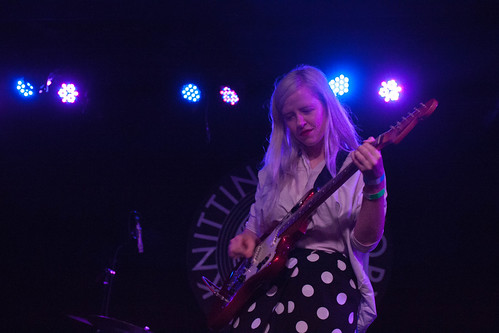
Since their formation in 2009, the Montreal-based shoegaze duo No Joy, comprised of Jasamine White-Gluz and Laura Lloyd have quietly developed a reputation both nationally and Stateside as being one of the more beguiling and captivating presences within the scene — in particular having a well-known reputation for producing an enormous sound while being rather shy. In fact, principle songwriter and vocalist White-Gluz was known to prefer staying hidden off to the corner of the stage than stand center stage, and for their recordings, White-Gluz’s vocals were never too high or loud within the mix and were frequently obscured by layers upon layers of guitars; however, the duo’s latest effort CREEP reportedly finds White-Gluz and Lloyd playing and singing with a swaggering confidence and cool self-assuredness with the material pushing the band’s sound in new directions as it draws from industrial electronica, ambient electronic, pop and other sources in a way that’s dimly reminiscent of Violens’ fantastic Amoral. Almost unsurprisingly, former Violens frontman and primary songwriter Jorge Elbrecht co-wrote and produced CREEP EP, assisting in creating a soundscape that sounds and feels familiar and boundary-pushing.

CREEP’s latest single “Hellhole” features White-Gluz’s ethereal crooning over a twisting and turning arrangement featuring blazing power chords, heavy metal-like downtuned bass, twinkling and shimmering synths, four-on-the floor drumming and an anthemic hook to create a song that juxtaposes light and dark, air and earth, masculine aggression and feminine wiles.

The recently released music video for “Hellhole” features grainy VHS home video footage of Jasamine White-Gluz as a teenage, making a lovingly clumsy attempt at a Sheryl Crow video — and while White-Gluz was a typical, goofy teen, you can see the sincerity and ambition that drives the woman in the girl and vice versa.

Comprised of Sonny Cheeba and Geechi Seude, the Bronx-based hip-hop duo Camp Lo is best known for their smash hit “Luchini (A.K.A This Is It)” off their critically applauded debut effort, Uptown Saturday Night, which was released 20 years ago yesterday.  Interestingly, renowned Nigerian-born, Montreal-based producer and artist Teck-Zilla, a JOVM mainstay, who has released a number of critically applauded EPs and mixtapes recently paid homage to the album and standout track “Sparkle” with a hazy and jazzy remix, which features horn blast and 808-like boom-bap beats that manages to retain the original’s swaggering soulfulness.


New Video: The Moodily Psychedelic Visuals for Heat’s “Lush”

Comprised of Susil Sharma (vocals, guitar and synths) Matthew Fiorentino (guitar, synth), and Raphael Bussières (bass), the Montreal, QC-based indie rock/post-punk trio Heat have received praise from Brooklyn Vegan and NME for a swaggering and moody material that’s “equal parts hooks, melody and attitude.” The band’s latest single “Lush” off their new album, Overnight is moody and seductive track in which the band pairs shimmering synths, angular guitar chords played though reverb, thumping, four-on-the-floor drumming, and a sinuous bass line with a razor sharp hook to create a sound that nods heavily at The Psychedelic Furs and Echo and the Bunnymen — but with a slick, dance floor-friendly feel.
Directed by Charles Andre Coderre, the recently released video feels as though it could have been released sometime in the 80s as it employs the use of split screens — in one half, a man may be sleeping or it may turn into heavily treated footage of daily life somewhere — mainly people walking around a busy Chinatown. It’s a trippy yet fitting accompaniment to a propulsive and wistfully moody song

New Video: The Hallucinatory Visuals for Beat Escape’s “Seeing Is Forgetting”

Although they’ve cloaked themselves in varying degrees of mystery, the Montreal-based DJ and production duo Beat Escape have received attention across the blogosphere for a moodily atmospheric sound consisting of cascading layers of shimmering synths, swirling electronics, shimmering guitar chords and ethereal vocals paired with a propulsive, motorik-like groove as you’ll hear on “Seeing Is Forgetting.” And while evoking waking from a particularly vivid dream, in which reality and your dreams are hopelessly blurred, the song also manages to draw from 80s synth pop and contemporary dream pop simultaneously.

Created and directed by Sabrina Ratte, a video artist, who creates virtual environments using analog technologies, the video possesses a hallucinatory feel that’s punctuated by bursts of static. As Ratte explains in press notes “. . . the video was created using analog video tools and techniques, mixed with digital textures and 3D architectures. While depicting hallucinated landscapes, illuminated by electrical discharges, the timeless abstract environments undergo a metamorphosis, evolving in sync with the song’s hypnotic energy.”

New Video: The Haunting Visuals for Preoccupations’ “Memory”

As the band’s frontman Matt Flegel has explained in press notes, Preoccupations’ self-titled album draws from very specific things — the sort of things that has most people up at night, fraught with anxiety and despair. And while the album’s first single “Anxiety,” was about the process of both natural and forced change upon the band and people generally, while on another level the song captures the uncertain and uncomfortable push and pull of human relationships, including the bitterness, regret, ambivalence, frustration and self-doubt they almost always gender within us all. The self-titled album’s second single “Degraded” while being a tense and angular song also may arguably be the most straightforward and hook-laden song they’ve written to date. However, lyrically speaking, the song reveals that its full of bilious accusation and recrimination while evoking a dysfunctional relationship splintering apart.

The album’s third single “Memory” is an expansive song that clocks in at just a little under 11:30 and is comprised of three distinct and very different movements held together by the song’s central narrative, which focuses on how much the past and its distortions, influences and invades every relationship and aspect of our lives and relationships — while also suggesting the vacillating cycles of bipolar mania. The song’s lengthy and atmospheric introduction consists of shimmering guitar chords paired with an angular, slashing bass line, and propulsive drumming and seems to look back on a relationship with a bit of regret. The song’s second section sounds as though it drew from Joy Division/New Order as shimmering guitar chords, soaring synths and Wolf Parade‘s Don Boecker contributing lilting falsetto vocals and an anthemic hook — and while being a bit bittersweet, the section also conveys a profound sense of joy and wonder before fading out into a coda consisting of gently undulating feedback that lingers with a spectral quality.

As the band’s Scott “Monty” Munro explains in press notes “‘Memory’ was the second song that we started working on for Preoccupations after ‘Anxiety.’ It was unique to the sessions of the record in that we worked on it in every studio that we were in. The idea we had for its arc made it necessary to put more work into it than any of the other tracks. The finished result was worked on in six different studios over almost two years. Getting Dan [Boeckner of Wolf Parade] to record the vocals was the final piece of the puzzle and was Matt [Fiegel]’s idea. We were tracking in Montreal and cold-called him to see if he wanted to sing a duet of songs, but his vocal was so perfect that we didn’t use Matt’s for most of it.” And the end result may be the most cinematic song they’ve released to date.

Directed by award-winning director Kevan Funk, the recently released short film/music video as he told NPR was loosely based on the story of Mohammed Bouazizi, the Tunisian street vendor, who after years of harassment by police, who lit himself on fire in the middle of traffic in December 2010, much like the acts of self-immolation performed by Buddhist monks protesting the Vietnam War in the 1960s. And much like those protests, some have said that Bouazizi’s protest may have triggered both the Tunisian Revolution, in which the country’s then-president Zine El Abidine Ben Ali was forced to step down from power — and later the events of the Arab Spring. “I don’t mean to sound dark, but there’s something poetic about a fire burning so intensely that one day, it actually physically manifested,” Funk explains. “You ask yourself, ‘how much pain can we take? How much control do we have?'”

Starring the band’s Mike Wallace as the video’s lead, the video follow a man as he cycles and vacillates through the bipolar mania of action and boredom, while becoming further lost in his own mind and disconnected from others. Gradually, Wallace’s character becomes increasingly obsessed with fire and loses his grip on his own sanity and reality. Disturbingly, the video reminds us that there’s only so much loneliness and pain we can take before we shatter, and that our grip on ourselves and our sanity is ftenuous at best. But it also asks the viewer “Do you know your mind? Do you know how much you can take? Do you know the darkness within your heart?”

New Video: Catch Charlotte Cardin Hang Out with Friends in Her Hometown in Her Latest Tell Off of a New Single

Big Boy’s latest single “Dirty Dirty” will further cement Cardin’s burgeoning reputation for pairing her old-school jazz and pop-like vocals with sparse, electro pop and hip-hop-leaning production. In this case, tweeter and woofer rantingly beats, shuffling drum programming and twinkling keys in a swaggering and sultry song that’s simultaneously a tell off and a come on to a lover, who has ignored and rejected the song’s narrator for another in which the song’s narrator tells her love object “she should be me but because you’re a fool, I’ll move on without you.” Ouch!

Directed by Sebastien Duguay, who also directed the video for Cardin’s “Faufile,” the recently released music video for “Dirty Dirty” was filmed in Montreal’s Mile-End section and reveals Cardin at her most unguarded, candid and real as we follow Cardin hanging out with a collection of dear friends and family, eating, goofing off and singing the song. Not only does it capture Cardin in her most nature environment; but it also suggests something that’s profoundly true — that having dear friends and family, who sustain you and lighten your heart and soul can be rare.