Tag: Paris France

New Video: JOVM Mainstays The Penelopes Return with an 80s New Wave and Synth Pop Inspired New Single

Comprised of Paris-born, London-based duo Axel Basquiat (composer, vocals, bass) and Vincent T. (production, sound engineering and keys), The Penelopes are an indie electro pop act, production and DJ duo who have developed a reputation for propulsive, Giorgio Moroder-like remixes of Lana Del Ray, Pet Shop Boys, We Have Band, Night Drive, The Ting Tings, Alt J and others, and for their own original material, which critics have compared favorably to the likes of Daft Punk, M83 and Air. Now, if you’ve been frequenting this site over the past 3 years or so, you may have come across posts on their remixes of The Ting Tings “Do It Again,” Alt J’s “Hunger of the Pine” and an anthemic, club-banging cover of Depeche Mode’s “Never Let Me Down Again” that managed to retain the song’s sense of longing.

The duo released a new single package featuring their cover of Bowie’s “This Is Not America,” which received airplay on KCRW, along with several remixes, including Miguel Campbell’s remix, which received airplay on Nemone’s BBC 6 show, and a new, original song “Tina.” The duo’s latest single “Tina” manages to be a decided refinement of the sound that captured both the site’s attention and the rest of the blogosphere; in fact, while retaining a dance floor friendly feel, the song manages to decidedly leans in the direction of 80s New Wave and synth pop — in particular, I’m reminded a bit of Simple Mind’s “Don’t You Forget About Me,” as “Tina” possesses an rousingly anthemic nature that belies a swooning Romantic nature.

The recently released video cuts between footage from Asia Argento’s directorial feature film Misunderstood, starring Charlotte Gainsbourg and footage of the band performing the song in a studio, shot in a striking, film noir-like black and white.

New Video: Watch the Paris Symphonic Orchestra’s Instrumental Rendition of Uppermost’s “Constellation”

Now, if you’ve been frequenting this site over the past three or four months, you’ve come across a handful of posts featuring the Paris, France-based electronic music producer and electronic music artist Behad Netjabakshe, best known as Uppermost. And as you may recall, Netjabakshe has an internationally recognized profile for material he’s released through a number of renowned labels including Sony BMG, Ministry of Sound, BugEyed Records, Starlight Records and his own Uppwind Records — with singles like “Equivocal” landing at number 3 on Beatport’s electro house charts in 2009, and his Biscuit Factory EP landing at number 1 on the JunoDownload electro-house charts. Additionally, Netjabakshe has received attention for his remixes of Daft Punk, deadmau5, Burial, Crystal Castles, Jonathan Coulton, Syl Johnson, Congorock and others — and he’s had his work playlist by a nubmer of superstar producers and artists including Tiesto, Armin van Buren and Steve Angello.

Last week saw the release of the Paris-based producer and electronic music artist’s latest full-length effort, Origins 2011-2016, a massive 23 song LP, which features some of the French producer and electronic music artist’s most popular songs, including Flashback,” “Beautiful Light,” “Reminder” “Mistakes” as well as a new material including the shimmering and anthemic M83-channeling singles “Thousand Colors,” and “Emotion,” the Pink Floyd-channeling, cinematic “Reminder,” and the 45:33 and Sound of Silver-era LCD Soundsystem-leaning “Alive.” To celebrate the release of the album, Netjabakshe shared a swooningly gorgeous and cinematic rendition of “Constellation” performed by members of the Paris Symphonic Orchestra that retains the lush, cinematic quality of the original.

If you’ve been frequenting this site over the last few months of 2016 and the beginning of 2017, you’ve most likely come across a couple of posts featuring the , Paris, France-based electronic music producer and electronic music artist Behad Netjabakshe, best known as Uppermost. And as Uppermost, Netjabakshe has received attention internationally for material released through a series of renowned labels including Sony BMG, Ministry of Sound, BugEyed Records, Starlight Records and his own Uppwind Records — with singles like “Equivocal”landing at number 3 on Beatport’s electro house charts in 2009, his Biscuit Factory EP ranked first on the JunoDownload electro-house charts.And adding to a rapidly growing international profile, Netjabakshe has had his work playlisted by superstar producers and artists such as Tiesto, Armin van Buren and Steve Angello. Netjabakshe has also received attention for his remixes of Daft Punk, deadmau5, Burial, Crystal Castles, Jonathan Coulton, Syl Johnson, Congorock and others.

Uppermost‘s soon-to-be released full-length effort Origins 2011 – 2016 is a 23 song LP that features some of the French producer and electronic music artist’s most popular songs, including Flashback,” “Beautiful Light,” “Reminder” “Mistakes” as well as a new material including the shimmering and anthemic M83-channeling singles “Thousand Colors,” and “Emotion” and the Pink Floyd-channeling, funky and cinematic “Reminder.”Origins 2011 – 2016‘s latest single “Alive” will further cement Netjabakshe’s reputation for slickly produced synth pop as the Paris-based electronic music artist and producer pairs layers of shimmering, arpeggio synths with a sinuous bass line, Nile Rodgers-like guitar and and a rousingly, anthemic hook; however, where two of the album’s singles were reminiscent of M83, the album’s latest single leans a bit more towards 45:33 and Sound of Silver-era LCD Soundsystem, thanks to a club-friendly and accessible style.


Although over the past twenty years or so Cape Verde, the tiny island nation comprised of an archipelago of 10 different, volcanic islands off the Northwestern coast of Africa has been hailed as one of the continent’s most stable democracies, its history suggests that things were very different. With a prime location in the Atlantic Ocean, the island nation was uninhabited until the 15th century, when the Portuguese colonized it, established it was not only the first European settlement in the tropics; but as a major commercial center and stopover point for the Transatlantic Slave Trade during the 16th and 17th centuries. The decline and eventual abolition of the slave trade in the 19th century resulted in a crippling economic crisis; however, because of the island’s location in the middle of major shipping lanes, it quickly became an important commercial center and port. Interestingly, with few natural resources and inadequate sustainable investment from the Portuguese, who had controlled the island nation for the better part of 300 years, Cape Verde’s citizens had become increasingly frustrated with colonial rule.

During the late 1940s and early 1950s, a series of independence and nationalist movements across colonized Africa began sprouting up across Africa –including Cape Verde. In 1951, Portugal changed the island nation’s status from a colony to overseas province in an attempt to blunt Cape Verdeans growing nationalism; however, by 1956 Amilcar Cabral led a group of Cape Verdeans and Guineans, who formed the African Party for the Independence of Guinea and Cape Verde (PAIGC). The group demanded improvement in economic, social and political conditions in Cape Verde and Portuguese Guinea — and interestingly enough, formed the basis of both nations’ independence movement. After moving its headquarters to Conakry, Guinea in 1960, the PAIGC began an armed rebellion the following year, which resulted in a bloody and complicated civil war that had Soviet Bloc-supported PAIGC fighting Portuguese and African troops.

Portuguese Guinea declared independence in 1973 and was granted de jure independence the following year as Guinea-Bissau. Amilcar Cabral led Cape Verde’s burgeoning independence movement until his assassination that same year, then led by Cabral’s half-brother Luis Cabral, who led the archipelago nation to independence in 1975. Much like their counterparts across the continent, the tiny island nation suffered through the similar ills of a society born by and influenced by colonialism, slavery and greed struggling to integrate into a rapidly globalizing world — and not quite knowing how to do so. The sense of detachment from the modern world fostered among Cape Verdeans a yearning to integrate, to connect with the larger world in any way that they could. And those who emigrated to the cosmopolitan European cities didn’t find much respite as Cape Verdeans were viewed as “hot-blooded” “dropouts” and “juvenile delinquents.” However, with the ready availability of electronic instruments, a doorway to a sense of modernity and an perceived anchor in their adopted homes was understandably seductive. As Val Xalino, a Cape Verdean-born, Gothenburg, Sweden-based electronic music artist and pioneer of his birthplace’s electronic sound explains in press notes “Cape Verdeans were celebrating their independence and with that the dancing became even more important.People wanted to hear something different. They wanted the synthesizer!”

Émigré musicians began traveling back and forth between Europe and their island homeland with luggage packed with synthesizers and MIDI instruments. And although many were primarily urban-based, musicians began frequent traveling to the countryside to learn the rhythms and melodies of rural farmers, frequently sampling melodies played off of slightly off-tune and damaged accordions and other field recordings. The result was this weird and compelling sound that drew from folk melodies and rhythms and contemporary electronic production — and from both African and European influences. The hearts and minds of a new nation of passionate, musically-included people were enthralled, including Paulino Viera, who would quickly become the island nation’s most important, beloved and influential musician.

Veira was especially drawn to keyboard-based instruments as he had honed his skills playing organ and piano at a Catholic seminary. His musical career started in earnest as a backing member of the renowned vocalist Cesaria Evora, whose cavaquinho-based folk songs received international attention while being instrumental in establishing the island nation as a music scene worthy of your attention — especially if you were into music across the wildly diverse African Diaspora. Interestingly, an underground electronic music scene had started with Viera leading charge once he relocated to Lisbon, Portugal, where he lead Voz de Cabo Verde, a beloved ensemble that frequently collaborated with other Cape Verdean-born musicians across the Diaspora. As Elisio Gomes, a Cape Verdean-born, Paris-based vocalist, who collaborated with Veira often, explained in press notes ““Paulino was the most visionary. He always had this gift to be 10 years ahead of his time. That’s why our music sounds like it was produced today.”

Now, as I’ve mentioned frequently on this site, the technological advances brought forth by computers and the Internet have made discovering new and extremely rare, lost music from known and little known artists much easier, all while contributing to the proliferation of extremely niche based labels, who are willing to take careful and thoughtful risks based around the tastes and listening habits of their staff and their most fervent followers. Naturally, it meant these smaller, niche labels would frequently spend their time re-introducing artists, whose work was so far ahead of its time that audiences just couldn’t grasp it upon its initial release — and yet fills in an important gap historically speaking; re-introducing regionally favored artists, whose work should have seen a bigger audience but didn’t; releasing music from various locations around the world that Westerners should know and love but was largely ignored; to provide an alternate history of developments across a genre — based on a region or a country that Westerners had long ignored and so on. And adding to a growing list of small labels releasing cool stuff, Ostinato Records will be releasing a cool compilation of electronic music from Cape Verde — a compilation in which the aforementioned Paulino Veira contributes to about half the songs — titled Ostinato Records Presents: Synthesize The Soul: Astro-Atlantic Hypnotica From The Cape Verde Island 1973-1988.

And through 18 extremely diverse tracks, the compilation will reveal how immigration from Cape Verde to Europe and the US created an alternate history of electronic music that had been largely ignored by most Westerners. Manuel Gomes’ “Jelivrà Bo Situaçon” pairs propulsive African percussion, shuffling Nile Rodgers-like funk guitar, twisting and turning keyboard chords played on what sounds like an old Casio keyboard paired with Gomes’ softly yearning, bittersweet vocals and is the compilation’s first single. Sonically speaking while the song clearly has the mark of either decidedly lo-fi production or comes as the result of re-mastering from old analog masters, it possesses a hypnotic, cosmic glow with groove and melody turning into one cohesive unit. And while being a bit bittersweet, the song at its core possesses the sense of unbridled freedom and possibility of the dance floor, and the hopes and dreams of a new nation learning to create its own image and history for itself.

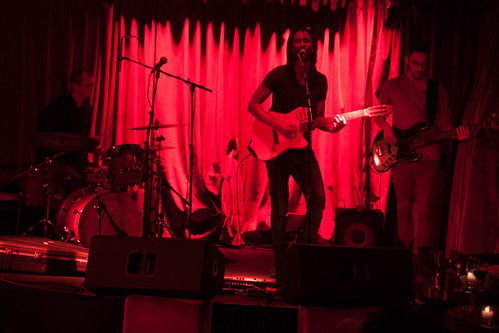


New Video: The Humanist and Globalist Pop Sounds of Daby Touré

Daby Touré is a Mauritanian-born, Paris-based singer/songwriter, who has had a lifelong love and obsession that began with listening to The Police, Stevie Wonder and Michael Jackson over the radio; however, he can trace the origins of his music career to when he taught himself the basics of guitar, while possessing an instinct that music was to be his life.

As a teenager, Touré relocated to Paris and his lifelong passion for music gradually drew him away from his studies in business; in fact, Touré began fully immersing himself in Paris’ jazz scene. And after several years of experimenting with his sound and songwriting, Touré met electronic music artist and producer Cyrille Dufay in 2003 — and the duo collaborated on Touré’s critically applauded breakthrough album Diam, an album that was signed to Peter Gabriel’s Real World Records. Interestingly, as a result the Mauritanian-born, Paris-based singer/songwriter opened for Gabriel during the renowned British artist’s 2004 Growing Up World Tour, which allowed Touré to have a growing international profile — with the album being added to playlists across France and the UK.

In 2006, the Mauritanian-born, Paris-based singer/songwriter was nominated for Discovery of the Year in that year’s BBC World Music Awards and he released his sophomore effort, in which he collaborated with sound engineer Ben Finlay, who has worked with Peter Gabriel, Sting, Simply Red, Jeff Beck and Robert Plant; and mixer and engineer Tom Oliver, who has worked with Sinead O’Connor, U2, Seun Kuti, Tony Allen, Susheela Raman and Charlie Winston. The following year saw the release of his third full-length effort Stereo Spirit, an album praised internationally for material that possessed catchy hooks and singalong-worthy lyrics — while pushing his sound towards the genre-defying.

By 2009, Touré collaborated with bluesman Skip McDonald on the Call My Name EP, an effort that Sing Out! described as being “neither African nor blues, but instead pulls from both and also from rock, a touch of pop and even dub for a unique, appealing and — its as to be said — quite commercial sound. The two voices and styles complement each other perfectly, and the songs they’ve created – for they seem more like creations than compositions – summon up echoes of their histories, but end up in a hybrid that’s essentially completely new.” With the success of his collaboration with McDonald, Touré has collaborated with an increasing number of internationally recognized artists including French pop artists Francis Cabrel and Maxime Le Forestier on Touré’s 2012 French language effort Lang(u)age — and he’s performed alongside Bob Geldof, Rihanna and Enzo Avitabile, among others.

As Touré explains in press notes “I was born in Africa And all the traditional music I picked up when I was young is still in me and that doesn’t change. But in my music I am still searching, and mixing, and trying things and that’s what I am doing now. I have travelled far from the ‘traditional’ or ‘folkloric’ music of my country.” In fact, over the past few years, the Mauritanian-born, French-based singer/songwriter has increasingly has merged the linguistic sounds of the six languages he speaks while moving towards a more globalized and universal sound — all while maintaining the accessibility that won him international attention.

Although his most recent effort was 2015’s Amonafi, which was released through renowned indie label Cumbancha Records, the internationally renowned singer/songwriter will be in town for two sets at Subrosa on Thursday night and to celebrate the occasion, released the music video for album single “Oma.” Sonically “Oma” is a breezy pop song that owes a debt to dub and reggae as much as it does to traditional African folk music in a seamless fashion and with an infectious, crowd-pleasing hook Throughout, Touré sings in several different languages — including English for part of the song’s hook, which gives the song a jet-setting, globalist universality. And yet, the song draws from a personal experience. As Touré explains of the song “One day as I was walking down the street, I passed a woman and her children. She was alone, sitting on the ground, and asking for charity and nobody seemed to care. This woman spoke to me that day. She inspired this song. Oma is this mother’s cry.”

The recently released music video for the song is a fairly straightforward take on the song, that follows after the song’s thematic concern with the video having Touré encountering a homeless woman and her child, and Touré approaching this woman and her child for a friendly and empathetic conversation that influences his song.

Live Footage: Uppermost Performs Reminder in Paris

Now, if you’ve bee frequenting this site over the course of the past month or so, you may recall that I previously wrote about Behdad Netjabakshe, Paris, France-based electronic music producer and electronic music artist, best known as Uppermost. Netjabakshe has received international material for material released through a number of renowned labels including Sony BMG, Ministry of Sound, BugEyed Records, Starlight Records and his own Uppwind Records. Adding to a growing internationally recognized profile, Netjabakshe’s “Equivocal” landed at number 3 on Beatport’s electro house charts back in 2009, his Biscuit Factory EP ranked first on the JunoDownload electro-house charts — and he’s had singles playlist by renowned artists and producers such as Tiesto, Armin van Buren and Steve Angello. Additionally, he’s received attention for remixing the work of Daft Punk, deadmau5, Burial, Crystal Castles, Jonathan Coulton, Syl Johnson, Congorock and countless others.

Netjabakshe’s forthcoming full-length effort Origins 2011-2016 is a massive 23 song LP that features some of the French electronic music artist and producer’s most popular songs such as “Flashback,” “Beautiful Light,” “Reminder” and “Mistakes” as well as a ton of new material including the shimmering and anthemic M83-channeling single “Thousand Colors,” that possessed a bit of muscle and forcefulness. The French electronic music artist and producer recently released live concert footage performing the cinematic, shimmering and funky “Reminder” in Paris. Interestingly, while the retro-futuristic gently nods at both M83 and Pink Floyd, the song manages to sound as though it should be part of the soundtrack of a sci-fi thriller.

New Video: JOVM Mainstays La Femme Return with Surreal and Nightmarish Visuals For Their Latest Single “Mycose”

The Parisian collective’s highly-anticipated sophomore effort Mystere was released earlier this year and you may recall that I’ve written about three of the album’s singles — Sphynx,” a track that manages to evoke a lingering fever dream, “Ou va la mode” a somewhat stripped down track that seemed as though the French act were returning to the breezy and decidedly French take on surfer rock that comprised Le Podium # 1 but with warped, carnival from hell-like organ and “Septembre,” a track that sounded indebted to 60s psych rock and psych pop with a mournful, bittersweet air. The album’s fourth and latest single “Mycose” is a moody and somewhat atmospheric track comprised of undulating synths, a propulsive bass line, some industrial clang and clatter paired with punchily cooed lyrics and a psychedelic-leaning guitar solo. And of course, Mystere’s latest single will further cement the French collective’s reputation for crating a propulsive and danceable sound that also manages to be difficult to pigeonhole.

Directed by Paul Gondry, the son of renowned director Michel Gondry, the recently released video for “Mycose” was shot on the streets of New York and while coolly seductive, the video possesses a nightmarish horror-film meetings high-fashion ad logic.

New Video: The Atmospheric Sounds and Visuals of Dia’s “Gambling Girl”

Writing and recording under the moniker Dia, Birrittella has began to receive attention for “Gambling Girl,” the latest single off her debut EP Tiny Oceans and as you’ll hear from the new single, Birrittella’s specializes in a moody and lushly orchestral baroque pop-leaning sound in which Birrittella’s ethereal vocals are paired with a subtly droning melody consisting of electric guitar, ukulele, cello and swirling electronics. Thematically speaking the material is inspired by a 12th century Romantic poem written by Kafiristan, in which the poet confesses to his love “since you love me and I love you, the rest matters not.” According to Birrittella, the message of complete surrender and martyrdom for love was a powerful one and it gives “Gambling Girl” a swooning urgency just underneath the surface, while sounding as though it drew from Mazzy Star and Kate Bush.

Directed by Robert Condol, the video is shot in a sort of dreamy series of flashbacks of a desperately and passionately in love couple on a ranch in sunset, riding horses and being romantic in front of a cinematically shot desert vista.

Behdad Netjabakshe is a Paris, France-based electronic music producer and electronic music artist, best known as Uppermost who has received international attention for material released through a number of renowned labels including Sony BMG, Ministry of Sound, BugEyed Records, Starlight Records and his own Uppwind Records with his “Equivocal” landing at #3 on the Beatport electro-house charts back in 2009 and his Biscuit Factory EP ranking first on the JunoDownload electro-house charts, as well as having his work playlisted by renowned artists and producers such as Tiesto, Armin van Buren and Steve Angello. Adding to a growing international profile, Netjabakshe has remixed the work of Daft Punk, deadmau5, Burial, Crystal Castles, Jonathan Coulton, Syl Johnson, Congorock and countless others.

Netjabakshe’s forthcoming full-length effort Origins 2011-2016 is a massive 23 song LP that features some of the French electronic music artist and producer’s most popular songs such as “Flashback,” “Beautiful Light,” “Reminder” and “Mistakes” as well as a ton of new material including the shimmering and anthemic M83-channeling single “Thousand Colors,” a single that possess enough muscle to rock clubs all over the world.


Known as the head of trendy, taste-making, French indie electronic music label Roche Musique and as a highly-regarded, up-and-coming electronic music and artist, whose production and sound possesses elements of house, R&B, hip-hop and nu-disco, Kartell, along with labelmates and friends Kaytranada, Stwo and Bondax are at the forefront of a “French touch” electronic music revival, which has also helped the Paris-based producer, electronic music artist and label head develop a growing international profile. And adding to a growing international profile, Kartell has remixed the work of Karma Kid and Lianne la Havas, collaborated with a number of renowned artists and producers, including Flares and others, as well as a busy touring schedule that included more than 100 dates across Europe, Asia, North America and South America.

Sapphire and Tender Games Kartell’s last two EPs were released to critical praise — and his soon-to-be released EP Last Glow, which his label Roche Musique will be releasing will further cement his reputation for slickly produced electronic music as you’ll hear on the house music and R&B-leaning “5 A.M.” And as you’ll hear on his latest single, Kartell employs the use of stuttering and cascading blocks of shimmering synths, boom bap-like beats, a chopped and cut soulful vocal sample to craft a song that feels sinuous and sensual and nods at Octo Octa and the 100% Silk Records roster — but with a populist, late night, club-banging feel.


With the 2015 release of their excellent, sophomore effort Manual, the Brazilian psych rock quartet Boogarins quickly became a JOVM mainstay artist. Now, if you’ve been frequenting this site over the past year or so, you’d recall that the internationally acclaimed psych rock quartet can trace their origins to when its founding members, Fernando “Dino” Almeida and Benke Ferraz started playing music together as teenagers in their hometown, the central Brazilian city of Goiânia. Interestingly, the music that the duo of Almedia and Ferraz began to write and eventually record quickly revealed a unique vision of psych pop that drew from their country’s incredibly rich and diverse musical and cultural history  — but with a decidedly modern viewpoint. And unlike a number of contemporary rock bands in their native Brazil, Boogarins were among one of the first, who wrote and sung lyrics completely in Brazilian Portuguese.

The release of the band’s full-length debut As Plantas Que Curam reverberated throughout Brazil as it was a massive critical and commercial success — without the support of a major label or a publicity firm pushing the album. As the band rose to national prominence, they started to receive larger international attention, and as a result they’ve played some of the world’s largest and most popular festivals including   Austin Psych Fest, Burgerama, Primavera Sound Festival, as well as playing headlining shows in clubs in London, Paris, Barcelona and New York. And while touring to support their their full-length debut, the members of the quartet had began writing and revising the material that would eventually comprise Manual. Now, interestingly enough, the material on their sophomore effort was specifically conceived as a diary or dream journal, which gives the material a deeply personal, almost stream-of-consciousness-like feel; but it also reveals a band that has become increasingly sociopolitically conscious as the album’s lyrical content also draws from the complex socioeconomic and political that affected their homeland’s communities before, during and after the 2014 World Cup — namely that entire neighborhoods and communities were being razed for massive commercial developments that helped multinational, global corporations and their interests make money hand over fist instead of uplifting those who desperately needed uplift.

During a rather busy bit of international touring the Latin Grammy nominated act, the quartet holed up in house near Austin, TX‘s SPACE Studios for most of the summer, and they spent their time writing and recording new material in between a several weeks along Austin club residency. the band’s latest single “Elogio a Instituição do Cinismo” (translated into English, the title is “Praise the Institution of Cynicism”)is a decided sonic departure as the band incorporates the use of thumping beats and breakbeats, swirling and whirling electronics, abrasive and buzzing guitars to create a malevolent and angrily brewing storm of sound that’s paired with vocals that manage to be both dreamily placid yet pissed off. While being hallucinatory, the song manages to be a rowdy, furious almost dance floor-like stomp, revealing a band that’s readily and aggressively pushing psych rock and Brazilian rock into strange, yet excitingly new directions.


New Video: The Gorgeously Cinematic Yet Eerie Visuals for Pamela Hute’s “Banshees”

Last month, I wrote about Pamela Hute, a Paris-based singer/songwriter, who began her music career in earnest at a very young age. As a teen she formed The Mashed Potatoes before going solo in 2006 — and as a solo artist, she’s released two albums, 2010’s Tales From Overseas and 2013’s Bandit, with Bandit being mixed by John Agnello, who has worked with the likes of The Kills, Sonic Youth and Cyndi Lauper. Both of those albums revealed that Hute specializes in jangling guitar pop with rousingly anthemic hooks paired with earnest lyrics as you’ll hear on The Breeders and 90s alt rock channeling “Banshees,” the second and latest single off her self-produced effort Today. But at its core, Today manages to reveal what may arguably be Hute’s most personal songwriting, influenced by a trip she took to California.

Now, as you may recall I wrote about the live video, which featured Hute and her backing band performing “Banshees” at La Fourmi in Limoges, France. The recently released official video, which Hute made with her cousins and nephews this past summer is shot in a gorgeous and cinematic black and white and it features three characters dressed as crows participating in a weird, almost pagan-like ritual in the woods, before following the trio as they walk about the countryside. It’s arguably some of the most artful and yet eerie imagery I’ve seen in some time.

Deriving their name from the computing term “soft error” — or a fault occurrence in a digital memory system that changes an instruction in a program or a data value, Soft Error is an accomplished production and DJ duo of Tim and Rupert, who have been well-regarded in electronic music scenes and composition for film, theater and TV respectively. Their full-length debut Mechanism which is slated for a January 6, 2017 through Village Green Records was recorded at Valgeir Sigurðsson’s renowned Greenhouse Studios in Reykjavik, Iceland and draws from 1907s Krautrock, the BBC Radiophonic Workshop, Cliff Martinez, John Carpenter and Jon Hopkins — while also dimly nodding at the likes of Kraftwerk  and contemporary acts like Collapse Under the Empire.

“You Caught Up,” the duo’s cinematic and retro-futuristic debut single and first single off their forthcoming full-length was written and recorded in Paris, arranged in London and mixed in Iceland, consists of layers of shimmering and cascading synths, a sinuous bass line and propulsive drumming and a gorgeous wind section arrangement. Interestingly, the composition reveals a painterly nature, as each note and each chord adds a bit of texture and color like a brushstroke upon a canvas — while sounding as though it should be part of a soundtrack to a futuristic thriller.

New Video: Introducing the Jangling and Anthemic Guitar Rock of French Singer/Songwriter Pamela Hute

Pamela Hute is a Paris-based singer/songwriter, who began her music career in earnest at a very young age — as a teen she formed The Mashed Potatoes before going solo in 2006. And as a solo artist, she’s released two albums, 2010’s Tales From Overseas and 2013’s Bandit, with Bandit being mixed by John Agnello, who has worked with the likes of The Kills, Sonic Youth and Cyndi Lauper. Interestingly both albums revealed that Hute specialized in jangling guitar pop and synth pop with rousingly anthemic hooks paired earnest lyrics as you’ll hear on The Breeders and 90s alt rock channeling “Banshees,” the second and latest single off her self-produced effort Today. But at its core, Today manages to reveal what may arguably be Hute’s most personal songwriting, influenced by a trip she took to California.

The recently released music video is shot in a gorgeous and cinematic black and white, and captures Hute with her backing band performing “Banshees” live at La Fourmi in Limoges, France.