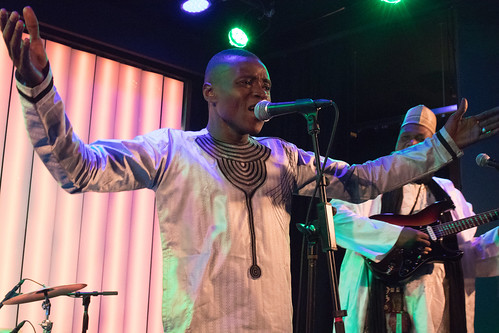
Professionally known as Kaleta, Leon Ligan-Majek is a Benin-born, Brooklyn-based singer/songwriter, multi-instrumentalist, bandleader and producer, who leads the up-and-coming local, Afro-funk act Kaleta and Super Yamba Band. Although the project is relatively new to the scene, Ligan-Majek can trace his music career back to Lagos, Nigeria, where Ligan-Majek spent his teenaged years playing in local churches. Eventually, the Benin-born, Brooklyn-based signer/songwriter, multi-instrumentalist, bandleader and producer caught the attention of renowned juju pioneer King Sunny Ade. “I was at Church when I heard King Sunny Ade sound checking one block away. By the time church service was over Sunny Ade’s gig was in full gear,” Ligan-Majek says of his first encounter with King Sunny Ade. “I infiltrated the gathering, snuck into the front row to watch the show. At the strike of the last note, right before Sunny Ade disappeared I went between him and his body guard and told him point blank my desire to play guitar for his band. He invited me to his house. I went the next day with a cassette containing songs and guitar riffs I wrote with him in mind.”
Kaleta went on to spend several years in King Sunny Ade’s backing band, recording four albums with the Juju pioneer before leaving the band to join Afrobeat pioneer Fela Kuti and Egypt 80. Unsurprisingly, the Benin-born, Brooklyn-based singer/songwriter, multi-instrumentalist and producer learned how to fuse elements from an electric array of West African genres and styles — including highlife, juju, Afrobeat, Afro-funk and Afro-dance.
In 1991, Ligan-Majek relocated from Lagos to New York after Fela Kuti and Egypt 80 completed the North American leg of their world tour. And almost as soon as he set foot in New York, he wound up being the co-founder of two Afrobeat ensembles, Akoya Afrobeat and Zozo Afrobeat — and as a member those acts, he had shared stages with the likes of Jimmy Cliff, Yellowman, and Lauryn Hill. “Lauryn Hill was rehearsing in the same music complex when she heard my music from another room,” Kaleta recalls. “She stormed into Zozo Afrobeat’s rehearsal, and two weeks later, I was on tour with her playing guitar and traditional Beninese percussion. . . we performed about 45 dates all over the world.”
While Ligan-Majek’s chops suited him well to back some of biggest names in music, he had an irresistible drive to create his own unique work. He searched for a band of his own but he knew that he needed a perfect combination — an irrefutable explosion of creative energy that came from a dedicated, like-minded group of musicians. Interestingly, Ligan-Majek credits his ambition and his vision to his older brother’s massive influence. Ligan-Ozavino Pascal was an obsessive music listener, with a passion for funk and soul. And as the story goes, Ligan-Ozavino Pascal occasionally weaponized his record collection to teach his younger brother discipline. When Kaleta misbehaved, his older brother would lock him in his room with a pile of records. The price of his freedom? A careful listen. “I had to submit to his huge love for music,” says Kaleta. “He introduced me to James Brown, Otis Redding, and other American, French and Cuban music.”
The Brooklyn-based Super Yamba Band, comprised of Daniel Yount (drums), Evan Frierson (percussion), Walter Fancourt (sax), Sean Smith (trumpet) have long been students and devoted fans of vintage West African, psychedelic Afro-funk. When they met Kaleta, who sang and played guitar over roots-rhythms while bbringing his infectious style to the project, things clicked. “I loved the way they stick together as a team,” says Kaleta. “Their exuberance. Their love for African music, notably Benin funk… I found out they were listening to my idols, too.” Between the members of the project, it became obvious that they stumbled upon something rare, exciting and in need of further cultivation and exploration. The members of Super Yamba Band had the skill and dedication that Kaleta had long sought for his solo work — and in turn, Kaleta brought the heard-earned wisdom from four decades as a professional musician that he was eager to share with bandmates.
Since their formation, the band has spent the past couple of years honing their material and playing live shows across town and elsewhere, including an opening set last year for Niger-based Afro funk/Afro pop act Tal National and an appearance at last year’s Barbes and Electric Cowbell Records Secret Planet APAP Showcase. Interestingly, the band’s “Mr. Diva” was remastered and re-released earlier this year — and as the story goes, the band was so encouraged by the success at recreating their live sound in the studio, that they set out to record what would eventually become their forthcoming full-length debut Medaho.
Slated for a September 6, 2019 release through Ubiquity Records, Kaleta and Super Yamba Band’s full-length debut derives its name from the Goun and Fon word for “big brother,” “elder,””teacher” — and the album is dedicated to the memory of Kaleta’s brother Ligan-Ozavino, who died earlier this year. Sonically, the material finds the band unabashedly paying homage to its massive influences, including James Brown, Fela Kuti, Orchestre Poly-Rythmo, El Rego, The Funkees, among others — but interpreting their work, learning from it, deconstructing it when necessary, amplifying it, defying it and pushing it and the sound into the future.
Mèdaho‘s first single is album title track “Mèdaho.” Centered around a looping, wah-wah and other pedal effected guitar lines, a sinuous groove, propulsive percussion and Kaleta’s grunts and howls, the song manages to recall He Miss Road/Expensive Shit-era Fela Kuti, The Payback-era James Brown, as it possesses a similar grit and forcefulness — but unlike the period specific work that has influenced the track features a lysergic haze.