Tag: The Wire

New Video: Introducing the Hypnotic Grooves and Visuals of Niamey, Niger’s Tal National

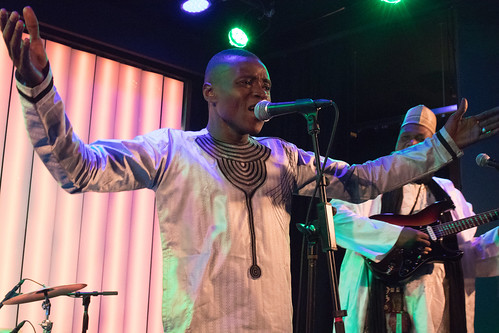
Currently composed of Almeida (guitar), Babaye (guitar), Tafa (guitar), Massaoudo (vocals), Souleymane (vocals), Maloumba (vocals), Seidou (vocals), Dalik (vocals), Yac Tal (bass), Essa (bass), Omar (drums), Souleymane (drums), Aboullay (drums), Sgt. Maty (drums, vocals), the Niamey, Niger-based collective Tal National features a rotating cast of collaborators that represents their homeland’s diverse array of cultures with members from their homeland’s Songhai, Fulani, Hausa and Tuareg populations. Interestingly, the collective have developed a reputation for joyous and hypnotic, West African guitar music that draws from the diverse musical cultures of Niger as their work possesses elements of highlife, Afrobeat, kora, Tuareg blues, Malian griot, Hausa rolling 12/8 rhythms and so on, as well as American psych rock delivered with virtuoso precision and unrelenting energy.

The band’s 2013 debut effort was released through FatCat Records to critical acclaim from the likes of The New York Times, The Guardian, The Independent, Mojo, Vice and The Wire, with frenetic live sessions on NPR, KEXP and WBEZ. Building upon a growing international profile, the band received praise from the likes of Pitchfork, Afropop Worldwide, The Fader, The Quietus, The Boston Globe and NPR.

Released last Friday, Tantabara, Tal National’s third album continues their ongoing collaboration with Chicago, IL-based engineer Jamie Carter on production and engineering duties, and the album which was recorded in the collective’s hometown of Niamey, Niger. Unsurprisingly, the album find the collective furthering their expressed mission of making a global audience dance to their hypnotic grooves, all while focusing on capturing the energy and vibe of their live sound to tape. Much like their counterparts, the collective have managed to create a huge sound of extremely limited resources, which frequently means that the members of the collective record in a remote, recording rid in a dusty, makeshift studio, working with minimal recording equipment and instruments on the verge of disrepair. Interestingly, the collective credits their songwriting and recording process to adding to their overall communal spirit, with opening their home up as a studio as a way for everyone within the group to be involved; in fact, Tantabara’s 8 tracks features 8 different vocalists — 7 of whom are full-time members.
 
Additionally, the album finds the collective looking back on a busy and influential period of time spent honing their live and recorded sound drawing from a number of Stateside tours, live sets at WOMAD Festival and Roskilde Festival and their legendary 5 hour plus live shows at their Niamey nightclub.
 
Tantabara’s latest single “Akokas,” much like the bulk of their work is centered around a tight danceable yet trance-like groove, some blistering and virtuoso guitar work and complex polyrhythm but at its core is much-needed celebration of diversity, acceptance and tolerance — and along with that, two larger, universal messages: that music is a powerful, unifying force and that there’s love, freedom, acceptance on the dance floor, if you let go of your preconceived notions and let the moment.
 
The recently released video for “Akokas” features wild and psychedelic visuals of the band’s members performing the song, capturing the band’s ebullient and euphoric spirit and the song’s trippy grooves.

Last year, the renowned director, screenwriter, producer and composer John Carpenter released his first album of non-soundtrack-based music, Lost Themes to critical praise from an impressive array of major media outlets including The GuardianThe New York TimesThe TimesUncutThe WireThe Los Angeles TimesNPRPitchforkVanity FairNewsweekBillboardEntertainment WeeklyArtforumThe Wall Street Journal, Rolling Stone and others. And as a result, the album was one of the most commercially successful albums released in Sacred Bones Records history, as the album debuted on the  Top 100 Charts in both the UK and US. Unsurprisingly, the album, which was recorded with Carpenter’s son Cody Carpenter and his godson Daniel Davies strongly confirms what cinephiles, sci-fi fans and Carpenter files have asserted for countless years — that the director’s work was not only years ahead of its time but that his work has managed to continually influence contemporary electronic music. In fact, artists like Red Traces and Umberto have released works that frequently seem indebted to Carpenter and his film scores.

Building on the buzz and success that Carpenter and Sacred Bones Records received after the release of Lost Themes, the director and the indie record label released Lost Themes Remixed, an album that featured remixes from the likes of  Zola JesusSilent ServantFoetus‘ JG Thirwell, Skinny Puppy‘s ohGr, PAN Records‘ Bill Kouligas, and Uniform. (In fact, if you’ve been frequenting this site over the past few months, you might recall that I wrote about Uniform’s dance-floor ready remix of Carpenter’s “Vortex” and Zola Jesus and Dean Hurley’s techno-leaning rework of “Night.” But interestingly enough, Carpenter has been incredibly prolific, as Sacred Bones and Carpenter will be releasing a sequel to Lost Themes Lost Themes II on April 15.

The material on Lost Themes II is inspired and informed by a change in the creative process with Cody Carpenter, Daniel Davies and the acclaimed producer writing, working revising and recording in the same studio — and with all three collaborators working together, the result was a more focused effort, completed on a compressed schedule, in a similar fashion to Carpenter’s earliest films. Additionally, the material is much more nuanced and lush, as the trio of collaborators added acoustic and electric guitar to flesh out the material, as well as add texture. Last month, I wrote about Lost Themes II‘s first single,  “Distant Dream” pairs John Carpenter’s unmistakable minimalist synths with live drums, bursts of angular guitar and bass chords, and swirling electronics in a moody and tense composition that sounds as though it could be part of a taut, psychological thriller set in a dystopian future. Lost Themes II‘s second and latest single “Angel’s Asylum” pairs layers of dramatic and twinkling and undulating synths and ambient electronics with buzzing power chords and four-on-the-floor drumming in a composition that has the trio quickly building upon a theme but with subtle variations until a gently strummed acoustic guitar section paired with ambient electronics and synths and a gentle layer of twinkling synths form the composition’s coda. In many ways the song goes from an extremely dark and rock-like intensity to an ethereal beauty that arches heavenward at the end.


John Carpenter is a director, screenwriter, producer, editor and composer most commonly known for working in some of the most beloved and influential, horror and science fiction films of the 70s and 80s, including Dark Star (1974), Assault on Precinct 13 (1976), Halloween (1978),The Fog (1980), Escape from New York (1981)The Thing (1982), Christine (1983), Starman (1984), Big Trouble in Little China (1986), Prince of Darkness (1987), and They Live (1988) — with the Halloween theme being one of the most recognizable themes in movie history.

Last year, Carpenter released his first album of non-soundtrack based music, Lost Themes to critical praise from an impressive array of major media outlets including The GuardianThe New York TimesThe TimesUncutThe WireThe Los Angeles TimesNPRPitchforkVanity FairNewsweekBillboardEntertainment WeeklyArtforumThe Wall Street Journal, Rolling Stone and others. Additionally, the album was one of the most commercially successful albums released in Sacred Bones Records history, as the album debuted on the Top 100 Charts in both the UK and US.

Unsurprisingly, the album, which was recorded with his son Cody Carpenter and the fameddirector, producer and composer’s godson Daniel Davies, the album confirms the fact that John Carpenter’s sound and aesthetic was not only ahead of its time but manages to be timeless and powerfully influential — with the work of artists like Red Traces, Umberto and others being deeply indebted to John Carpenter and his film scores. Now interestingly enough Carpenter closed out the last half of 2015 with the release of Lost Themes Remixed, an album that featured remixes from the likes of Zola JesusSilent ServantFoetus‘ JG Thirwell, Skinny Puppy‘s ohGr, PAN Records‘ Bill Kouligas, and Uniform.

The incredibly prolific Carpenter will be releasing a sequel to Lost Themes Lost Themes II which is slated for an April 15 release through Sacred Bones Records. The material on Lost Themes II is inspired by a change in the creative process with Cody Carpenter, Daniel Davies and the acclaimed producer writing, working revising and recording in the same studio — and with all three collaborators working together, the result was a more focused effort, completed on a compressed schedule, in a similar fashion to Carpenter’s early films. Additionally, the material is much more nuanced and lush, as the trio of collaborators added acoustic and electric guitar to flesh out the material, as well as add texture.

Lost Themes II‘s first single “Distant Dream” pairs John Carpenter’s unmistakable minimalist synths with live drums, bursts of angular guitar and bass chords, and swirling electronics in a moody and tense composition that sounds as though it could be part of a taut, psychological thriller set in a dystopian future.


New Audio: The Dreamy and Futuristic Sounds of Midday Veil’s “Babel”

Comprised of co-founders Emily Pothast and David Golightly, along with Timm Mason, Jayson Kochan, Garrett Moore and Sam Yoder, the Seattle,WA-based sextet Midday Veil have developed a reputation for crafting material that’s subtle and incredibly nuanced, […]

Profile: Getting to Know Brooklyn’s Animal Years

Getting to Know Brooklyn’s Animal Years, by Natalie Hamingson I was introduced to Animal Years this past June, during their standout set at New Music Seminar. Intrigued by their tight, dance-inducing live show, I wanted to […]