
JOVM’s William Ruben Helms celebrates U2 co-founder and frontman Bono’s 66th birthday.
Tag: U2 Achtung Baby
Throwback: Happy 64th Birthday, The Edge!
JOVM’s William Ruben Helms celebrates U2 guitarist and vocalist The Edge’s 64th birthday.
Throwback: Happy 63rd Birthday, Bono!
JOVM’s WIlliam Ruben Helms celebrates Bono’s 63rd birthday.
New Video: The Symbolic (and Messy) Visuals for INVSN’s “This Constant War”
Earlier this year, I wrote about the Umea, Sweden-based post-punk quintet INVSN, an act comprised of some of Sweden’s most accomplished musicians — including Dennis Lyxzen (vocals), a founding member and frontman of Refused, and a former member of The (International) Noise Conspiracy, The Lost Patrol Band, AC4, and who has collaborated with The Bloody Beetroots and others; Sara Almgrem (bass, vocals), a member of The Doughnuts, The (International) Noise Conspiracy, The Vicious and Masshysteri; Andres Sternberg (guitar, keyboards), a member of Deportees, The Lost Patrol Band and a member of Lykke Li’s backing band; Andre Sandström (drums, percussion), a member of Ds-13, The Vicious, The Lost Patrol Band, Ux Vileheads and others; and Christina Karlsson (keyboards, vocals), a member of Tiger Forest Cat, Honungsvägen and Frida Serlander‘s backing band. And interestingly enough, the members of the band are five, long-term friends, with Lyxzen in particular being known for a lengthy career incorporating sociopolitical themes into his work; in fact, as Lyxzen has publicly explained, “Music always meant more to me then just entertainment. It has had a profound impact on everything that I am as a person and I see music as art and art as life. We live in a world devoid of meaning where we serve the lowest common denominator at all times. Where politics as an idea has failed us and where art is being reduced to consumerism and clickbait.”
The band’s initial recordings were written and recorded with lyrics in their native Swedish under the name Invasionen, but when the members of the band decided that it was time to take the project and their work internationally, they felt that writing and singing lyrics in English, along with a new name would be necessary — and they settled on INVSN. Regardless of the name or the language, the post-punk band has always had a political message — and during this particular moment, when humanistic, Enlightenment values and thinking are being challenged by extreme right wing and extreme religious movements across the world, the members of INVSN strongly believe that their music, and the work of other like-minded musicians are part of a necessary and urgent outcry from a counterculture that has yet to give up. And while being righteously angry, their overall approach is rooted in the belief that change is gonna come — and it’s going to come real soon.
The Swedish band’s latest effort The Beautiful Stories is slated for release on Friday, and the album was recorded and produced by by Adam “Atom” Greenspan, best known for his work with Nick Cave and The Veils at Svenska Grammofonstudion in Gothenburg, Sweden. Reportedly, the album finds the band experimenting and expanding their aesthetic and songwriting approach with material that possesses elements of post-punk, industrial electronica, indie rock and indie pop, which gives their sociopolitical concerns an accessible, almost radio-friendly vibe.
Now, as you may recall “I Dreamt Music” was a decidedly post-punk leaning song, sounding as though it drew influence from Joy Division and Gang of Four, thanks to the song’s decided politically charged tone. And as Lyxzen explained in press notes, “I wanted to write about the longing for resistance to the cultural/political/musical landscape that holds us imprisoned. I wanted to write about the naive, romantic and pretentious notion that music and art should be about ideas that can change and transform and maybe even be the beacon of hope in these dismal times.” And as a result, the song manages to possesses a sense of cynicism and distrust and an equal bit of outrage.”
Interestingly enough, Beautiful Stories’ latest single “This Constant War” finds the band pairing jangling, Country-leaning guitar chords, layers of buzzing electronics and a propulsive rhythm section with boy/girl harmonies and a soaring, swooning hook in a song that sounds a bit like Joshua Tree and Achtung Baby-era U2 but filtered through Primal Scream, New Order and Ministry, while nodding at The Lonely Wild, as the material possesses a cinematic yet yearning quality at its core.
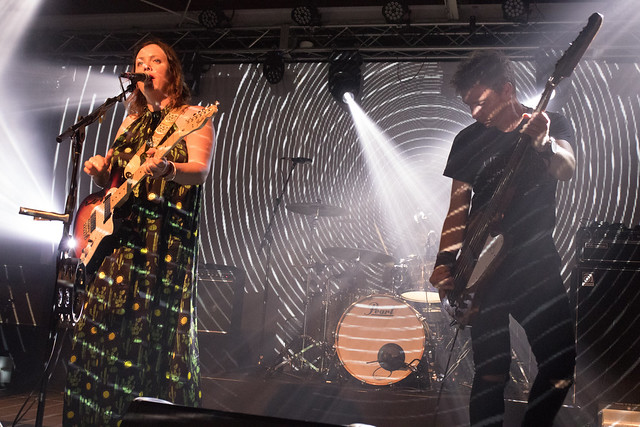
The recently released video for “This Constant War” features the members of the band passionately singing the song or broodingly staring off into space as the hands of an unseen person smears colored paint onto the faces and bodies of the bandmembers.
Led by its founding member, composer and bassist Ezra Gale and featuring Rick Parker (trombone), Alex Asher (trombone), Jon Lipscomb (guitar) and Madhu Siddappa, the Brooklyn-based trombone-led dub quintet Super Hi-Fi can trace their origins to a rather unlikely beginning. Gale, who was a founding member of acclaimed San Francisco-based Afrobeat act Aphrodisia, an act that once played at Fela Kuti‘s famed Lagos, Nigeria-based night club The Shrine, had relocated to Brooklyn and was collaborating with Quoc Pham in Sound Liberation Front when Gale was asked to get a band together for Pham and Gale’s then-monthly Afro-Dub Sessions parties in Williamsburg. Much like DJ Turmix’s Boogaloo Party, the Afro-Dub Sessions Party would pair the live band fronted by Gale with the dub’s top-flight producers and DJs including Victor Rice, Prince Polo, Subatomic Sound System, the Beverley Road All-Stars and others.
When Gale founded Super Hi-Fi, the project was initially intended to translate the improvisatory mixing process of dub to the live show; however, with the 2012 release of their critically applauded debut effort Dub to the Bone, a busy touring schedule in which they opened for nationally known acts like Rubblebucket, Beats Antique and John Brown’s Body, followed by the release of their Yule Analog Vol. 1 and Vol. 2, the project began to cement its growing reputation for crafting a unique and expansive take on dub and reggae.
With the recent release of Super Hi-Fi Plays Nirvana, the Brooklyn-based dub quintet push the boundaries of reggae and dub by paying tribute to Nirvana. And in typical Super Hi-Fi fashion, the members of the band manage to create their own take on the iconic Seattle-based trio’s material with renowned dub producers, Sao Paulo, Brazil‘s Victor Rice; Venice, Italy‘s Doctor Sub; and Brooklyn’s Prince Polo — all of whom are frequent collaborators with the band — assisting to further bend and morph the band’s sound in trippy and psychedelic ways, which help take fairly familiar songs into bold, new territory.

Adding to the uniqueness of the release, Very Special Recordings, a small, boutique Brooklyn-based label founded by Super Hi-Fi’s Ezra Gale, that specializes in releases cassettes that showcase the diverse of their borough’s and city’s music scene. Interestingly, while we all live in a world of Spotify playlists and streamable music that one never really owns, cassettes have seen something of a renaissance of late with several artists and labels releasing cassette only releases — and in some way, it’s a response against not just streaming services but against the trend towards technophilia for the sake of technophilia. While being relatively cheap to make and sell, a cassette tape does require a bit of effort — you’d have to go to a physical record store to purchase your favorite band’s new record and then bring it home to play; have a label or friend mail or give you a tape; and at the very least, you’ll probably listen to the whole tape, if not an entire side once. Plus, let’s not forget, that unless your favorite song is the first song or last song of a side, finding it can be a frustrating and time-consuming experience. And yet, if you remember buying cassettes at your local record store, as I do, it’s an experience that frankly I sometimes miss very dearly.
I recently spoke to Super Hi-Fi’s Ezra Gale about Super Hi Fi Plays Nirvana, how the arranging and re-arranging process differs from Gale’s normal songwriting process, the band’s upcoming releases and more. Check it out below.
__________________
WRH: In the Q&As for The Joy of Violent Movement, we almost always begin with some fairly introductory stuff for readers. So let’s begin, shall we?
WRH: How did the members of the band meet?
Ezra Gale: I had an idea for a two trombone band and placed a Craigslist ad for trombone players which got exactly two responses, from Alex Asher and Ryan Snow, who became our first two trombone players. Everybody else I just met through other musicians.
WRH: How would you describe your sound?
EG: It’s dub, but I don’t know if it’s reggae.
WRH: Who are you listening to right now?
EG: The last album I bought was Bowie‘s last album, Blackstar, which is just incredible.
WRH: Seminal albums like Nirvana’s Nevermind, U2’s Achtung Baby, A Tribe Called Quest’s The Low End Theory and Midnight Marauders, R.E.M.’s Automatic For The People, Soundgarden’s Badmotorfinger, Superunknown and Down On The Upside, Pearl Jam’s Ten, Vs. and Vitalogy and others reaching important milestone anniversaries, it’s a bit surprising to me that to my knowledge more bands haven’t seriously begun to tackle them with more covers and more tribute albums, especially if you consider how many Led Zeppelin, Pink Floyd, and Beatles tribute albums have been released over the years. Why haven’t there been more Pearl Jam, U2, R.E.M. tributes and covers? And how did you come upon paying tribute to Nirvana?
EG: I really don’t know about those other bands, for us we started playing a version of “Something In the Way” a couple years ago, and we all sort of got the idea that maybe a whole album of Nirvana tunes could be interesting.
WRH: Much like your fantastic Christmas albums, Super Hi-Fi Plays Nirvana features a couple of very well-known songs such as In Utereo’s “Heart Shaped Box,” and their famous Unplugged cover of “Where Did You Sleep Last Night?” as well as some rather deeper cuts such as “Verse Chorus Verse,” their Incesticide cover of “Love Buzz” Nevermind’s “Something In The Way” and “Polly.” What inspired you to choose those songs to tackle instead of something more tried and true?
EG: Well, initially I wanted to do all really obscure ones. Nirvana is a band whose famous songs have been played to death and I don’t know if anyone really needs to hear another version of “Smells Like Teen Spirit”, for example. But I know them from when Bleach came out and they were just this really great, intense band from Seattle that not many people knew- my college band even opened for them then, randomly. So I wanted to spotlight some of those lesser-known songs of theirs. But then, I think i was riding my bike and I suddenly started hearing “Heart Shaped Box” in this really slow, weird way, so we ended up doing that one. Ultimately it’s just about giving each song a different treatment and finding something new to do with it, no matter how many times you’ve heard it before.
WRH: How do you go about re-arranging material that’s fairly familiar in a way that adds your particular spin to it — while maintaining something familiar? And how does the process of re-arranging material differ from your normal songwriting process?
EG: It is different than a normal songwriting process. This album was very similar to our two Christmas albums (“Yule Analog” Vols. I and II), in that the goal was to take familiar material and make it sound different. And like in arranging those Christmas songs, I made some rules for myself doing it, which were that the melody line had to be the same, but everything else around it could change. So the rhythms are obviously very different, but also, Nirvana was a band with only one singer and we have two trombones, so in a lot of these versions the second trombone part is made up- like in “Verse Chorus Verse”, “Heart Shaped Box” and “Where Did You Sleep” especially. And also the chords are quite different in some of these, “Polly” and “Where Did You Sleep” especially are pretty different chord changes than the Nirvana versions.
My attitude towards cover versions is just that there’s no point in doing them if all you’re doing is to play it like the original version. No matter how great the original song is, I don’t ever want to regurgitate what someone else has done- go listen to the original if you want that. At the same time, I think it should be recognizable as the original song, somehow. So the challenge of taking material and sort of shaping it into something different that still has echoes of the original song is something I really enjoy doing.
WRH: While doing a little research for this interview, I learned that you’re currently working on your sophomore full-length effort, as well as Beatles/Police 45 for Record Store Day. Could you tell us a little bit about those projects?
EG: Yes, we are about 80% done with the mixing for the new full-length album, which is going to be called “The Blue and White” and it will be our second LP of all-original music. It’s quite different I think, there are lots of vocals and different sounds for us. It was recorded and mixed all onto tape too, which has been a real pain in some ways (!) but is so, so worth it- it sounds amazing I think. It will be out in the springtime sometime I think, on vinyl, somehow or other, we haven’t figured out yet.
And then the single is done and will be released on Electric Cowbell Records for Record Store Day in April, it’s the Beatles’ “I’m Only Sleeping,” which was actually recorded for our “Dub to the Bone” album but left off it, and a version of The Police‘s “Hole In My Life” which we recorded for the new album, both extremely whacked-out and different versions, I can’t wait to play it for people.
WRH What’s next for the band?
EG: We haven’t been playing live that much the last few months because I’ve been so focused on finishing these albums, so once we’re done completely with the new LP I’m looking forward to playing a lot more in the new year.
New Video: Dinowalrus Returns with Trippy, Motorik Groove-Driven Shoegaze and Psychedelic Visuals
FAIRWEATHER’s latest single “Falling to the Periphery” will further cement the band’s burgeoning reputation for crafting a sound that pairs ethereal melody and propulsive motorik groove. And while some of my colleagues have described “Periphery” as sounding as though it drew from Achtung Baby-era U2, which is a fairly apt description, the song to my ears reminds me much more of Primal Scream and TOY — in particular think of “Autobahn 66” off Evil Heat and “Conductor” off Join the Dots but possessing an airier quality.
The recently released music video however, features the band performing the song on top of a Brooklyn rooftop under increasingly psychedelic and neon-colored skies and interestingly enough, the video does reminds me of two distinct and completely different U2 videos — the video for “Where The Streets Have No Name” and the video for “Mysterious Ways.”