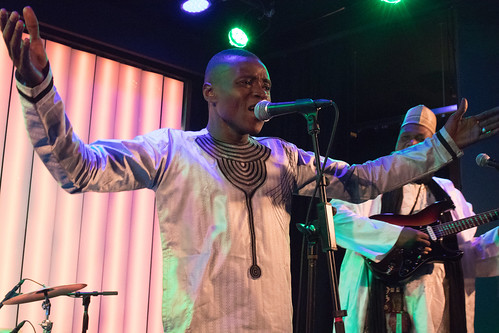
Tag: Womad Festival

New Video: Introducing the Hypnotic Grooves and Visuals of Niamey, Niger’s Tal National

Currently composed of Almeida (guitar), Babaye (guitar), Tafa (guitar), Massaoudo (vocals), Souleymane (vocals), Maloumba (vocals), Seidou (vocals), Dalik (vocals), Yac Tal (bass), Essa (bass), Omar (drums), Souleymane (drums), Aboullay (drums), Sgt. Maty (drums, vocals), the Niamey, Niger-based collective Tal National features a rotating cast of collaborators that represents their homeland’s diverse array of cultures with members from their homeland’s Songhai, Fulani, Hausa and Tuareg populations. Interestingly, the collective have developed a reputation for joyous and hypnotic, West African guitar music that draws from the diverse musical cultures of Niger as their work possesses elements of highlife, Afrobeat, kora, Tuareg blues, Malian griot, Hausa rolling 12/8 rhythms and so on, as well as American psych rock delivered with virtuoso precision and unrelenting energy.

The band’s 2013 debut effort was released through FatCat Records to critical acclaim from the likes of The New York Times, The Guardian, The Independent, Mojo, Vice and The Wire, with frenetic live sessions on NPR, KEXP and WBEZ. Building upon a growing international profile, the band received praise from the likes of Pitchfork, Afropop Worldwide, The Fader, The Quietus, The Boston Globe and NPR.

Released last Friday, Tantabara, Tal National’s third album continues their ongoing collaboration with Chicago, IL-based engineer Jamie Carter on production and engineering duties, and the album which was recorded in the collective’s hometown of Niamey, Niger. Unsurprisingly, the album find the collective furthering their expressed mission of making a global audience dance to their hypnotic grooves, all while focusing on capturing the energy and vibe of their live sound to tape. Much like their counterparts, the collective have managed to create a huge sound of extremely limited resources, which frequently means that the members of the collective record in a remote, recording rid in a dusty, makeshift studio, working with minimal recording equipment and instruments on the verge of disrepair. Interestingly, the collective credits their songwriting and recording process to adding to their overall communal spirit, with opening their home up as a studio as a way for everyone within the group to be involved; in fact, Tantabara’s 8 tracks features 8 different vocalists — 7 of whom are full-time members.
 
Additionally, the album finds the collective looking back on a busy and influential period of time spent honing their live and recorded sound drawing from a number of Stateside tours, live sets at WOMAD Festival and Roskilde Festival and their legendary 5 hour plus live shows at their Niamey nightclub.
 
Tantabara’s latest single “Akokas,” much like the bulk of their work is centered around a tight danceable yet trance-like groove, some blistering and virtuoso guitar work and complex polyrhythm but at its core is much-needed celebration of diversity, acceptance and tolerance — and along with that, two larger, universal messages: that music is a powerful, unifying force and that there’s love, freedom, acceptance on the dance floor, if you let go of your preconceived notions and let the moment.
 
The recently released video for “Akokas” features wild and psychedelic visuals of the band’s members performing the song, capturing the band’s ebullient and euphoric spirit and the song’s trippy grooves.
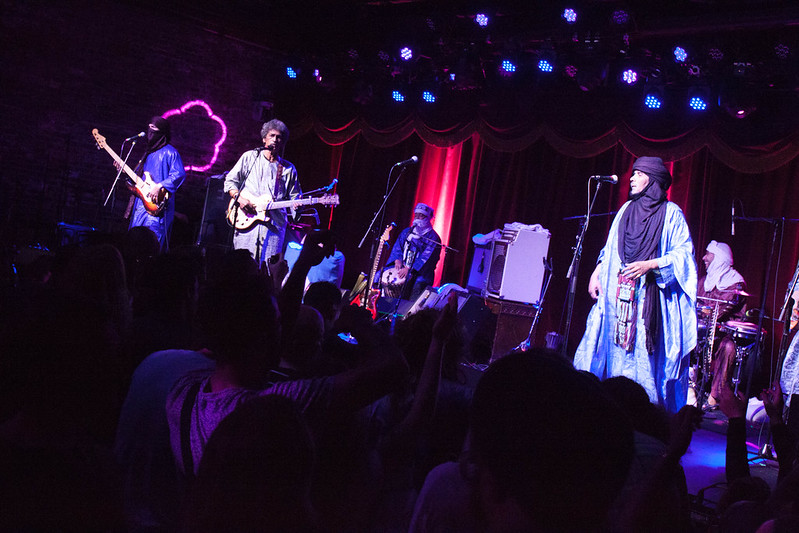
Led by its Rochester, NY-born, Brooklyn-based bandleader dholi, drummer and composer Sunny Jain (a dhol, is a shoulder slung, two-headed drum, typically one of the main instruments of bhangra), who has  recorded several jazz albums with his Sunny Jain Collective and has collaborated with Norah Jones, Peter Gabriel, Q-Tip, and the acclaimed Pakistani Sufi rock band Junoon and others; and featuring John Altieri (sousaphone), Ernest Stuart (trombone), Jonathon Haffner (saxophone), Sonny Singh (trumpet), Chris Eddleton (drums), Rohin Khemani (drums), and newest member Jonathan Goldberger (guitar), the newly-constituted Brooklyn-based octet Red Baarat, whose name derives its name from a baraat, a wild wedding procession that Jain explains in press notes includes a groom on top of a horse, extended friends and family singing and dancing, usually led by a brass band and for what the color red symbolizes in both Indian and American culture. (Red is typically worn at traditionally Indian weddings and symbolizes fiery passion; the sort of passion that Jain and company have towards music and the passion they elicit from listeners.)

Although the band formed back in 2008, with the release of their critically applauded and commercially successful sophomore effort, Shruggy Ji, the members of the Brooklyn-based collective developed a national and international profile for a seamless, genre and boundary-defying sound that draws from Indian classical music, bhangra, hip-hop, rock and pop with rousingly anthemic hooks and a dance floor friendly funk, based around Jain’s utopian vision and faith that communication across cultures simply takes empathy, creativity, love and a willingness to surrender to the spirit of music, art — and of the moment. And as a result of Shruggy Ji‘s critical and commercial success, the band has played some of the world’s biggest, most renowned music festivals, including Bonnaroo, Austin City Limits, Hardly Strictly Bluegrass, New Orleans Jazz & Heritage Festival and Peter Gabriel’s WOMAD Festivals in Australia, New Zealand and the UK, played sold out headlining shows at the Luxembourg Philharmonic, the Bowery Ballroom and have performed at the request of The White House, TED and the Olympic Games. Considering that we’re living in a presidential administration that is ruled around hate and distrust of outsiders and others, Jain and company’s mission seems not just hopeful; but proudly, defiantly revolutionary.

The band’s forthcoming (and much-anticipated) third full-length effort Bhangra Pirates is the first album with the band’s latest addition, guitarist Johnathan Goldberger, who adds psychedelic and surrealistic textures and percussive guitar lines. Additionally, the band has played a bit with their sound as the dhol and sousaphone also have been processed in a subtle fashion —  while retaining the enormous, propulsive, tribal stomp and equally enormous New Orleans brass-leaning horn section that won them international attention as you’ll hear on the rousing single “Bhangale,” which features guest spots from Delicate Steve. What has personally won me over with their sound  — and you’ll hear it on “Bhangale” is that there’s a sweaty, “you-are-there” improvised feel, in which the musicians seem to quickly get into a sustained and forceful groove and follow it and each other to its inevitable conclusion. And frankly, if it doesn’t make you get up and start stomping around and shouting along with them, there’s something wrong.


New Video: The Breezy Tropicalia of Santiago de Cuba’s Septeto Santiaguero

With the release of 8 full-length albums, the 3 time Cubadisco Award-winning, 2 time Latin Grammy-nominated Santiago de Cuba-based septet Septeto Santiaguero have developed an internationally recognized profile for a sound that draws from the […]