Category: African Music

Live Footage: Imarhan Perform Album Single “Tamudre” in Upcoming Documentary on Taureg Life

Comprised of Iyad Moussa “Sadam” Ben Abderahmane, Tahar Khaldi, Hicham Bouhasse, Abdelkader Ourzig and Haiballah Akhamouk, the Tamanrasset, Algeria-based quintet Imarhan formed back in 2008 and are among a newer generation of Tuareg musicians, who have yet to fight in the conflicts that have devastated Saharan Africa over the past 3 or 4 decades. Interestingly, the band has been mentored by members of internationally renowned Tuareg collective Tinariwen, while developing a reputation across the Tuareg world and elsewhere for pairing the ancestral tamashek poetry and rhythms of their elders with the much more contemporary sounds that reflect their urban upbringings, listening to a wide variety of music from across the globe. 

With the 2016 release of the Algerian quintet’s critically applauded, self-titled debut album, they quickly became a buzz-worthy act with a growing internationally recognized profile that found them opening for a number internationally renowned touring acts including Kurt Vile, the aforementioned Tinariwen, Songhoy Blues and Mdou Moctor at venues across the US, the European Union and China. Building upon a growing profile, Imarhan’s forthcoming and highly-anticipated sophomore album Temet is slated for a February 23, 2018 release through City Slang Records — and the Patrick Votan and Eyadou Ag Leche-produced album derives its name from the Tamashek word for “connections,” which shouldn’t be surprising as the album reportedly is an urgent wake up call to the listener, meant to remind them that we are all deeply connected and without unity and understanding, that we will never be able to solve our world’s most urgent and pressing connections — i.e., environmental destruction, inequality, racism, growing strife and conflict, etc. As the band’s Ben Abderahmane said in press notes some time ago, “People should love each other. They need to know each other, we need to know each other, everyone should get to know their neighbor. We need to have the same approach as our elders,” he continues. “You will stumble across an old man who knows the world and will hand down his knowledge to his children.”

Now, if you’ve been frequenting this site over the past few months, you may recall that the album’s first single “Azzaman” was a meditative, hypnotic yet subtly contemporary take on the region’s desert blues sound that nods at psych rock — while thematically the song focuses on the passing of time and the handing over of a heritage and traditions by each successive generation, and the importance of leaving the right legacy. But along with that, the song makes a point of connecting different cultures of mixing the old and the new in a sensible way. Temet’s second single “Tamudre” consists of a hypnotic and downright propulsive groove, punctuated with layers of percussion (both drumming and handclaps), call and response vocals and some impressive guitar work. Naturally, the song manages to remind me quite a bit of Tinariwen’s “Sustanaqqam” and “Adounia Ti Chidjret” but with a loose, bluesy vibe. 

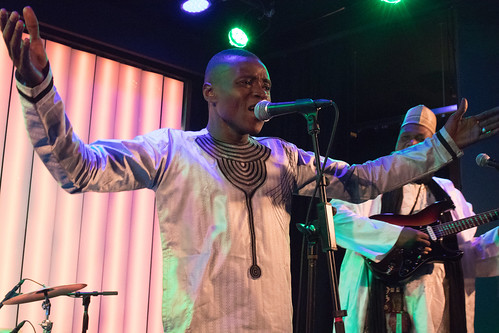
As for the recently released live footage, the Parisian, independent filmmaker Vincent Moon set out of Algeria earlier this year, equipped only with a camera. ‘I never ever film with an object in mind,” Moon explains in press notes. “It’s more about letting it go and let[ting] the object materialize by itself. Interestingly, in this case, wound up being the members of Imarhan, who at the time, were in the middle of working on the material, which would comprise Temet. Moon followed the band for two weeks, documenting hours of music, conversations and pictures in Tamanrasset and within the neighboring mountain ranges, specially the Assekrem (Tamashak for “World’s End”) within the larger Hoggar Mountains in Southern Algeria. The end result is an hour-long documentary film Children of Tam, which is a portrait of the band and of the Tuareg people, capturing these proud people in their daily lives — and interesting enough, the documentary features live footage of the band performing album single “Tamudre” in their hometown. 

New Audio: Seun Kuti and Egypt 80 Team Up with The Legendary Carlos Santana on a Funky and Powerful New Single

Lagos, Nigeria-born and-raised multi-instrumentalist, bandleader and singer/songwriter Seun Kuti is the youngest son of the legendary and controversial Afrobeat pioneer Fela Kuti. And as the story goes when Seun was nine, he expressed a desire to perform with his father — and within a short time, Seun started performing with his father’s backing band Egypt 80. Much like his older brother, Femi, Seun Kuti has followed the political and social ethos of his late father, continuing to push their father’s pro-Black, pan-African/pan-African Diaspora, anti-colonialist, sociopolitical messages to wider, international audiences. Oddly enough, during Fela’s life, he was in many ways the bane of the Nigerian political establishment, as he bravely called out the hypocrisy, inequality, inequity, corruption and brutality that they and their fellow countrymen faced on a daily basis — while pointing out that corruption and brutality is always the same.

However, with increasing international attention on both Fela and his sons over the past 20 years, the Kutis have managed to walk a careful tightrope of siding with the little guy and courageous speaking truth to power at all costs, including risk of life and limb while also becoming unofficial ambassadors to Nigeria, their proud and beautiful people and their culture. Around the time, I started this site, I caught Femi Kuti and Positive Force at Irving Plaza and there was a proud contingency of Nigerians, who spoke of Femi and his father with proud, reverential terms, at one point referring to Femi as “Professor!” “Speak Professor, Speak!” They would exclaim whenever Femi would say something that resonated with them. In some way, I was reminded of how older Jamaicans speak of Bob Marley.

Fela died in 1997 when Femi was 35 and Seun was just 14. Almost immediately upon his father’s death, Seun took over the frontperson duties of his father’s legendary backing band, a band that features members of his father’s backing bands Afrika ’70 and Egypt 80 — many of whom were with Fela, when he was speaking out about the Nigerian government at a time, when doing so could mean risking jail, brutal beatings an/or death. And interestingly enough, Seun’s 2008 debut effort Many Things was produced by Martin Meissonnier, who produced two of Fela’s albums.

Now, as you may know live, Seun Kuti has developed a reputation for sets being a fair mix of his own original material, along with covers of his father’s material, and because his father rarely (if ever) performed songs he recorded in the studio live, Seun covering his father’s material is often seen as an opportunity for fans to hear songs like “Water Get No Enemy,” “Shuffering and Shmiling,” “Colonial Mentality” and “Army Arrangement” live — and with a dynamism that rivals that of his late father.

Seun Kuti’s fourth album with Egypt 80, Black Times is slated for a March 2, 2018 release through British label Strut Records, and the new album reportedly finds Seun and company honoring the revolutionaries who have come and gone before while being a much needed rallying cry for the torchbearers to come. And to further emphasize that theme, the album finds Seun and the legendary Egypt 80 collaborating with a list of acclaimed musicians and artists, including Carlos Santana and Robert Glasper, among others. As Seun Kuti explains in press notes, “Black Times is a true reflection of my political and social beliefs. It is an album for anybody who believes in change and understands the duty we have to rise up and come together. The elites always try to divide the working class and the poor people of the world. The same oppression felt by workers in Flint, Michigan is felt by workers in Lagos and Johannesburg.”

The funky yet blistering album title track and first single “Black Times” features the imitable guitar work of Carlos Santana in a song that’s meant to shine a black light on society, exposing its rot, immorality and hypocrisy while pointing out the need for Black folk all over the world to band together and demand justice and inequality for all people. But beyond that it suggests that everyone needs to take a serious look at themselves and their world in order to truly begin to change it — and while it may be hard work, it’s necessary work to make the world better.

Akuba Records is a new label, whose mission is to bring listeners the very best deep, cosmic, soulful and funky disco music out of their Africa, and their debut release is a split release between He’s The Man and Atik-A. The A side single He’s The Man’s “Squeeze  Me Tight” is an old school club banger, reminiscent of Parliament Funkadelic, Heatwave and oddly enough 45:33-era LCD Soundsystem, as the track features propulsive drumming, a sinuous bass line, an enormous brass section, soulful Lou Rawls-like vocals, complete with a sultry backing section, arpeggiated keys and trippy analog effects — with the end result being something both tribal and cosmic.


With the release of 2004’s, critically applauded sophomore effort Totobonalokua, the collaborative trio Toto Bona Lokua, comprised of French singer/songwriter Gerald Toto, Cameroonian jazz musician Richard Bona and Congolese singer/songwriter Lokua Kanza received international attention in world music circles for a sound that effortlessly blended traditions, cultures and languages  — and interestingly enough, the album was a commercial success in France, despite little promotion and no tour dates.

Since the release of Totobonalokua, the members of the trio have pursued a series of diverse solo projects, which kept them incredibly busy but throughout that period of time, each member of the trio would be regularly be asked by fans and the press when they would reunite to make a new album — or if they were plans to do so. Interestingly enough, although the trio’s paths seldom crossed, they managed to keep in touch, and as as the story goes, Gerald Toto eventually suggested that it might be time to get together and write new album. Of course, his collaborators and friends Bona and Kanza readily agreed. Understandably, it took some time to synchronize the schedules of three very busy people but eventually they found some time to write and record their forthcoming effort Bondeko, which derives its names from the Lingala word for “friendship” or “fraternity.”

Slated for a January 19, 2018 release through French record label Nø FørmatBondeko reportedly picks up where its predecessor left off but with the material managing the delicate balance of being nuanced and finely crafted, virtuosic yet spontaneous, playful yet profound — and they do so while retaining the gorgeous layered harmonizing and boundary blurring sound that won them international attention. In fact, Bondeko‘s first single “Ma Mama” finds the trio meshing the breeziness of Bossa nova with traditional African vocal chants in a way that will remind some listeners of Bobby McFerrin and of Crosby Stills and Nash; but perhaps more importantly, the trio manage to bridge the African Diaspora with a unique vision that’s both playful and compellingly profound.


New Audio: Here Lies Man Releases a Psych Rock Cover of Fela Kuti’s “Sorrow Tears and Blood”

With the release of their self-titled full-length debut earlier this year, the Los Angeles, CA-based act Here Lies Man founded by Marcos Garcia, who was a member of renowned Afrobeat act Antibalas and featuring fellow Antibalas bandmates Chico Mann (guitar, vocals) and Geoff Mann (drums), along with Rich Panta (percussion), JP Maramba (bass) and Kris Casto (organ), have developed a reputation for a sound that seamlessly bridges classic, Fela Kuti-era Afrobeat with classic, Black Sabbath and Led Zeppelin-era rock. 

Building upon a growing national profile, the band will be releasing a 12 inch EP Animal Noises, which is slated for release on Friday through RidingEasy Records, and the EP’s first single is a psych rock cover of Fela Kuti’s “Sorrow, Tears and Blood” that manages to retain the song’s melody and furious outrage while turning into an blistering, arena rock-friendly jam. 

New Video: Up-and-Coming Tuareg Band Imarhan Release Meditative Sounds and Visuals on Modern Taureg Life in “Azzaman”

Comprised of Iyad Moussa “Sadam” Ben Abderahmane, Tahar Khaldi, Hicham Bouhasse, Abdelkader Ourzig and Haiballah Akhamouk, the Tamanrasset, Algeria-based quintet Imarhan formed back in 2008 and while being among a newer generation of Tuareg musicians, who haven’t fought in the various conflicts that have devastated the region; however, since their formation, the band, which has been mentored by internationally renowned Tuareg act Tinariwen, has developed a reputation across the Tuareg world and elsewhere for pairing the ancestral tamashek poetry and traditional rhythms of their elders with contemporary sounds that reflect their urban upbringings, listening to a variety of music from around the globe. (Interestingly, the connection to Tinariwen is not just a generational one of acclaimed elders wanting to pass their wisdom on to the young, new breed; it’s actually familial, as Tinariwen’s Eyadou Ag Leche is Ben Abderahmane’s cousin.)
 
In fact, with the release of their 2016, critically applauded, self-titled debut album, the band quickly became a buzz-worthy act with a growing profile that found them opening for the likes of Kurt Vile, the aforementioned Tinariwen, Songhoy Blues and Mdou Moctor at venues across the US, the European Union and China. And building upon that growing profile, the band’s highly-anticipated sophomore effort Temek, derives its name from the Tamashek word for “connections” and the Patrick Votan and Eyadou Ag Leche-produced album, which was recorded earlier this year in Paris reportedly is a urgent wake up call to the listener, reminding them that we are all connected and that without unity, we will never be able to solve our world’s most pressing problems — i.e., environmental destruction, inequality, racism, growing strife and conflict, etc. As the band’s Ben Abderahmane says in press notes, “People should love each other. They need to know each other, we need to know each other, everyone should get to know their neighbor. We need to have the same approach as our elders,” he continues. “You will stumble across an old man who knows the world and will hand down his knowledge to his children.” But along with that message, the album finds the band pushing their sound to include elements of funk, disco and rock; in fact, the album’s first single “Azzaman” is a mediative and hypnotic yet subtly contemporary take on the region’s famed desert blues sound, as the song finds the band hinting at psych rock, thanks to some impressively blazing guitar work.
 
Directed by Visions Particulières and filmed in Algiers, Algeria, the recently released video for “Azzaman” offers an equally meditative glance at Tuareg life, pointing out that while some things are understandably different culturally and linguistically, we share much more similarities than we expect. After all, people struggling to get by daily with their dignity intact is universal; and in fact, if you were watching the video in mute, it wouldn’t be until you saw the street scenes that you’d notice anything wildly different. As the band explains, the video’s concept “is about the passing of time and the handing over of a heritage by each generation. It’s about the importance of leaving the right legacy. It’s also about connecting the cultures, the mixing of the old with the new. The video was shot in Algiers to reflect the meaning behind the song, it’s a big cosmopolitan city, an urban environment which culturally offers a lot yet it’s still a place in which we can keep on preserving some Tuareg ways of life.”


Comprised of frontwoman and guitarist Fatou Seidi Ghali, Alamnou Akrouni and Madassane Ahmoudou, Les Fillies de Illighadad hail from Illighadad, a secluded and remote, rural commune in central Niger, near the edge of the Sahara Desert that’s only accessible via a grueling drive through the open desert. There’s little modern infrastructure in the village, and the town lacks electricity and running water with the surrounding countryside supporting hundreds of shepherd families, living with and among their herds of livestock, as their ancestors have done for centuries.

The sound that has long defined rural Niger is known as tende which derives its name from a drum built from goat skin stretched across a mortar and pestle and is rooted in sparse arrangements featuring vocals, handclaps and percussion while thematically, songs focus on life in the village, love and praise of ancestors. And interestingly enough, it’s a genre and style largely dominated by women; in fact, long known as being both collective and communal, tende is a specifically a tradition for the young girls of the nomad camps — and typically, tende is played during celebrations and to pass time during the rainy season. Now, if you’ve been frequenting this site over the past few years, you’d recall that there have been certain genres of Tuareg music that have received international attention from music journalists and fans in the West and elsewhere — in particular, the desert blues, pioneered by acts like Tinariwen, Bombino and Mdou Moctar have become synonymous with Tuareg music and culture to the West; however, music rooted in the use of the electric guitar is a relatively recent phenomenon with exiled Tuareg living in Libya and Algeria, who had also been equally influenced by Western rock, funk and punk rock began using instrumentation to mimic female vocalists. Out of necessity they replaced traditional tende percussion with plastic jerrycans. Naturally when those exiles returned to their ancestral homeland, they brought their new sound with them, and in time the new guitar sound came to eclipse tende — especially in urban centers. With tende being primarily sung by women, the desert blues was the male counterpart, and the Tuareg guitar scene is largely dominated by men.

Interestingly Les Filles de Illighadad’s Fatou Seidi Ghali is an extreme rarity — she’s one of the only female Taureg guitarists in Niger. As the story goes, Ghali would sneak away with her older brother’s guitar and taught herself how to play, and while being groundbreaking within her culture, it’s also a bold way of reasserting the role of tende and of women in Tuareg music; but while employing the use of electric guitar, they manage to use the traditional drum and a calabash half-buried in water instead of the more contemporary djembe or drum kit.  The trio’s full-length debut effort Eghass Malan was recorded while they were on their first European tour — and after a handful of shows. And as you’ll hear from the album’s latest single and album title track “Eghass Malan,” the trio recorded the song and the rest of the album’s material with a sort of impromptu minimalism of a band jamming together, thanks in part to rather bare bone arrangements of twisting, turning and hypnotic guitar lines, multi-part harmonies, simple yet driving rhythms and handclaps but with a clean, effortless production sheen — and although recorded in the modern fashion, the song points to a much more timeless and ageless sound that goes back to our nomadic and tribal origins while pushing an entire culture in a new direction.


New Video: Introducing The Darkly Seductive Sounds and Visuals of London’s Hana Piranha

With the release of their debut album Cold Comfort, the London-based rock quartet Hana Piranha, comprised of Hana Maria (vocals, violin), James Bulbeck (guitar), Will Brown (bass) and Samuel de Brozie-Ward (drums) quickly developed a reputation across the UK for a sound that paired muscular power chord-based riffs, anthemic hooks, bursts of razor sharp violin and snarling vocals — and unsurprisingly their sound had been compared to Kittie covering AC/DC with a violin and Juliette Lewis as well as to their influences Garbage, Nine Inch Nails, Marilyn Manson, PJ Harvey and others.

Building upon the buzz that their debut received, the London-based quartet have been releasing singles off their sophomore album Fishing with Dynamite, and as you’ll hear with the album’s latest single “Slave,” the band  will further cement their reputation for crafting muscular goth-inspired rock with a seductive air and anthemic hooks but while subtly expanding upon their sound, as the song finds the band nodding at 70s glam rock. 

Directed and edited by Arron West, the recently released video splits between segments of the band performing the song in a dark studio with some highly symbolic, BDSM-based imagery. 

Now known as the Federal Republic of Somalia, most Westerners view the country as being a lawless, dysfunctional and broken country, split and reeling from a brutal and bloody civil war between two or three different factions — and while that has been true over the past 25-30 years, what Westerners and others have sadly forgotten is that because of its location,the Eastern African nation for known for more than a millennium for being a major trading post, with several powerful Somali empires dominating regional trade, including the Ajuran Empire, the Adal Sultanate, the Warsangali Sultanate, and the Geledi Sultanate. And as one of antiquity’s major trade posts, the cultures and peoples of the Arabian Peninsula, Persia, India, Southeast Asian and China found a way to influence and slowly work their way into the region’s unique musical culture and sound.

In the late 19th century, the British and Italian empires through a series of treaties with Somalia’s historical empires and sultanates gained greater control of parts of the country’s coastline, establishing the colonies of British Somaliland and Italian Somaliland while Mohammed Abdullah Hassan’s Dervish State fought and defeated the British four times before a crushing defeat by the British in 1920. Italy, then acquired full control of the northeastern, central and southern parts of the country after defeating the Majerteen Sultanate and the Sultanate of Hobyo — and their occupation of the country lasted until 1941 when the British took over with a military administration. British Somaliland would remain a protectorate of the British while Italian Somaliland became a United Nations Trusteeship under Italian administration, the Trust Territory of Somaliland.

Throughout the late 1950s and 1960s, independence movements across Africa helped to redefine the map; in fact, by 1960 Italian Somaliland and British Somaliland united in 1960 to form the Somali Republic under a civilian and democratic based government. Sadly, democratic government didn’t last long; by 1969, the Supreme Revolutionary Council led by authoritarian Mohamed Siad Barre seized power and established the Somali Democratic Republic.

Now that I’ve gone through roughly 1000 years or so of Somali history in a couple of hundred words, things musically for us begin in more contemporary times — 1988. You see, back in 1988 on the eve of a bloody, two-decade civil war, Siad Barre launched a series of punishing air strikes in Somalia’s northern region, known known as Somaliland in an attempt to smash a growing independence movement within that region of the country.

Musically speaking things for us begin in relatively contemporary times — 1988. On the eve of a bloody, two decade plus civil war, Siad Barre launched a series of punishing air strikes in Somalia’s northern section, now known as Somaliland in an attempt to squash a rumbling independence movement within the region. Unsurprisingly, one of the targets Said Barre targeted for airstrikes was the regional radio station Radio Hargeisa, as a way to prevent the organization of further resistance. Knowing that an attack on their radio station and their hometown was imminent, a handful of radio operators, tastemakers and historians recognized that they needed to preserve more than 50 years of modern Somali music as quickly as possible — and it meant finding a way to remove thousands upon thousands of cassette tapes, records and master reels and then dispersing them to neighboring countries like Djibouti and Ethiopia — or in many instances, burying the tapes deep underground to protect them from theft, airstrikes, fire and so on.

The Somali Civil War broke out in 1991 and it resulted both the collapse of Mohamed Siad Barre’s government and a number of armed factions fighting for influence and control throughout the country’s southern region. With the absence of a central government, Somalia quickly began to known as a failed state with residents returning to customary and religious law in most regions, along with a couple of autonomous regions — namely Somaliland and Puntland. But interestingly, the early part of the millennium saw the creation of several fledgling and sputtering federal administrations, including the Transitional Federal Government, which in 2004 reestablished national institutions such as the military. And with the assistance of Ethiopian troops, the Transitional Federal Government assumed control of the country’s southern conflict zones, beating back the Islamic Courts Union, which eventually splintered into a several radical Islamicist groups, including Al-Shabaab, a group that continued an ongoing battle with the Transitional Federal Government and the African Union Mission in Somalia (AMISOM) for control of the region and its territory.

By 2012, insurgent groups had lost most of the territory they had seized, and a political process that provided benchmarks for the establishment of a permanent democracy  — and it included the drafting of a provisional constitution, which reformed Somalia as a federation. At the end of that lengthy process was the creation of the Federal Government of Somalia, the first permanent government in the country in well over 20 years, followed by a period of necessary and hopeful reconstruction in Mogadishu.

Remember those audio recordings that the engineers, programmers, historians and tastemakers dispatched to Djibouti and Ethopia and buried in various locations across the region? Interestingly enough, those recordings were recently excavated from their shelters with some of those recordings being kept in the 10,000 cassette tape archives of the Red Sea Foundation, the largest known collection of Somali music and cassettes, located in Somaliland’s capital Hargeisa. (Yes, things do and can come full circle.)

Ostinato Records, best known for the preservation, digitalization, and distribution of obscure world music was able to digitized a significantly large portion of the Red Sea Foundation’s archives, choosing 15 songs as part of their latest compilation of African music Sweet as Broken Dates: Lost Somali Tapes from the Horn of Africa. And while revealing the diversity of styles and sounds of Somali musicianship, the compilation also provides a glimpse of life in Mogadishu in the 1970s and 1980s, when the coastal capital was referred to as the “Pearl of the Indian Ocean.” At the time bands like Iftiin, Sharero and Dur Dur played at some of East Africa’s glitziest nightclubs, while Waaberi Band played packed to the rafter sets at the national theater.  Nightlife, music, culture and art were enormous — and interestingly while there were renowned male vocalists like Mahmud “Jerry” Hussen, Somali music of the 70s and 80s were best known for beloved female vocalists Faadumo Qaasim, Hibo Nuura, Sahra Dawo and a collection of truly empowered, prolific women; in fact, half of the compilation features songs sung by and written by women.

This cultural and musical golden age occurred under a socialist, military dictatorship, which effectively nationalized the country’s music industry. The state owned a thriving scene and essentially music was recorded for and by national radio stations, and it was distributed and disseminated through public broadcasts or live performances. Privately owned labels were non-existent and the work of a generation of artists was never made available for mass release in the way it is elsewhere — and until recently, hadn’t been heard outside of Somalia or its immediate neighbors. Most of that period, Somali music was largely influenced by the cultures and people who traveled to the region throughout its history as a major trade port; however, during the height of the Cold War, Somalia had periods of financial and logistical support by both the Soviets and the US in the Ethio-Somali War — and with about a decade of US backing, American soul, funk and hip-hop captured the imaginations of Somali youth, adding to a unique element to the country’s musical culture and sound.

While compiling the tracks on Sweet as Broken Dates: Lost Somali Tapes from the Horn of Africa, members of the Ostinato Records team spent the better part of a year traveling back and forth between Mogadishu, Hargeisa, Djibouti and across the Somali Diaspora in parts of Europe, the US and the Middle East to track down the musicians, songwriters, composers, government officials, scenesters, radio personalities and other folks, who had played a role during the 1970s and 1980s and got their stories down in a detailed, 15,000 word liner note booklet.


As the folks at Obstinato Records explain in press notes “Along side the story of Somalia’s music before the civil war, the selection is also focused on the pan-Somali sound. Spread over much of the Horn of Africa, Somali language and culture transcend arbitrary borders. Somali singers from Djibouti were at home in Mogadishu.” They add that “this compilation  seeks to revive the rightful image, history, and identity of the Somali people, detached from war, violence, piracy, and the specter of a persistent threat.”

Now, as you may recall, the compilations’ first single Danan Hargeysa’s “Uur Hooyo (Mother’s Womb)” feat. Mohamed “Huro” Abdihashi was recorded and released back in 1987 and the breezy confection nods at the trippy psychedelia of dub and dubstep as the collaborators pair a shuffling, two-step-like rhythm with explosive blasts of horn, shimmering synths, Nile Rodgers-like guitar and a strutting bass line, and while revealing an obvious reggae and calypso influence, the song possesses an undeniably sunny and funky vibe. Recently, the folks at Ostinato Records released two more singles from the compilation, Aamina Camaari’s “Rag waa Nacab iyo Nasteexo (Men are Cruel and Kind)” and Sharaf Band’s “Kadeed Badanaa Naftaydani (My Life is Full of Tribulations)” feat. Xawoo Hirraan in anticipation of its official release on August 25, 2017.

Aamina Camaari’s “Rag waa Nacab iyo Nasteexo (Men are Cruel and Kind)” is an achingly gorgeous and slow-burning lament of a song that pairs Camaari’s ethereal and plaintive vocals with a lush and soaring Middle Eastern and Indian-inspired string arrangement and percussion and Casio synthesizer-like beats that dimly reminds a bit of Omar Souleyman, The Bombay Royale and JOVM mainstays Tinariwen while being absolutely unlike anything I can quite describe; but at its core is an an ancient and timeless ache. Sharaf Band’s “Kadeed Badanaa Naftaydani (My Life is Full of Tribulations)” feat. Xawoo Hirraan is a swaggering and funky track that manages to sound as though it drew influence from Afrobeat and American soul and funk; but much like the preceding single, it features the ethereal and plaintive vocals of Xawaoo Hirraan, which give the song a similar ache.

Certainly, all three tracks from the forthcoming compilation evoke a far simpler time full of laughter, flowing beer and wine, of dancing until the sun came up and walking home in a drunken and elated shuffle, with arms draped over the shoulders of a companion or two, softly singing — and of sad love songs that speak directly to the lonely heart. No matter the language, it’s the sound of fleeting youth and swooning hearts before life’s ambiguities and horrors.


Now known as the Federal Republic of Somalia, Westerners view the country as being a lawless, dysfunctional and broken country, split and reeling for a brutal and bloody civil war, and while that has been true over the past 25-30 years, what most people have forgotten is that for roughly a millennia, the Eastern African nation was one of antiquity’s major trading posts with several power Somali empires dominating regional trade, including the Ajuran Empire, the Adal Sultanate, the Warsangali Sultanate, and the Geledi Sultanate. And as a major trading post, the cultures of the Arabian Peninsula, Persia, India, Southeast Asian and China, all of whom conducted trade with the Eastern African nation, managed to influence and slowly worked their way into Somalia’s rich and unique musical culture.

The British and Italian empires through a series of treaties with Somalia’s historical empires and sultanates during the late 19th century gained greater control of parts of the coast, establishing the colonies of British Somaliland and Italian Somaliland while Mohammed Abdullah Hassan’s Dervish State fought and defeated the British four times before a crushing defat by the British in 1920. Italy acquired full control of the northeastern, central and southern parts of the country after defeating the Majerteen Sultanate and the Sultanate of Hobyo — and their occupation of the country lasted until 1941 when the British took over with a military administration. British Somaliland would remain a protectorate of the British while Italian Somaliland became a United Nations Trusteeship under Italian administration, the Trust Territory of Somaliland.

In the 1960s, independence movements across the continent helped redefine the map with Italian Somaliland and British Somaliland uniting in 1960 to form the Somali Republic under a civilian government. Sadly, democratic government didn’t last long; by 1969, the Supreme Revolutionary Council led by authoritarian Mohamed Siad Barre seized power and established the Somali Democratic Republic. Now, here’s where things musically for us begin — in 1988 on the eve of bloody, two decade civil war Siad Barre launched a series of punishing air strikes in Somalia’s northern section, now known as Somaliland in an attempt to squash a rumbling independence movements in the region. Unsurprisingly, one of the targets Siad Barre targeted was the regional radio station Radio Hargeisa, as a way to prevent the organization of further resistance. Knowing that an attack on their radio station and their hometown was imminent, a handful of radio operators, tastemakers and historians recognized that they needed to preserve more than 50 years of modern Somali music — and it meant finding a way to remove thousands upon thousands of cassette tapes, records and master reels and then dispersing them to neighboring countries like Djibouti and Ethiopia, sometimes burying the tapes deep under the ground to protect them from airstrikes, fire, and so on.

The Somali Civil War broke out in 1991 and Mohamed Siad Barre’s government collapsed and as a result a number of armed factions began fighting for influence and control, particularly towards the south. And because of the absence of a central government, Somalia began to be known as a failed state, wth residents returning to customary and religious law in most regions. There were a few autonomous regions towards the north, including Somaliland and Puntland. The early part of the millennium saw the creation of several fledging and sputtering federal administrations including the Transitional Federal Government in 2004, which reestablished national institutions as as the military and in 2006 with the assistance of Ethiopian troops, assumed control of the Eastern African nation’s southern conflict zones from the Islamic Courts Union, which eventually splintered into several radical groups such as Al-Shabaab. Al Shabaab in particular continued to battle the Transitional Federal Government and the African Union Mission in Somalia (AMISOM) for control of the region.

By 2012, insurgent groups had lost most of the territory they had seized and a political process providing benchmarks for the establishment of a permanent democracy was launched, and it included a provisional constitution, which reformed Somalia as a federation. The end result was the Federal Government of Somalia, the first permanent central government in over 20 years was formed and a period of reconstruction began in Mogadishu.

Remember those buried audio recordings I mentioned earlier? Well they were excavated and recalled from their foreign shelters very recently, Some of those recordings are now kept in the 10,000 cassette tape achieve of the Red Sea Foundation, the largest known collection of Somali music and cassettes in the world in Somaliland’s capital Hargeisa. Ostinato Records, best known for the preservation, digitalization, and distribution of obscure world music was able to digitized a significantly large portion of the Red Sea Foundation’s archives, choosing 15 songs as part of their latest compilation of African music Sweet as Broken Dates: Lost Somali Tapes from the Horn of Africa. And while revealing the diversity of styles and sounds of Somali musicianship, the compilation also provides a glimpse of life in Mogadishu in the 1970s and 1980s, when the coastal capital was referred to as the “Pearl of the Indian Ocean.” At the time bands like Iftiin, Sharero and Dur Dur played at some of East Africa’s glitziest nightclubs, while Waaberi Band played packed to the rafter sets at the national theater.  Nightlife, music, culture and art were enormous — and interestingly while there were renowned male vocalists like Mahmud “Jerry” Hussen, Somali music of the 70s and 80s were best known for beloved female vocalists Faadumo Qaasim, Hibo Nuura, Sahra Dawo and a collection of truly empowered, prolific women; in fact, half of the compilation features songs sung by and written by women.

Strangely enough, this cultural and musical golden age occurred under a socialist, military dictatorship, which effectively nationalized the country’s music industry. The state owned a thriving scene and essentially music was recorded for and by national radio stations, and it was on distributed and disseminated through public broadcasts or live performances. Privately owned labels were non-existent and the work of a generation of artists was never made available for mass release — and until recently, hadn’t been heard outside of Somalia and its immediate neighbors. Adding to a rather strange period of history, during the height of the Cold War, Somalia had been supported by the Soviets and then US in the Ethio-Somali War — and with a decade of US backing, American soul and funk captured the imagination of Somali youth and musicians.

The Ostinato Records team then spent the better part of year traveling to Mogadishu, Hargeisa, Djibouti and across the Somali Diaspora in parts of Europe, the US and the Middle East to track down the musicians, songwriters, composers, government officials, scenesters, radio personalities and other folks, who had played a role during the 1970s and 1980s and got their stories down in a 15,000 word liner note booklet.

As the folks at Obstinato Records explain in press notes ” Alongside the story of Somalia’s music before the civil war, the selection is also focused on the pan-Somali sound. Spread over much of the Horn of Africa, Somali language and culture transcend arbitrary borders. Somali singers from Djibouti were at home in Mogadishu.” They continue by saying that “this compilation  seeks to revive the rightful image, history, and identity of the Somali people, detached from war, violence, piracy, and the specter of a persistent threat.”

The compilation’s first single Danan Hargeysa’s “Uur Hooyo (Mother’s Womb)” feat. Mohamed “Huro” Abdihashi was recorded and released in 1987, and the breezy and summery track manages to nod at the trippy psychedelia of 70s dub and soul as a shuffling rhythm is paired with explosive and expressive horn blasts, synths that possess a cosmic sheen, and a strutting bass line. And if there’s one thing the song does evoke is a far simpler time of laughter, constantly flowing wine and beer, of dancing until the sun came up and walking home in a drunken and elated shuffle with arms draped over the shoulders of your comparisons softly singing the songs you heard in the nightclub throughout the night. The language, the scales and the melodies may be somewhat alien to many Westerners, but it’s the wistful tone — albeit in retrospect perhaps? — that should feel familiar. It’s the sound of youth before inevitably being altered permanently by life’s complexities, ambiguities and horrors.


New Video: Introducing the Infectious Positivity of Ivory Coast-born Tel Aviv-based Elisee Akowendo

Yves Elisee Samuel Akowendo, best known as Elisee Akowendo is an Ivory Coast-born, Tel Aviv, Israel-based singer/songwriter and multi-instrumentalist, who grew up in a very religious and very musical home. “I come from a Christian family where music has a very important place,” Akowendo says in press notes. “Every morning, noon and evening, we sang gospel songs.” And as a boy, a young Akowendo discovered his love of rhythm as a drummer at his local church’s youth band, which paved a way of a lifelong passion for music. “I was constantly listening, composing and singing,” the Ivory Coast-born, Tel Aviv-based artist explains in press notes. Interestingly, as the story goes, Akowendo’s church group was invited to tour Israel — and while on our, he realized that he had to make a life altering choice: continue pursuing a master’s degree in business or follow his lifetime dream of becoming a professional musician. The Ivory Coast-born, Tel Aviv-based artist decided to follow his dream and remain in Israel.

Understandably, the transition wasn’t easy for Akowendo as he didn’t speak or understand Hebrew; however, his church and a growing ex-pat Ivory Coast community provided him with a great deal of support. “I met great people, made new friends, and hoped that maybe here I could live from music,” Akowendo said in press notes. Within a short period of time, Akowendo crossed paths with APE Records producer Tamir Muskat, who had discovered the Ivory Coast-born, Israeli-based musician and his band Groove Ambassadors on YouTube. As Muskat recalls, “I was surfing through videos and became mesmerized by this amazing African drummer. Then I saw him jump out from behind the drum kit, and grab the mic. It blew me away. I knew immediately that I wanted to work with him.”

Muskat connected with Akowendo and played him some beats and the duo just immediately connected over music and their mutual passion for creating music; however, for Akowendo, he hadn’t written lyrics before and it was a major challenge for him — an his latest single “I Dey Shina” is the first time that the Ivory Coast-born, Israeli-based artist has written lyrics. And interestingly enough, while he admits that he feels equally comfortable singing in French as he does rhyming in English, much of his latest single is sung in his native dialect, Baoule. “Sometimes it’s easier to express certain emotions in your native language,” he explains of his decision to sing in his native tongue.

Considering the embittering negativity of our world, the song manages to convey an infectious and much-needed positivity; in fact, as Awokendo explains the song was about him looking at his life, seeing how he was living his dream — and thanking God for the fact that he could actually live his dream, while showing others that sometimes we need to be reminded about how we should grateful for what we have. But he also adds that the song also suggests that if you have a dream that you shouldn’t give up on it; that we should invest as much positive energy as possible into our dreams every single second of every day. Additionally, he goes on to say that he hopes to pass along a much bigger message into the world — that we can all live together in peace, if we love and help one another.

Emphasizing such an infectious and positive message is a club-banging production that sounds as though it draws from British grime, soca and industrial electronica as it features stuttering drum programming, hot flashes of hi-hat, some metallic clang and clatter and ambient electronics with an anthemic hook.

Directed by Bonamaze, the recently released music video also radiates a infectious positivity as it features the Ivory Coast-born, Israeli-based artist singing and dancing with an international crew of dancers, complete with bright colors. And honestly, it’s just a ton of fun.

New Video: Tinariwen Reminds Us That Music is a Mighty Weapon

The recently released music video for “Sastanàqqàm” is reportedly inspired by real life events. When the members of the band returned to their homeland in 2006 they spent some time wandering around looking for old friends, associates, family members, neighbors and the like. Roughly 1,000 miles away from their homeland in Northern Mail, the members of Tinariwen came across six young musicians who hailed from M’Hamid el Ghizlane. These boys were the only boys that the members of the collective came across during their visit; but they immediately saw a reflection of themselves, their dreams and aspirations in the music they heard the boys play. In the subsequent years, the boys from M’Hamid el Ghizlane learned the Tinariwen catalog note for note, word for word although they couldn’t speak a word of Tamashek. When the members of the band returned to the town to record the material, which would comprise Elwan, their disciples had displayed a mastery of Tinariwen’s catalog — and the members of the band recognized that they had passed the torch on to their young disciples; in fact, the band decided to invite their disciples to be in the music video for “Sastanàqqàm,” symbolically standing in for the members of the band. The video follows as some of Tinariwen’s elder members wrapped new turbans around the heads of their young disciples, symbolically marking the passage from boyhood and manhood; but also marking how music can be transmitted across generations and influence young men and women to pick up instruments and speak truth to power. Let that serve as a reminder that music and art hold great power — a power that even the most autocratic demagogue can’t possibly stop.