Tag: Ali Farka Toure

New Audio: Acclaimed Norwegian Act Pom Poko Release an Exuberant and Breakneck New Single

Deriving their name from one of the more outre films ever released by Japanese animation studio Studio Ghibli, Pom Poko is a rising Norwegian quartet — Ragnhild Fangel (vocals), Martin Miguel Tonne (guitar), Jonas Krøvel (bass) and Ola Djupvik (drums) — that can trace their origins back to 2016 when the members of the band met while they were studying jazz at Trondheim Music Conservatory, and bonded over their desire to play punk rock at a jazz gig at a literature festival.

Interestingly, the individual members of the rising Norwegian act have publicly cited a wide and eclectic array of influences on their sound and approach, including Oumou Sangare, Ali Farka Toure, Vulfpeck, Palm, KNOWER, Hella, Death Grips, Jenny Hval and Nick Drake among others. And as a result, the act has managed to establish a sound and approach that defies easy description or categorization. “We’ve all done lots of improvised music in the past, and I think that shapes the way we play, even though the tunes are not improvised,” the band explained in press notes. “We like when new and strange things happen in an old song, and that music can change over time by being played live, because that removes predictability and the ‘recipe’ that some genres of music have.”

Last year’s full-length debut Birthday received praise from the likes of Interview Magazine, The Line of Best Fit, The Independent, Clash Magazine, DIY Magazine and NME, who picked the band as one of the acts to watch out for in 2019 — and with the breakneck “My Blood,” a track that possessed elements of math rock, punk rock and indie rock was a great example of their wildly inventive, exuberant sound. Adding to a breakthrough year, the band also received airplay on BBC Radio 6 while landing Norwegian Grammy (Spellemannprisen) Award and Nordic Music Prize nods.

Building upon the momentum of last year, the Norwegian quartet’s highly-anticipated Marcus Forsgren-produced sophomore album Cheater is slated for a November 6, 2020 release through Bella Union Records. Written during the same period that produced one-off singles like “Leg Day” and “Praise,” Cheater finds the band further establishing the sound that has won them national and international acclaim — but the major difference between the two is that Cheater’s material wasn’t road-tested before the band went into the studio.”That meant we had to practice the songs in a more serious way, but it also meant the songs had more potential to change when we recorded them since we didn’t have such a clear image of what each song should/could be as the last time,” Pom Poko’s Ragnhild Fangel explains.

“I think it’s very accurate to say that we wanted to embrace our extremes a bit more. In the production process, I think we aimed more for some sort of contrast between the meticulously written and arranged songs and a more chaotic education and recording but also let ourselves explore the less frantic part of the Pom Poko universe,” Fangel says of the differences between Birthday and Cheater. “I think both in the more extreme and painful way, and in the sweet and lovely way, this album is kind of amplified.”

Cheater’s latest single “My Candidacy” finds the act managed to walk a tightrope between breakneck mosh pit friendly punk, centered around enormous power chords and saccharine sweet verses. Featuring the classic grunge rock alternating loud, quiet, loud song structure, the song explodes with an unpredictable, brash and girlish coquettishness while evoking the swooning rush of love. According to the band “the song itself is about the wish to be able to believe in unconditional love, even though you know that there probably is no such thing. We, at least, believe in unconditional love for riffy tunes with sing-song choruses.”
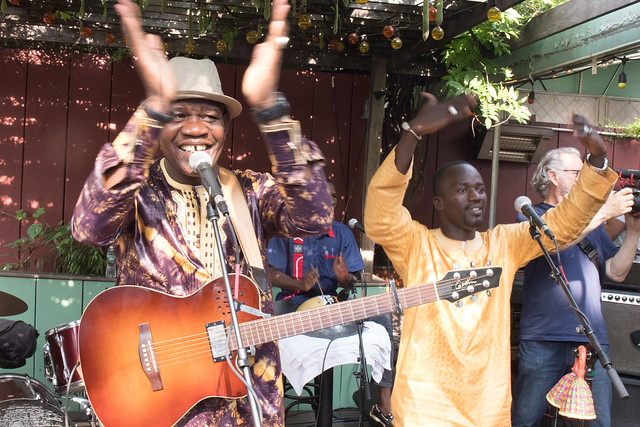
New Audio: Celebrated Malian Afel Bocoum Releases a Breezy Genre-Defying Single

Afel Bocoum, a celebrated Niafunké, Mali-born and-based singer/songwriter and guitarist is among the last of a breakthrough generation of African artists, who have mixed their traditional music with the new sounds that arrived from all overthe world during the 20th and 21st centuries. But interestingly enough, despite the accolades that surround him, music hasn’t been an easy dream for the celebrated Niafunké-born and-based singer/songwriter and guitarist: Most aspiring musicians face stiff parental and societal opposition; however for Bocoum, the parental opposition he faced was deeply perplexing, given the fact that this father Abakina Ousmane Bocoum, a.k.a. Kodda was one of the most famous and beloved njarka players of the 20th century.

But Bocoum wasn’t deterred. Music was omnipresent: it was in the holey or spirit dances of Songhoy, in the melodies of the Fulani flue, in the gumbé drum sessions with their wild moonlit dancing, in the stories and poetry of the griots and in the hymn of the local Protestant Mission.  For a young Bocoum, music was more than just entertainment; it taught people about life and the right way to live it. It guaranteed social cohesion and the strength of the collective conscience, especially in a society that was at the time, largely illiterate and had no access to modern media. “There was no radio at the time, no TV, nothing. It was incredible,” Bocoum remembers. “When you saw someone with a guitar, you followed him everywhere.”

As a teenager, the legendary Ali Farka Touré exerted a powerful hold on the young Bocoum. When Bocoum first met Touré in the late 1960s, he was a barely a teenager and Touré was already considered one of the region’s most famous and greatest sons. Bocoum hung out with Touré as much as he could, eventually becoming a member of Asco, Touré’s backing band. And as a member of of Asco, Bocoum toured with the legendary singer/songwriter and guitarist throughout the 80s and 90s, appearing on Touré’s 1992 effort, The Source. 

Interestingly, the idea of releasing his own music arose  from a gentle curiosity, rather than any self-serving ambition or desire to upstage his beloved mentor. “Everybody seemed to be releasing albums all around me, so it was like, ‘why not?’” Bocoum says in press notes. Tourè hooked his mentee up with Nick Gold, artistic director of  World Circuit, which led to Bocoum’s 1999 full-length debut, Alkibar (The Messengers), an effort that established Bocoum as an international star in his own right.

As a result of Alkibar’s success, Bocoum was invited to work with Blur and Gorillaz frontman and creative mastermind Damon Albarn and Toumani Diabaté on the 2002 album Mali Music. From there, he became a regular contributor on the Africa Express compilation series, collaborating with a who’s who list of internationally acclaimed artists, including Béla Fleck, Habib Koité, Tarit Ensemble, Oliver Mutukudzi and others. “You have to collaborate, otherwise you’ll get nowhere in today’s world,” Bocoum says of his work with those artists. “All those collaborations were positive.”

Bocoum’s forthcoming album, the Damon Albarn and Nick Gold produced-Lindé is slated for a September 4, 2020 release through World Circuit Records. Deriving its name from a wild expanse near his hometown, the album which was recorded in Mail’s capital city of Bamako, reportedly finds the celebrated Malian singer/songwriter and guitarist drawing from the timeless sounds of the Niger River bend with a variety of styles across the globe,  through collaborations with a diverse and eclectic array of artists including eminent Malian artists like Madou Kouyaté, the late Hama Sankaré and Madou Sidiki, along with the recently departed, legendary Afrobeat pioneer and Fela Kuti collaborator Tony Allen, Bob Marley and Skatalites collaborator Vin Gordon (trombone) and Joan as Police Woman creative mastermind Joan Wasser on violin.

Throughout the album’s material, you’ll hear traditional African folk instruments like ngoni, njurkele, kora and calabash with guitars, percussion, horns and call-and-response vocals, and the end result is something timeless and mystical, yet modern.  At its core, the material possesses a deep and abiding message: in the face of an uncertain and turbulent world and a homeland struggling with jihad, poverty and tribal warfare, the album’s material urges the listener to have hope and to seek solidarity and unity. “We have to meet each other, talk to each other, look each other in the eye and tell the truth,” Bocoum says. “If we’re not united, I can see no solution. Our social security is music. That’s all we’ve got left. People love music, so we have to make use of that fact.”

Earlier this year, I wrote about Lindé‘s first single, the breezy and uplifting “Avion.”  Centered around the shimmering guitar work of Mamadou Kelly, Oumar Konaté and Lamine Soumano, call-and-response vocals, propulsive polyrhythm that is playful and optimistic ode to air travel, complete with the prerequisite safety announcement  — in French, of course —  that quickly takes off and soars upward. But it’s also a gentle yet urgent call for all people to band together around the most human of all things — music, love and dancing; that music can take us to the promised land of peace and equality among all.

Lindé’s  latest single “Bombolo Lindo” features Skatalites’ Vin Gordon (trumpet), Songhoy Blues’ Garba Touré (guitar) and Toumani Diabaté’s brother Madou Diabaté (kora) on a song that broadly draws from across the Pan Africa Diaspora: you’ll hear shuffling and uptempo reggae riddims, shimmering guitar and kora, an infectious and soaring hook and some sweeping trombone lines. And while seemingly possesses irie vibes, the songs’ lyrics attempt to realistically temper the dreams of African youths desperately attempting to escape to Europe — with the hopes that it’ll be some promised land of money and opportunity.  “The small percentage of people who manage to make it to Europe shouldn’t cry ‘victory!’ because there are still many problems left for them to overcome, including finding a place to live, a job to do and food to eat,” Bocoum explains. “They mustn’t forget that, from the moment they arrive, they’re subject to the laws of the receiving country. And then they have to learn how to communicate and deal with the climate. Add it all up and you’ll see that overall, there’s more loss than benefit, and finding that anticipated happiness is just a lottery. More often than not, you’re talking about a 1 in 100 chance of success.”

New Video: Celebrated Malian Musician Afel Bocoum Releases a Gorgeous Glimpse into Malian Life in Visual for “Avion”

Afel Bocoum, a celebrated Niafunké, Mali-born and-based singer/songwriter and guitarist is among the last of a breakthrough generation of African artists, who mixed their traditional music with the new sounds that arrived from all over the world during the 20th and 21st centuries. Interestingly, music hasn’t been an easy dream for the celebrated Niafunké-born and-based singer/songwriter and guitarist: While most aspiring musicians face stiff parental and societal opposition; however for Bocoum, the parental opposition he faced was deeply perplexing, given the fact that this father Abakina Ousmane Bocoum, a.k.a. Kodda was one of the most famous and beloved njarka players of the 20th century. 

But Bocoum wasn’t deterred. Music was omnipresent: it was in the holey or spirit dances of Songhoy, in the melodies of the Fulani flue, in the gumbé drum sessions with their wild moonlit dancing, in the stories and poetry of the griots and in the hymn of the local Protestant Mission.  For a young Bocoum, music was more than just entertainment; it taught people about life and the right way to live it. It guaranteed social cohesion and the strength of the collective conscience, especially in a society that was at the time, largely illiterate and had no access to modern media. “There was no radio at the time, no TV, nothing. It was incredible,” Bocoum remembers. “When you saw someone with a guitar, you followed him everywhere.”

As a teenager, the legendary Ali Farka Touré exerted a powerful hold on the young Bocoum. When Bocoum first met Touré in the late 1960s, he was a barely a teenager and Touré was already considered one of the region’s most famous and greatest son. Bocoum hung out with Touré as much  as he could, eventually becoming a member of Asco, Touré’s backing band — and as a member of of Asco, Bocoum toured with the legendary singer/songwriter and guitarist throughout the 80s and 90s, appearing on Touré’s 1992 effort, The Source. 

The idea of releasing his own music arose  from a gentle curiosity, rather than any self-serving ambition or desire to upstage his beloved mentor. “Everybody seemed to be releasing albums all around me, so it was like, ‘why not?’” Bocoum says in press notes. Tourè hooked his mentee up with Nick Gold, artistic director of  World Circuit, which led to Bocoum’s 1999 full-length debut, Alkibar (The Messengers), an effort that established Bocoum as an international star in his own right.  

Interestingly, as a result of Alkibar, Bocoum was invited to work with Blur and Gorillaz frontman and creative mastermind Damon Albarn and Toumani Diabaté on the 2002 album Mali Music. From there, he became a regular contributor on the Africa Express compilation series, collaborating with a who’s who list of internationally acclaimed artists, including Béla Fleck, Habib Koité, Tarit Ensemble, Oliver Mutukudzi and others. “You have to collaborate, otherwise you’ll get nowhere in today’s world,” Bocoum says of his work with those artists. “All those collaborations were positive.”

Bocoum’s forthcoming album, the Damon Albarn and Nick Gold produced-Lindé is slated for a September 4, 2020 release through World Circuit Records. Deriving its name from a wild expanse near his hometown, the album which was recorded in Mail’s capital city of Bamako, reportedly finds the celebrated Malian singer/songwriter and guitarist drawing from the timeless sounds of the Niger River bend with a variety of styles across the globe, as he collaborates with a diverse and eclectic array  of artists including eminent Malian artists like Madou Kouyaté, the late Hama Sankaré and Madou Sidiki, along with the recently departed, legendary Afrobeat pioneer and Fela Kuti collaborator Tony Allen, Bob Marley and Skatalites collaborator Vin Gordon (trombone) and Joan as Police Woman creative mastermind Joan Wasser on violin. 

You’ll hear traditional African folk instruments like ngoni, njurkele, kora and calabash with guitars, percussion and call-and-response vocals with the end result being something both timeless and mystical yet modern. But at its core, there’s a deep and abiding message: in the face of an uncertain and turbulent world and a homeland struggling with jihad, poverty and tribal warfare, the album’s material  urges the listener to hope, solidarity and unity. “We have to meet each other, talk to each other, look each other in the eye and tell the truth,” Bocoum says. “If we’re not united, I can see no solution. Our social security is music. That’s all we’ve got left. People love music, so we have to make use of that fact.”

“Avion,” Lindé’s first single is a uplifting and breezy track, centered around the shimmering guitar work of Mamadou Kelly, Oumar Konaté and Lamine Soumano, call-and-response vocals, propulsive polyrhythm that is playful and optimistic ode to air travel, complete with the prerequisite safety announcement  — in French, of course —  that quickly takes off and soars upward. But it’s also a gentle yet urgent call for all people to band together around the most human of all things — music, love and dancing; that music can take us to the promised land of peace and equality among all. Considering recent world events, we  need more uplifting calls for unity and love. 

The recently released video gives the video a gorgeous glimpse of daily life in Mali, as we see fisherman, goat herders, the nomadic and proud Taureg people riding horses and  camels, massive metropolitan areas and the like. It reveals a world that’s more diverse and interesting that what most Westerners would know or acknowledge with a gentle  and kind viewpoint. 

New Video: French Emcee Flem Teams Up with Vieux Farka Touré on a Politically Charged Single — and Visual

Flem is a rising French emcee, who has developed a reputation for his fluid flow and conscious themes — and as a result, he has worked with an eclectic array of French artists includes Sages Poètes de la Rue’s DanyDan, Assassin’s DJ Duke, La MC Malcriado’s Izé Bosineau and Aethority’s Mattias Mimoun and a growing list of others. His forthcoming album Nomades, which is slated for an October 2020 release finds the rising French emcee collaborating with acclaimed Malian singer/songwriter Vieux Farka Touré — with the result meshing contemporary hip-hop and traditional African blues. 

Interestingly, the duo’s collaboration and friendship can be traced back over a decade — with Flem and Touré sharing stages at festivals at shows from Paris to Timbuktu. Some time ago, the pair were performing in Niafunké, Mali, a stronghold of the Touré family,. when Flem along with a small group of Westerners were quickly evacuated to Bamako, Mail, narrowly escaping an attack. This particular event managed to strengthen the pair’s friendship and reinforced the need for them to create a new project that was much more urgent, conscious and militant than they had done individually. 

Over the better part of the past decade, Mali has been split apart by a bloody civil war between different warring religious and ethnic factions, undermined by unbalanced international relationships, rampant corruption and terrorism. Nomades touches upon the historical and cultural link between Europe and Africa, the ethnic conflicts that have been used by foreign countries, who have economic interests across the continent, the emigration of African youth for a better way of life anywhere they can, monetary independence, freedom, love and hope and so on. 

Nomades’ first single is a perfect example of the album’s overall sound: Touré’s looping, shimmering and expressive guitar, gently padded percussion and Touré’s lilting voice are paired with an infectious hook and Flem’s fiery lyrics, which touch upon his love of Mali, its food and its people, while praying for an end to war, racism, colonial oppression and more. The song manages to bring the African blues sound to the modern day — while also reminding the listener that hip hop has become the sound and voice of resistance everywhere.

“I went to Mali for the first time in 2003 with my friend Moctar, at his family home. We stayed for a month and a half and travelled from Bamako to Timbuktu,” the rising French emcee writes in a lengthy statement. “This trip inland, which is no longer possible today, changed my life. Abdulaye, Moctar’s cousin, introduced me to Vieux Farka Touré in 2009. The artistic connection was instantaneous and after a jam at his house, Vieux invited me to the prestigious Festival au Desert stage in Essakane, in the north of Mali.

Three years later, while I was recording the arrangements for my debut album Passeport, war in the Sahel broke out at the end of my stay, in January 2012. I was staying at Vieux Farka’s, in the family home in Bamako. It was important for Vieux Farka to show me his village and invite me on stage, this time for a festival in honour of his father. It should be remembered here that the late Ali Farka Touré was first a truck driver, then an internationally renowned artist and Grammy Award winner, but also the mayor of his village: Niafunké. The day after the concert, the intelligence and security services in Mali, who were protecting the area at the time, warned us of an imminent attack on the village. The terrorists had seen on television that a few Westerners were there. They interpreted this presence as a provocation to Sharia law, which was beginning to be imposed in the north of the country. Vieux Farka woke me up in my room and said: ‘You’re leaving right now!; I wanted to go back with him, but it was too dangerous. I was evacuated by the Malian army via the river. He came back as we had come, in a 4×4. The boat trip was magnificent, I had always dreamed of doing it, but the conditions were particular. Later, the rest of the Touré family also left the village to take refuge at Vieux’s house in Bamako.

In October 2015, my first album was released. There was no tour in France, but there was a one-off concert with Vieux Farka Touré at La Boule Noire in Paris. February 2017: the Institut Français (French Institute) and the CCF (French Cultural Center) in Bamako invited me for the start of the literary season, which ended with a concert by Vieux Farka Touré and myself. I went there with the pianist Mattias Mimoun and the harpist Katell Boisneau. We had a lot of fun playing again all together.  I felt more than ready to prepare my second album.

In 2018, after the first night of recording with Ilan Sberro at the St-Ouen Auditorium, Vieux started listening to my lyrics and asked me: “Did you write a song for Mali?” I hadn’t, not intimately, not totally.  Maybe I didn’t feel legitimate to do it. I love this country; I’ve got friends there who I consider to be members of my family. And I’m welcomed there as family. This country has given me a lot of love and has taught me things that can’t be explained. I was born, I grew up and I live in France, but I’ve been going to Mali regularly for 17 years now. Here’s my song Mali on a music by Vieux Farka Touré, accompanied by the superb voice of singer Amy D.

Mali Nébifé, Mali I love you. Flem.”

Directed by Dominique Milherou, the recently released video is split between footage of daily life in Mail from kids riding bikes and kicking around a soccer ball, to women dancing in the streets — to intimately shot footage of Flem, Amy D and Touré in the studio  recording the song and performing the song. When the song hits sociopolitical commentary, we see footage of some of the Western leaders, who have helped to exploit and profit off the region’s people, resources and conflicts. 

Deriving their name from one of the more vigorously outre films by Japanese animation studio Studio GhibliPom Poko is an up-and-coming Norwegian quartet, comprised of Ragnhild (lead vocals), Ola (Drums), Jonas (Bass) and Martin (guitar). The members of the band can trace their origins back to about 18 months ago when they met while they were all studying at Trondheim Music Conservatory.  Interestingly, the members of the band cite a wide and eclectic range of influences on their sound including Oumou Sangare, Ali Farka Toure, Vulfpeck, Palm, KNOWER, Hella, Death Grips, Jenny Hval and Nick Drake among others. Interestingly, they manage to defy easy description or categorization, as well as anything resembling a prescriptive approach. “We’ve all done lots of improvised music in the past, and I think that shapes the way we play, even though the tunes are not improvised. We like when new and strange things happen in an old song, and that music can change over time by being played live, because that removes predictability and the ‘recipe’ that some genres of music have.”

With the release of their first three officially released singles, the up-and-coming Norwegian band have received attention both nationally and internationally, receiving praise from the likes of Interview Magazine, The Line of Best Fit, The Independent, Clash Magazine, DIY Magazine and NME, who picked the band as one of the acts to watch out for this year. Building upon a growing profile, the band’s full-length debut effort Birthday is slated for a February 22, 2019 release through renowned indie label Bella Union Records. And the album’s latest single is the breakneck, math rock meets indie rock “My Blood,” which is centered by an arrangement featuring rapid-fire time signature changes, key and tone changes, thunderous drumming, enormous heavy metal-like power chords and a gorgeous melody underpinning it all. Sonically, the song strikes me as an amalgamation of The Cardigans, Cinemechanica and Bo Ningen while sounding (and being) wildly inventive.


New Audio: Sampha Shimmering, Dance Floor Friendly Remix of Legendary Malian Vocalist Oumou Sangare’s “Minata Waraba”

Oumou Sangare is a Bamako, Mail-born and-based, Grammy Award-winning,  singer/songwriter and musician, who comes from a deeply musical family, as her mother, Aminata Diakite was a renowned singer. When Sangare was young, her father had abandoned the family, and she helped her mother feed the family by singing; in fact, by the time she had turned five, Sangare had been well known as a highly gifted singer. After making it to the finals of a nursery school talent show, a very young Sangare performed in front of a crowd of 6,000 at Omnisport Stadium — and by the time she was 16, she had gone on tour with a nationally known percussion act, Djoliba.

Sangare’s 1989 debut effort, Moussoulou (which translates into English as “Women”) was recorded with renowned Malian music master Amadou Ba Guindo, and was a commercial success across Africa, as it sold over 200,000 copies. With the help of the world renowned Malian singer/songwriter and multi-instrumentalist Ali Farka Toure, the father of Vieux Farka Toure, Sangare signed with English record label World Circuit — and by the time she turned 21, she had received an internationally known profile. Interestingly, Sangare is considered both an ambassador of Mali and the Wassoulou region of the country, just south of the Niger River, lovingly referred to as “The Songbird of Wassoulou,” as her music draws from the music and traditional dances of the region while lyrically her work has been full of social criticism, focusing on the low status of women within Malian society and elsewhere, and the desire to have freedom of choice in all matters of one’s life, from who they can marry to being financially independent.

Interestingly, since 1990 Sangare has performed at some of the world’s most important venues and festivals including the Melbourne Opera, Roskilde Festival, Gnaoua World Music Festival, WOMAD, Oslo World Music Festival and the Opera de la Monnaie, while releasing several albums including — 1993’s Ko Sira, 1996’s Worotan and 2004’s 2 CD compilation Oumou. Adding to a growing profile, Sangare has toured with Baaba Mal, Femi Kuti and Boukman Eksperyans, and she has been named a Commander of the Order of Arts and Letters in 1998, won the UNESCO Prize in 2001 and was named an ambassador of the FAO in 2003.

Mogoya which translates into English as “People Today,” was Sangare’s first full-length effort in over 22 years, and it was released to critical praise from the likes of Dazed, The Fader, The Guardian while making the Best of 2017 Lists of Mojo, the BBC, the aforementioned The Guardian as well as Gilles Peterson — and the album found the renowned Malian artist collaboration with the legendary Tony Allen and French production team A.L.B.E.R.T. and pushing her sound in a new, direction; in fact album single “Minata Waraba” features  Sangare’s gorgeous and expressive voice with shimmering African instrumentation paired with a slick and hyper modern production that emphasizes a sinuous, electric bass line and shuffling, complex polyrhythm that reminds me of a 2013 Fela Kuti tribute compilation, Red Hot + Fela, which featured contemporary artists re-imagining some of the Afrobeat creator’s signature tunes.

Sangare will be releasing the Mogoya Remixed album through Nø Førmat Records today, and the album features remixes of the album’s material by contemporary artists and producers, who have been high profile fans of her work; in fact the album’s latest single is from the British-born and based producer and artist Sampha. Sampha has split his time between solo and collaborative work, and has worked with the likes of SBTRKT, FKA Twigs, Jesse Ware, Drake, Beyonce, Kanye West, Solange and Frank Ocean. His full-length debut Process won the Mercury Music Prize last year, and earned him a 2018 BRIT Award nomination for Best British Breakthrough.

Sampha has publicly mentioned his love of Oumou Sangare’s music, explain in press notes, “My dad had a copy of Oumou’s album Worotan and no other album has spoken to me quite like that. Her music has been a huge inspiration ever since and it’s a real honour to have remixed some of her music.” Sampha’s remix retains Sangare’s crystalline vocals but pairs it with a thumping production, featuring tribal house like beats and shimmering arpeggiated synths that while modern, still keeps the song rooted to Africa. Interestingly, Sangare has mentioned being bowled over by Sampha’s remix, saying  “When I first heard Sampha’s remix, I was amazed at the beat. Our rhythmic patterns are not always easy for Western people. But, wow, Sampha’s beat is definitely African, definitely. Listening to it I can tell that Sampha has African blood in his veins. I am really excited by this version, I play it again and again.”

With the release of “Now I’m Alive,” the first single off his forthcoming Refugee EP, the fairly mysterious Tel Aviv, Israel-born, Brooklyn-based singer/songwriter, multi-instrumentalist and producer O Mer has been compared to the James Blake, Tame Impala and Arthur Russell; however, the Tel Aviv, Israel-born, Brooklyn-based producer has cited renowned Malian singer/songwriter and multi-instrumentalist Ali Farka Toure, father of equally renowned Malian singer/songwriter and guitarist Vieux Farka Toure, Greek vocalist Aris San, The Yardbirds and others. “Icarus,” the second and latest single off his forthcoming EP features O Mer’s ethereal and tender vocals paired with a stark and haunting production that features stuttering drum programming, shimmering, arpeggio synth chords. The song manages to evoke a fractured psyche ruled primarily by a visceral and uncomfortable amount of regret and self-loathing while to my ears slightly nodding to Bonobo and others.

Check out upcoming tour dates, below.

Tour Dates

03/16 – Alphaville – Brooklyn, NY
05/27 – Rockwood Music Hall – New York, NY

If you’ve been frequenting JOVM for a while, you may remember that I’ve written about Norwegian electro pop duo, BLØSH. With the release of their breezy and infectious debut single “Can’t Afford to Lose You,” the duo comprised of of Madrid-born, Oslo, Norway-based cellist and vocalist Teresa Bernabé and guitarist Jørgen Berg Svela, an Oslo native, quickly found themselves with an expanding international profile as the duo saw praise and attention from JaJaJa MusicIndie Shuffle and airplay on Amazing Radio.

Give It Away,” which I wrote about last November further cemented the duo’s burgeoning reputation for crafting infectious pop as the song paired an upbeat melody, punchy bass lines, a looping guitar line and a soaring, anthemic hook with with Bernabé’s breezy vocals  while sonically drawing from African music and African-inspired pop  — in particular Paul Simon‘s Graceland, the legendary Ali Farka Touré and Afrobeat. Now the Oslo, Norway-based duo is continuing to build on the buzz of “Can’t Afford to Lose You,” and “Give It Away” with the release of their latest single “When Love Is Alive.” Beginning with a steady bass line, the song pairs reverb-y guitars, propulsive drumming and Bernabé’s ethereal vocals in a slow-burning song that expresses an aching longing and yearning for giving and receiving the love that the narrator desperately wants and deserves — but with the sad realization that love is often short-lived. And as a result, the song possesses the same breeziness as their previous singles but with a subtle sense of mourning.


With the release of their debut single “Can’t Afford to Lose You,” the Norwegian electro pop duo BLØSH, comprised of Madrid-born, Oslo, Norway-based cellist and vocalist Teresa Bernabé and guitarist Jørgen Berg Svela, an Oslo native, the duo quickly found themselves with an expanding international profile, thanks in part to a breezy and infectious pop-leaning sound. Already, the duo have seen praise and attention from JaJaJa Music, Indie Shuffle and airplay on Amazing Radio.

Building on the buzz that they’ve already received, the duo’s newest single “Give It Away” is “about not taking life — or the situations that life puts you in — too seriously,” as the duo explained in press notes. The song will likely cement the duo’s burgeoning reputation for crafting infectious pop as the song pairs an upbeat melody, punchy bass lines and a looping guitar line with Bernabé’s breezy vocals and soaringly anthemic hooks.  Sonically speaking, the song draws from African music and African music-inspired pop — in particular Paul Simon‘s Graceland, the legendary Ali Farka Touré, and to my ears Afrobeat as the song and its funky and playful melody is built around the looping and angular guitar line. Simply put, the song is crafted and pure pop confection.