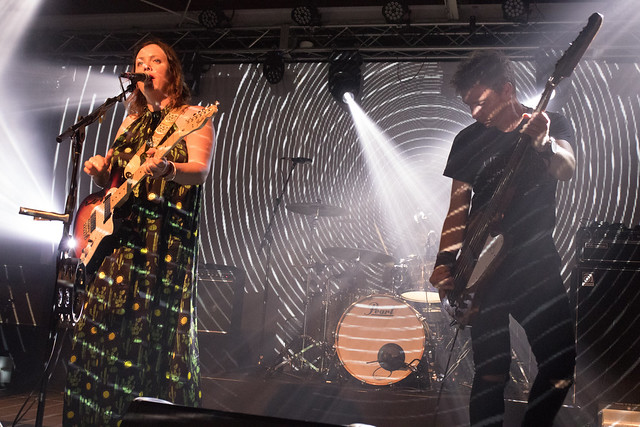
Deriving their name from a dream that that their co-founder Neil Halstead (vocals, guitar) had once had, and “Slowdive,” a single written and recorded by co-founder Rachel Goswell’s (vocals, guitars) favorite band, Siouxsie and the Banshees, the Reading, Berkshire, UK-based shoegazer band Slowdive, which is currently comprised of its co-founders Halstead and Goswell, along with Nick Chaplin (bass), Christian Savill (guitar) and Simon Scott (drums) can trace its origins to when its co-founders, childhood friends started the band in 1989.
According to both Halstead and Goswell, their initial demos were highly derivative My Bloody Valentine and Sonic Youth-based songs that they recorded for fun, until the the addition of Christian Savill, a former member of Eternal joined the band. “We advertised for a female guitars, but only Christian replied. He writes a sweet letter though, he said he’d wear a dress if necessary,” the members of the band recall. Their second official demo as a band was a leap forward for the band — while their previous demo found the band heading towards noisy No Wave and experimentalism, “Avalyn,” was a gentle and steady flow of nearly white noise; in fact, the demo caught the attention of fellow Reading-based act Swervedriver, who helped bring the band on to their label Creation Records. Interestingly, the demo single eventually became the band’s debut single as the band couldn’t recreate the same atmosphere and sound in a professional studio.
Once they signed to Creation Records, the band went through the first of a series of lineup changes as their original drummer Adrian Sell left the band to go back to school. As the members of Slowdive recall, their original drummer didn’t quite fit in — he didn’t share the same aims and tastes of the others, and it made touring uncomfortable. He was first replaced by Neil Carter, who played on the Morningrise EP before being replaced by Simon Scott, a former member of Charlottes, who joined the band and played with them for about four years before leaving to pursue a career in jazz. Ian McCutcheon joined the band before the band’s self-financed 1994 North American tour, a tour they had to pay for themselves, as their American distributor SBK Records had gone out of business.
Throughout their first run together, Slowdive released three full-length albums 1991’s Just for a Day, 1993’s Souvlaki and 1995’s Pygmalion and a number of EPs, and initially, the band saw quite a bit of commercial and critical success: 1990’s self-titled EP, 1991’s Morningrise EP and Holding Our Breath EP were released to critical praise from the likes of NME, Melody Maker, and others — with Holding Our Breath landing at #52 on the UK Albums Charts, thanks in part to the commercial success of UK Indie Chart topping single “Catch the Breeze.”
Work on Slowdive’s full-length debut began shortly after the band’s primary songwriting Halstead convinced Creation Records label head Alan McGee that the band had enough songs written for an album; however, they didn’t. They had to hurriedly write songs the studio — experimentation with marijuana and sounds occurred during the music, with lyrical inspiration coming from the abstract nature of the music. As Halstead recalls “[We] went into a studio for six weeks and had no songs at the start and the end we had an album.” The result was their full-length debut Just for a Day was released to praise from NME and landed in the Top 10 of the UK Indie Charts; however, the band had the misfortune of releasing their full-length debut when the British music press had started to backlash against shoegaze — with a number of critics panning the album. The backlash got even worse when critics began re-evaluating the genre after the release of My Bloody Valentine’s Loveless later that year. Consider the time period: Massive Attack‘s Blue Lines was released in April; Pearl Jam’s Ten and Metallica‘s Black Album were released that August; Nirvana‘s Nevermind was released that September; Primal Scream‘s Screamadelica,Soundgarden‘s Badmotorfinger and A Tribe Called Quest‘s Low End Theory were released about a week after Nevermind; U2‘s Achtung Baby was released a few weeks after Loveless. While critics can be shortsighted and biased, there was one thing that was obvious — a seismic shift in music was occurring. Let’s not forget to mention Ice Cube’s Death Certificate, Public Enemy‘s Apocalypse 91: The Enemy Strikes Black, Cypress Hill‘s eponymous debut, De La Soul’s De La Soul Is Dead were also released that year, as well. Yes, 1991 was an insane year for music — and for me, many of those albums changed the course of my music listening life. (As for the shortsightedness of music critics, Slowdive has become one of the more influential acts of their day with Souvlaki being considered a classic of the genre — but I’m jumping ahead.)
In early 1992, the band were touring to support Blue Day, a re-release of their early EP material and in a rather busy year, they were also writing songs for their sophomore album. But as the band noted the negative coverage they had received in the press had began to affected their songwriting to the point that they were increasingly self-conscious and worried about how their material would be received. They wrote, recorded and re-recorded 40 songs that Creation Records’ McGee loathed. The band scrapped the album and started over. Interestingly, the band wrote to Brian Eno and requested that he produce their sophomore album; however, Eno told them that while he liked their music, he wanted to collaborate, not produce. Halstead later called the recording sessions “one of the most surreal, stoned experiences of [his] life.” But the end result was two songs which appeared on the album “Sing,” a co-write with Eno and “Here She Comes,” which Eno contributes keys.
Creation Records wanted a much more commercial sounding album. Halstead agreed and at one point, he suddenly left, seeking seclusion a Welsh cottage while the remaining members of the band were left in a recording studio waiting for Halstead to return.When Halstead returned, he had some new music, including “Dagger” and “40 Days.” Souvlaki, which derives its name from a Jerky Boys skit, was released in 1993 to critical panning. Much to their misfortune, Suede released their self-titled debut, which was a critical and commercial success, and an album generally credited as beginning the Brit pop movement.
With increasing issues between their label and distributor, who had been delaying the release of Souvlaki and an EP, the band went through several more lineup changes as they released Pygmalion. The band was then dropped by the their label, and the band’s founding duo along with Ian McCutcheon formed Mojave 3. “After that (Pygmalion), Slowdive didn’t so much split as take a shift in direction, one that a couple of the other members weren’t comfortable with. It didn’t seem right to carry on with the same name, we needed to get a fresh start and all the pieces fell into place for us to get one,” the band’s Goswell explains in their bio.
Since then Scott went on to form Televise, an act that added electronics to the ambient, shoegazer sound. He also joined Lowgold in 1999 before releasing solo albums through 12k, Miasmas, Sonic Pieces and Kompakt Records before cowriting and performing with Seattle’s The Sight Below. Savill went on to form Monster Movie, a dream pop act with former Eternal bandmate Sean Hewson that specializes in an early Slowdive-like sound. Along with Mojave 3, Halstead and Goswell have released solo albums with Halstead forming side project Black Hearted Brother in 2012 while Goswell joined supergroup Minor Victories in 2015.
In 2014, the members of Slowdive reunited to play dates across the global festival curious and it included stops at that year’s Primavera Sound Festival in Barcelona, Spain and Porto, Portugal, Electric Picnic Festival, FYF Fest, Fortress Festival, Wave-Gotik-Treffen, Roskilde, Radar Festival and Off Festival, which they promptly followed up with a 20 date North American tour.
The band’s fourth album, 2017’s self-titled album was their first new batch of material in 22 years, and they supported the album with a stop at the dearly departed House of Vans.
The shoegaze pioneers’ fifth album everything is alive is slated for a September 1, 2023 release through Dead Oceans. The highly-anticipated everything is alive is their first album in over six years, and the material reportedly sees the British outfit finding ever more contours of its immersive, elemental sound. The songs themselves contain the duality of a familiar internal language mixed with the exaltation of new beginnings.
The record began with the band’s Halstead in the role of writer and producer, working on demos at home. Experimenting with modular synths, Halstead originally conceived everything is alive as a “more minimal electronic record.” The band’s collective decision-making ultimately saw them drawing back to their signature reverb-drenched guitar sound — but the synths seeped their way into the compositions. “As a band, when we’re all happy with it, that tends to be the stronger material. We’ve always come from slightly different directions, and the best bits are where we all meet in the middle.” Halstead says. “Slowdive is very much the sum of its parts,” Goswell adds. “Something unquantifiable happens when the five of us come together in a room.”
The album was recorded over a couple of years, starting in the fall of 2020 at Courtyard Studio, where they’ve historically recorded. Sessions moved to Oxfordshire, and then the Wolds of Lincolnshire and then to Halstead’s Cornish studio. Early last year, the band enlisted Shawn Everett to mix six of the album’s eight tracks.
Because of their deep and lengthy history, there’s a palpable familial energy to the band — and fittingly to to the album: The album is dedicated to Goswell’s mother and Scott’s father, who both died in 2020. “There were some profound shifts for some of us personally,” Goswell says. Life’s profound shifts and uneasy crossroads are often reflected in the many-layered emotional tenor of their music. And while everything is aliveis informed by some of life’s heaviest experiences, the material sees the band poised, wizened and pitching themselves to hope. Sure, there’s sadness, but there’s gratitude and uplift, coming from the acknowledgement that life is complicated yet profoundly beautiful in itself.
Thematically, the album is in many ways an exploration into the shimmering nature of live and the universal touch points within it. Sonically, the album reportedly sees the acclaimed British outfit boldly pushing their sound towards the future with the material touching upon the psychedelic soundscapes they’ve long been known for with 80s electronic elements, and John Cale-inspired journeys.
Last month, I wrote about the breathtakingly gorgeous “kisses,” which struck me as being a sort of gentle refining of the classic, enveloping Slowdive sound that I’ve long adored: reverb-drenched guitar textures, Goswell’s and Halstead’s uncannily precise, yearning harmonies, soaring hooks and choruses and a gently driving groove — but while featuring an emphasis on atmospheric synths. The result is a song that — for me, at least — evokes a waking dream full of yearning, nostalgia and hope.
everything is alive’s second and latest single “skin in the game” is a slow-burning, forlorn and smudged song built around Halstead’s aching vocal radiating outward from hazy and distorted guitars paired with a narcotic and syrupy rhythm. Much like its immediate predecessor, the song evokes a woozily heartbreaking nostalgia, mixed with regret., unease and uncertainty.