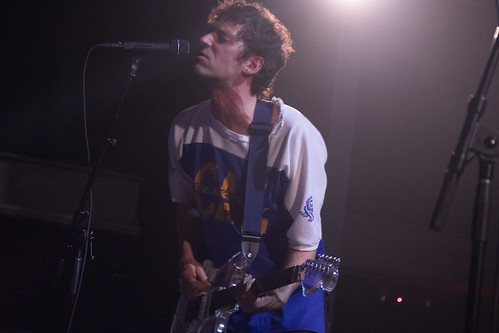
Back in 2013, Chicago-based post-punk act Disappears — founding member Brian Case (vocals, guitar) along with Noah Leger (drums), Jonathan Van Herik (guitar) and Damon Carruesco (bass) — released two of my favorite efforts of the past decade or so: the atmospheric and tempestuous Kone EP and the tense, raging Era.
Damon Carruesco left the band in 2017. The band’s remaining members — Case, Leger and Van Herik — decided to continue onward, but under a new name and with a decidedly new sonic direction and songwriting approach as FACS.
With their FACS full-length debut, 2018’s Negative Houses, the trio quickly established an intense, cathartic, heavy sound — that’s not always obviously heavy. Since then the band has gone through a couple of lineup changes: Alianna Kalaba (bass) replaced van Herrik for a handful of the band’s albums. including last year’s Still Life in Decay, a decidedly focused effort that saw the band at what may arguably be their most solidified. The apocalyptic chaos of the album’s predecessor was pushed away in favor of examination with a remarkably uneasy clarity, while being a sort of addendum to 2021’s Present Tense. The album, which featured tracks like “When You Say” and “Slogan,” was the last album to feature Kalaba, who amicably left the band.
The Chicago-based post-punk outfit and JOVM mainstays’ sixth studio album Wish Defense is slated for a February 7, 2025 release on CD, cassette, black vinyl and a limited white vinyl variant while supplies last [pre-order] through Trouble In Mind Records.
The album marks the return of original band member Jonathan Van Herik, who replaces longtime bassist Alianna Kalaba. Van Herik’s return to the band reportedly brings renewed vigor and a marked angularity from the Chicago-based outfit’s more recent output. While the songs still hit hard, the approach is sideways; in fact, the roles have changed since Van Herik’s original tenure and previous time with Case and Leger in Disappears. Now on bass, Van Herik was originally the band’s guitarist while Case, the band’s current guitarist, played bass. The role reversal between Case and Van Herik has reportedly helped the band’s dynamic, offering a different musical perspective than before, while revisiting the trio’s long-held collaboration with some distance and time.
Tragically, Wish Defense is the last album engineered by Steve Albini. Two days of sessions were recorded at Electrical Audio in early May, before Albini’s untimely death. Renowned engineer and friend Sanford Parker stepped in to finish the session 24 hours later, tracking the last bits of vocals and overdubs. Longtime collaborator John Congleton mixed the albums as Albini would have, in Electrical Audio’s A Room, off the tape, using Albini’s notes about the session.
Thematically, the album focuses on the centuries old subject of the duality of man. Who is your “true self” and what do they want? The album sees the band taking a good long look in the mirror to face themselves. As the band’s Brian Case explains, the album’s lyrical content revolves about doppelgängers or doubles, tackling the idea of facing yourself and observing your ideas and motivations.
Anchored around an angular and forceful bass line from Van Herik, funky yet forcefully off-kilter rhythmic patterns from Leger, Case’s squiggling and chiming guitar lines paired with a slow-burning, noisy coda and arguably one of Case’s more melodic vocal turns in some time. Fittingly, it continues the band’s long-held reputation for material that’s psychologically probing with Case laying out the entire album’s theme in one stanza, asking the listener — and in turn himself: Are your actions and emotions your true self? Or are they a performative aspect of that “other” person you put forward into the world? Case says that ultimately, the sentiment is ” . . . don’t let the bastards get you down, there’s something beyond this moment, like hope — but not in the naive belief that ultimately people are good.”
Directed by Joshua Ford, starring Megan Paradowski, the accompanying video for “Wish Defense” was filmed at Los Angeles-based XIX Studio and plays along with the song’s thematic and lyrical concerns: While Paradowski expressively dances throughout, we see doubling — whether through shadow, visual effect or slick editing.