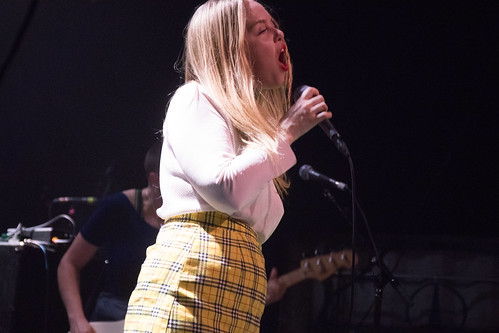
With the release of “Running Away” and “Surface Tension,” which landed on Spotify‘s New Music Friday, Lorem and Fresh Finds Playlists, the young and rapidly rising, Portland, ME-based singer/songwriter Genevieve Stokes quickly received attention for crafting alt pop songs featuring a lush mixture of electronic and organic instruments and centered around an insight and honesty that belies her relative youth. Inspired by Regina Spektor, Frank Ocean, Bon Iver and Big Thief‘s Adrianna Lenker, the 18 year-old, Maine-based singer/songwriter can trace the origins of her music career to performing publicly as early as when she was 7 — so in many ways, Stokes is a grizzled pro.
Stokes’ is gearing up to release her highly-anticipated debut EP, which will feature her two previously released singles and her latest single, the slow-burning “Lonely and Bored.” Centered around twinkling keys, atmospheric electronics, Stokes’ gorgeous vocals and a soaring hook, “Lonely and Bored” is a self-assured yet melancholic and mediative track with a warm and effortlessly vibey air reminiscent of ’90s and ’00s neo-soul. But interestingly, the song is inspired by Stokes’ own personal experiences: “I’ve struggled with derealization and depersonalization for a couple years now,” the rising Portland, ME-based singer/songwriter says in press notes. “Often I find it hard to stay grounded in reality. It can be very isolating, but luckily it gets easier to manage over time. ‘Lonely and Bored’ is about a time in my life when I felt particularly disconnected from the world around me and my own emotions. I think a lot of people have experienced this sense of detachment, and hopefully this song helps them feel less alone.”
vincethealien is a mysterious and emerging artist, who’s reportedly on a mission to find a planet, a people or just an individual person to connect to, crafting a sound that seems indebted with Serpentwithfeet, Kelela, Brockhampton, Solange, Thundercat, Sampha, and Frank Ocean — with a focus on harmonies and vocal craft.
vincethealien’s second and latest single, the others9000-produced “Easy Bake” is a sultry pop confection centered around shimmering synth arpeggios, stuttering trap-like beats, layered come hither-styled vocals full of double entendres and a bouncy hook. The end result is an intergalactic take on R&B from Jupiter in the year 3765.
Global Network is a rising Paris-based electronic act — comprised of Loris Sasso and Nils Peschanski — can trace their origins back to the Parisian suburb (la banileue in French) where they grew up. Away from the pressure cooker of Central Paris, bored kids can dream, experimental and develop their own forms of expression, and as a result some of Paris’ most vital and important art got its start there — in particular rap, and techno.
Initially knowing of each other through mutual school friends, the individual members of the duo began moving closer into each other’s orbits as they began to make their way in Paris’ music scene with different creative projects. But it wasn’t until their previous groups broke up that they began collaborating together. Turning back to the spontaneity and freedom that marked their formative years, the duo of Sasso and Peschanski got together in nighttime sessions in a bid to clear their heads and refocus their energy. In 2018, the duo started Global Network, a project that draws from their mutual love of Erykah Badu, Frank Ocean, Justin Timberlake, Jamie xx, and Radiohead — with an emphasis on sincerity, simplicity, love and moments of shared pleasure. “Global Network is the sum of all the experience we’ve accrued, of our failures and our successes,” the duo say in press notes.
The Parisian duo’s latest single is the slow-burning “Your Love.” Centered around atmospheric electronics, shimmering and squiggling synth arpeggios and Loris’ achingly vulnerable vocals, the track is Quiet Storm-like R&B with an enormous hook — and paired with a slick, hyper modern production, the track sonically brings JOVM mainstays Beacon and the Insecure soundtrack.
Directed by Anh Phim the recently released video features a mix of sensually shot live footage and 3D animation that’s visually trippy and mind-bending, as the video tells a tale of aliens, who fall in love in a completely different reality and dimension. “Anh Phi, the director, is a close friend of us. He decided to leave France and return to his motherland, in order to retrace and understand his Vietnamese origins,” the members of Global Network say in press notes. “Among the group of creatives Anh Phi had met was Wiiki a budding digital artist whose mesmerizing visuals we believed were a perfect fit with our sound. Thus the wheels were set in motion for this music video. One year down the line, after relentless hard work from Wiiki and Anh Phi, we are delighted to present the official music video for ‘Your Love.'”
“The visual for ‘Your Love’ is meant to tell the story of an alien love that emerges to consume one’s life,” Wiiki explains. “The story is about the extraterritorial girl finding her way to her destination (Loris). As she walks on, the world surrounds (Loris) start to subdue and gives way to her’ ways. It is a metaphor for how a person or an idea of a person and her “ways” of love can change everything that had come before. It’s about being consumed, diffused by love and to give up.”
Helene Alexandra Jæger is a Norwegian-born, Los Angeles-based singer/songwriter, multi-instrumentalist and creative mastermind behind the rising recording project Holy Boy. Recorded at Ben Hillier’s London-based Pool Studios, Jæger’s 2017 Holy Boy self-titled debut was released to widespread critical acclaim with EP single “The Blood Moon” receiving airplay on BBC Radio 1 while establishing her sound – a sound that takes cues from The Velvet Underground and Talk Talk’s Spirit of Eden, Suicide, the dark side of the 60s, vintage girl bands and West Coast hip-hop and she has dubbed “neon gothic.” Thematically, the Norwegian-born, Los Angeles-based artist’s work focuses on “explorations in consciousness,” she explains in press notes.
Building upon a growing profile, Jæger performed sets at that year’s CMJ, NXNE and SXSW. She followed that up with the critically applauded single “Elegy,” which The Line of Best Fit described as being “at once eclectic and utterly immersive; smoky and classic, yet simultaneously futuristic.”
Much like the countless emerging artists I’ve covered on this site over the past decade, Jæger began the year with big plans to boost her profile and her career that included booked sets at this year’s SXSW, which would have corresponded with the release of the first single off her forthcoming 11 song, full-length debut, which is slated for release this summer. Of course, as a result of the COVID-19 pandemic, SXSW was cancelled while countless other festivals, tours and shows were postponed until later this year. Interestingly, the album’s first single was released last month – and it turns out to be an eerily fitting and timely cover of The Doors’ classic “Riders On The Storm.” Centered around layers of shimmering organs, including Hammond, Rhodes, Optigan and Vox Continental, vintage 70s drum machines and 80s Casio synths, along with Jæger’s dusky vocals drenched in gentle reverb, delay and other ethereal effects, the Norwegian-born, Los Angeles-based artist’s haunting and cinematic rendition retains the somber and brooding tone of the original while adding that seemingly unending sense of dread and uncertainty that we’ve all felt in our lives over the past month or so.
The accompanying video is fittingly creepy and yet highly symbolic: it features a lo-fi, computer generated skeleton in space, walking up a never-ending staircase.
I recently exchanged emails with Jæger for this Q&A. Current events have impacted all of us – and they’ve found a way to bleed into our personal and professional lives in ways that will likely reverberate for some time to come. Because she had plans to play at SXSW until it was canceled as a result of the COVID-19 pandemic, we chat briefly about how the pandemic has impacted her and her career. But the bulk of our conversation, we chat about her attention- grabbing cover of The Doors’ classic tune, and what we should expect from her forthcoming debut. Check it out below.
___ WRH: Most parts of the country are enacting social distancing guidelines as a result of the COVID-19 pandemic. Here in New York, we’ve been social distancing and in-quarantine for the better part of three weeks. It’s been tough – but it’s for the greater good. How are you holding up?
Helene Alexandra Jæger: I love New York, and it’s crazy what’s happening right now. I hope it turns around and that we all learn something from this that can save lives in the future and now. Here in L.A., we’ve been at home for three or four weeks — I can’t even remember — and most things have been shut since then. It’s been strict, but I’m grateful for that – better safe than sorry in this type of a situation.
I’m lucky as an introvert, I’m quite comfortable spending time on my own reading, exploring info online, creating and listening to music.
WRH: You were about to release new material at around the time that SXSW had to cancel because of the COVID-19 pandemic. How has COVID-19 impacted you and your career at the moment?
HAJ: The cancellation came so suddenly; the whole festival was shut down less than a week before I was headed there to showcase my album live for the first time. I feel the cancellation of SXSW was a turnaround, for the first time people started to realize how serious this outbreak might get…
Until that, most people I heard from thought the danger was exaggerated, and so I’m really glad the city of Austin made a firm decision, because I don’t know what the situation would have been like if 60,000 people had gathered for SXSW as planned, just a few weeks back.
Since this outbreak, I’ve been trying to manage the “Riders On The Storm” release that was too late to cancel — and somehow turned out to be more poignant right now than I’d ever expected.
I was planning to release my debut album this spring, was working on music video plans, and had live shows in the pipeline around the release, but that’s all on ice now. The good thing is, I get to create more and spend time making more music. I also have a poetry collection I’ve been working on for a while, and it’s given me time to focus on that and prepare for that release.
WRH: How would you describe your sound, for those unfamiliar to you and Holy Boy’s sound?
HAJ: This is always tricky. I feel like it’s a world where it’s dark, but there are neon lights on, and you can see the stars and the moon. There’s a dreamy quality to it, but it can also get gritty and sensual. I sometimes think of it as Moon in Scorpio, 5th house, that’s my placement. It’s a dark and deep place where there’s sometimes a feeling of being closer to space than earth. Musically, I call it Neon Gothic or LA noir, organ rock.
WRH: Who are your influences?
HAJ: I love all kinds of music, but for this coming album, I’ve been immersing myself in what felt like it resonated with the emotions in those songs. Songs like “No Quarter” by Led Zeppelin, David Bowie’s Blackstar album, “Nikes” by Frank Ocean, Suicide and songs by The Shangri-La’s, Johnny Jewel’s work . . .
WRH: Who are you listening to right now?
HAJ: I’m really enjoying the Spotify Discover Weekly playlist where the algorithm presents you with music it thinks you’ll like, and I’ve been going on a deep dive based on doing research for a TV idea I’ve been working on… A beautiful and uplifting raw song I think everyone could benefit from right now is an old gospel type recording “Like A Ship” by Pastor T.L. Barrett and The Youth for Christ Choir… I think it’s a really inspiring song for this time.
I’ve also been listening to demos and outtakes from Bob Dylan’s “Blonde On Blonde” sessions and it’s been such a revelation to hear how incredibly different the other takes were… To see how fluid his process was, that a song like “Like A Rolling Stone” ended up the way we know it, when the other takes were so different… There’s a real magic to it. Like listening into an alternate reality.
WRH: You recently released an eerie and ominous cover of The Doors’ “Riders on the Storm.” I think if Jim Morrison was alive today, he would have really dug what you did with the song. What drew you to the song? Have the living members of The Doors heard the song? If they did, what did they think of it?
HAJ: That means a lot to me, thank you so much. I know he had an interest in the worlds beyond and the nature of life and death, which I personally resonate with, so it was a great experience to channel one of his/their songs . . .
One of the reasons I was drawn to making a cover of “Riders On The Storm”, besides being a huge fan of The Doors, is it feels like a seeker’s song, and it felt like a kindred spirit to the way I look at the world. A sense of not quite being at home and not quite belonging on earth.
From what I know, they haven’t heard it, but I really hope they would enjoy my version. I hope they are all safe and well, all four of them in this world and the other.
WRH: The recent video for “Riders on the Storm” features a computer-animated skeleton in space, walking up an infinite staircase. It’s fittingly ominous and as eerie. How did you come about this treatment – and what is it supposed to represent?
HAJ: When I saw Andrei/@dualvoidanimafff’s lofi retro futuristic animations online, I knew I wanted to work on something with him. For “Riders On The Storm”, I just saw this idea of a skeleton walking up a never-ending staircase in space… Like man’s ascension, our eternal human quest to become more or to rise out of the limitations of physical life, to reach this idea of heaven or perfection… It felt to me like a logical depiction of the song’s theme, “Riders On The Storm”… The impossibility of our pursuit, but also the beauty – that throughout history we’ve never stopped trying.
WRH: You have an album slated for a late August release. What should we expect from the album?
HAJ: My version of “Riders On The Storm” is definitely in the same world that the record takes place in. An otherworldly atmosphere built around Hammond/Rhodes/Optigan organs, Vox Continentals, vintage 70s drum machines and obscure 80s Casio synths. It’s definitely a nighttime record, it’s happening in the dark, songs that I hope can be cathartic in a time like this and what most likely lies ahead.
M for Montreal (French – M pour Montreal) is an annual music festival and conference, which takes place during four days in late November. Since its founding 14 years ago, the music festival and conference has rapidly expanded to feature over 100 local and international buzzworthy and breakout bands in showcases across 15 of Montreal’s top venues.
300 music industry movers and shakers, heavyweights and tastemakers from over 20 different countries make the trek to Montreal to seek out new, emerging artists and new business opportunities Last month, I had the distinct honor and pleasure to be one of those 300 music industry movers and shakers, heavyweights and tastemakers, who made the trek to Montreal for the four-day festival. (And yes, I had some amazing poutine and a smoked meat sandwich. After all, when in Rome, right?)
Friday, November 22, 2019 marked M for Montreal’s third day and night of the festival’s four days and for me, it was the busiest and most exhausting one of my time in Montreal, as I made several stops in completely different parts of the city, including a Music PEI (Prince Edward Island)-sponsored brunch showcase early that morning, which featured three of the Eastern Canadian province’s hottest, up-and-coming artists – Vince The Messenger, Russell Louder and Dylan Menzie.
By any music festival’s third or fourth day, you’re most likely a hungover, sweaty, sleep-deprived mess with aching feet and knees and maybe even a sore back. You have business cards from people you can’t remember meeting or having a conversation with – and those people you do remember, their names and faces have blurred. And despite being overstimulated and in complete discomfort, you’d do it over and over and over again because – well, you’re having the best possible life and you might be a bit of a sadomasochist. As for me, I was a bit sleep deprived and somehow managed to enter the wrong address into Google Maps for the brunch showcase. Naturally, this resulted in somehow walking almost three blocks past the venue and missing what seemed to be at least two songs of the opener, Vince The Messenger’s set. D’oh! But I was so impressed by him that I knew I wanted to interview him as part of my festival coverage.
The up-and-coming Etobicoke, Ontario-born, Charlottetown, Prince Edward Island-based emcee Vince The Messenger’s solo career started in earnest with the release of last year’s full-length debut Self Sabotage, an effort that led to the Etobicoke-born, Charlottetown-based emcee being nominated for a New Artist of the Year Award and the album receiving an Urban Recording of the Year at this year’s Music PEI Awards. After catching the 22-year old Canadian emcee’s set last month, I can see why: his work is an effortless and seamless synthesis of golden era hip-hop boom bap, introspective and thoughtful lyricism based on personal experience and feelings and slick, modern production. And it’s all done in a way that – to my ears, at least – seems perfectly suited for Hot 97 and Power 105.1.
I recently chatted with the rapidly rising Canadian artist via email about a wide range of topics including Prince Edward Island’s music scene, being an emcee and hip-hop artist on the small Eastern Canadian province, his influences, M for Montreal and more. He’ll strike you as a thoughtful and interesting young talent – and I hope that we’ll be hearing more about him in the States. Check out the interview below. And then feel free to check out some of the Canadian artist’s work, too.
__
William Ruben Helms: While I have a number of Canadian readers, the bulk of my readers are from the States – primarily in and around the New York Metropolitan area. As you can imagine, many of us won’t know much about Prince Edward Island, let alone Charlottetown. Can you tell us something about the province that we should know but somehow don’t know? What’s the music scene like? Is it unusual to be an emcee out there?
Vince The Messenger: PEI is a province that moves at a comfortable pace. The island thrives off of its tourist industry, with a beach in literally any direction and an abundance of east coast cuisine, the island really booms in the summer months. The music scene is small and tightknit. The music scene is home to singer/songwriters, indie rock, pop-punk, blues, classical, jazz and everything in between. Being an emcee is most definitely a little unusual out here. PEI is definitely not known for its hip-hop, but with artists like myself and others, we’re working to change that narrative.
WRH: Besides yourself, are there any other artists from your province that listeners and fans should know about outside the province?
VTM: Absolutely, PEI is small, but it’s concentrated with bubbling talent. Niimo, Slime Da Garbage Mane, The Lxvndr Effect are a few of the artists that make up the current hip-hop scene in Charlottetown.
WRH: How did you get into music?
VTM: I got into music at a relatively young age. The idea of interacting with music creatively was first introduced by my father when I was young, maybe five or so. He used to play in a few bands during his younger adulthood in Toronto, so it wasn’t uncommon for him to have instruments around the house. We’d write songs together and record them on cassette, he’d play guitar and I’d sing. This foundation of interacting with music led me to take songwriting more seriously in my later school years. By junior-high I was recording and releasing my own music and performing at all-ages events around my city. Things really didn’t pick up for me until recent years when I developed a close working relationship with my DJ and producer Niimo. From that point on I put out my first album, began playing shows and festivals frequently and have tapped into my artistry on a higher level.
WRH: There’s quite a bit of that old school boom bap in your sound and work. How much has that influenced your work? Who are your influences?
VTM: The music coming out of the boom-bap era was incredibly real and raw. Hip-hop coming out in the following eras saw more commercialization and at some fault lost some elements of what made it genuine. I’ve always reached towards the golden age due to its rich substance, that’s always something I’ve strived to provide with my own music. Hip-hop being the most popular genre today a lot of what you see on the surface is heavily commercialized and can lack substance. Luckily with streaming and the power of the internet artists with alternative approaches to hip-hop are still alive and well and are able to get their music and message out to the masses. My influences range from artists like The Fugees, A Tribe Called Quest, Nas, Das Efx, Biggie to more modern acts like Mick Jenkins, Earl Sweatshirt, Joey Badass and Kendrick Lamar.
WRH: How would you describe your work?
VTM: My work is an expressive take on my life, my experiences and my aspirations. I try to blend a sound that’s easily digestible with lyrics containing deeper meaning for those who seek it.
WRH: I managed to miss a song or two of your set during the Prince Edward Island-sponsored M for Montreal brunch showcase. I was sleep-deprived and managed to enter the wrong address for the venue and walked two and a half blocks past the place. D’oh! Thankfully, I still managed to catch most of the set. I saw a fair amount of rappers during the festival, including a late-night showcase at Le Belmont later that night. But out of the rappers I saw you were among my favorites. How did it feel to represent Charlottetown and Prince Edward Island in front of a bunch of national and internationally-based music industry types?
VTM: It felt great representing Charlottetown in front of a bunch of music industry types and delegates. It’s always been interesting representing Charlottetown as a rap artist mostly because when outsiders or even insiders for that matter think of the PEI music scene hip-hop/rap is not a genre that comes to mind. That’s slowly changing as myself and other Charlottetown artists bring more life to the genre and art style in the city. It presents a unique opportunity to showcase my music with minimal preconceptions of what rap music from my city should sound like, and when it’s received as positively as it is it feels even better.
WRH: Did you get a chance to see any music during M for Montreal? And if so, was there anyone you enjoyed?
Luckily, I was able to catch a few shows during the festival. I saw Montreal’s Maky Lavender open for Toronto artists Charlie Noir, Tremayne, and Sydanie at Bar Le Ritz. The energy in the room was high, I was hoping to catch some other rap acts during the festival so I’m glad I managed to see that show. I also saw the Libson Lux Records showcase featuring Paupière, Russell Louder and Radiant Baby at Casa Del Popolo. This was another highly energetic showcase with some powerful performances.
WRH: Your solo career started last year, and you’ve been really busy. You released your solo debut Self Sabotage last year. You’ve released a handful of singles this year – and you’ve had a bunch of collaborations and guest spots. I listened to some of your work before I landed in Montreal and again for research for this interview. “Mr. Sun” and “Menace” are two of my favorite tracks of Self-Sabotage. Those songs much like the rest of your material captures your innermost thoughts, experiences, and feelings in a profoundly intimate and personal fashion – that’s somewhat uncommon with hip hop. How much of your work is influenced by your own personal experiences?
VTM: The majority of my work is influenced by my own personal experiences in some form. Whether that be a report of first-hand events or observations I make from things happening around me. A lot of what I write comes from an emotive space – I write how I feel and use these lyrics as a method of journaling.
WRH: You released “Android” a few weeks before M for Montreal. To me, it’s an interesting track because it features you rhyming over a production that’s both atmospheric and glitchy. So what’s the track about?
VTM: “Android” is a track that definitely sits differently in my discography. When Niimo sent me the beat I was skeptical about rapping on it initially just because of how different of a sound it was for me, but there was something about it that had me captured. The song doesn’t necessarily follow a strict theme from beginning to end, instead, it runs as a series of thoughts in a stream of consciousness style. What starts off as a braggadocious ballad turns into me airing out a list of concerns, but ending on the same braggadocious high note.
WRH: This isn’t really a question but that “Azucar Freestyle” you’ve got up on Spotify is fucking fire.
VTM: I appreciate that. That song came out of my fandom of Earl Sweatshirt. I recorded over the instrumental of his song “Azucar” off of Some Rap Songs and instead of putting that up on its own Niimo flipped the same sample and recreated the beat under my acapella.
VTM: Since releasing Self Sabotage I’ve been working closely with Niimo on my next album Trustfall. That’ll be out early in the new year accompanied by visuals and a series of other materials to complement it. Outside of the new music, you can expect to see me showcasing within North America and put out more and more content for my audience.
BADBADNOTGOOD, the Toronto-based jazz-inspired act, currently comprised of founding members Chester Hansen (bass), and Alexander Sowinski (drums) with Leland Whitty has received attention for a sound and compositional approach that draws from hip-hop, electronica, jazz and prog rock — and for jazz based interpretations of hip-hop tracks, which have allowed the act to collaborate with the likes of Kendrick Lamar, Tyler The Creator, Earl Sweatshirt, Denzel Curry, Danny Brown, Mick Jenkins, Ghostface Killah and others. (It shouldn’t be surprising that the act can trace its origins to the band’s founding members bonding over a mutual love of hip-hop — in particular MF Doom and Odd Future.)
As the story goes, the band’s founding members, which also included Matt Tavares played a piece based on Odd Future’s music for a panel of their jazz performance instructors, who sadly didn’t believe it had much musical value. But after they released the composition as “The Odd Future Sessions, Part 1,” the track caught the attention of Tyler the Creator, who helped the video go viral.
The Canadian act followed that up with the 2011 release of their full-length debut BBNG, which featured interpretations of A Tribe Called Quest, Waka Flocka Flame and Odd Future. Building upon a growing profile, the members of BADBADNOTGOOD recorded a live jam session with Tyler The Creator in Sowinski’s basement, with videos from the session amassing more than a million views each.
2012’s sophomore effort BBNG2 was recorded over the course of a ten-hour studio session and featured Leland Whitty (saxophone) and Luan Phung (electric guitar) and featured their own original material, as well as renditions of songs by Kanye West, My Bloody Valentine, James Blake, Earl Sweatshirt and Feist. That year, the band was the official Coachella Festival house band, backing Frank Ocean and Odd Future over the course of its two weekends.
2013 saw the release of III, which featured “Hedron,” a track that was also featured on the compilation album Late Night Tales: Bonobo; “CS60” and “Can’t Leave the Night,” which was released with the B-side “Sustain,” and they were involved on the soundtrack for The Man with the Iron Fists, assisting with the production and composition.
2015 saw the release of the band’s fourth, full-length album Sour Soul, and the album which is more of a hip-hop album that nods at jazz found the Canadian act collaborating with Ghostface Killah. They ended the year with covers of a handful of holiday standards, including “Christmas Time Is Here” with Choir! Choir! Choir!
Leland Whitty joined the band as a full-time member in early 2016, and the band quickly went to work producing “Hoarse” off Earl Sweatshirt’s full-length debut Doris and “GUV’NOR,” a remix, which appeared on JJ DOOM’s Keys to the Kuffs (Butter Edition). By the middle of that year, BADBADNOTGOOD released their fifth full-length album IV, an album that featured guest spots from Future Islands’ Sam Herring, Colin Stetson, Kaytranada, Mick Jenkins and JOVM mainstay Charlotte Day Wilson, and was named BBC Radio 6’s #1 album of the year.
Light In The Attic Records has started a an exclusive vinyl and digital cover series — and the latest installment of the series features the acclaimed Toronto act collaborating with vocalist Jonah Yano on a cover of Majestics’ 1982 slow jam “Key To Love (Is Understanding).” Interestingly, while Jonah Yano and BADBADNOTGOOD finds the acclaimed Canadian act crafting a lovingly straightforward and soulful cover but with a subtle personal twist and a slick production. The BADBADNOTGOOD and Jonah Yano cover along with the Majestics original are available now for streaming through your favorite digital producer and will be released on “Majestic Pink” 7″ vinyl on February 21, 2020 release.
“As lovers of old soul, funk and rare recordings, ‘Key to Love’ has always been a song that has had an impact on our heart and ears,” the acclaimed Canadian act said in a statement. “We hope our version relays how special this song is and gives it some new listeners and a second life […] It’s an incredibly beautiful song that deserves to be heard, and we hope to play a small part in that.” They add, “We had met Jonah Yano about a year ago and we started to jam and make demos. After some really fun recording sessions we asked him if he would help us with the cover and we smashed the whole song out in a week.”
“It is a pleasant surprise,” Donald Cooper of Majestics said upon hearing BADBADNOTGOOD’s version of the song. “They did a good job and it was well done with their own slight personal twist […] [it’s] an honor to be recognized.”
Born the son of musician James Litherland, James Blake is an acclaimed London-based singer/songwriter, multi-instrumentalist and producer, who showed an interest and aptitude in music at a very young age: he received classical piano training as a child, eventually attending Goldsmith, University of London, where he received a degree in Popular Music. While attending Goldsmith, Blake and a friends hosted a series of Bass Society music nights that featured British artists like Distance, Skream and Benga.
Blake first received recognition for a series of EPs in 2010 — CMYK EP and Klavierwerke and his 2011 self-titled debut, all which were released to critical praise. His sophomore effort, 2013’s Overgrown won that year’s Mercury Prize and a Best New Artist Grammy nomination. 2016’s The Colour in Anything further established Blake’s unique sound and approach, which draws from electronic music, electro pop, R&B and blue-eyed soul.
Throughout his career, Blake has managed to collaborate with a wide and eclectic variety of contemporary artists including Mount Kimbie, Bon Iver, Kendrick Lamar, Beyonce, Vince Staples, Rosalia, Jay-Z, Oneohtrix Point Never and Frank Ocean — and for his remixes under the moniker Harmonimix. His most recent album, the critically applauded Assume Form finds Blake collaborating with Travis Scott, Metro Boomin, Andre 3000, Moses Sumney, and Rosalia.
Recently, Blake was invited to perform the first-ever live session at KCRW’s brand-new Annenberg Performance Studio. The session aired on KRCW’s Morning Becomes Eclectic hosted by the station’s Musical Director, Jason Bentley. Joined by his bandmates Rob McAndrews and Ben Assiter, Blake performed material from Assume Form, including the album’s title track, “Barefoot In The Park,” “I’ll Come Too,” and “Don’t Miss It,” as well as a live version of his song “Retrograde” and a cover of Joni Mitchell’s “A Case of You.” “I’ll Come Too” is a slow-burning and atmospheric track centered around Blake’s ethereal and plaintive vocals, shimmering synths, stuttering beats and a soaring hook — and while bearing an uncanny resemblance to classical music, the track finds Blake expressing an achingly passionate yearning and vulnerability.
Comprised of Bob Matthews (guitar, production) and Catherine Pockson (vocals, piano), the London-based electro pop duo Alpines formed in 2010 and since their formation they’ve quickly built up a national and international profile as they opened for the likes of The Naked and The Famous, Emeli Sande and Florence and the Machine — eventually signing to a major label. Once their stint within the major label system ended, instead of being overwhelmed by a sense of bitter resignation, they self-released their first two, critically applauded full-length albums 2014’s Oasis and 2016’s Another River.
The duo’s soon-to-be-released third, full-length album Full Bloom is slated for a November 16, 2018 release through Untrue Records and the album reportedly channels some of the duo’s core influences — in particular, Prince, Aaliyah, Frank Ocean, Lauryn Hill, Aretha Franklin, Erykah Badu, D’Angelo, Kelela, 90s rave culture and Massive Attack; while lyrically the material touches upon growth, change, ecology, the every day challenges of love, acceptance and hardship. And as a result, the material finds the duo examining the inner and outer complexities of modern life, and our insecurities and vulnerabilities in a a profound mature fashion. Initially, the material was built around a basic piano idea, that they expanded upon within their Kingston-Upon-Thames studio. As the duo says, “There are tracks that lean more towards Catherine’s love of classic singer-songwriters and soul music, and others that are inspired by left-field producers and rap.” Additionally, the material draw from Netflix’s The OA, the work of architect Rachel Whiteread, contemporary fashion and art, as well.
The chilly yet soulful, “Full Bloom” is the album’s latest single, and the album title track is centered around Pockson’s soulful, pop belter vocals and a 90s soul meets house music-like production consisting of subtle yet lush layers of arpeggiated synths, twinkling keys, a classic house music breakbeat and a rousingly anthemic hook. And as a result, the song sonically brings Snap!’s “Rhythm Is A Dancer,” Black Box’s “Everybody Everybody” and Soul 2 Soul’s “Get A Life” among others. Lyrically, the song focuses on the fact that while things may seem difficult, that right now is the time to get it together, and save the Earth because time is a-wasiting; if we don’t, we’re all done for. “The title is in reference to the beauty of the natural world which is so fragile,” Alpine’s Catherine Pockson explains in press notes, “as well as a nod to what we feel we have achieved musically,” after several years of graft and struggle. The song is inspired by a recently UN Climate Change report that said we have maybe a good decade or so before we irrevocably alter the environment — for the worse. “The song is about the climate crisis, our love of the earth, and how time is really running out,” states Catherine Pockson, “The refrain ‘everything has to change” is both a plea for definitive action, and a wake-up call to those who have yet to accept the reality. If we don’t completely change our way of life within the next few years, the damage to the natural world will be irreversible – some of it already is.”
Gareth “Gaz” Coombes is an Oxford, UK-born and raised singer/songwriter and multi-instrumentalist best known as a founding member and frontman of renowned British indie rock act Supergrass, who over the course of their 17 years together released six full-length albums — 1995’s I Should Coco, 1997’s In It for the Money 1999’s self-titled, 2002’s Life on Other Planets, 2005’s Road to Rouen and 2008’s Diamond Hoo Ha, all of which landed on the UK Top 20. (Reportedly, the band had written material for a seventh album, just before their breakup, Release the Drones that remains unfinished and unreleased.)
Since Supergrass’ breakup Coombes has released two solo efforts — 2011’s Sam Williams-produced Here Comes the Bombs and his breakthrough 2015, self-produced sophomore album, Matador, which received a Mercury Prize nod thanks to the commercial success of its five singles, as well as critical praise from the likes of Q Magazine and Mojo Magazine. Interestingly, Coombes’ third, full-length album World’s Strongest Man, was released earlier this year through Hot Fruit/Caroline International Records. The album was written and recorded at Coombes’ home studio and at Oxford’s Courtyard Studios with co-production with his longtime collaborator Ian Davenport, in a working process that Coombes has compared to being like “editing a novel.” And in some way that shouldn’t be surprising as the album was reportedly inspired by Grayson Perry’s autobiography The Descent of Man, Frank Ocean‘s Blonde, the work of Neu! and hip-hop while at points exploring the effects of unchecked and toxic masculinity among other things — but with a deeply personal bent.
The album’s latest single “Deep Pockets” finds the former Supergrass frontman taking on a decided motorik groove, with the song nodding at Screamadelica and Evil Heat-era Primal Scream, complete with a slick and infectious hook — and the song will likely cement Coombes reputation for crafting mischievously forward thinking and hook driven rock.
Recently Coombes and his backing band were on The Late Late Show with James Corden, where they performed a loose and urgent version of “Deep Pockets.”
Last year, Pitchfork, one of the premier music websites; October, a beer culture-centric website that aims to capture the spirit, ambition, making and drinking of the precious and beloved stuff through essays, travelogues and events; and Bon Appetit, the award-winning food lifestyle brand teamed up for what may arguably be one of the most unique festivals I’ve come across in some time: OctFest, a beer, music and food festival. 2018’s edition of OctFest, which will take place on Governor’s Island on September 8, 2018 and September 9, 2018 will feature a food lineup curated by Bon Appetit , a music lineup curated by Pitchfork that will include Vince Staples, The Flaming Lips and dozens of other music acts, 90+ craft breweries from all around the world – and with arguably some of the most gorgeous views of Manhattan you’ll see in your life.
So let’s talk a bit about each aspect of the festival, huh?
10 Barrel Brewing Co. (Bend, OR)
Austin Eastciders (Austin, TX)
Breckenridge Brewery (Littleton, CO)
Elysian Brewing Company (Seattle, WA)
FiftyFifty Brewing Company (Truckee, CA)
Firestone Walker Brewing Company (Paso Robles, CA)
Founders Brewing Co. (Grand Rapids, MI)
Four Peaks Brewing Co. (Tempe, AZ)
Golden Road Brewing (Los Angeles, CA)
Goose Island Beer Co. (Chicago, IL)
Jolly Pumpkin Artisan Ales (Dexter, MI)
Karbach Brewing Co. (Houston, TX)
Kona Brewing Company (Kailua-Kona, HI)
Live Oak (Austin, TX)
Monkless Belgian Ales (Bend, OR)
On Tour Brewing Company (Chicago, IL)
Rogue Ales (Newport, OR)
The Shop Beer Co. (Tempe, AZ)
Virtue Cider (Fennville, MI) North America – East
Blue Point Brewing Company (Patchogue, NY)
Brasserie Archibald (Canada) Braven Brewing Company (Brooklyn, NY)
Brewery Ommegang (Cooperstown, NY)
Brickworks Cider (Canada)
Circa Brewing Co. (Brooklyn, NY)
Cisco Brewers (Nantucket, MA)
Collective Arts Brewing (Canada)
DC Brau (Washington, D.C.)
Devils Backbone Brewing Company (Roseland, VA)
Flying Dog Brewery (Frederick, MD)
Hanging Hills Brewing Company (Hartford, CT)
Jack’s Abby Craft Lagers (Framingham, MA)
Keegan Ales (Kingston, NY)
Lamplighter Brewing Co. (Cambridge, MA)
LIC Beer Project (Long Island City, NY)
Lord Hobo Brewing Company (Woburn, MA)
M.I.A. Beer Company (Doral, FL)
Microbrasserie Gainsbourg (Canada)
Mill Street Brewery (Canada)
Narragansett Brewing Company (Pawtucket, RI)
Sand City Brewing Co. (Northport, New York)
Springdale (Framingham, MA)
Stanley Park Brewing (Canada)
Sunday Beer Co. (Brooklyn, NY)
The Bronx Brewery (Bronx, NY)
Veza Sur Brewing Co. (Miami, FL)
Wicked Weed Brewing (Asheville, NC)
Zero Gravity Craft Brewery (Burlington, VT) Europe
Aktien Brewery of Kaufbeuren (Germany)
Birra del Borgo (Italy)
Brasserie La Binchoise (Belgium)
Brouwerij Bosteels (Belgium)
Brouwerij DeKroon (Belgium)
Camden Town Brewery (UK)
Ginette (Belgium)
Hertog Jan (Netherlands)
Jopen (Netherlands)
La Virgen (Spain)
Laugar Brewery (Spain)
Radeberger (Germany)
Wild Beer Co (UK) Latin America
Barfuss (Argentina)
Bocanegra (Mexico)
Bogota Beer Co (Colombia)
Cervecería Urbana (Mexico)
Cervecería Wendlandt (Mexico)
Cerveza Patagonia (Argentina)
Colorado (Brazil)
Cucapá (Mexico)
Lohn Bier (Brazil)
Melas Beer (Colombia)
Nicaragua Craft Beer Co. (Nicaragua) Pratinha (Brazil)
Wals (Brazil) Asia, Africa, Oceania
Bira 91 (India)
4 Pines Brewing Company (Australia)
Balter Brewing Co (Australia)
Boxing Cat Brewery (China)
Cape Brewing Co. (South Africa)
Good George (New Zealand)
Newlands Spring Brewing Company (South Africa)
Pirate Life Brewing (Australia)
Playground Brewery (South Korea)
Taihu Brewery (Taiwan)
The Hand & Malt Brewery (South Korea)
Music
While I’ll definitely have interest in the food and beer, my primary interest is the music and I’m looking most forward to catching sets from the following:
Saturday, September 8
Vince Staples: Staples is a 25 year-old, North Long Beach, CA-born and-based emcee and actor, who first rose to prominence as member of hip-hop collective Odd Future, which also featured Mike G, Earl Sweatshirt and Tyler The Creator – and the collaborative Mac Miller-produced Stolen Youth mixtape. October 2014 saw the release of his solo debut EP, Hell Can Wait, which included attention grabbing singles “Hands Up” and “Blue Suede.”
Building upon a growing profile, Staples’ full-length debut 2015’s Summertime ’06 was released to critical applause – with Staples being featured as part of XXL’s 2015 Freshman Class. Staples’ critically acclaimed sophomore album, 2017’s Big Fish Theory found the acclaimed, young emcee expanding upon his sound as the album’s production incorporated avant-garde, dance and electronic influences. Additionally, Staples’ made a guest appearance on Gorillaz’s latest effort Humanz.
Staples is headlining Saturday night and I’m looking forward to hearing material off both Summertime ’06 and Big Fish Theory live.
BADBADNOTGOOD: Currently comprised of founding members Matthew Tavares (keys), Chester Hansen (bass), and Alexander Sowinski (drums) with newest member Leland Whitty (saxophone), the Toronto, Ontario, Canada instrumental act BADBADNOTGOOD derive their name from an abandoned comedy TV project that Tavares was working on before the band formed – and whether as trio or a quartet, the band has developed a reputation for a sound and compositional approach that draws from hip-hop, electronica, jazz, prog rock; but they’re perhaps best known for their jazz-based interpretation of hip-hop tracks, which have allowed them to collaborate with Kendrick Lamar, Tyler The Creator, Earl Sweatshirt, Denzel Curry, Danny Brown, Mick Jenkins, Ghostface Killah and others. Interestingly, the band can trace its origins to when the band’s founding trio bonding over a mutual love of hip-hop – in particular MF Doom and Odd Future.
As the story goes, the then-trio played a piece based on Odd Future’s music for a panel of their jazz performance instructors, who didn’t believe it had much musical value – but interestingly enough, after they released the track as “The Odd Future Sessions, Part 1,” the track caught the attention of Tyler The Creator, who helped the video go viral. The Canadian act followed that up with the 2011 release of their full-length debut BBNG, which featured interpretations of A Tribe Called Quest, Waka Flocka Flame and Odd Future. Building upon a growing profile, the members of BADBADNOTGOOD recorded a live jam session with Tyler The Creator in Sowinski’s basement, with videos from the session amassing more than a million views each.
2012’s sophomore effort BBNG2 was recorded over the course of a ten-hour studio session and featured Leland Whitty (saxophone) and Luan Phung (electric guitar) and featured their own original material, as well as renditions of sons by Kanye West, My Bloody Valentine, James Blake, Earl Sweatshirt and Feist. That year, the band was the official Coachella Festival house band, backing Frank Ocean and Odd Future over the course of its two weekends.
2013 saw the release of III, which featured “Hedron,” a track that was also featured on the compilation album Late Night Tales: Bonobo; “CS60” and “Can’t Leave the Night,” which was released with the B-side “Sustain,” and they were involved on the soundtrack for The Man with the Iron Fists, assisting with the production and composition.
2015 saw the release of the band’s fourth, full-length album Sour Soul, and the album found them collaborating with Ghostface Killah – and interestingly, the album is more of a hip-hop album that nods at jazz. They ended the year with covers of a handful of holiday standards, including “Christmas Time Is Here” with Choir! Choir! Choir!
Leland Whitty joined the band as a full-time member in early 2016, and followed that up with producing “Hoarse” off Earl Sweatshirt’s full-length debut Doris and “GUV’NOR,” a remix, which appeared on JJ DOOM’s Keys to the Kuffs (Butter Edition). By the middle of that year, BADBADNOTGOOD released their fifth full-length album IV, an album that featured guest spots from Future Islands’ Sam Herring, Colin Stetson, Kaytranada,Mick Jenkins and Charlotte Day Wilson, and was named BBC Radio 6’s #1 album of the year.
Live the act, which also includes keyboardist James Hill can easily shift between jazz, acid jazz, jazz fusion, hip-hop, prog rock, advant-garde jazz, funk and rock with an effortless and seamless fashion – and seemingly at will. I saw them earlier this summer at BRIC Celebrate Brooklyn! Festival at the Prospect Park Bandshell and they are a must see.
Preoccupations: Now throughout the past handful of years of this site’s history, I’ve written quite a bit about Canadian post-punk act and JOVM mainstays Preoccupations, and as you may recall, the band which is comprised of Matt Flegel (bass, vocals), Mike Wallace (drums), Scott Munro (guitar) and Daniel Christiansen (guitar) initially formed under the highly controversial name Viet Cong – and as a result of their original name, the members of the band found themselves in the middle of a furious and frenzied debate around cultural appropriation and the usage of terms, names and symbols closely associated with historical groups and actions that evoke the horrors and brutality of despotism, fascism, war, genocide and so on. Ultimately, the band decided it was best to change their name before the release of their sophomore album, an effort that found each of the individual members of the band in unsteady and uncertain positions – at the time, each of the individual members of the band had relocated to different cities across North America, which forced the band to change their long-established creative process.
Unlike their previously recoded material, the band went into the writing sessions without having a central idea or theme to consider or help guide them along, essentially making the recording sessions a collective, blind leap of faith. Interestingly, the band’s sophomore, self-titled album wound up drawing from that mix of anxiety, despair and regret that creates sleepless nights. New Material, the band’s third full-length album was released earlier this year, and the album builds upon the Canadian post-punk act’s growing reputation for crafting dark and moody post-punk centered around themes of anxiety, uncertainty, futility, frustration, creation and destruction but as the band’s Matt Flegel says of the self-recorded album, the album is “an ode to depression. To depression and self-sabotage, and looking inward at yourself with extreme hatred.” And while the material is dark, murky and deeply introspective, the members of Preoccupations have developed a reputation for having an intense and energetic live show, which reveals the material’s anthemic nature.
Sunday, September 9
The Flaming Lips: Currently comprised of founding members Wayne Coyne (guitar, vocals) and Michael Ivins (bass), with Steven Drozd, Derek Brown, Jake Ingalls, Matt Duckworth and Nicholas Ley, the Norman, OK-based psych rock/psych pop/indie rock act The Flaming Lips formed back in 1983 with Coyne (guitar), Coyne’s brother Mark (vocals), Ivins (bass) and Dave Kotska (drums). Interestingly, after Kotska joined the band, Richard English joined the band – and that year, they recorded the only full-length album with Mark Coyne, the band’s self-titled effort.
After Mark Coyne left the band, Wayne assumed vocal duties and the and released their 1986 full-length debut Hear It Is on Pink Dust Records, a psych rock imprint of Engima Records. With that initial lineup, the band released two more albums, 1987’s Oh My Gawd!!! and 1989’s Telepathic Surgery, which was originally planned to be a 30-minute sound collage. From that point on, the band has gone through a series of lineup changes – 1989’s Dave Fridmann-produced In a Priest Driven Ambulance featured Nathan Roberts (drums) and Mercury Rev’s Johnathan Donahue (guitar), and saw the band expanding upon their sound with further experimentation with tape loops and effects, as well as Coyne making a transition to vocal style inspired by Neil Young.
Back in 1990, the members of The Flaming Lips caught the attention of Warner Brothers Records and were promptly signed when an AR rep witnessed a show in which the band almost burned down the American Legion Hall in their hometown with the use of pyrotechnics. In 1991, the members of the band started recording their major label debut Hit to Death in the Future Head, which was delayed for nearly a year because of their use of a sample from Michael Kamen’s score from the major motion picture Brazil, which had a lengthy clearance process. After the recoding of the album, Donahue left the band to focus on his work with Mercury Rev and Roberts leaving the band, citing creative differences.
Ronald Jones and Steven Drozd joined the band and with that lineup they released Transmissions from the Satellite Heart, their only full-length album in which their longtime producer and collaborator Fridmann wasn’t involved; however, because of the success of album single “She Don’t Use Jelly,” the band was featured on Beverly Hills 90210, Late Show with David Letterman,Charmedand Beavis and Butthead. Building upon a growing profile, the band went on a lengthy stint of touring opening for Red Hot Chili Peppers and Candlebox.
1995’s Clouds Taste Metallic was released to critical fanfare in 1995 although it didn’t achieve the same commercial success of its predecessor. In 1996, the band went through another lineup chance with the depature of Ronald Jones. The three remaining members of the band felt a growing dissatisfaction with stand rock music, led to the extremely experimental Zaireeka, a four CD album intended to be heard by playing all four CDs in four separate CD players simultaneously. Sonically, the material incorporated traditional musical elements, found sounds often manipulated by contemporary recording studio techniques and electronics.
And while their experimental efforts received, the band received mainstream success with 1999’s The Soft Bulletin, which meshed catchy melodies with synthetic strings, hypnotic and carefully manipulated beats, booming cymbals and weird but deeply philosophical lyrics. Critically, the album has been compared to The Beach Boys’ Pet Soundsas it featured the entire studio as an instrument to be manipulated. The Soft Bulletin’s critically applauded follow-up, 2002’s Yoshimi Battles the Pink Robots featured guest musician Yoshimi P-We and found the band incorporating the increasing use of electronics and computer manipulation – and the album is generally considered their first critical and commercially successful album after 20 years as a band; in fact, “Approaching Pavonis Mons by Balloon (Utopia Planitia)” won a Grammy for Best Rock Instrumental Performance, and the album was certified Gold in 2006. Since then the band has been considered one of those must-see acts, thanks in part to a show that has largely been described as a pure spectacle.
Rodgers is arguably one of the more influential and important figures of pop music and dance music of the past 40+ years, and he’s had a role on some of the most beloved albums and singles, and I gotta admit I’m looking forward to hearing all of those old Chic songs live.
Yo La Tengo: Yo La Tengo is Spanish for “I have it” — referring to a female-gendered object or person, in which it would be “I’ve got her,” but the Hoboken, NJ-based indie rock band actually derive their name from an old baseball anecdote. During the New York Mets‘ inaugural season in 1962, centerfielder Richie Ashbury and Venezuelan-born shortstop Elio Chacon found themselves colliding in the outfield. As the story goes, whenever Ashbury went for a catch, he wold scream “I’ve got it! I’ve got it!” but Chacon spoke Spanish and had a limited understanding of English. During a game later that year, Ashbury yelled “Yo la tengo! Yo la tengo!” instead and saw Chacon backing off on the play, avoiding further collisions; however, left fielder Frank Thomas, who didn’t understand Spanish and missed the team meeting that proposed using “Yo la tengo!” to avoid outfield collisions, collided into Ashburn. After getting up from their collision Thomas reportedly asked Ashburn, “What the hell is a Yellow Tango?”
As far as the band, the New Jersey-based indie rock band, which is currently comprised of founding members Ira Kaplan (guitar, piano, vocals), and Georgia Hubley (drums, piano, vocals), along with James McNew (bass, vocals) can trace their origins back to 1984. When Kaplan and Hubley formed the band, they played an advertisement to recruit other musicians, who shared their mutual love of The Soft Boys, Mission of Burma and Arthur Lee and his band Love, and as a result, the band’s first lineup featured Kaplan, Hubley, Dave Schramm (lead guitar) and Dave Rick (bass) with whom they released their debut 7 inch “The River of Water,” which featured a cover of Arthur Lee’s “A House Is Not a Motel.” After the band recorded “Private Doberman” for the Coyote Records compilation Luxury Condos Coming to Your Neighborhood Soon, the band went through a number of lineup changes before settling on their current lineup in 1992 — although the band’s original guitarist Dave Schramm joined the band during the sessions for their 14th record, Stuff Like That There.
Despite achieving limited mainstream success, Yo La Tengo have developed a reputation for being a critically applauded act while maintaining a devoted cult following, thanks in part to their live shows, which reveal an almost encyclopedic repertoire of covers — their SummerStage set last year began with a cover of Ace Frehely‘s “Back in the New York Groove“– and for their annual Hanukkah residency at Maxwell’s that featured a shit ton of covers and special guests, including their parents. Live, they manage to walk a tightrope between power and lush beauty, irony and sincerity within the turn of a phrase.
No Age: Comprised of Randy Randall (guitar) and Dean Allen Spunt (vocals, drums), the Los Angeles, CA-based noise rock duo No Age can trace their origins to the breakup of their previous band Wives, in which Spunt played bass and sang while Randall played guitar. The duo’s first official release was an extremely limited release collection of 5 vinyl singles and Eps that they released on 5 different labels on or around the same day – March 26, 2007. Designed by Brian Roettinger and the members of No Age, the back of each record’s sleeve was a different color and had a different letter that when put together spelled out the band’s name. Half of the songs on the singles and EPs wound up comprising their full-length debut Weirdo Rippers.
Since the release of Weirdo Rippers, Randall and Spunt have developed a reptaution for relentless touring, frequently playing shows at unusual locations – they once played a show at the Los Angeles River and they famously accompanied video artist Doug Aitken and Chloe Sevigny to Athens, Greece and Hydra Island, Greece to perform a multimedia piece “Black Mirror.” The performances took place on an old Greek barge at the Port of Piraeus, off the Island of Hydra and a final performance with the barge driven to the middle of the ocean. Additionally, they’ve found new and interesting ways to pair art around the release of their music – 2009’s Losing Feeling EP was released with a limited edition “Losing Feeling” companion zine; 2012’s “Collage Culture” 12 inch was a soundtrack to readings of excerpts of Aaron Rose, Mandy Kahn and Brian Roettinger’s Collage Culture, split in two channels – one side with readings from the book, the other side with No Age music written specifically for the release.
The acclaimed noise rock act is currently touring to support their latest effort Snares Like a Haircut, which was released earlier this year through Drag City Records.
Check out the full musical lineup below.
MUSICAL LINEUP
Saturday, September 8
Vince Staples
BADBADNOTGOOD
NAO
Saba
Preoccupations
Vagabon
Standing on the Corner
Hatchie
Flasher
Madison McFerrin
Sunday, September 9
The Flaming Lips
Nile Rodgers & CHIC
Yo La Tengo
Girlpool
Hop Along
No Age
Kamaiyah
Shopping
Julie Byrne
The Courtneys
Tickets are still available, please check out OctFest.co for information.
You can check out information and updates on the festival at Oct.co, and on Twitter by following @Pitchfork and @ReadOctober.
I’ll be covering the festival through my various social accounts, so feel free to check me out through the following:
Inner Tongue is the (mostly) solo recording project of a rather mysterious Vienna, Austria-based singer/songwriter, composer and musician, who grew upon an intensely musical home — his father is a saxophonist, who constantly wrote songs, so musical instruments were always lying around and his parents frequently shared their favorite albums with him; in fact, Inner Tongue formed his first band when he was 6. “We started out using one of my dad’s synths to play a pre-programmed beat,” he recalls. “I’d sing something that sounded to us like English.” Unsurprisingly, the Austrian artist, who cites Bjork, Moby, Portishead, Micheal Jackson, Sonic Youth, Radiohead, Pet Shop Boys, Aphex Twin, and The Cure’s The Cure In Orange as influences — although those influences don’t quite correspond to his own sound and songwriting approach continued playing and writing music, playing in a small number of bands, including one that had briefly worked with Duran Duran and David Bowie’s producer before getting dropped by their label.
Interestingly, with the release of some of his earliest solo work, the Austrian artist quickly garnered comparisons to James Blake, Childish Gambino, Frank Ocean, Death Cab for Cutie, Sohn, and Chet Faker/Nick Murphy. His quietly released yet critically applauded 2015 debut EP Tz Ka allowed him to open for the likes of Ghostpoet, Everything Everything and others. The Vienna, Austria-based singer/songwriter, composer, and musician’s full-length debut Favours was released earlier this year, and interestingly, the album’s overall sound and thematic concern is inspired by a deeply personal yet remarkable story. Back in 2013, Inner Tongue was diagnosed with a rare vocal-cord disorder that was so severe that only a handful of specialists throughout the entire world were capable of treating it; but eventually his condition required surgery, which left him, for a time unable to talk. Understandably, the months that followed the surgery were emotionally and physically shattering but he began composing music again. At the time, singing was out of the question and as the Austrian singer/songwriter, composer and musician says in press notes, “I decided to modify my musical focus temporarily by writing songs which could produce a melodic tension without vocals, but which featured the traits of forward-looking pop music. It was as if someone had pressed a resent button on the musical identity I had of myself.” Adds Inner Tongue, “I used to layer many sounds and melodies before, and felt like I hid the core of any idea behind that technique.”
Some of the Austrian artist’s full-length debut was made at home with most recorded in a friend’s stood in Vienna. Foals’ John Catlin, who collaborated with him on his 2015 debut EP assisted once again although his involvement varied throughout; however, as Inner Tongue says, Catlin “was continually involved as a producer and friend,” who also mixed the album with some further overdubbing where necessary. As the Austrian artist readily admits, the entire experience of writing and recording his full-length debut provoked ” “a lot of soul searching, trying to become a better mixing engineer and producer. I’m somewhat controlling when it comes to my music, and I need to get the little details right.”
However, unlike his debut EP, Favours was more of a collaborative effort, as he shared his ideas with a collective of very dear and close friends. “All contributions are built on a vision I initially had and then gain shape during the process,” Inner Thought says. His live backing band contributed much of the music with his father playing sax on “New York.” The live version of “2 Seconds,” Favours’ latest single features a sparse yet soulful arrangement centered around twinkling Rhodes piano keys and Inner Thought’s achingly tender vocals, which manage to express a plaintive, vulnerable need. It’s a delicate, sensitive yet incredibly sexy song that balances earnest emotion with deliberate attention to craft.
Oumou Sangare is a Bamako, Mail-born and-based, Grammy Award-winning, singer/songwriter and musician, who comes from a deeply musical family, as her mother, Aminata Diakite was a renowned singer. When Sangare was young, her father had abandoned the family, and she helped her mother feed the family by singing; in fact, by the time she had turned five, Sangare had been well known as a highly gifted singer. After making it to the finals of a nursery school talent show, a very young Sangare performed in front of a crowd of 6,000 at Omnisport Stadium — and by the time she was 16, she had gone on tour with a nationally known percussion act, Djoliba.
Sangare’s 1989 debut effort, Moussoulou (which translates into English as “Women”) was recorded with renowned Malian music master Amadou Ba Guindo, and was a commercial success across Africa, as it sold over 200,000 copies. With the help of the world renowned Malian singer/songwriter and multi-instrumentalist Ali Farka Toure, the father of Vieux Farka Toure, Sangare signed with English record label World Circuit — and by the time she turned 21, she had received an internationally known profile. Interestingly, Sangare is considered both an ambassador of Mali and the Wassoulou region of the country, just south of the Niger River, lovingly referred to as “The Songbird of Wassoulou,” as her music draws from the music and traditional dances of the region while lyrically her work has been full of social criticism, focusing on the low status of women within Malian society and elsewhere, and the desire to have freedom of choice in all matters of one’s life, from who they can marry to being financially independent.
Interestingly, since 1990 Sangare has performed at some of the world’s most important venues and festivals including the Melbourne Opera, Roskilde Festival, Gnaoua World Music Festival, WOMAD, Oslo World Music Festival and the Opera de la Monnaie, while releasing several albums including — 1993’s Ko Sira, 1996’s Worotan and 2004’s 2 CD compilation Oumou. Adding to a growing profile, Sangare has toured with Baaba Mal, Femi Kuti and Boukman Eksperyans, and she has been named a Commander of the Order of Arts and Letters in 1998, won the UNESCO Prize in 2001 and was named an ambassador of the FAO in 2003.
Mogoya which translates into English as “People Today,” was Sangare’s first full-length effort in over 22 years, and it was released to critical praise from the likes of Dazed, The Fader, The Guardian while making the Best of 2017 Lists of Mojo, the BBC, the aforementioned The Guardian as well as Gilles Peterson — and the album found the renowned Malian artist collaboration with the legendary Tony Allen and French production team A.L.B.E.R.T. and pushing her sound in a new, direction; in fact album single “Minata Waraba” features Sangare’s gorgeous and expressive voice with shimmering African instrumentation paired with a slick and hyper modern production that emphasizes a sinuous, electric bass line and shuffling, complex polyrhythm that reminds me of a 2013 Fela Kuti tribute compilation, Red Hot + Fela, which featured contemporary artists re-imagining some of the Afrobeat creator’s signature tunes.
Sangare will be releasing the Mogoya Remixed album through Nø Førmat Records today, and the album features remixes of the album’s material by contemporary artists and producers, who have been high profile fans of her work; in fact the album’s latest single is from the British-born and based producer and artist Sampha. Sampha has split his time between solo and collaborative work, and has worked with the likes of SBTRKT, FKA Twigs, Jesse Ware, Drake, Beyonce, Kanye West, Solange and Frank Ocean. His full-length debut Process won the Mercury Music Prize last year, and earned him a 2018 BRIT Award nomination for Best British Breakthrough.
Sampha has publicly mentioned his love of Oumou Sangare’s music, explain in press notes, “My dad had a copy of Oumou’s album Worotan and no other album has spoken to me quite like that. Her music has been a huge inspiration ever since and it’s a real honour to have remixed some of her music.” Sampha’s remix retains Sangare’s crystalline vocals but pairs it with a thumping production, featuring tribal house like beats and shimmering arpeggiated synths that while modern, still keeps the song rooted to Africa. Interestingly, Sangare has mentioned being bowled over by Sampha’s remix, saying “When I first heard Sampha’s remix, I was amazed at the beat. Our rhythmic patterns are not always easy for Western people. But, wow, Sampha’s beat is definitely African, definitely. Listening to it I can tell that Sampha has African blood in his veins. I am really excited by this version, I play it again and again.”
Gareth “Gaz” Coombes is an Oxford, UK-born and raised singer/songwriter and multi-instrumentalist best known as a founding member and frontman of renowned British indie rock act Supergrass, who over the course of their 17 years together released six full-length albums — 1995’s I Should Coco, 1997’s In It for the Money 1999’s self-titled, 2002’s Life on Other Planets, 2005’s Road to Rouen and 2008’s Diamond Hoo Ha, all of which landed on the UK Top 20. (Reportedly, the band had written material for a seventh album, just before their breakup, Release the Drones that remains unfinished and unreleased.)
Since Supergrass’ breakup Coombes has released two solo efforts — 2011’s Sam Williams-produced Here Comes the Bombs and his breakthrough 2015, self-produced sophomore album, Matador, which received a Mercury Prize nod thanks to the commercial success of its five singles, as well as critical praise from the likes of Q Magazine and Mojo Magazine. Interestingly, Coombes’ third, full-length album World’s Strongest Man, which is slated for a May 4, 2018 release through Hot Fruit/Caroline International Records was written and recorded at Coombes’ home studio and at Oxford’s Courtyard Studios with co-production with his longtime collaborator Ian Davenport, in a working process that Coombes has compared to being like “editing a novel.” And in som way that shouldn’t be surprising as the album was reportedly inspired by Grayson Perry’s autobiography The Descent of Man, Frank Ocean‘s Blonde, the work of Neu! and hip-hop while at points exploring the effects of unchecked and toxic masculinity among other things — but with a deeply personal bent.
The album’s latest single “Deep Pockets” finds the former Supergrass frontman taking on a decided motorik groove, with the song nodding at Screamadelica and Evil Heat-era Primal Scream, complete with a slick and infectious hook — and the song will likely cement Coombes reputation for crafting mischievously forward thinking and hook driven rock.
The recently released self-directed, filmed and edited video features Coombes in the back of an Uber Pool during one of the oddest and trippiest rides I’ve ever seen, as the Uber Pool picks up a variety of weird characters as the car zooms through Los Angeles — and interestingly enough, for some reason the video reminds me of the paranoid and fucked up sequences during the movie rendition of Comfortably Numb in Pink Floyd’s The Wall. As Coombes says in press notes about the video, “I shot the ‘Deep Pockets’ video on a shoestring, mostly in LA at the end of 2017. The idea came from the lyrics and memories of weird night drives over the years — a never ending car journey laced with paranoia, intermittent hallucinations and unexpected carpooling. I liked the idea of getting together with some fun, interesting people in a cat at night, filming it all and just seeing what happened. “