Tag: Peter Gabriel

2017 has been a breakthrough year for the Reykjavik, Iceland-based indie rock/post-punk trio  Fufanu.. Now, if you’ve been frequenting this site over the course of this past year, you’d recall that the band, currently comprised of founding members Kaktus Einarsson (vocals, guitar), whose father Einar was a member of The Sugarcaubes and Guðlaugur “Gulli” Einarsson (guitar, programming) (no relation, by the way) along with newest member, Erling Bang (drums) can trace their origins to when the band’s founding duo met while at school. And according to the band’s founding duo, Katkus had glanced at Gulli’s iTunes and noticed that they had listened to a lot of the same techno and electronic music. After quickly bonding over mutual interests, the duo went into a studio and began writing and recording electronic music under the name Captain Fufanu. Interestingly, within a month of their formation, Kaktus and Gulli had started playing shows in and around their hometown.

Building upon a rapidly growing profile, the duo went into the studio to record what would be their full-length debut as Captain Fufanu; but in a strange twist of fate, the studio where Kaktus and Gulli had recorded the album was burgled. Naturally, everyone involved in the process presumed the album was lost. While many bands would be devastated by losing their life’s work in such a shitty fashion, Kaktus and Gulli put a positive spin on the ordeal, viewing it as an opportunity to reinvent themselves and their sound, as they were developing a growing technical and musical prowess. Coincidentally, Kaktus Einarsson had been spending time in London working on Damon Albarn’s Everyday Robots and touring with the late and legendary Bobby Womack when he began writing lyrics. Simultaneously, Gulli had started to craft a completely revised sound, which according to Kaktus managed to convey exactly what he had been thinking and feeling at the time. The result was the duo pairing Kaktus’ brooding and ironically detached vocals with an arrangement that featured guitar, bass, drums, synths and other electronics. Armed with a new sound, the duo renamed the project Fufanu.

Fufanu’s first live set as Fufanu, with their new sound and material was at 2014’s Iceland Airwaves and they quickly became one of the most talked about bands of the entire festival. Right after the festival, they went into the studio to record their full-length debut, A Few More Days To Go, which was released to applause both nationally and internationally; in fact, with an even bigger profile, Fufanu toured with The Vaccines and others, and played some of Northern Europe’s and Scandinavia’s largest festivals, including the aforementioned Iceland Airwaves, JaJaJa Festival and others.

Released earlier this year, the band’s sophomore album Sports finds the band going through some significant changes — Kaktus and Gulli recruited Erling “Elli” Bang (drums) to further flesh their sound out, with the newly constituted trio refining their material’s sound and thematic concerns, represented through album title track  “Sports,” which retains the synth-driven sound of their debut while nodding at CanNeu!  Joy Division and early ’80s Peter Gabriel,  the slow-burning and moody  “Liability” and “White Pebbles.”  However, the highly buzzed about Icelandic trio begin the holiday season and close out the year, with “Top Of The Queens,” a track that was recorded during the Sports sessions and didn’t make the cut.

Of course, what makes an the release of a previously unreleased album track intriguing is the fact that they frequently give the listener — if they’re familiar with the album in question — some insight into the complex editorial decisions that comprise the making of an album. In some cases, you can immediately tell why a particular song wasn’t included — it just didn’t fit the tone and vibe of the album. In other cases, it’s not apparent. Sometimes, it’s a matter of a song floating around for a while and the band just is tired of the song or it’s an issue of not having a whole lot of time and something has to get cut — or a variety of other issues. Interestingly enough, “Top Of The Queens” manages to continue in a similar, anthemic hook-laden, synth-based rock vibe but it has a rougher, punk rock band in a dive bar edge to it.


New Video: The Trippy Psychedelia Meets New Age Visuals for Jonathan Wilson’s Lush New Single “Over The Midnight”

Jonathan Wilson is a Los Angeles, CA-based singer/songwriter, multi-instrumentalist and producer, who has collaborated with the likes of Father John Misty, Lucius, Karen Elson and Conor Oberst, contributed guitar and vocals as a member of the backing and touring bands for Roger Waters’ Grammy nominated Is This The Life We Really Want?, and throughout that same period, the highly sought after Wilson has released two albums which have garnered comparisons to the Laurel Canyon troubadours of the 1960s and 1970s — in particular Crosby, Stills and Nash, Neil Young, Dennis Wilson, Tom Petty and others; however, Wilson’s third and forthcoming album, Rare Birds, which is slated for a March 2, 2018 release through renowned indie label Bella Union Records is reportedly one of the singer/songwriter, multi-instrumentalist and producer’s most ambitious and downright “maximalist” works to date featuring contributions from collaborators Father John Misty and Lucius, as well as Lana Del Rey and New Age musician Laraaji.

While much of the album’s material thematically and lyrically find Wilson meditating on a failed relationship and its aftermath, he has insisted in press notes that it’s not meant to specifically be a concept album. “It’s meant more as a healing affair, a rejuvenation, a reconciliation, for others, and for me. I wanted to balance personal narrative with the need I feel for calming, healing music. I think we need journeys in sound, psychedelic gossamer-winged music, to incite hope, positivity, longing, reckless abandon and regret. It’s all in there.” And interestingly enough, the album’s first single “Over The Midnight” finds Wilson pairing British, early 80s synth pop with layered instrumentation that may bring to mind Peter Gabriel 3, Security and So-era Peter Gabriel, Kate Bush and Tears for Fears but while nodding at the lush psych pop of contemporaries like Tame Impala — but with a swooning romanticism; after all, the song is about a sacred and profoundly safe space where lovers could exist while escaping a world on the verge of collapse.

Directed by Andrea Nakhla and featuring animation by Clara Luzian, the recently released video for “Over The Midnight” draws from New Age concepts of consciousness and awareness of one’s connectedness to the larger universe around them and to others.


New Video: The Surreal and Noir-ish Visuals for JOVM Mainstay Fufanu’s Latest Single “White Pebbles”

Over the course of this site’s 7 year history, I’ve been proud to champion an increasingly diverse batch of artists across the globe, writing and perform across a widely eclectic array of genres, sub-genres and styles. And as you may recall, earlier this year, I’ve written a quite a bit about Reykjavik, Iceland-based indie rock/post-punk trio Fufanu. Currently comprised of founding members Kaktus Einarsson (vocals, guitar), whose father Einar was a member of The Sugarcaubes and Guðlaugur “Gulli” Einarsson (guitar, programming) (no relation, by the way) along with newest member, Erling Bang (drums) the up-and-coming Icelandic band can trace their origins to when the band’s founding members met while at school. According to the band’s founding duo, Katkus had glanced at Gulli’s iTunes and noticed that they had listened to a lot of the same techno and electronic music. After quickly bonding over mutual interests, the duo went into a studio and began writing and recording electronic music under the name Captain Fufanu. And within a month of their formation, Kaktus Einarsson and Gulli Einarsson had started playing shows in and around Reykjavik.

Building upon a growing local and national profile, the duo went into the studio to record what would be their full-length debut as Captain Fufanu; but in a strange twist of fate, the studio where Kaktus Einarsson and Gulli Einarsson had recorded the album was burgled. And as a result, the album was presumed stolen and lost — forever. While many bands would be devastated by losing their work in such a fashion, the band’s founding duo decided that it was the perfect time to reinvent their sound and themselves, as they were beginning to develop a growing technical and musical prowess. Coincidentally, around the time that this was happening, Kaktus Einarsson was in London working on Damon Albarn’s Everyday Robots and touring with the late and legendary Bobby Womack when he began writing lyrics. Simultaneously Gulli had started to create a craft a completely revised sound, which according to Kaktus managed to convey exactly what he had been thinking and feeling. They then paired Kaktus’ brooding and ironically detached vocals with live instrumentation — guitars and drums — and electronics, and with their new sound, renamed themselves Fufanu.

Fufanu’s first live set with their new sound and material was at 2014’s Iceland Airwaves and they quickly became one of the most talked about bands of the entire festival. Almost immediately after the festival, the duo went into the studio to record their full-length debut A Few More Days To Go. And with the release of their debut effort, the then-duo saw a rapidly growing national and international profile as they toured with The Vaccines and others, and they played some of Northern Europe and Scandinavia’s largest festivals, including the aforementioned Iceland Airwaves, JaJaJa Festival and others.

Released earlier this year, the band’s sophomore album Sports finds the band going through some significant changes — Kaktus and Gulli recruited Erling “Elli” Bang (drums) to further flesh their sound out, with the newly constituted trio refining their material’s sound and thematic concerns, represented through album title track  “Sports,” which retains the synth-driven sound of their debut while nodding at the likes of Can, Neu!  Joy Division and early ’80s Peter Gabriel, and the slow-burning and moody  “Liability.” Sports’ third and latest single “White Pebbles” continues in a similar vein of its immediate predecessor as it’s a slow-burning, moody and enigmatic track featuring angular bass and guitar chords and ominously swirling electronics, all of which evoke a late night, meditative sense of regret over the embittering, confusing and downright heartbreaking events of one’s life; after all, as the band explained to Billboard, the song is about “looking back in time, and understanding all the little things you didn’t get back then, but are so obvious today.” 

Directed by the Snorri Brothers, the recently released video for “White Pebbles” features the members of Fufanu as a trio of existentially bored policemen, who drive around in a badass car with no particular purpose — until they go on a rather chilled-out, nonchalant police chase, with the members of the band seeming much more fascinated by the entire thing; but the women they chase always manages to be just ahead of them and out of reach.

Reportedly, the video required an unusual amount of preparation, including extensive research for a muscle car in a Reykjavik suburb and a back-alley meeting with a local, police detective to acquire the uniforms but it adds a strange sense of realism to a surrealistic video shot in a noir-ish fashion. “On the actual day of shooting, driving around in this bad ass Mustang in a complete police outfit, getting people really confused and then having a stare-off against one of Iceland’s leading public figures of the commercial culture made everything make so much sense and felt so right,” the band explains. 

Featuring Superhuman Happiness‘ founding members Stuart Bogie, Eric Biondo, along with Andrea Diaz (a.k.a. Dia Luna); producer and multi-instrumentalist Ian Hersey, a former member of Rubblebucket; and Brain Bisordi (percussion), the Brooklyn-based experimental pop act TOUCH/FEEL can trace its origins to when Superhuman Happiness’ primary trio, had convened to write material for what they thought would be the band’s third full-length effort. And as the trio explains in press notes, while they had already begun to be known for crafting a sound based around bright and mischievous harmonies and driving, funky polyrhythms, the newer material turned out to be the complete inverse, as the material took on much darker melodies and harmonies with slower, heavier rhythms. The lyrics they began writing with that new sound focused on death, destruction and transformation as being a necessary part of the cycle of existence, drawing some thematic influence from the Egyptian Book of the Dead, the Tarot, re-runs of Unsolved Mysteries and the renewed sense of urgency that countless folks across the country felt after this past Presidential election. The project’s founding trio of Bogie, Biondo and Diaz then enlisted Ian Hersey and Byran Bisordi to join their new project, as the founding trio felt that both Hersey and Bisordi helped bring a rough edge to the proceedings that makes the music feel raw and alive, “and more like chamber music in the sense that we are playing to each other, and striving to engage each other like a string quartet would — without backing tracks or whatever to regulate the music to a clock.”

The project draws from a wild variety of influences including early Peter Gabriel, Sade, the Kronos Quartet, Fela Kuti and Kraftwerk, sonically as you’ll hear on the project’s debut single “ASHES/GOLD,” Diaz’s husky crooning ethereally floats over a slick production featuring processed drums, analog synths, filtered bass guitar, saxophone, flute and trumpet — and while still bearing a resemblance to the sound that won them attention with Superhuman Happiness, the track is a mid tempo track, full of  plaintive, unresolved longing and ambiguous and murky emotions.

From what I understand live, the material is meant to take the audience through 9 specific movements, much like a chamber music group balancing composition and improvisation and incorporating dancers and a degree of performance art. TOUCH/FEEL’s first live set is on March 4, 2017 at National Sawdust — and based on what the band describes, it sound be a spectacle.


Live Footage: Fufanu Live on KEXP

Over the past couple of months here, I’ve written quite a bit about the Reykjavik, Iceland-based indie rock/post-punk trio Fufanu. The trio, which is currently comprised of founding members Kaktus Einarsson (vocals, guitar), whose father Einar, was a member of The Sugarcaubes and Guðlaugur “Gulli” Einarsson (guitar, programming) (no relation, by the way) along with Erling Bang (drums) can trace their origins to when the band’s founding members met while at school. According to the band’s founding duo, Katkus had glanced at Gulli’s iTunes and noticed that they had listened to a lot of the same techno and electronic music. And after quickly bonding over mutual interests, the duo went into a studio and began writing and recording electronic music under the name Captain Fufanu. Within a month of their formation, Kaktus Einarsson and Gulli Einarsson had started playing shows in and around Reykjavik.

Building on a growing local profile, the duo went into the studio to record what would be their full-length debut as Captain Fufanu; but in a strange twist of fate, the studio where Kaktus Einarsson and Gulli Einarsson had recorded the album was burgled. And as a result, the album was presumed lost. Instead of trying to recall the material they initially wrote from memory, Kaktus Einarsson and Gulli Einarsson decided that the moment was a perfect time for them to completely reinvent their sound. Interestingly, as that happened, Katkus was in London working on Damon Albarn’s Everyday Robots and touring with Bobby Womack when he began writing lyrics. Simultaneously Gulli had started to create a revised sound, which according to Kaktus Einarsson managed to coney exactly what he had been thinking. The duo then added guitars and drums, along with Kaktus’ brooding and detached vocals — and with their revised sound, renamed themselves Fufanu.

Their first live set with their new sound and aesthetic was at Iceland Airwaves and they quickly became one of the most talked about bands of the entire festival. Building upon the buzz they had received, they went into the studio their full-length debut A Few More Days To Go. And with the release of their debut, the duo received a rapidly growing national and international profile as they toured with a number of internationally renowned acts including The Vaccines and have played at JaJaJa Festival. With their recently released sophomore effort Sports, Kaktus and Gulli recruited Erling “Elli” Bang (drums) to further flesh out their sound as they expanded upon it and its thematic direction.

Now, you may recall that I’ve written about the first two singles off the Icelandic trio’s recently released sophomore effort Sports — the album’s title track “Sports,” which retained the synth-driven sound that first captured national and international attention while pairing it with a tight, motorik-like groove reminiscent of Can, Neu! Joy Division and early ’80s Peter Gabriel (in particular, think of Peter Gabriel 3 and Security) along with live instrumentation, which gives the material both an organic feel and a forcefulness — and “Liability,” which while continuing in a similar vein was a bit more slow-burning. Both singles possessed a murky and enigmatic air, they point at the soul-crushing mundanity and drudgery of daily life but just under the surface there’s the broiling frustration and resentment of someone who’s desperate to break free — and not sure how to do so without some recrimination.

Last year, the members of the band were on KEXP and the set included live versions of “Circus Life” and “Now” off their full-length debut Few More Days to Go along with “Sports” and then-unreleased single “Bad Rockets” off the recently released Sports. And while being fairly straightforward renditions of the material, the KEXP set will give you a sense of their intense and live set, a live set that frequently includes Kaktus Einarsson storming, strutting and stomping about the stage, alternating between being menacing and playful and so on. During this set, Kaktus throws his monitor headphones off his head and on to the floor, to headbang and stomp about as Gulli plays a furious and blistering solo. Just from this particular footage, I’m hoping that the Icelandic act will play a set or two here in NYC.

New Video: Swedish Dream Pop Sensation Linnea Olsson Takes You to Hell — and Back in New Video

If you’ve been frequenting this site over the past couple of months, you’ve likely recall that I’ve written about Swedish singer/songwriter and multi-instrumentalist Linnea Olsson. After collaborating with Peter Gabriel, Sting, Ane Brun and Maia Hirasawa., Olsson quickly established herself as a go-to cellist; however, the Swedish singer/songwriter and multi-instrumentalist has recently begun to receive international attention for her self-described cello-driven fantasy pop.

“The Weekend,” which was released at the end of last year, was a swooning track featured Olsson paired a gorgeous and lush, classical string arrangement with highly modern and ironic lyrics describing a neurotic and delusional narrator, who escapes into her own revenge fantasies. And yes, Olsson’s latest single “Hall of Tragedy” will further cement her growing reputation for crafting swooning and gorgeous pop, and for her equally beautiful and plaintive vocals; however, while “The Weekend” possesses a quirky mischievousness and an atmospheric chamber pop quality, “Hall of Tragedy” pairs that atmospheric chamber pop sound with a brooding seriousness reminiscent of Ocean Rain-era Echo and the Bunnymen.

Featuring Olsson’s stop-motion animation, the recently released animated video is according to Olsson an “apocalyptic children’s book video for grown-ups” that manages to illustrate what falling into deep, unyielding depression would feel like from the song’s narrator’s perspective. And as a result, it adds a deeply visceral and haunting feel to the proceedings.

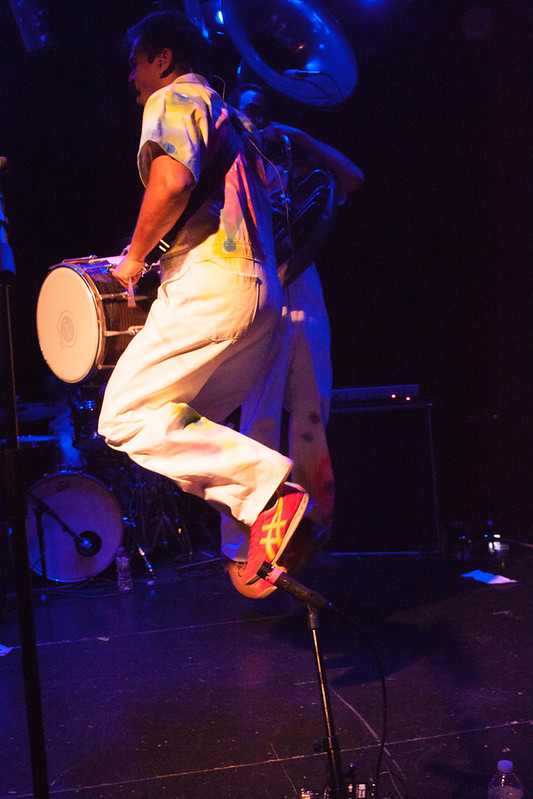
Led by its Rochester, NY-born, Brooklyn-based bandleader dholi, drummer and composer Sunny Jain (a dhol, is a shoulder slung, two-headed drum, typically one of the main instruments of bhangra), who has  recorded several jazz albums with his Sunny Jain Collective and has collaborated with Norah Jones, Peter Gabriel, Q-Tip, and the acclaimed Pakistani Sufi rock band Junoon and others; and featuring John Altieri (sousaphone), Ernest Stuart (trombone), Jonathon Haffner (saxophone), Sonny Singh (trumpet), Chris Eddleton (drums), Rohin Khemani (drums), and newest member Jonathan Goldberger (guitar), the newly-constituted Brooklyn-based octet Red Baarat, whose name derives its name from a baraat, a wild wedding procession that Jain explains in press notes includes a groom on top of a horse, extended friends and family singing and dancing, usually led by a brass band and for what the color red symbolizes in both Indian and American culture. (Red is typically worn at traditionally Indian weddings and symbolizes fiery passion; the sort of passion that Jain and company have towards music and the passion they elicit from listeners.)

Although the band formed back in 2008, with the release of their critically applauded and commercially successful sophomore effort, Shruggy Ji, the members of the Brooklyn-based collective developed a national and international profile for a seamless, genre and boundary-defying sound that draws from Indian classical music, bhangra, hip-hop, rock and pop with rousingly anthemic hooks and a dance floor friendly funk, based around Jain’s utopian vision and faith that communication across cultures simply takes empathy, creativity, love and a willingness to surrender to the spirit of music, art — and of the moment. And as a result of Shruggy Ji‘s critical and commercial success, the band has played some of the world’s biggest, most renowned music festivals, including Bonnaroo, Austin City Limits, Hardly Strictly Bluegrass, New Orleans Jazz & Heritage Festival and Peter Gabriel’s WOMAD Festivals in Australia, New Zealand and the UK, played sold out headlining shows at the Luxembourg Philharmonic, the Bowery Ballroom and have performed at the request of The White House, TED and the Olympic Games. Considering that we’re living in a presidential administration that is ruled around hate and distrust of outsiders and others, Jain and company’s mission seems not just hopeful; but proudly, defiantly revolutionary.

The band’s forthcoming (and much-anticipated) third full-length effort Bhangra Pirates is the first album with the band’s latest addition, guitarist Johnathan Goldberger, who adds psychedelic and surrealistic textures and percussive guitar lines. Additionally, the band has played a bit with their sound as the dhol and sousaphone also have been processed in a subtle fashion —  while retaining the enormous, propulsive, tribal stomp and equally enormous New Orleans brass-leaning horn section that won them international attention as you’ll hear on the rousing single “Bhangale,” which features guest spots from Delicate Steve. What has personally won me over with their sound  — and you’ll hear it on “Bhangale” is that there’s a sweaty, “you-are-there” improvised feel, in which the musicians seem to quickly get into a sustained and forceful groove and follow it and each other to its inevitable conclusion. And frankly, if it doesn’t make you get up and start stomping around and shouting along with them, there’s something wrong.


New Video: Icelandic Post-Punk Trio Fufanu Return with Surreal Sports-Themed Visuals for “Liability”

Over the past couple of months, I’ve written about the Reykjavik, Iceland-based indie rock/post-punk trio Fufanu. And you may recall that the trio, which is currently comprised of founding members Kaktus Einarsson (vocals, guitar), whose father Einar, was a member of The Sugarcaubes and Guðlaugur “Gulli” Einarsson (guitar, programming) (no relation, by the way) along with Erling Bang (drums) can trace their origins to when the band’s founding members met while at school. According to the band’s founding duo, Katkus had glanced at Gulli’s iTunes and noticed that they had listened to a lot of the same techno and electronic music. Quickly bonding over mutual interests, the duo went into a studio and began writing and recording electronic music under the name Captain Fufanu. And within a month of their friendship and the project’s life, they had began to play shows in and around Reykjavik.

In a strange twist of fate, the studio where Kaktus Einarsson and Gulli Einarsson had recorded their full-length Captain Fufanu album was burgled. And as a result, the album they recorded was presumed lost. Instead of trying to call the material they initially wrote from memory, Kaktus Einarsson and Gulli Einarsson decided that the moment was a perfect time for them to completely reinvent their sound. Interestingly, at the time, Kaktus was in London working on Damon Albarn’s Everyday Robots and touring with Bobby Womack when he began writing lyrics. Simultaneously Gulli had started to create a revised sound, which managed to convey what Kaktus had been thinking at the time. The duo then added guitars and drums, along with Kaktus’ brooding and detached vocals — and with their revised sound, renamed themselves Fufanu.

Their first live set with their new sound and aesthetic was at Iceland Airwaves and they quickly became one of the most talked about bands of the entire festival. Building upon the buzz they had received, they went into the studio their full-length debut A Few More Days To Go. And with the release of their debut, the duo received a rapidly growing national and international profile as they toured with a number of internationally renowned acts including The Vaccines and have played at JaJaJa Festival. With their recently released sophomore effort Sports, Kaktus and Gulli recruited Erling “Elli” Bang (drums) to further flesh out their sound as they expanded upon it and its thematic direction.

Now you might remember that I wrote about Sports’ first single, album title track “Sports,” a single that retained the synth-driven sound that first captured national and international attention while pairing it with a tight, motorik-like groove reminiscent of Can, Neu! and Joy Division while nodding at Security-era Peter Gabriel. “Liability,” Sports‘ second single continues in a similar vein as the trio pair angular busts of guitar with shimmering synths that twist and turn through the mix, a sinuous bass line and a mid-tempo groove that nods at the techno that the project once was. However, much like “Sports” the single possesses a dark, enigmatic air while pointing out the mundanity, drudgery and banality of daily life; but just under the surface there’s a broiling frustration and resentment of someone wanting to break free and yet not knowing how to do so.

Co-directed by the members of Fufanu and Gabriel B. Bachmann, the recently released music video for “Liability” continues the sporting leitmotif the band introduced with the “Sports” video; however, the actual sports are reduced to a seemingly surrealistic abstraction in which the members of the band are competing against themselves.

Linnea Olsson is Swedish singer/songwriter and multi-instrumentalist, who quickly established herself as a go-to cellist, thanks in part to her having worked with Peter GabrielStingAne Brun and Maia Hirasawa. Lately, Olsson has begun to receive international attention for her self-proclaimed cello-driven fantasy pop. Now, if you had been frequenting this site around the end of last year, you may recall that I wrote about “The Weekend,” a swooning and gorgeous track that reminded me quite a bit of Kishi Bashi as a classical string arrangement was paired with extremely modern and ironic lyrics describing a desperately neurotic and delusional narrator, who escapes into a world in which she’s an enormous star, who gets revenge on those who wronged her. Her latest single “Hall of Tragedy” thematically is much more serious; but it will further cement the Swedish singer/songwriter and multi-instrumentalist’s burgeoning reputation for crafting swooningly gorgeous cello-driven pop — and in the case of her latest single, the song also serves as the perfect showcase for an undeniably beautiful vocals in what may be arguably be the moodiest and most atmospheric song she has released to date.


Last month, I wrote about the  Reykjavik, Iceland-based indie rock/post-punk trio Fufanu — and if you recall, the trio, which is currently comprised of founding members Kaktus Einarsson (vocals, guitar), whose father Einar, was a member of The Sugarcaubes and Guðlaugur “Gulli” Einarsson (guitar, programming) (no relation,by the way) along with Erling Bang (drums) can trace their origins to when the band’s founding members met while at school. According to the band’s founding duo, Katkus had glanced at Gulli’s iTunes and noticed that they had listened to a lot of the same techno and electronic music. Quickly bonding over mutual interests, the duo went into a studio and began writing and recording electronic music under the name Captain Fufanu. And within a month of their friendship and the project’s life, they had began to play shows in and around Reykjavik.

In a strange twist of fate, the original album of material that Kaktus Einarsson and Gulli Einarsson wrote and recorded has long been presumed lost as the studio they recorded their original Captain Fufanu album was burgled. And instead of trying to recall the material they initially wrote from memory, the project’s founding members decided that it was a perfect time to completely reinvent their sound.  Around the same time, Kaktus Einarsson was in London working on Damon Albarn‘s Everyday Robots and touring with Bobby Womack when he began writing lyrics  while simultaneously Gulli Einarsson had started to recreate their sound in a  way that Kaktus describes as conveying what he had been thinking. They then added guitars and drums and began pairing that with Katkus’ brooding vocals — and then renamed themselves Fufanu.

Their first live set with their new sound and aesthetic was at Iceland Airwaves and they quickly became one of the most talked about bands of the entire festival. Building upon the buzz they had received, they went into the studio their full-length debut A Few More Days To Go, which further expanded a growing national and international profile as they toured with renowned acts such as The Vaccines and played at JaJaJa Festival. The band’s forthcoming Nick Zinner-produced sophomore full-length Sports is slated for a February 3, 2017 release through renowned British label One Little Indian Records. And with the band’s sophomore effort,  the project’s founding duo recruited Erling “Elli” Bang (drums) to further flesh out their sound as they expanded upon it and its thematic direction. With Sports’ first single, album title track “Sports,” the band retained the synth-driven sound that first caught international attention while pairing it with a tight, motorik groove reminiscent of CanNeu!  and Joy Division while nodding at Security-era Peter Gabriel.

“Liability,” Sports‘ second single continues in a similar vein as the trio pair angular busts of guitar with shimmering synths that twist and turn through the mix, a sinuous bass line and a mid-tempo groove that nods at the techno that the project once was. However, much like “Sports” the single possesses a dark, enigmatic air while pointing out the mundanity, drudgery and banality of daily life; but just under the surface there’s a broiling frustration and resentment of someone wanting to break free and yet not knowing how to do so.


New Video: The Humanist and Globalist Pop Sounds of Daby Touré

Daby Touré is a Mauritanian-born, Paris-based singer/songwriter, who has had a lifelong love and obsession that began with listening to The Police, Stevie Wonder and Michael Jackson over the radio; however, he can trace the origins of his music career to when he taught himself the basics of guitar, while possessing an instinct that music was to be his life.

As a teenager, Touré relocated to Paris and his lifelong passion for music gradually drew him away from his studies in business; in fact, Touré began fully immersing himself in Paris’ jazz scene. And after several years of experimenting with his sound and songwriting, Touré met electronic music artist and producer Cyrille Dufay in 2003 — and the duo collaborated on Touré’s critically applauded breakthrough album Diam, an album that was signed to Peter Gabriel’s Real World Records. Interestingly, as a result the Mauritanian-born, Paris-based singer/songwriter opened for Gabriel during the renowned British artist’s 2004 Growing Up World Tour, which allowed Touré to have a growing international profile — with the album being added to playlists across France and the UK.

In 2006, the Mauritanian-born, Paris-based singer/songwriter was nominated for Discovery of the Year in that year’s BBC World Music Awards and he released his sophomore effort, in which he collaborated with sound engineer Ben Finlay, who has worked with Peter Gabriel, Sting, Simply Red, Jeff Beck and Robert Plant; and mixer and engineer Tom Oliver, who has worked with Sinead O’Connor, U2, Seun Kuti, Tony Allen, Susheela Raman and Charlie Winston. The following year saw the release of his third full-length effort Stereo Spirit, an album praised internationally for material that possessed catchy hooks and singalong-worthy lyrics — while pushing his sound towards the genre-defying.

By 2009, Touré collaborated with bluesman Skip McDonald on the Call My Name EP, an effort that Sing Out! described as being “neither African nor blues, but instead pulls from both and also from rock, a touch of pop and even dub for a unique, appealing and — its as to be said — quite commercial sound. The two voices and styles complement each other perfectly, and the songs they’ve created – for they seem more like creations than compositions – summon up echoes of their histories, but end up in a hybrid that’s essentially completely new.” With the success of his collaboration with McDonald, Touré has collaborated with an increasing number of internationally recognized artists including French pop artists Francis Cabrel and Maxime Le Forestier on Touré’s 2012 French language effort Lang(u)age — and he’s performed alongside Bob Geldof, Rihanna and Enzo Avitabile, among others.

As Touré explains in press notes “I was born in Africa And all the traditional music I picked up when I was young is still in me and that doesn’t change. But in my music I am still searching, and mixing, and trying things and that’s what I am doing now. I have travelled far from the ‘traditional’ or ‘folkloric’ music of my country.” In fact, over the past few years, the Mauritanian-born, French-based singer/songwriter has increasingly has merged the linguistic sounds of the six languages he speaks while moving towards a more globalized and universal sound — all while maintaining the accessibility that won him international attention.

Although his most recent effort was 2015’s Amonafi, which was released through renowned indie label Cumbancha Records, the internationally renowned singer/songwriter will be in town for two sets at Subrosa on Thursday night and to celebrate the occasion, released the music video for album single “Oma.” Sonically “Oma” is a breezy pop song that owes a debt to dub and reggae as much as it does to traditional African folk music in a seamless fashion and with an infectious, crowd-pleasing hook Throughout, Touré sings in several different languages — including English for part of the song’s hook, which gives the song a jet-setting, globalist universality. And yet, the song draws from a personal experience. As Touré explains of the song “One day as I was walking down the street, I passed a woman and her children. She was alone, sitting on the ground, and asking for charity and nobody seemed to care. This woman spoke to me that day. She inspired this song. Oma is this mother’s cry.”

The recently released music video for the song is a fairly straightforward take on the song, that follows after the song’s thematic concern with the video having Touré encountering a homeless woman and her child, and Touré approaching this woman and her child for a friendly and empathetic conversation that influences his song.

Quickly establishing herself as a go-to cellist, who has worked with Peter Gabriel, Sting, Ane Brun and Maia Hirasawa, Linnea Olsson is Swedish singer/songwriter and multi-instrumentalist, who has begun to see international praise from the likes of The New York Times and The 405 for her self-proclaimed cello-driven fantasy pop. Olsson’s  latest single “The Weekend” is a simply put a stunningly gorgeous and swooning track that sonically speaking reminds me of quite a bit of the work of K. Ishibashi and his solo recording project Kishi Bashi as a classical-leaning string arrangement is paired with extremely modern and somewhat ironic lyrics in which the song’s narrator talks about drinking enough to forget everything that’s happened in the past week or so and treating the weekend as a much needed escape — from everything; however, the narrator’s escapist fantasies involve getting revenge on those who wronged her by becoming the biggest, most fantastic star on the face of the earth.