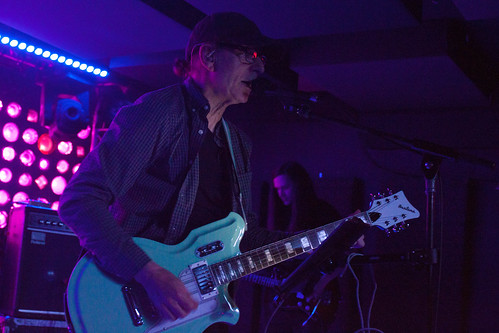
Child of Night is a rather mysterious Columbus, OH-based post-punk act and over the course of two EPs — last year’s Breathless EP and Neither of These Alone Is Enough, the members of the band have quickly developed a reputation for crafting murky, lo-fi synth based post punk that sounds as though it were inspired by Joy Division, Interpol, The Cure and others.
What Remains, Child of Night’s forthcoming EP is slated for a late August release through Altarpiece Records and the EP’s latest single “Sirens” continues on a similar vein as their previously released material — murky, synth based post punk with decidedly goth leanings; however, there’s a subtle refinement of their sound, as there’s a focus on crafting a steady, dance floor friendly groove centered around a propulsive bass line, and four-on-the-floor drumming. It’s as though Antics-era Interpol somehow went a smidge disco and a smudge in the direction of John Carpenter soundtracks.
The recently released video for “Sirens” fittingly looks as though it were filmed on grainy and completely fucked up VHS tape, which in some way evokes lingering ghosts and menacing presences just out of the frame.
Inner Tongue is the (mostly) solo recording project of a rather mysterious Vienna, Austria-based singer/songwriter, composer and musician, who grew upon an intensely musical home — his father is a saxophonist, who constantly wrote songs, so musical instruments were always lying around and his parents frequently shared their favorite albums with him; in fact, Inner Tongue formed his first band when he was 6. “We started out using one of my dad’s synths to play a pre-programmed beat,” he recalls. “I’d sing something that sounded to us like English.” Unsurprisingly, the Austrian artist, who cites Bjork, Moby, Portishead, Micheal Jackson, Sonic Youth, Radiohead, Pet Shop Boys, Aphex Twin, and The Cure’s The Cure In Orange as influences — although those influences don’t quite correspond to his own sound and songwriting approach continued playing and writing music, playing in a small number of bands, including one that had briefly worked with Duran Duran and David Bowie’s producer before getting dropped by their label.
Interestingly, with the release of some of his earliest solo work, the Austrian artist quickly garnered comparisons to James Blake, Childish Gambino, Frank Ocean, Death Cab for Cutie, Sohn, and Chet Faker/Nick Murphy. His quietly released yet critically applauded 2015 debut EP Tz Ka allowed him to open for the likes of Ghostpoet, Everything Everything and others. The Vienna, Austria-based singer/songwriter, composer, and musician’s full-length debut Favours was released earlier this year, and interestingly, the album’s overall sound and thematic concern is inspired by a deeply personal yet remarkable story. Back in 2013, Inner Tongue was diagnosed with a rare vocal-cord disorder that was so severe that only a handful of specialists throughout the entire world were capable of treating it; but eventually his condition required surgery, which left him, for a time unable to talk. Understandably, the months that followed the surgery were emotionally and physically shattering but he began composing music again. At the time, singing was out of the question and as the Austrian singer/songwriter, composer and musician says in press notes, “I decided to modify my musical focus temporarily by writing songs which could produce a melodic tension without vocals, but which featured the traits of forward-looking pop music. It was as if someone had pressed a resent button on the musical identity I had of myself.” Adds Inner Tongue, “I used to layer many sounds and melodies before, and felt like I hid the core of any idea behind that technique.”
Some of the Austrian artist’s full-length debut was made at home with most recorded in a friend’s stood in Vienna. Foals’ John Catlin, who collaborated with him on his 2015 debut EP assisted once again although his involvement varied throughout; however, as Inner Tongue says, Catlin “was continually involved as a producer and friend,” who also mixed the album with some further overdubbing where necessary. As the Austrian artist readily admits, the entire experience of writing and recording his full-length debut provoked ” “a lot of soul searching, trying to become a better mixing engineer and producer. I’m somewhat controlling when it comes to my music, and I need to get the little details right.”
However, unlike his debut EP, Favours was more of a collaborative effort, as he shared his ideas with a collective of very dear and close friends. “All contributions are built on a vision I initially had and then gain shape during the process,” Inner Thought says. His live backing band contributed much of the music with his father playing sax on “New York.” The live version of “2 Seconds,” Favours’ latest single features a sparse yet soulful arrangement centered around twinkling Rhodes piano keys and Inner Thought’s achingly tender vocals, which manage to express a plaintive, vulnerable need. It’s a delicate, sensitive yet incredibly sexy song that balances earnest emotion with deliberate attention to craft.
With the release of 2013’s Tales of Us, Goldfrapp, comprised of Alison Goldfrapp and Will Gregory, released one of their most hauntingly cinematic and gorgeous efforts they’ve ever released, as the album’s material found the duo pairing Goldfrapp’s arresting vocals with classical music-inspired arrangements centered around piano and strings, acoustic guitar and occasional electronic flourishes. However, last year’s critically applauded and commercially successful Silver Eye was a striking return to form — and as you may recall Anymore,” the album’s first single featured a slick yet abrasive sound featuring enormous, thumping 808-like beats, layers of buzzing and undulating synths. Interestingly, “Anymore” much like the rest of the material on the album buzzed with a restless, creative energy and sense of experimentation that was partially the result of the acclaimed duo working with Grammy-wining producer John Congleton, who has worked with St. Vincent, John Grant and Wild Beasts; as well as collaborations with electronic composer Bobby Krlic, best known as The Haxan Cloak and Leo Abrahams, a guitarist, who has collaborated with Brian Eno.
Album single “Ocean” continued in a similar vein as the song centered around an abrasive and minimalist-leaning production of arpeggiated synths, thunderous beats. As the duo explained to Billboard the song was created during a morning writing and recording session and was originally built from what Goldfrapp called a “a very small improvisation.” “I remember coming into the studio one morning and I think we just had a few drums going and it was really basic,” Goldfrapp recalled. “Will said ‘Do you fancy doing some vocals this morning?’ So I was like, ‘Alright then’ and slightly reluctantly, i went into the vocal both and the words just came out.” And as a result, the song manages to bristle with a furious sense of unpredictability.
July 6, 2016 will mark the release of Silver Eye: Deluxe Edition and while the deluxe edition will include the original album material, there will be a bonus disc of remixes and alternate versions, including a re-recording of “Ocean” that features Depeche Mode‘s Dave Gahan, as well a previously unreleased Will Gregory remix of “Anymore.” Naturally, turning the original song into a duet with Gahan’s and Goldfrapp’s imitable vocals gives the song a harder, darker, moodier, goth edge while still managing to be a straightforward rendition of the song. But perhaps, more important, if you’re a fan of both, it’s the most necessary and effortless collaboration that you needed to hear.
Directed by Alison Goldfrapp, the gorgeous and cinematically shot video for “Ocean” found her returning to Fuerteventura, where the videos for “Anymore” and “Everything Is Never Enough” were shot for her scenes, while she directed Dave Gahan in Madrid during a break in Depeche Mode’s current world tour. As a photographer, the video features some scenery and cinematography that has me jealous. As Alison Goldfrapp says of the video, “I had an amazing time directing Dave in the video for the track and we couldn’t be happier with the end result.”
With the release of 2013’s Tales of Us, Goldfrapp, comprised of Alison Goldfrapp and Will Gregory, released one of their most hauntingly cinematic and gorgeous efforts they’ve ever released, as the album’s material found the duo pairing Goldfrapp’s arresting vocals with classical music-inspired arrangements centered around piano and strings, acoustic guitar and occasional electronic flourishes. However, last year’s critically applauded and commercially successful Silver Eye was a striking return to form — and as you may recall Anymore,” the album’s first single featured a slick yet abrasive sound featuring enormous, thumping 808-like beats, layers of buzzing and undulating synths. Interestingly, “Anymore” much like the rest of the material on the album buzzed with a restless, creative energy and sense of experimentation that was partially the result of the acclaimed duo working with Grammy-wining producer John Congleton, who has worked with St. Vincent, John Grant and Wild Beasts; as well as collaborations with electronic composer Bobby Krlic, best known as The Haxan Cloak and Leo Abrahams, a guitarist, who has collaborated with Brian Eno.
Album single “Ocean” continued in a similar vein as the song centered around an abrasive and minimalist-leaning production of arpeggiated synths, thunderous beats. As the duo explained to Billboard the song was created during a morning writing and recording session and was originally built from what Goldfrapp called a “a very small improvisation.” “I remember coming into the studio one morning and I think we just had a few drums going and it was really basic,” Goldfrapp recalled. “Will said ‘Do you fancy doing some vocals this morning?’ So I was like, ‘Alright then’ and slightly reluctantly, i went into the vocal both and the words just came out.” And as a result, the song manages to bristle with a furious sense of unpredictability.
July 6, 2016 will mark the release of Silver Eye: Deluxe Edition and while the deluxe edition will include the original album material, there will be a bonus disc of remixes and alternate versions, including a re-recording of “Ocean” that features Depeche Mode’s Dave Gahan, as well a previously unreleased Will Gregory remix of “Anymore.” Naturally, turning the original song into a duet with Gahan’s and Goldfrapp’s imitable vocals gives the song a harder, darker, moodier, goth edge while still managing to be a straightforward rendition of the song. But perhaps, more important, if you’re a fan of both, it’s the most necessary and effortless collaboration that you needed to hear.
Patrick Holbrook is a Chicago, IL-based electronic music producer and artist, and his darkwave, synth-based solo recording project Well Yells has received attention both locally and regionally for a spectral sound paired with surreal, dream-like lyrics that draws from much of the music he had admired and learned to play bass following along to — in particular, Joy Division and Bauhaus, and the fragments of music he could remember from his dreams. Although unsurprisingly, his work has been compared to The Cure, Depeche Mode, John Carpenter, The Legendary Pink Dots, and Clan of Xymox among others.
Holbrook’s latest Wells Yell album Skunk was released earlier this year, and the album’s latest single “Near” is a brooding and cinematic track centered around layers of wobbling and arpeggiated synths, submerged vocals fed through layers of effects pedals, shimmering guitar chords and subtle, industrial clang and clatter. Sonically, the song manages to evoke a slowly unfurling and inescapable, existential dread.
As Holbrook told me through an email, the recently released video for “Near” was directed and shot by Toupee’s Mark Fragassi, and a segment of the of the video was shot at “. . . the Steelworkers Park on the South Side [Chicago], which have these really uncanny ruins of a steel mill — the walls are all that remain, but they’re 1/4 mile long!”
The Portland, OR-based multi-instrumentalist and singer/songwriter Jenny Logan may arguably be one of her hometown’s quietly kept and most talented secrets as Logan is a member of grunge of pop trio Loveboys, post-punk act Miss Rayon and guitar pop act Sunbathe, who I recently saw open for Typhoon at Music Hall of Williamsburg (more on that later). Along with that, Logan had a stint playing bass for Summer Cannibals and keyboards for a Seattle-based Rolling Stones cover band. Amazingly, the incredibly busy Logan managed to squeeze in the time to pursue her own singular musical vision with her solo recording project Deathlist, releasing her attention grabbing Deathlist debut last year, an effort which found Logan playing almost every instrument.
Slated for a March 9, 2018 release, Fun, the follow up to her Deathlist debut was written and recorded in the aftermath of the death of her best friend, and as a result, the material focuses on the grief and despair of a seemingly solitary mourner, with its narrator finding herself contending with a harrowing and impossible to answer question: how does one continue a conversation with someone, who will never be there again? And while the ironically titled Fun may feature some of the most achingly personal material that Logan may have arguably ever released, it points to one of the most universal experiences any of us will ever know: someone we love, respect and cherish will die, and we’ll brokenheartedly fumble through some portion of our lives, desperately trying to find some larger meaning to all the lingering ghosts of our pasts — or some convenient closure, when there never really is. Yet, we find a way to push on, to find some beauty and occasionally even acceptance within chaos.
Unsurprisingly with the material focusing on death and loss, Logan’s cites Christian Death, Sisters of Mercy and Suicide as inspiring aspects of the album’s sound, and while you’ll hear hints of that on album single “Charm School,” as Logan pairs buzzing and slashing guitars with throbbing, propulsive bass, forceful, industrial-like drum machines and razor sharp hooks; but I also hear hints of Sixousie and the Banshees, The Cure and Dirty Ghosts as the song manages to channel confusion, sorrow and anger — simultaneously and within a turn of a phrase.
Publicly citing Tears for Fears, The Cure, Spectrum, Guided by Voices, Sympathy Nervous and This Heat as major influences, the Springfield, MO-based synth wave/synth punk duo Kudzu, comprised of Seth Goodwin (vocals, synths, drum programming) and Mark Gillenwaters (vocals, guitar) will be releasing their forthcoming full-length album Defeated on March 2, 2018 through Push & Pull Records. And reportedly, the album’s 9 songs come from several layers of disenchantment and frustration — first with their local punk and DIY scenes, which has resulted in a general dissociation from them and second, the stark reality of life in the Ozarks. As the band’s Mark Gillenwaters explains in press notes “I feel like there is a type of alienation you can harbor in a place like this that lends itself to bleak music. I like to treat lyrics as more emotional than literal, so some lyrics might not make sense but still convey the emotion I’m trying to present.”
“Some Cops,” the latest single off the band’s forthcoming album finds the duo drawing from the likes of Ministry, PIL and early Nine Inch Nails as it features layers of buzzing, analog synths, slashing and buzzing power chords, propulsive yet forceful drum programming and an anthemic hook — and while clearly being mosh pit friendly, the song bristles and snarls with a pent up frustration at its core.
With the release of their 2014 full-length debut Dry, the Kiev, Ukraine-based post-punk quartet On The Wane, currently comprised of Dari Maksimova (bass, vocals), Anna Lyashok (drums, vocals), Eugene Voitov (guitar, synth), and newest member, Eli Demyanenko (drums, drum machine), received attention across their native Ukraine and elsewhere for a sound that draws from shoegaze, goth, New Wave and noise rock — with the members of the band citing Sonic Youth, The Cure, Joy Division, Pixies, Bauhaus, My Bloody Valentine, Slowdive, Cocteau Twins and Ringo Deathstarr as influences on their work.
Following a successful Ukrainian tour, the band, the quartet went into the studio and recorded a 6 track EP, Sick, which found the band’s sound drawing from the likes of Mudhoney, Fugazi and others with the effort being praised for a sound that drew from Sonic Youth, Gang of Four and The Damned among others; however, after the release of Sick, the band went through a lineup change with their newest member Demyanenko and with his addition, the Ukrainian-based post punk act added synthesizers and a drum machine to their sound. And as a result, the quartet’s sophomore effort Schism finds the band changing things up yet again — this time with the band taking on an increasingly goth-based, electronic rock sound that nods at 4AD Records, Garbage and Siouxsie and the Banshees, as you’ll hear on the album’s latest single “Sultry Song.”
Directed by Mikhail Efimenko, the recently released video, was based on the band’s idea to create a non-complicated video showing the atmosphere of their rehearsal space/studio/workplace and to introduce the band to the world.
Over the past two years or so, you’ve likely come across a number of posts featuring the London-based JOVM mainstays Ten Fe. Initially comprised of singer/songwriter duo Ben Moorhouse and Leo Duncan, the duo won national and international attention for pairing their distinct writing styles and voices into a unique sound.
Now, as you may recall Moorhouse and Duncan had played in a number of London area bands in which they individually felt as though there was pressure to fit into a particular scene, whether through a one way of playing or a certain way of looking, and it was something they felt unnatural and unnecessarily labored — and it was something that they deeply reviled. Interestingly enough, as the story goes, Moorhouse and Duncan met at a party and became busking partners in the London Underground. In those very early days, they enjoyed the very simple pleasures of playing music they loved — mostly early rock, early Beatles and the like — and earning cash while doing so. Coming from a place of pure joy, they noticed a profound simpatico, and they began to play their own original material. “We had a very clear idea of what we wanted. For things to be simple, based around songs that are unashamed in their directness, and that we love: The Cure, U2, Springsteen and The Stones. We’d spend years playing through these on the tube, realising you don’t need to break the mould. Its best to ignore all the voices telling you that you need to for the sake of it, and go for something deeper,” the duo explained in press notes. And with Ten Fe, Moorhouse and Duncan wanted to focus primarily on the song with style serving the song — and while being anthemic and downright arena rock friendly, their sound is difficult to describe and even more so to pigeonhole, as it possesses elements of the Manchester sound, Brit Pop, Americana, electro pop and contemporary indie rock. They manage to do this while balancing careful, deliberate attention to craft with soulful earnestness and bombast.
Moorhouse and Duncan then spent the next two years, writing, revising and recording in each other’s bedrooms, which included prolonged writing sessions at Duncan’s dad’s house in Walsall, UK, relentless busking, hustling and saving, and an impossibly lengthy list of band members and producers before they signed a publishing deal and briefly relocated to Berlin, where they recorded their Ewan Pearson-produced full-length debut effort Hit the Lights. “Its no coincidence that the name of this band means ‘have faith’” says Leo Duncan.
After spending the past 18 months touring to support their full-length debut effort Hit the Light, which included an incredible set at Mercury Lounge earlier this year, the project officially expanded into a full-fledged band with the permanent additions of touring members Rob Shipley (bass) and Johnny Drain (keys), who are two of Duncan’s oldest friends from Walsall, and Alex Hammond (drums). Returning back to England, the newly constituted quintet began writing material for their highly-anticiapted sophomore effort, and the first bit of recorded output as a quintet “Single, No Return” may be a bit of a taste of what we should expect from the new album, as it manages to capture the band’s live sound and energy, complete with a swaggering and jaunty stride. Interestingly, the band has referred to the song as being a descendant of Hank Williams‘ “Ramblin’ Man,” a song which the band’s founding members used to play while busking in the London Underground, and although they claim that when it came to the song’s arrangement they thought of The Rolling Stones, Creedence Clearwater Revival, Crosby, Stills, Nash and Young but with a bit of swing to the mix, to my ears it sounds a bit more like the Psychic Ills, filtered through Brit Pop; but no matter — the song manages to evoke life on the road and its seductive pull on one’s soul while further establishing their ability to craft effortlessly slick, hook-driven material.
For the better part of a decade, Frankie Rose played a significant and vital role in Brooklyn’s indie rock scene, as an original member of several critically applauded and commercially successful acts including Crystal Stilts, Dum Dum Girls, Vivian Girls and Beverly, as well as a solo artist. Now, if you’ve been frequenting this site for some time, you may recall that Rose had briefly relocated back to her hometown of Los Angeles with the intention of establishing a new, creative and professional moment in her career; however, the experience of being down and out, and not quite knowing what to do next wound up inspiring her fourth full-length album Cage Tropical, which was co-written with Jorge Elbrecht, known for his work with Tamaryn, Gang Gang Dance, No Joy and my own personal favorite Violens.
Adding to a run of New Wave-inspired material, Rose is set to release a full-length cover of The Cure‘s critically applauded sophomore effort Seventeen Seconds as part of Turntable Kitchen’s Sounds Delicious vinyl covers series. The first single off Rose’s Seventeen Seconds cover album is a fairly straightforward and moody rendition of one of my favorite Cure songs “A Forest,” but interestingly enough, the cover album’s latest single is a slightly sped up rendition of “At Night,” which retains the original’s moody and foreboding vibe — all while reminding contemporary listeners of how influential and timeless The Cure’s work has been; in fact, you can easily imagine a contemporary band recording something that would have sounded like the material off Seventeen Seconds right now.
This past weekend has been a very busy one for me, as I’ve taken part in a Baby Robot Media hosted Mondo.NYC panel titled “Your First PR Campaign” and I’ve managed to cover some of the festival — while squeezing in my beloved New York Yankees, who have managed to get into the American League Division Series against the Cleveland Indians. There will be more on Mondo.NYC in the future; but in the meantime, let’s get to some music, eh?
For the better part of a decade, Frankie Rose played a significant role in Brooklyn’s indie rock scene, as an original member of several critically applauded and commercially successful acts including Crystal Stilts, Dum Dum Girls, Vivian Girls and Beverly, as well as a solo artist. And interestingly enough, Rose has been considered a controversial and restlessly creative presence, frequently leaving projects, just as they were beginning to attain some measure of success. Now, if you’ve been frequenting this site over the course of the summer, you may recall that Rose relocated back to her birthplace of Los Angeles with the intention of establishing a new, creative and professional moment in her career; however, the experience of being down and out, and not quite knowing what to do next wound up inspiring her fourth full-length album Cage Tropical, which was co-written with Jorge Elbrecht, known for his work with Tamaryn, Gang Gang Dance, No Joy and my own personal favorite Violens. Album single “Dyson Sphere” managed to sound as though it owed a debt to 80s New Wave — in particular A Flock of Seagulls “I Ran (So Far Away),” Siouxsie and The Banshees’ “Israel” and “Happy House,” immediately came to my mind.
Adding to a run of New Wave-inspired material, Rose is set to release a full-length cover of The Cure‘s critically applauded sophomore effort Seventeen Seconds as part of Turntable Kitchen’s Sounds Delicious vinyl covers series. The first single off Rose’s Seventeen Seconds cover album is a fairly straightforward and moody rendition of one of my favorite Cure songs “A Forest.” And if there’s one thing the Frankie Rose cover should do two things: remind contemporary listeners that a great song can truly be timeless and that The Cure should be considered one of the more important bands of the 1980s.