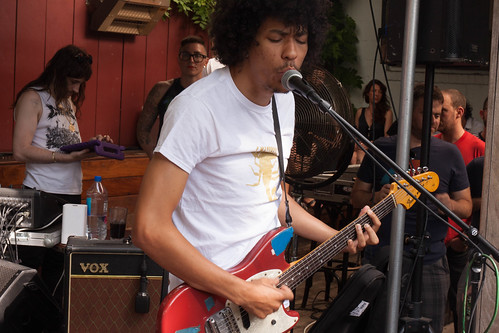
Tag: Boogarins

Forming in 2014 and deriving their name from the fictional spice in Frank Herbert’s sci-fi saga Dune that makes intergalactic travel, telepathy and longevity possible, the Madrid, Spain-based psych rock quintet Melange, comprised of long-time friends Adrian Ceballos (drums and vocals), Daniel Fernandez (bass and vocals), Mario Zamora (keyboard and vocals), Sergio Ceballos (guitar and vocals), and Miguel Rosón (guitar and vocals) are among their hometown’s most accomplished and acclaimed musicians — with the band’s individual members having stints in locally renowned acts including Lüger, RIPKC, and Bucles and others.

Now, if you’ve been frequenting this site over the summer, you may recall that the members of Melange brashly emerged into both Madrid’s and their home country’s music scenes with their self-released, double LP, which featured a highly conceptual narrative influenced by the diverse experiences of the bandmembers. Thematically, the material touched upon evolution, comprehension and transformation through music — all while sonically drawing from prog rock, psych rock and folk music, and as a result, the band received praise from  El Pais, Mondo Sonoro, Sol Musica, and Ruta 66 as well as airplay from Radio 3, and played at some of their homeland’s biggest and well-regarded festivals including Low Festival, Sonogram Festival, Sala Stereo Festival, Sala Planta Baja, Festival Noroeste, Festival Wos, Fueu Festival and others.

Building upon a breakthrough 2016, which included a busy touring schedule, the band spent their free-time writing and recording their h ighly-anticipated, Carlos Diaz-produced sophomore album Viento Bravo,  which live to tape at Gismo 7 Studios in Motril, Spain and Phantom Power in Madrid Spain. Reportedly, the album finds the band refining their sound — with the album’s breezy, tropicalia-like first single “Rio Revuelto” reminding me quite a bit of JOVM mainstays Boogarins, Junip , Jose Gonzales and The Yes Album-era Yes. The album’s second and latest single “Cotard” continues in a similar vein as its predecessor but with an even trippier song structure emphasized by arpeggiated organ chords and some impressive guitar world — but unlike its predecessor, it has a more direct psych rock and prog rock-based sound, seemingly nodding at The Doors‘ “Light My Fire,” Yes’ “Roundabout,” and “I’ve Seen All Good People” among others.


Renowned psych rock label Beyond Beyond is Beyond Recordswill be releasing Viento Bravo on November 17, 2017.



New Video: JOVM Mainstays Boogarins Return with Hallucinatory and Abrasive Visuals for Their Boundary-Pushing New Single

During a rather busy bit of international touring the Latin Grammy-nominated act, Boogarins, holed up in house near Austin, TX’s SPACE Studios for most of the summer, and they spent their time writing and recording new material in between a several weeks- long Austin club residency. the band’s latest single “Elogio a Instituição do Cinismo” (translated into English, the title is “Praise the Institution of Cynicism”)is a decided sonic departure as the band incorporates the use of thumping beats and breakbeats, swirling and whirling electronics, abrasive and buzzing guitars to create a malevolent and angrily brewing storm of sound that’s paired with vocals that manage to be both dreamily placid yet pissed off. While being hallucinatory, the song manages to be a rowdy, furious almost dance floor-like stomp, revealing a band that’s readily and aggressively pushing psych rock and Brazilian rock into strange, yet excitingly new directions.

Filmed and edited by Victor Souza and featuring collages by Beatriz Perini, the recently released lyric and subtitled video emphasizes the bitter, vitriol-fueled critique of society at the heart of the song, suggesting that society encourages people to be deceptive and allows people to be used as means for more ends in themselves. The collages help emphasize the song’s whirling malevolent storm.

With the 2015 release of their excellent, sophomore effort Manual, the Brazilian psych rock quartet Boogarins quickly became a JOVM mainstay artist. Now, if you’ve been frequenting this site over the past year or so, you’d recall that the internationally acclaimed psych rock quartet can trace their origins to when its founding members, Fernando “Dino” Almeida and Benke Ferraz started playing music together as teenagers in their hometown, the central Brazilian city of Goiânia. Interestingly, the music that the duo of Almedia and Ferraz began to write and eventually record quickly revealed a unique vision of psych pop that drew from their country’s incredibly rich and diverse musical and cultural history  — but with a decidedly modern viewpoint. And unlike a number of contemporary rock bands in their native Brazil, Boogarins were among one of the first, who wrote and sung lyrics completely in Brazilian Portuguese.

The release of the band’s full-length debut As Plantas Que Curam reverberated throughout Brazil as it was a massive critical and commercial success — without the support of a major label or a publicity firm pushing the album. As the band rose to national prominence, they started to receive larger international attention, and as a result they’ve played some of the world’s largest and most popular festivals including   Austin Psych FestBurgeramaPrimavera Sound Festival, as well as playing headlining shows in clubs in LondonParisBarcelona and New York. And while touring to support their their full-length debut, the members of the quartet had began writing and revising the material that would eventually comprise Manual. Now, interestingly enough, the material on their sophomore effort was specifically conceived as a diary or dream journal, which gives the material a deeply personal, almost stream-of-consciousness-like feel; but it also reveals a band that has become increasingly sociopolitically conscious as the album’s lyrical content also draws from the complex socioeconomic and political that affected their homeland’s communities before, during and after the 2014 World Cup — namely that entire neighborhoods and communities were being razed for massive commercial developments that helped multinational, global corporations and their interests make money hand over fist instead of uplifting those who desperately needed uplift.

During a rather busy bit of international touring the Latin Grammy nominated act, the quartet holed up in house near Austin, TX‘s SPACE Studios for most of the summer, and they spent their time writing and recording new material in between a several weeks along Austin club residency. the band’s latest single “Elogio a Instituição do Cinismo” (translated into English, the title is “Praise the Institution of Cynicism”)is a decided sonic departure as the band incorporates the use of thumping beats and breakbeats, swirling and whirling electronics, abrasive and buzzing guitars to create a malevolent and angrily brewing storm of sound that’s paired with vocals that manage to be both dreamily placid yet pissed off. While being hallucinatory, the song manages to be a rowdy, furious almost dance floor-like stomp, revealing a band that’s readily and aggressively pushing psych rock and Brazilian rock into strange, yet excitingly new directions.


New Video: The Harsh and Haunting Sounds and Visuals for Boogarins “Cuerdo”

Much like the album’s previously release single “Tempo,” the album’s latest single “Cuerdo” is a deeply contemplative song; however, the dreamy new single sounds as though it draws from Kid A and Amnesiac-era Radiohead and Dark Side of the Moon-era Pink Floyd as reverb-heavy guitar chords, a subtle yet gorgeous horn arrangement with the vocals at times feeling peacefully submerged, almost entombed within the dreamy and slow-burning mix. Interestingly, as the band’s guitarist Benke Ferraz notes, the song focuses on the feeling of not belonging and being in a situation in which you can’t express yourself — perhaps out of danger if you’re part of a minority group.

Directed by Ricardo Spencer, the recently released video for “Cuerdo” reveals the haunting and harsh beauty of nature as it depicts a group of buzzards descending upon a dead cow at various angles — a cinematic wide screen which has every figure involved look like microscopic dots before quickly panning in to see the vultures eating the dead cow in super slow motion. As the band’s Ferraz expressed in press notes, the vultures seemed to represent quite a bit for anyone who feels for minorities of any stripe and how our especially conservative — and seemingly sadistic — societies and media outlets deal with them.

New Video: Boogarins Returns with Yet Another Breezy and Contemplative Song, and Gorgeous Visuals

Boogarins latest single “Tempo” is an contemplative song with an expansive song structure consisting of alternating dreamy and moody section with a loud, anthemic section featuring buzzing guitar chords and feedback — and much like the album’s previously released singles the latest single sounds as thought it draws from Pink Floyd, 60s garage psych, Tropicalia and jazz, which gives the song a breeziness that belies its thoughtful and psychedelic nature. According to press notes, the song’s lyrics speak about stopping time and freeing yourself from the everyday grind of work, school and obligations and escaping from the pressures of daily life.

Interestingly, the members of the band reached out to their fans on social media and asked them to shoot footage of two different moods: the first being “man’s world,” a world full of soul-crushing and demeaning imagery of urban life — commuting and rushing about, working, studying and starting at computer screens; and the second being images of sanctuary and safe places — friends, being out in nature, music, art and anything that would make you feel open, free and whole. As a result of their open call, the band received hundreds of submissions, which were then edited and crafted into a gorgeous, surreal and coherent whole by Cobrandit Films’ Owen Mack.


Over the past couple of months I’ve been experimenting with a monthly Spotify playlist that covers the songs I’ve reviewed over the course of the past month, along with the songs I’ve referenced. And although some songs almost always seem to be missing during the initial compilation, I think it still manages to be a fairly comprehensive look at the past month on JOVM. (Just an early world, December will be pretty interesting as there will be a monthly playlist and I will be doing a Best of List primarily through Spotify as an additional experiment. But we’re jumping ahead here.)

November’s playlist continues the eclectic and tasteful curation that this site has long been known for and includes Aroc!‘s collaborations with Eric Bellinger, the gorgeous sounds of Floating Points, the socially conscious psych rock of Brazilian superstars Boogarins, JOVM mainstays Rene Lopez, Escort, Shabaam Sahdeeq, Pr0files, White Reaper, Beacon, New Order and Freddie Gibbs and others among a lengthy list. You’ll catch new singles from the Houston, TX-born, New York-based indie soul artist Melany Watson, several singles off Coke Weed‘s excellent Mary Weaver, two singles off The Giraffes kick ass, stoner rock album Usury, a new single from Swedish psych rock sensation Caviare Days, anthemic singles from Brandi Carlile‘s powerhouse country album, The Firewatcher’s Daughter and Canadian trio Red Moon Road, a few singles off Neon Indian‘s club-friendly VEGA Intl. Night School and more. There’s quite a bit of funk on this list as I make references to The Whispers, The Gap Band, Kool and the Gang, Chic, Rick James, and others. And there’s quite of synth pop including Tears For Fears, Depeche Mode, The Human League and more.  Check it out and tell your friends while you’re at it!

The internationally acclaimed Brazilian indie psych rock quartet, Boogarins can trace their origins to when its founding duo, Fernando “Dino” Almeida and Benke Ferraz started playing music together as teenagers in their hometown, the central Brazilian city of Goiânia. The music that Almedia and Ferraz began to write and then eventually record was a unique vision of psych pop that drew from their country’s incredibly rich and diverse musical history — but with a decidedly modern viewpoint. Their 2013 full-length debut, written and recorded as a duo, As Plantas Que Curam was a decidedly lo-fi home studio effort, pieced together in isolation before the duo had played a live gig. By the time, their debut album was released, Almedia and Ferraz had recruited a rhythm section, and the completed lineup had started developing a profile both in their hometown and nationally, as they started booking and playing regular gigs in Sao Paulo and several of Brazil’s largest cities.  Without much support from a label or from a major PR firm, As Plantas Que Curam was a critical and commercial success in Brazil, as the album received praise from Rolling Stone Brazil, who had dubbed the band “Best New Artist” in 2013, and the album was nominated for several awards on GloboTV’s annual music award shows. Arguably, a great deal of the success and attention that Boogarins has seen in their homeland comes from the fact that unlike the majority of contemporary Brazilian acts that primarily sing lyrics in English, like their British, Australian and American counterparts, Boogarins material is written and sung completely in Brazilian Portuguese.

Now, if there’s one thing the blogosphere has gotten absolutely right, its the fact that as a general rule it has given attention and praise to a number of fantastic internationally based acts that many American listeners wouldn’t have been aware of before, unless they were particularly adventurous. And over the last two years or so, Boogarins have started to receive increasing international attention as the band as toured across the globe, playing at some of the world’s most renowned and largest festivals, including Austin Psych FestBurgeramaPrimavera Sound Festival and headlining shows in clubs in LondonParisBarcelona and New York. Naturally, with that kind of exposure, the band started to receive praise from a number of internationally recognized outlets such as Pitchfork and The New York Times, who compared the Brazilian band’s sound to the likes of early Jefferson Airplane.

During their Spring 2014 European tour, the members of Boogarins spent two weeks in Jorge Explosion’s Estudio Circo Perrotti in Gijón, Spain, where they started tracking for material, which would wind up comprising their sophomore effort, Manual, which is slated for an October 30 release. Actually, the album’s full (and official title) is Manual,ou guia livre de dissolução dos sonhos, which translates into English as Manual, or Free Guide to the Dissolution of Dreams, and the material on the album is specifically meant to be viewed as a diary or sort of dream journal. The band eventually returned to Brazil and in between concert dates across South America, they finished the album in Ferraz’s home studio.

Manual‘s material is reportedly not only more personal than their debut, it’s also more socially conscious as it draws from the sociopolitical and class issues affecting their homeland before, during and after the 2014 World Cup as entire neighborhoods were pushed aside and destroyed for massive commercial developments that helped wealthy global corporations make even more money, instead of uplifting those who desperately needed uplift and were promised it from the World Cup. (Certainly, as a native New Yorker, the stories of increasingly gentrification changing the face, character and population of the city would seem remarkably familiar.)

Just a few weeks ago, I had written about album single “Avalanche,” a slow-burning yet breezy and percussive song comprised of shimmering guitar chords played through reverb and delay pedals, swirling feedback and a sinuous bass line paired with plaintive and ethereal vocals. And in some way, the song sonically speaking sounded as though it drew from Dark Side of the Moon and Wish You Were Here-era Pink Floyd and Tropicalia but thematically drawing from Rage Against the Machine; in other words, dreamy and trippy yet grounded in the real world — and done in a way that’s powerfully accessible.  The album’s latest single “6000 Dias” is a slow-burning kaleidoscopic song that’s propelled and held together by a tight rhythm section, as the song is composed of about three distinct segments — one which includes a gorgeously, twisting and turning guitar solo that’s reminiscent of Robby Krieger‘s incredible, guitar solo in “Light My Fire” before ending in a gentle fade out, which evokes the sensation of slowly waking from a pleasant reverie.