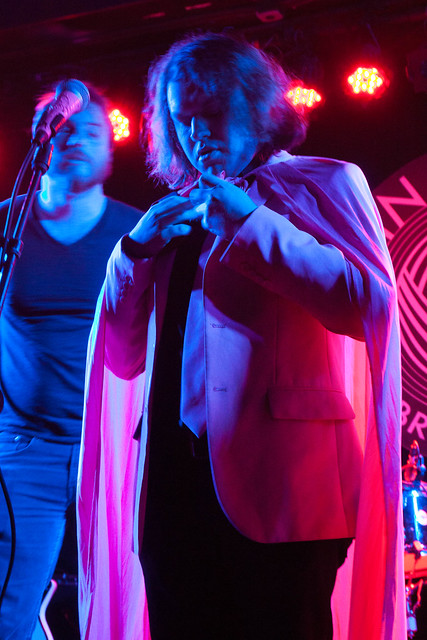
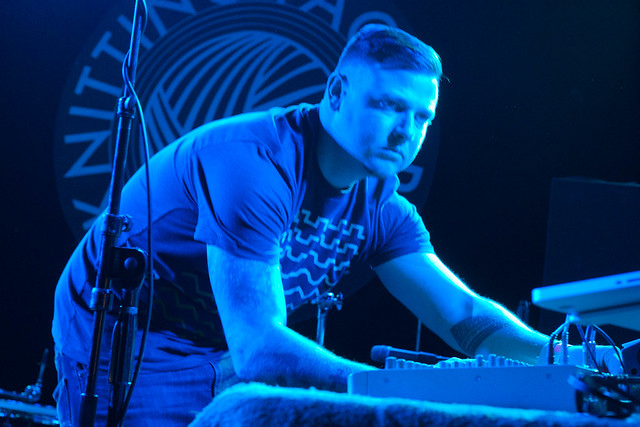
Öhman’s latest single “Hearts to Gold” is as he explains in press notes “a tale of celebration. Shining positive light on creators, the over-thinkers, anyone who has ever been a part of a sub-culture anyone who dealt with the anxiety of society’s expectations.” Sonically speaking Öhman pairs layers of shimmering synths, swirling electronics, boom bap beats and wobbling low end in an ethereal, dreamy yet anthemic song that possess an encouraging and hopeful message to struggling creatives everywhere, and it should push those folks forward when times seem particularly difficult.
The recently released music video is an extremely symbolistic video that begins by following a lone, black leather clad motorcyclist speeding along lonely country roads before stopping in the woods to have a fight for the death against what appears to behis/her doppleganger — or more loathsome and dangerous enemy, suggesting the intense struggles creative people often have with themselves and with outside forces as they attempt to create.
Adam Öhman is a Stockholm, Sweden-based electronic music producer and artist, best known as Mountain Bird. And with the release of several singles, the Swedish producer and artist has developed a growing internationally recognized profile for a sound that’s been compared favorably to renowned French electro pop act M83 — and for adding his name to a growing Swedish electro pop/dream pop scene that includes acts like Moonbabies, Niki and The Dove and countless others. Adding to a growing profile across Europe and elsewhere, Öhman’s work has received airplay on Steve Lamacq‘s BBC Radio 2 show, Radio X, Absolute Radio and elsewhere.
Naturally, building upon a steadily growing buzz, Öhman is currently in the studio working on new material that will eventually be released through renowned Swedish label With Love Recordings — the label home of acts like CANVAS, Swim, Neeco Delaf and others. Öhman’s latest single “Hearts to Gold” is as he explains in press notes “a tale of celebration. Shining positive light on creators, the over-thinkers, anyone who has ever been a part of a sub-culture anyone who dealt with the anxiety of society’s expectations.” Sonically speaking Öhman pairs layers of shimmering synths, swirling electronics, boom bap beats and wobbling low end in an ethereal, dreamy yet anthemic song that possess an encouraging and hopeful message to struggling creatives everywhere, and it should push those folks forward when times seem particularly difficult.
Swedish singer/songwriter and multi-instrumentalist David Alexander and his solo dream pop/electro-pop Summer Heart has received international attention for a wistfully nostalgic, 60s psych pop-leaning, lo-fi sound that compares favorably to Caribou‘s earliest material, Washed Out, In Ghost Colours-era Cut Copy, Painted Palms and others; in fact, his 2011 Please Stay EP received praise from The Guardian and The Startopped Hype Machine‘s charts. In his native Sweden, Alexander has a reputation for being a pioneer of Sweden’s burgeoning dream pop movement, a movement that includes Moonbabies, The Land Below, Hey Elbow, Blind Lake and Emerald Park.
Interestingly, Alexander’s international profile has grown as several of his songs have appeared in TV series — including the NBC series, Whitney, which brought him the attention of millions of American TV viewers. Now, if you were frequenting this site last year, you might recall that I wrote about “Nothing Can Stop Us Now,” a song that consisted of jangling guitars, washboard-led percussion, layers of ethereal vocals and cascading synths with a warm buzzing summer afternoon warmth. His latest single “The Forbidden” off his forthcoming EP also named The Forbidden is a slow-burning and shoegaze-leaning single that pairs Alexander’s ethereal cooing with shimmering guitars and synths played through gentle amounts of reverb and jazz-like drumming. And although the song evokes the sensation of waking up from a pleasant dream, just underneath its placid surface is a wistful melancholy that will remind the listener that all things will eventually dissipate.
Alexander along with a backing band featuring some of his dearest friends will be making Stateside appearances at SXSW and Williamsburg Brooklyn’s The Knitting Factory later this month. Check out tour dates below.
Originally known for her work in electro pop projects Her Habits, Gemology and others, Toronto-born, Brooklyn-based singer/songwriter and electro pop artist Joanie Wolkoff has been a JOVM mainstay artist before striking out on her own last year with her solo recording project Wolkoff. In fact, last year was a very big year for the Canadian-born, Brooklyn-based artist — she collaborated with renowned electronic act The Hood Internet on “Going Back,” a single released to massive praise across the blogosphere, including several major media outlets, including Vice Noisey and Billboard— and as you can imagine resulted in a growing national profile for Wolkoff.
Interestingly, Wolkoff’s previously released work channeled the contemporary electro pop sound of acts like Beacon, Seoul (both of whom are also JOVM mainstays) and others — in other words eerily minimalist productions consisting of icy synth stabs and woofer and tweeter rattling bass paired with plaintive vocals. However, her ongoing collaboration with young, up-and-coming producer Icarus Moth, which started with the release of the Talismans EP has set the duo apart from the pack as Icarus Moth’s production reveals a deliberate and painterly approach. While drawing from contemporary electro pop and world dance music, the young producer has developed a reputation for pairing big beats, swirling electronics and lush layers of synths with medieval-sounding instrumentation in a way that evokes brushstrokes across a canvas — as you’ll hear on EP single “Curve Appeal,” and others.
Building upon the buzz the duo received last year, Wolkoff and Icarus Moth are set to release Wolkoff’s full-length debut Without Shame on April 15. Lyrically and thematically, the material on the album explores the role shame has in our lives and perhaps more importantly the possibility of sidestepping its grip on us through breaking rank and venturing into the unknown. And as a result, the material on the album may be among the most deeply personal — and yet profoundly universal — material she’s released to date. Without Shame‘s first single “The Homecoming” pairs big tweeter and woofer rattling bass with skittering drum programming, swirling and ambient electronics, Eastern-tinged instrumentation and Wolkoff’s coquettish cooing, and in some way the song possesses the dreamy and ethereal feel of Swedish dream pop — think of Moonbabies‘ excellent Wizards on the Beach and The Knife but subtly filtered through chip tune and old school house music.
Without Shame‘s second and latest single “Kings Highway” pairs Icarus Moth’s painterly production style consisting of swirling electronics, layers of cascading synths, chiming synths, boom-bap beats and ambient electronics with Wolkoff’s husky and coquettish vocals singing lyrics that are both surreal and Romantic in a song that’s sensual and seductive — while sounding as though inspired it were by electro pop, R&B and house music. And although radio friendly and accessible, it’s challenging and possesses an art school sheen. Certainly, from the first two singles Icarus Moth should be an in-demand producer as he has a unique sound — and it suggests that Wolkoff and Icarus Moth’s collaboration may be one of the most exciting and unique collaborations in contemporary pop.
Originally known for her work in electro pop projects Her Habits, Gemology and others, Toronto-born, Brooklyn-based singer/songwriter and electro pop artist Joanie Wolkoff has been a JOVM mainstay artist before striking out on her own last year with her solo recording project Wolkoff. In fact, 2015 was a very big year for the Canadian-born, Brooklyn-based artist — she collaborated with renowned electronic act The Hood Internet on “Going Back,” a single released to massive praise across the blogosphere, including several major media outlets, including Vice Noisey and Billboard — and as you can imagine resulted in a growing national profile for Wolkoff.
Interestingly, Wolkoff’s previously released work channeled the contemporary electro pop sound of acts like Beacon, Seoul (both of whom are also JOVM mainstays) and others — in other words eerily minimalist productions consisting of icy synth stabs and woofer and tweeter rattling bass paired with plaintive vocals. However, her ongoing collaboration with young, up-and-coming producer Icarus Moth, which started with the release of the Talismans EP has set the duo apart from the pack as Icarus Moth’s production reveals a deliberate and painterly approach. While drawing from contemporary electro pop and world dance music, the young producer has developed a reputation for pairing big beats, swirling electronics and lush layers of synths with medieval-sounding instrumentation in a way that evokes brushstrokes across a canvas — as you’ll hear on EP single “Curve Appeal,” and others.
Building upon the buzz the duo received last year, Wolkoff and Icarus Moth are set to release Wolkoff’s full-length debut Without Shame on April 15. Lyrically and thematically, the material on the album explores the role shame has in our lives and perhaps more importantly the possibility of sidestepping its grip on us through breaking rank and venturing into the unknown. And as a result, the material on the album may be among the most deeply personal — and yet profoundly universal — material she’s released to date. Without Shame‘s first single “The Homecoming” pairs big tweeter and woofer rattling bass with skittering drum programming, swirling and ambient electronics, Eastern-tinged instrumentation and Wolkoff’s coquettish cooing, and in some way the song possesses the dreamy and ethereal feel of Swedish dream pop — think of Moonbabies‘ excellent Wizards on the Beach and The Knife but subtly filtered through chip tune and old school house music. Thanks to its accessibility, the song manages to be both radio-friendly and club-friendly — but it also reveals Wolkoff and Icarus Moth’s collaboration to be one of the most unique sounding collaborations I’ve come across in some time.
If you’ve been frequenting JOVM over the past couple of years, you may know that the Swedish cities of Umea, Sweden’s third (and most Northern) and Malmo, Sweden’s twelfth (and most Southern) have emerged with reputations as being Sweden and Scandinavia’s newest, most exciting creative hotbeds as an increasing number of artists and bands from both cities have started to receive international recognition — including the likes of JOVM mainstays Moonbabies, Cajsa Siik, Frida Selander and YAST and others. I have to add to that list, Umea, Sweden-bornsinger/songwriter, producer and sound designer Catharina Jaunviksna, who splits time between her home country, Italy and Ireland and who has received attention with her solo recording project Badlands. With the release of 2012’s Battles Within EP and single “Tutu,” Jaunviksna’s Badlands project received attention from the likes of The 405 and Under the Radar for a sound that many of my colleagues have described as possessing elements of trip-hop and experimental pop.
April will mark the release of her forthcoming full-length effort Locus and album’s first single “Echo” reveals yet another change in sonic direction for Jaunviksna, as the single is a dance floor-ready song consisting of layers of staccato synth stabs and layers of cascading and twinkling synths, swirling electronics and an infectious hook paired with Jaunviksna’s ethereal coos bubbling and floating over the mix’s hazy surface, which give the song an eerie and spectral undercurrent. Thematically and lyrically the song reportedly discusses self-censorship and the inherent dangers self-censorship can entail. As Jaunviksna explained in press notes “Even though the first intentions might be good, it always ends as a witch hunt and nobody daring to speak their mind.” But sonically speaking to my years, the song channels the likes of Depeche Mode, Still Corners and others as the song possess a captivating pull, begging the listener to come up closer.
Finish electronic music act Husky Rescue have developed a reputation across both their native Finland and Scandinavia for a songwriting approach that focuses on restless experimentation — and for material that sonically and aesthetically walks a very careful tightrope between anxious tenseness and childlike innocence. The band’s last album The Long Lost Friend will be re-issued worldwide on December 11 as a double album — the first album is comprised of original album’s eight previously released tracks; however, since the initial recording sessions and release of Long Lost Friend, vocalist Johanna Kalén left the band because of health issues, so the second album consists of material written by Marko Nyberg (vocals and production), and Antony Bentley (composer and musical director).
Now if you’ve been frequenting this site over the past month, you may recall that I’ve written about Husky Rescue and Long Lost Friend‘s first single “Deep Forest Green.” But some backstory may be a little necessary: According to press notes, there actually is a real story of a long lost friend that informs the material on original album. As the story goes, the long lost friend in question was someone Nyberg was particularly close to throughout most of his childhood — in fact, the two played music together and had a deep mutual understanding that comes from very close friendships. Sadly, the two friends lost touch with each other through most of their twenties, but while Nyberg was writing the songs on Long Lost Friend, he had regained contact with this dear friend. Reportedly, the material as a whole blends the literal and metaphorical, so the material manages to be about more than just one individual friendships — but varying states of emotional intimacy and how difficult and confusing it is to attain them.
Whereas album single “Deep Forest Green” seemed to sound as though it owed a sonic and thematic debt to the work of Bjork, Talking Heads and others, the album’s latest single “Far From The Storm,”pairs Kalén’s lovely yet ethereal vocals with gently strummed guitar chord sample, twinkling keys and gently undulating synths. The song concludes with coda that’s one part psychedelic and one part ominous as it features a towering and buzzing guitar solo. Sonically and structurally, the song seems as though it draws from Moonbabies fantastic Wizards on the Beach and Radiohead’s “Paranoid Android” — or in other words, cinematic dream pop with an even breezier nature and catchy hooks.
Over the past year Moonbabies, a Malmö, Sweden-based indie electro pop act comprised of husband and wife duo Ola Frick and Carina Johansson Frick have become something of a mainstay act on JOVM, as I’ve written about several singles off their impressive Wizards on The Beach, which was released earlier this year and have interviewed Ola Frick as part of the site’s ongoing Q&A series.
Although the Fricks have known each other since they were both high schoolers, they started writing and recording together in 1997. And with the release of their debut effort, the Malmo, Sweden-based duo had quickly developed a reputation for crafting an intricate shoegazer rock-based sound. However, by the time the duo had written, recorded and released their critically and commercially successful sophomore effort, The Orange Billboard the duo’s sound expanded and had become refined; in fact, many critics across Europe had compared the album’s sound favorably to Wilco‘s critically acclaimed effort, Yankee Hotel Foxtrot. And as a result of the critical attention the album received, the duo embarked on an extensive European tour to support it. War on Sound, The Orange Billboard‘s follow-up effort was a critical and commercial success in Sweden and the album’s title track “War on Sound” won them greater international attention as the song was featured on an episode of Grey’s Anatomy.
As the story goes, the Fricks were busily working on what would be their highly-awaited, third full-length effort, the couple had begun to feel an increasing pressure to create and deliver songs that were commercially viable — to the point that that they had begun to feel as though they were drifting away from their initial creative vision and spirit. Recognizing that they were in a creative rut, the duo forced themselves out of the their comfort zone, relocating to Berlin, Germany. While in Berlin, they quickly felt in love with the city’s globally renowned EDM and house music scenes; in fact, as a result, the material they had begun writing began to lean heavily towards a more electronic-based sound. However, the duo did feel an entirely different pressure — the pressure of having to prove themselves in a much bigger, much more competitive scene, and after two years in Germany, the Fricks returned to their native country and started the recording progress again.
Upon their return to Sweden, the duo found the recording process to be both unsuccessful and frustrating, as they spent time forcing themselves to be push the process forward, scrapping it when the material didn’t feel exactly how they wanted it and then starting over, which according to the Fricks, they did more than 30 times. Interestingly, as the band has publicly noted, the birth of their son seemed to be the catalyst that breathed new life into their entire creative process and forced a change in approach. Their approach became much simpler – move past bad memories and associations, and focus on the songs that evoked a visceral sensation. As they were going through old material, they began to see things that they didn’t originally see within the material, and they found that ideas started to flow about naturally around it — and in a way that they hadn’t had in a while. And the end result was the duo’s aforementioned Wizards on the Beach.
Album single “24” pairs layers of shimmering synths, boom bap-like drums, acoustic guitar and industrial clang and clatter with Frick’s ethereal vocals to create a song that evokes the sensation of waking from a pleasant and yet half-remembered dream while subtly channeling the work of Jose Gonzalez and Junip. Recently, the London-based duo Glass Children remixed Moonbabies “24” as part of a unique remix exchange between both bands (you’ll hear about the band shortly), and their remix pairs Ola Frick’s vocals while an upbeat production consisting of layers of gently undulating synths, propulsive, tribal drumming that makes the song much more club-ready and yet trippy while retaining the dreamy feel of its original.
Comprised of David Fairweather and Daniella Kleovoulou, the London-based electronic duo The Glass Children craft dark, 80s inspired, upbeat electro pop consisting of lush production and ethereal vocals. Their uptempo single “Undone” pairs layers of undulating synths, swirling electronics and Kleovoulou’s ethereal vocals in a song that sways and swoons with a plaintive Romanticism. Moonbabies’ remix pairs Kleovoulou’s ethereal vocals with swirling electronics and tribal-like percussion that actually makes the remix sound as though it could have been on Wizards on the Beach whileretaining the original’s plaintive Romanticism — and of course, adding a dreamy fade out to the conclusion reminiscent of the ending of Depeche Mode’s “Enjoy the Silence.”
I recently spoke to Moonbabies’ Ola Frick and The Glass Children’s David Fairweather and Daniella Kleovoulou via email about their unique remix exchange, their inspiration behind each band’s take on the other’s material and what’s next for both bands. Check it out below.
WRH: Moonbabies and The Glass Children recently remixed a single from their most recent full-length efforts — and both acts are releasing them on the same day as part of a “remix exchange” for lack of a better phrase. With Moobabies being based in Malmo, Sweden and The Glass Children being based in London, I wanted to know how did this collaboration come about?
Daniella Kleovoulou: It was through Twitter actually. When “Undone” was released Moonbabies discovered the track through a blog review and tweeted about it. A bit later Ola [Frick] contacted us about remixing the song which we were really up for. I told him that David [Fairweather] played me “24” a while back from a BIRP playlist and we both loved the song so Ola asked if we’d like to remix it in exchange . . . and that’s how it all started.
Ola Frick: Both of us loved “Undone” when we first heard it, I guess it was back in January-February maybe. And since their other tracks also showed that they’re pretty extraordinary we wanted to get in touch and see if we could do a collaboration or remix exchange, and that was just what happened. Nice peeps as it seems!
L to R: Daniella Kleovoulou and David Fairweather of London’s The Glass Children and Ola Frick and Carina Johansson Frick of Malmo, Sweden’s Moonbabies
WRH: The Moonbabies’ remix of The Glass Children’s “Undone” retains Daniella Kleovoulou’s husky vocals but pairs them with a percussive yet very dreamy production consisting of undulating and swirling electronics before ending with chiming keys and a distorted vocal sample that evoke the sensation of waking from a dream. That remix sounds as though it could have been a B-side to Wizards on the Beach. Ola, why did you choose “Undone”? The remix manages to retain the original’s spirit while giving the song a different interpretation. What inspired your remix?
Ola Frick: I’d say all my good studio work starts with a being filled up to the limit with a great feel/inspiration to begin with. Confidence, as well. And if you have it, it all goes smooth, happens fast and is driven by pure instinct. With this track I needed to have a complete blank canvas and just let it out. It happened very fast, 3-4 hours with some extra tweaks a day or two later, including mix/mastering. I just felt the song, and let it go in any way. And the first path it took (the big rhythm and thick vocals in focus) was the right. I’m very happy with it.
WRH: The Glass Children’s remix of Moonbabies “24”retains the Fricks’ vocals put pairs them with an uptempo, dance pop production — shimmering synths, skittering drum programming, swirling electronics, and the like. It sounds as though it’s both headphone-ready and club-friendly. And much like the Moonbabies’ remix, your remix retains the original’s spirit while giving the song a different interpretation. Why did you choose “24”?What inspired your remix?
David Fairweather: It’s partly inspired by the same production ideas we had for our song “Undone”: a big bass and lots of 80’s analogue synths. We went for a melancholic feel but with some euphoric strings poking their heads in. We wanted to keep the beautiful central riff the Moonbabies wrote on the guitar, but instead translate it to the piano.
WRH: What’s next for both bands?
Daniella Kleovoulou: We’re currently working on our debut EP and organising some shows around London for the winter. In the next couple of weeks, we’ll also be streaming an electro cover of Lee Hazlewood and Nancy Sinatra‘s “Some Velvet Morning” on SoundCloud.
Ola Frick: We have a few dancy Remixes we’ve done of tracks by the bands Blind Lake, Cantaloupe and The Land Below, that I guess and hope will be out before the end of 2015. And as you know we just released the Deluxe Edition Version of Wizards on the Beach with 12 bonus tracks. It sort of marks an end to a very long cycle for us. It feel great to get back into making something brand new, a complete fresh start, as were on a blank paper. Don’t know when something new will be out. One thing [that] stands out of the experience of working within the music industry 2015, is that we’re doing it straight out of pure joy, nothing else. We have set up our own imprint label Culture Hero, and no real pressure. My guess is a spring-time Moonbabies single or EP release. When something great pops up, we’ll capture it and release it. And I’m not lying when I say that I feel more confident and inspired than ever.
Summer Heart is the solo dream pop recording project of the Swedish singer/songwriter and multi-instrumentalist David Alexander. Summer Heart has received attention for a nostalgic, 60s psych pop-leaning, lo-fi sound that bears a subtle resemblance […]
Over the past few years, Sweden has become the home of a burgeoning dream pop scene as artists such as MOONBABIES, Summer Heart, Hey Elbow and The Land Below and others have received attention both […]
Other than the fact that the Gothenburg, Sweden-based duo Heart/Dancer is comprised Linnéa Atieno and Joakim Buddee, little is know about them; in fact, Googling them only brings their Facebook fan page, which doesn’t reveal much if […]
Comprised of the husband and wife duo of Ola Frick and Carina Johansson Frick, the Malmö, Sweden-based indie pop act, Moonbabies have known each other since they were high schoolers, and the duo started writing […]