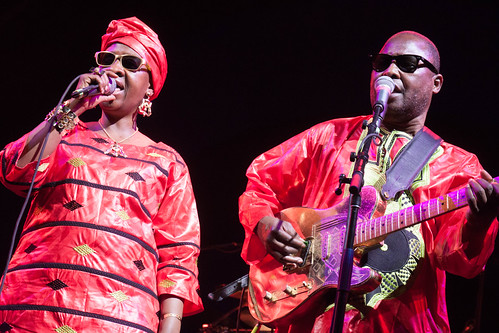
Tag: Tinariwen

Now known as the Federal Republic of Somalia, most Westerners view the country as being a lawless, dysfunctional and broken country, split and reeling from a brutal and bloody civil war between two or three different factions — and while that has been true over the past 25-30 years, what Westerners and others have sadly forgotten is that because of its location,the Eastern African nation for known for more than a millennium for being a major trading post, with several powerful Somali empires dominating regional trade, including the Ajuran Empire, the Adal Sultanate, the Warsangali Sultanate, and the Geledi Sultanate. And as one of antiquity’s major trade posts, the cultures and peoples of the Arabian Peninsula, Persia, India, Southeast Asian and China found a way to influence and slowly work their way into the region’s unique musical culture and sound.

In the late 19th century, the British and Italian empires through a series of treaties with Somalia’s historical empires and sultanates gained greater control of parts of the country’s coastline, establishing the colonies of British Somaliland and Italian Somaliland while Mohammed Abdullah Hassan’s Dervish State fought and defeated the British four times before a crushing defeat by the British in 1920. Italy, then acquired full control of the northeastern, central and southern parts of the country after defeating the Majerteen Sultanate and the Sultanate of Hobyo — and their occupation of the country lasted until 1941 when the British took over with a military administration. British Somaliland would remain a protectorate of the British while Italian Somaliland became a United Nations Trusteeship under Italian administration, the Trust Territory of Somaliland.

Throughout the late 1950s and 1960s, independence movements across Africa helped to redefine the map; in fact, by 1960 Italian Somaliland and British Somaliland united in 1960 to form the Somali Republic under a civilian and democratic based government. Sadly, democratic government didn’t last long; by 1969, the Supreme Revolutionary Council led by authoritarian Mohamed Siad Barre seized power and established the Somali Democratic Republic.

Now that I’ve gone through roughly 1000 years or so of Somali history in a couple of hundred words, things musically for us begin in more contemporary times — 1988. You see, back in 1988 on the eve of a bloody, two-decade civil war, Siad Barre launched a series of punishing air strikes in Somalia’s northern region, known known as Somaliland in an attempt to smash a growing independence movement within that region of the country.

Musically speaking things for us begin in relatively contemporary times — 1988. On the eve of a bloody, two decade plus civil war, Siad Barre launched a series of punishing air strikes in Somalia’s northern section, now known as Somaliland in an attempt to squash a rumbling independence movement within the region. Unsurprisingly, one of the targets Said Barre targeted for airstrikes was the regional radio station Radio Hargeisa, as a way to prevent the organization of further resistance. Knowing that an attack on their radio station and their hometown was imminent, a handful of radio operators, tastemakers and historians recognized that they needed to preserve more than 50 years of modern Somali music as quickly as possible — and it meant finding a way to remove thousands upon thousands of cassette tapes, records and master reels and then dispersing them to neighboring countries like Djibouti and Ethiopia — or in many instances, burying the tapes deep underground to protect them from theft, airstrikes, fire and so on.

The Somali Civil War broke out in 1991 and it resulted both the collapse of Mohamed Siad Barre’s government and a number of armed factions fighting for influence and control throughout the country’s southern region. With the absence of a central government, Somalia quickly began to known as a failed state with residents returning to customary and religious law in most regions, along with a couple of autonomous regions — namely Somaliland and Puntland. But interestingly, the early part of the millennium saw the creation of several fledgling and sputtering federal administrations, including the Transitional Federal Government, which in 2004 reestablished national institutions such as the military. And with the assistance of Ethiopian troops, the Transitional Federal Government assumed control of the country’s southern conflict zones, beating back the Islamic Courts Union, which eventually splintered into a several radical Islamicist groups, including Al-Shabaab, a group that continued an ongoing battle with the Transitional Federal Government and the African Union Mission in Somalia (AMISOM) for control of the region and its territory.

By 2012, insurgent groups had lost most of the territory they had seized, and a political process that provided benchmarks for the establishment of a permanent democracy  — and it included the drafting of a provisional constitution, which reformed Somalia as a federation. At the end of that lengthy process was the creation of the Federal Government of Somalia, the first permanent government in the country in well over 20 years, followed by a period of necessary and hopeful reconstruction in Mogadishu.

Remember those audio recordings that the engineers, programmers, historians and tastemakers dispatched to Djibouti and Ethopia and buried in various locations across the region? Interestingly enough, those recordings were recently excavated from their shelters with some of those recordings being kept in the 10,000 cassette tape archives of the Red Sea Foundation, the largest known collection of Somali music and cassettes, located in Somaliland’s capital Hargeisa. (Yes, things do and can come full circle.)

Ostinato Records, best known for the preservation, digitalization, and distribution of obscure world music was able to digitized a significantly large portion of the Red Sea Foundation’s archives, choosing 15 songs as part of their latest compilation of African music Sweet as Broken Dates: Lost Somali Tapes from the Horn of Africa. And while revealing the diversity of styles and sounds of Somali musicianship, the compilation also provides a glimpse of life in Mogadishu in the 1970s and 1980s, when the coastal capital was referred to as the “Pearl of the Indian Ocean.” At the time bands like Iftiin, Sharero and Dur Dur played at some of East Africa’s glitziest nightclubs, while Waaberi Band played packed to the rafter sets at the national theater.  Nightlife, music, culture and art were enormous — and interestingly while there were renowned male vocalists like Mahmud “Jerry” Hussen, Somali music of the 70s and 80s were best known for beloved female vocalists Faadumo Qaasim, Hibo Nuura, Sahra Dawo and a collection of truly empowered, prolific women; in fact, half of the compilation features songs sung by and written by women.

This cultural and musical golden age occurred under a socialist, military dictatorship, which effectively nationalized the country’s music industry. The state owned a thriving scene and essentially music was recorded for and by national radio stations, and it was distributed and disseminated through public broadcasts or live performances. Privately owned labels were non-existent and the work of a generation of artists was never made available for mass release in the way it is elsewhere — and until recently, hadn’t been heard outside of Somalia or its immediate neighbors. Most of that period, Somali music was largely influenced by the cultures and people who traveled to the region throughout its history as a major trade port; however, during the height of the Cold War, Somalia had periods of financial and logistical support by both the Soviets and the US in the Ethio-Somali War — and with about a decade of US backing, American soul, funk and hip-hop captured the imaginations of Somali youth, adding to a unique element to the country’s musical culture and sound.

While compiling the tracks on Sweet as Broken Dates: Lost Somali Tapes from the Horn of Africa, members of the Ostinato Records team spent the better part of a year traveling back and forth between Mogadishu, Hargeisa, Djibouti and across the Somali Diaspora in parts of Europe, the US and the Middle East to track down the musicians, songwriters, composers, government officials, scenesters, radio personalities and other folks, who had played a role during the 1970s and 1980s and got their stories down in a detailed, 15,000 word liner note booklet.


As the folks at Obstinato Records explain in press notes “Along side the story of Somalia’s music before the civil war, the selection is also focused on the pan-Somali sound. Spread over much of the Horn of Africa, Somali language and culture transcend arbitrary borders. Somali singers from Djibouti were at home in Mogadishu.” They add that “this compilation  seeks to revive the rightful image, history, and identity of the Somali people, detached from war, violence, piracy, and the specter of a persistent threat.”

Now, as you may recall, the compilations’ first single Danan Hargeysa’s “Uur Hooyo (Mother’s Womb)” feat. Mohamed “Huro” Abdihashi was recorded and released back in 1987 and the breezy confection nods at the trippy psychedelia of dub and dubstep as the collaborators pair a shuffling, two-step-like rhythm with explosive blasts of horn, shimmering synths, Nile Rodgers-like guitar and a strutting bass line, and while revealing an obvious reggae and calypso influence, the song possesses an undeniably sunny and funky vibe. Recently, the folks at Ostinato Records released two more singles from the compilation, Aamina Camaari’s “Rag waa Nacab iyo Nasteexo (Men are Cruel and Kind)” and Sharaf Band’s “Kadeed Badanaa Naftaydani (My Life is Full of Tribulations)” feat. Xawoo Hirraan in anticipation of its official release on August 25, 2017.

Aamina Camaari’s “Rag waa Nacab iyo Nasteexo (Men are Cruel and Kind)” is an achingly gorgeous and slow-burning lament of a song that pairs Camaari’s ethereal and plaintive vocals with a lush and soaring Middle Eastern and Indian-inspired string arrangement and percussion and Casio synthesizer-like beats that dimly reminds a bit of Omar Souleyman, The Bombay Royale and JOVM mainstays Tinariwen while being absolutely unlike anything I can quite describe; but at its core is an an ancient and timeless ache. Sharaf Band’s “Kadeed Badanaa Naftaydani (My Life is Full of Tribulations)” feat. Xawoo Hirraan is a swaggering and funky track that manages to sound as though it drew influence from Afrobeat and American soul and funk; but much like the preceding single, it features the ethereal and plaintive vocals of Xawaoo Hirraan, which give the song a similar ache.

Certainly, all three tracks from the forthcoming compilation evoke a far simpler time full of laughter, flowing beer and wine, of dancing until the sun came up and walking home in a drunken and elated shuffle, with arms draped over the shoulders of a companion or two, softly singing — and of sad love songs that speak directly to the lonely heart. No matter the language, it’s the sound of fleeting youth and swooning hearts before life’s ambiguities and horrors.

 

New Video: Tinariwen Reminds Us That Music is a Mighty Weapon

The recently released music video for “Sastanàqqàm” is reportedly inspired by real life events. When the members of the band returned to their homeland in 2006 they spent some time wandering around looking for old friends, associates, family members, neighbors and the like. Roughly 1,000 miles away from their homeland in Northern Mail, the members of Tinariwen came across six young musicians who hailed from M’Hamid el Ghizlane. These boys were the only boys that the members of the collective came across during their visit; but they immediately saw a reflection of themselves, their dreams and aspirations in the music they heard the boys play. In the subsequent years, the boys from M’Hamid el Ghizlane learned the Tinariwen catalog note for note, word for word although they couldn’t speak a word of Tamashek. When the members of the band returned to the town to record the material, which would comprise Elwan, their disciples had displayed a mastery of Tinariwen’s catalog — and the members of the band recognized that they had passed the torch on to their young disciples; in fact, the band decided to invite their disciples to be in the music video for “Sastanàqqàm,” symbolically standing in for the members of the band. The video follows as some of Tinariwen’s elder members wrapped new turbans around the heads of their young disciples, symbolically marking the passage from boyhood and manhood; but also marking how music can be transmitted across generations and influence young men and women to pick up instruments and speak truth to power. Let that serve as a reminder that music and art hold great power — a power that even the most autocratic demagogue can’t possibly stop.

Over the years, I’ve written quite a bit about the internationally renowned Saharan blues/Saharan rock collective  Tinariwen, an act that can trace its origins to the late 197s when its founding member, guitarist Ibrahim Ag Alhabib, who as the story goes had been inspired to learn the guitar from an old Western film, in which a cowboy played guitar, joined a small group of Tuareg rebels living in refuge camps throughout Libya and Algeria. Interestingly, Ag Alhabib and his fellow rebels had been influenced by the radical chaabi protest music of Moroccan groups like Nass El Ghiwane and Jil Jilala; Algerian pop rai; and western artists like Elvis PresleyLed ZeppelinCarlos SantanaDire StraitsJimi HendrixBoney M, and Bob Marley, and started writing music that meshed the traditional folk music of their people with Western rock, reggae and blues-leaning arrangements

After relocating to Tamanrasset, Algeria, Ag Alhabib started a band with Alhassane Ag Touhami and brothers Inteyeden Ag Ablil and Liya Ag Ablil that had played traditional Tuareg music with both Western and traditional instrumentation and arrangements at weddings, parties and other occasions across the Algeria, Libya and Mali. When this quartet started, they didn’t have a name; however, people across the region, who had seen them play had began calling the quartet,  Kel Tinariwen, which in the Tamashek language (the tongue of the Taureg people) translates roughly as “The People of the Deserts” or “The Desert Boys.”

In 1980, Libyan dictator, Muammar Gaddafi released a decree inviting all young Tuareg men, who were living illegally in Libya to receive full military training, as part of his dream of forming a Saharan regiment, comprised of the best young Tuareg fighters to further his territorial ambitions in Chad, Niger, and elsewhere across Northern Africa. Al Alhabib and his bandmates answered the call and received military training. Whether or not the founding members of the band truly believed in Gaddafi’s military ambitions would be difficult to say — but on a practical level, a steady paycheck to support yourself and your family back home certainly is an enticement. Five years later, Ag Alhabib, Ag Touhami and the Ag Ablil brothers answered a similar call by leaders of the Libyan Tuareg movement, who desired an autonomous homeland for their people, and wound up meeting fellow musicians Keddou Ag Ossade, Mohammed Ag Itlale (a.k.a “Japonais”), Sweiloum Ag Alhousseyni, Abouhadid Ag Alhousseyni, and Abdallah Ag Alhousseyni — all who had sang and played guitar. At this point, the lineup of Tinariwen was completed and the members of the collective began writing songs about the issues and concerns of their people.

The members of the band built a makeshift studio and then vowed to record and then distribute music for free for anyone who supplied them a blank cassette tape. And perhaps unsurprisingly, their DIY cassettes were highly sought after and were traded throughout Saharan Africa.

In 1989 the members of the collective had left Libya and relocated to Ag Alhabib’s birthplace of Tessalit, Mali; however, by the next year Mail’s Tuareg population revolted against the Malian government, with some members of the collective participating as rebel fighters. After a peace agreement known as the Tamanrasset Accords were reached in early 1991, the  members of Tinariwen left the military and devoted themselves to music full-time, and by the following year, some of the members of the band went to  Abidjan, Ivory Coast to record a cassette at JBZ Studios, which they followed up with extensive gigs for their fellow Tuaregs across Saharan Africa, which helped further establish the band’s reputation by word-of-mouth.

After collaborating with renowned French world music ensemble  Lo’Jo, the members of Tinariwen started to receive greater international attention outside of Saharan Africa, including their first British live set at Africa Oye, one of the UK’s largest African music/African Diaspora festival. Building on the increasingly buzz they were receiving, the band released their first full-length effort, The Radio Tisdas Sessions, their first recording to be released outside of their native Northern Africa. As the collective has pushed forward throughout the years, it has gone through lineup changes, incorporating a younger generation of Tuareg musicians, some who weren’t even born during some of the military conflicts of the older generation or whose lives were impacted by the fighting during the 1990s,  including bassist Eyadou Ag Leche, percussionist Said Ag Ayad, guitarist Elaga Ag Hamid, guitarist Abdallah Ag Lamida, and vocalists Wonou Walet Sidati and the Walet Oumar sisters.

As the collective started to see greater international attention, they’ve toured regularly across the European Union, North America, Japan and Australia, often playing at some of the world’s biggest and highly renowend music festivals including GlastonburyCoachellaRoskildeLes Vieilles CharruesWOMADFMM Sines Thomand Printemps de Bourges. And although they employ both Western instrumentation and traditional instrumentation and arrangements, their sound has always managed to evoke the surreal and brutally harsh beauty of the Saharan Desert, the poetry and wisdom of a rough and tumble, rebellious and proud people whose way of life is disappearing thanks to encroaching Westernization and technology.  And most recently yet another bloody and contentious war has splintered several nations across the Tuareg territory — including devastating wars across Mail and Libya. Now, if you had been frequenting this site over the past couple of months, you’d likely recall that the Tuareg collective’s forthcoming album Elwan (which translates into English as The Elephants) is slated for a February 10, 2017 release, and the album thematically focuses both on the disappearing traditions of the Tuareg people and of being forced into a reluctant and begrudging exile — with the realization that many of the collective’s members may never see their homeland again.

With Elwan‘s third and latest single “Assawt” the band’s frontman, guitarist and founding member Ag Alhabib turns the focus to the women of the Sahara, strong women who in his words are “searching for their freedom” and “who toil for the revolution,” recognizing their role and place in the long and often bloody fight for a Tuareg homeland. Ag Alhabib’s mournful yet soulful vocals are paired around a shuffling and snaking acoustic guitar line, a sinuous bass line, propulsive handclap-led percussion with the band joining in on a harmonized and anthemic hook. Interestingly, while drawing from the Tuareg tradition, the song also manages to subtly nod at the sounds of Mali, Nigeria and elsewhere as it continues to cement the collective’s reputation for crafting tight grooves.

The band and their label have done a kind favor by providing an English translation of the song’s lyrics, which you can check out below.

That’s the voice
of the Tamashek women
Searching for their freedom.
Those are the thoughts
of the old women
Living in a Sahara devoid of water,
Desiccated and miserable,
My wish is for it
to stop being subservient.
This is a message for those
Who toil for the revolution.

The band will be embarking on a North American tour, which will include two NYC area dates at Brooklyn Bowl. Check out the tour dates below.

30 MARCH 2017 – SOLANA BEACH, CA : BELLY UP TAVERN
31 MARCH 2017 – LOS ANGELES, CA : THE FONDA THEATRE
01 APRIL 2017 – BERKELEY, CA : THE UC THEATRE
02 APRIL 2017 – PORTLAND, OR : REVOLUTION HALL
04 APRIL 2017 – SEATTLE, WA : BENAROYA HALL
05 APRIL 2017 – VANCOUVER, BC : CHAN CENTRE FOR THE PERFORMING ARTS
7 APRIL 2017 – SALT LAKE CITY, UT : THE STATE ROOM
08 APRIL 2017 – DENVER, CO: SWALLOW HILL MUSIC ASSOCIATION
10 APRIL 2017 – MINNEAPOLIS, MN : CEDAR CULTURAL CENTER
11 APRIL 2017 – CHICAGO, IL : OLD TOWN SCHOOL OF FOLK MUSIC
12 APRIL 2017 – TORONTO, ONT : MASSEY HALL
13 APRIL 2017 – MONTREAL, QC : PLACE DES ARTS
14 APRIL 2017 – BOSTON, MA : ROYALE
15 APRIL 2017 – BROOKLYN, NY : BROOKLYN BOWL
16 APRIL 2017 – BROOKLYN, NY : BROOKLYN BOWL
18 APRIL 2017 – PHILADELPHIA, PA : UNION TRANSFER
19 APRIL 2017 – WASHINGTON, DC : BARNS AT WOLF TRAP
21 APRIL 2017 – PITTSBURGH, PA : CARNEGIE OF HOMESTEAD HALL


Comprised of founding members  Ousmane Ag Mossa and Cheick Ag Biglia along with Aghaly Ag Mohamedine,  Ibrahim Ag Ahmed Salam, Mahmoud Ag Ahmouden, Mossa Ag Borreiba, Fatma Wallet Cheick, Bassa Wallet Abdamou and Wannou Wallet Sidaty, the members of Tamikrest hail from the region around the city of Kidal in Northeastern Mali; in fact, all of the members of band attended the Les enfants de l’aurar school in Tinzawaren where they met and received basic music training. And with the members of the band being in their late 20s and early-to-mid 30s, their youths were shaped by the Tuareg Rebellion of 1990-1995 as each of the bandmembers had family, friends and others fought and died in their people’s fight for autonomy. Much like the members of the internationally acclaimed Tuareg collective Tinariwen, the members of Tamikrest began playing their people’s traditional music, as well as the music of Tinariwen — and thanks in part to the intent, the members of the band got a chance to listen to and be influenced but he work of Western artists like Jimi Hendrix, Bob Marley, Pink Floyd and Mark Knopfler.

When another series of riots exploded across Kidal and elsewhere in 2006, the band’s founding members decided the it would be best for them to fight with their instruments and songs — with songs that called attention to their people’s cause. Interestingly, a chance meeting with American-Australian band Dirtmusic at 2008 Festival Au Desert led to both friendship and to a lengthy collaboration in which the members of Tamikrest were invited to play on Dirtmusic’s 2010 sophomore effort BKO, which was recorded in Bamako, Mali. Chris Eckman, a member of Dirtmusic and The Walkabouts produced Tamikrest’s 2010 full-length debut Adagh and the band’s 2011 sophomore effort Toumastin

Kidal, the band’s fourth, full-length effort pays homage to the town in which the band was formed, as well as the town that’s one of their people’s main cultural centers. Historically, Kidal has been fought over, conquered and re-conquered many times over — and as a result, the town is a long-held symbol of the Taureg people’s defiance, resistance and hope. As the band’s co-founder explains of the album, “Kidal talks about dignity. We consider the desert as an area of freedom to live in. But many people consider it as just a market to sell to multinational companies, and for me, that is a major threat to the survival of our nomadic people.”


And although the Tuareg have traditionally been a nomadic people, there was a brief moment in which they actually had a homeland when the Tuaregs collectively rose up in 2017 and declared the Azawad region of Mali, an independent state. Sadly, it lasted less than a year as Al-Qaeda militants came in from the north and imposed strict Islamist rule and was followed by the French military, who arrived to liberate the area. And as a result, the Tuareg people were left with little or no chance for immediate self-determination; however, the dream remains for the Tuareg people, even if it seems trapped between several different governments, religious terrorists groups, and greedy, global corporations. As the band’s associate Rhissa Ag Mohamed mentions in press notes, “Kidal, the cradle of all of these uprisings, continues to resist the many acts perpetrated by obscure hands against our people. The album evokes all the suffering and manipulations of our populations caught in pincers on all sides.” And much like the aforementioned the members of Tamikrest feel an obligation to preserve and protect their people’s culture, while informing the world of their people’s plight — and unsurprisingly, Kidal‘s first single “Wainan Adobat” possesses a forceful urgency that belies its gorgeous yet cool self-assuredness. Interestingly, while the track nods at Tinariwen, the track also is reminiscent of Brothers in Arms-era Dire Straights. But perhaps most important, this song should be a reminder that in the difficult times that seem to be coming up ahead, that music and art should be used both as spiritual sustenance and as one of the most powerful political weapons known to man.


New Audio: Tinariwen Return with a Hypnotic and Triumphant New Single

Last month, I wrote about Elwan’s first single “Tenere Taqqal,” a slow-burning and hauntingly gorgeous song that possessed an understated yet aching longing for a way of life and for a home, which as Thomas Wolfe once wrote and the members of the band recognize, they may never be able to return to and will never have again. And certainly while there’s a tacit acknowledgement within the song that life continues onward as it always does, there’s also a brooding and pensive urgency within the song that comes from the members of the band recognizing that they have a sacred and profound duty of ensuring that something of the old traditions could be preserved and passed on to future generations. The album’s second single “Sastanàqqàm” is as the band’s Abdallah Ag Alhousseyni explains “an ode to the Sahara and its Nomads. It expresses the needs of the traveller as he crosses the desert on his mount. Essential needs: find water and a way to preserve it, find a good mode of transport. But also the love-hate relationship with the desert, the natural elements and the certainty that we will always go back to it.” Pairing those sentiments with a shuffling and deeply hypnotic groove and a propulsive and stomping percussion give the song a hopeful and downright joyous feel. At it’s core it’s the hope and promise of returning to the ancestral homeland — of its smell, of seeing beloved sights, of returning to the place where your ancestors have lived, played, prayed, wandered, hunted and died.

The band and their label have done a kind favor by providing an English translation of the song’s lyrics, which you can check out below.

Sastanàqqàm Lyrics

SASTANÀQQÀM

I QUESTION YOU

TÉNÉRÉ, CAN YOU TELL ME OF ANYTHING BETTER THAN TO HAVE YOUR FRIENDS AND YOUR MOUNT,
AND A BRAND NEW GOATSKIN, WATERTIGHT,
TO FIND YOUR WAY
BY THE LIGHT
OF THE FOUR BRIGHT STARS OF HEAVEN,
TO KNOW HOW
TO FIND WATER IN
THE UNLIKELIEST OF PLACES, AND ENLIST THE MOMENTUM OF THE WIND
TO HELP YOU MOVE FORWARD

TELL ME, TÉNÉRÉ
HOW YOU AND I
CAN REMAIN UNITED,
WITH NO HATE FOR EACH OTHER.
TÉNÉRÉ, I CAN NOW ADMIT THAT
I HAVE TRAVELLED FAR THROUGH THIS WIDE WORLD.
TÉNÉRÉ, I GIVE YOU MY OATH
THAT AS LONG AS I’M ALIVE,
I WILL ALWAYS COME BACK

New Video: Haunting Visuals and Sounds of Tinariwen’s “Tenere Taqqal” Captures a Rapidly Disappearing Way of Life

Interestingly, Tinariwen’s forthcoming full-length effort Elwan (which translates into English as The Elephants) is slated for a February 10, 2017 release, and the album thematically focuses both on the disappearing traditions of the Tuareg people and of being forced into exile — oddly enough as the members of the band were touring the world. And the album’s gorgeous first single “Tenere Taqqal” possesses an understated longing for a way of life and for a home, which as Thomas Wolfe wisely suggested they can never return to and will never get back. And yet there’s a tacit acknowledgment that life must continue onward and that they have a profoundly important duty of ensuring that something of the old traditions can be preserved and passed on to future generations. As a result, the single while being slow-burning and brooding also manages to possess an understated, quiet urgency — all while feeling older than time itself. Every time, I’ve listened to this track I can picture sitting among the Tuareg or the Bedouins at a campfire, as they tell tales of creation or of the great mystics and teachers, who have led flocks of faithful . .

The recently released animated video was directed by Axel Digoix and it vividly depicts the desert’s harshness, cruelty and beauty, and the profound spiritual and physical connection that the Tuareg people have towards it, while pointing out that their traditions and their world is being violently torn apart.

New Video: The Lush and Trance Inducing Sounds and Visuals of Mauritana’s Noura Mint Seymali

Arbina’s latest single “Na Sane,” consists Seymali’s gorgeous, siren-like vocals, Chingaly’s shimmering and dexterous guitar work that will make you say to yourself “I’ve never heard guitars sound like that,” Toure’s muscular, driving bass grooves and Tinari’s precise, jazz and rock-inspired drumming, with the result is a song that possesses a lush, enveloping and hypnotic quality. And while being thoroughly modern, the song draws from something deeply timeless and unmistakably universal — an aching yearning to be immersed in the love and power of the infinite.

As the band’s drummer and producer Matthew Tinari explains of the recently released video “Essentially, we just threw an impromptu family barbecue. One of the dancers is Noura’s brother Baba; some of the younger boys are nephews of Jeiche. The girl dancer is a friend from the neighborhood. It was a family affair!” The video manages to captures Moorish traditions and daily life in a gorgeous and cinematic fashion.

Founded by Ibrahim Ag Alhabib, Tinariwen can trace their origins back to the mid and late 1970s when Alhabib, who had been inspired to learn the guitar from an old Western film, in which a cowboy played a guitar, joined other Tuareg rebels living in refugee camps in Libya and Algeria, who were exploring the radical chaabi protest music of Moroccan groups like Nass El Ghiwane and Jil Jilala; Algerian pop rai; and western artists like Elvis PresleyLed ZeppelinCarlos SantanaDire StraitsJimi HendrixBoney M, and Bob Marley.

While in Tamanrasset, Algeria, Ag Alhabib started a band with Alhassane Ag Touhami and brothers Inteyeden Ag Ablil and Liya Ag Ablil, and they began playing the traditional sounds of the Taureg people at weddings and parties across Algeria and Libya. Interestingly, when they started, the band had no official name but people began calling them Kel Tinariwen, which in the Tamashek language translates roughly as “The People of the Deserts” or “The Desert Boys.”

In 1980, Libyan dictator, Muammar Gaddafi released a decree inviting all young Tuareg men, who were living illegally in Libya to receive full military training, as part of his dream of forming a Saharan regiment, comprised of the best young Tuareg fighters to further his territorial ambitions in Chad, Niger, and elsewhere across Northern Africa. Al Alhabib and his bandmates answered the call and received military training. They answered a similar call in 1985, by leaders of the Libyan Tuareg movement and wound up meeting fellow musicians Keddou Ag Ossade, Mohammed Ag Itlale (aka “Japonais”), Sweiloum Ag Alhousseyni, Abouhadid Ag Alhousseyni, and Abdallah Ag Alhousseyni — all who had sang and played guitar. The musicians joined together in a collective — now known across the world as Tinariwen — in order to write songs about the issues facing their people, built a makeshift stood and vowed to record music for free for anyone who supplied a blank cassette tape. And naturally, as a result their homemade cassette tape series  were highly sought after, and were traded throughout Saharan Africa. (It’s also incredibly punk — perhaps more punk, than anything most Western artists could ever come up with.)

In 1989. the members of the collective had left Libya and relocated to Ag Alhabib’s birthplace of Tessalit, Mali; however, by the next year Mail’s Tuareg population revolted against the Malian government, with some members of the collective participating as rebel fighters. After a peace agreement known as the Tamanrasset Accords were reached in early 1991, the  members of Tinariwen left the military and devoted themselves to music full-time — and by 1992, some of the members of the collective were to Abidjan, Ivory Coast to record a cassette at JBZ Studios, and they occasionally played gigs for far-flung Tuareg communities throughout Saharan Africa, which helped the band gain word-of-mouth popularity among their people.

Tinariwen started to receive international attention after they had began collaborating with the renowned French world music ensemble Lo’Jo — with the result being the highly acclaimed 2001 Festival au Desert in Essakane, Mali. Greater attention came to the band when the play their first UK performance at that country’s largest, free African festival, Africa Oye. And the year was topped by the release of their full-length debut, The Radio Tisdas Sessions, their first recording to be released outside of their native Northern Africa. Coincidentally, this has gone on as the collective has gone through some lineup changes, incorporating a younger generation of Tuareg musicians, musicians who didn’t live during some of the military conflicts of the older generation, including bassist Eyadou Ag Leche, percussionist Said Ag Ayad, guitarist Elaga Ag Hamid, guitarist Abdallah Ag Lamida, and vocalists Wonou Walet Sidati and the Walet Oumar sisters.

As the collective has started to see greater international attention, they’ve toured regularly across the European Union, North America, Japan and Australia, often playing at some of the world’s biggest and highly renowend music festivals including Glastonbury, Coachella, Roskilde, Les Vieilles Charrues, WOMAD, FMM Sines and Printemps de Bourges. And they’ve won over an incredible list of celebrity fans and champions including Carlos Santana, Led Zeppelin’s Robert Plant, U2‘s Bono and The Edge, Radiohead‘s Thom Yorke, Coldplay‘s Chris Martin, Henry Rollins, Brian Eno, and TV on the Radio, among others. And it shouldn’t be surprising because of their hauntingly gorgeous music rooted in the poetry and traditions of the tough, rebellious people of Northern Africa — and in some way, the material captures the vast expanse of the desert as their sound seems to arch heavenward . . .

At the end of last year, the members of Tinariwen played a show in Paris and invited the legendary grand dame of Tamashek culture, Lalla Badi, one of Tuareg culture’s beloved master of the tinde, which is both a percussive instrument covered by taut goatskin, played by women and a poetic repertoire sung at ceremonies and special and intimate occasions. Not only is she considered the paradigm of Tuareg femininity, she has also long been an outspoken advocate for Tuareg culture and causes, as well as being a mentor to the members of Tinariwen in their early incarnation. The end result was a live recording of their Paris show, Live in Paris slated for a November 20 release through Anti- Records.

The first single off the live album “Tinde Final Tinariwen” is a hauntingly gorgeous track that begins with droning guitar chords, propulsive percussion and a collection of male vocals crying and chanting before Badi’s regal vocals joining in on a composition that marries ancient traditions with contemporary sound. Indeed, there’s a forcefulness to the composition but it arches heavenward with lilting, trance inducing beauty that’s awe-inspiring.

Since their formation early last year, the Philadelphia, PA-based trio of Ecstatic Vision have quickly developed a reputation for a sound that draws from a wild variety of influences including Krautrock, Fela Kuti, Sun Ra, […]