Tag: WOMAD

New Video: The Legendary Calypso Rose Teams up with Carlos Santana and The Garifuna Collective on “Watina”

Born Linda McCartha Monica Sandy-Lewis in Bethel Village, Tobago, Republic of Trinidad and Tobago to a religious, fisherman father and a stay-at-home mother, the legendary Calypso Rose first started writing her own songs when she was 13. In the 1960s, the Mother of Calypso emerged as the epitome of Caribbean music: Her first commercial successes included 1966’s “Fire In Me Wire,” which she performed with Bob Marley & The Wailers in New York the following year.

Throughout her lengthy almost 60-year music career, the Mother of Calypso has written more than 1,000 songs and recorded over the 20 songs — all while being the first major female calypso star. Her lyrics frequently tackle issues like racism and sexism: in fact, her towering influence on calypso forced the renaming of the Calypso King competition to the Calypso Monarch, which she won in 1978.

Since 2015’s Far From Home, which featured multiple collaborations with Manu Chao, Calypso Rose’s career has seen a resurgence — with booming attention internationally. She has been busy spreading calypso around the world, playing around 200 shows in a four year span including sets at Les Vielles Charrues, We Love Green, and WOMAD festivals, as well as ParisOlympia Hall. In 2019, the calypso legend played at Coachella, becoming the oldest artist to ever play the festival.

Throughout her career, the calypso legend’s work is rooted in a remarkable and infectious optimism: While she continues to tackle issues like feminism, sexism, racism and the fight for a better, fairer world for individuals and for everyone, her work has always seen her bring up hedonistic subjects like partying, sex, the energy of youth and the like with a playful, knowing sense of wisdom and humor, which continues on her forthcoming album Forever, which is slated for a an August 26, 2022 release through Because Music.

Forever‘s material in particular conveys strong messages about the status of women in the various neighborhoods across the world she’s come to know well and love: Jamaica, Queens, NYC; her homeland of Trinidad and Tobago; Paris; and Belize. Each of these places have influenced and nourished her work — and in each, was where portions of the album were recorded. Unsurprisingly, the global spanning nature of its recording, allowed for so many difference influences on its overall sound: The material draws from across the Caribbean Diaspora, including rocksteady, soca, ska, mento — and of course, calypso.

The album sees the calypso legend presenting original material with a distinctly modern approach and revisiting some of her greatest classics. The end result is an album that attempts to speak to everyone — and to transcend all ages. Forever sees the Mother of Calypso collaborating with a diverse and eclectic cast of artists new and old throughout it’s 14 tracks, including Manu Chao, soca king Machel Montano, Jamaican dancehall icon Mr. Vegas, Toulouse, France-based emcee Oli, electronic duo Synapson and a lengthy list of others.

Forever‘s first single, the shuffling, genre-defying “Watina” which sees the Queen of Calypso collaborating with Belize’s The Garifuna Collective and the legendary Carlos Santana, who contributes some fiery and lysergic guitar licks effortlessly meshes dancehall, ska, soca and calypso in a crowd-pleasing, accessible and celebratory fashion — while telling a larger story of the ills of colonialism and slavery that’s familiar throughout the region.

With “Watina” in particular, Calypso Rose and company pay homage to the Garifuna, a Caribbean people scarred by slavery, excluded from history and memory but whose population is spread across the US, as well as the coasts of Honduras, Guatemala, Nicaragua and the Calypso Rose’s beloved Belize, which has been a part of her life in some fashion for over 40 years. “Watina” was originally a local hit for The Garifuna Collective, founded and led by Andy Palacio until his death in 2008.

Interestingly, “Watina” was produced by Calypso Rose’s longtime, Belizean-born producer Ivan Duran. Duran worked with Palacio and The Garifuna Collective and according to Duran, the legend was the only person, who could recapture the frenzy and impact of the song while respecting Palacio’s legacy.

By recording and re-imagining the song with many of the same casts of musicians sees the Trinidadian legend reaffirming her ties to Belize while continuing to exploit the dichotomy between the song’s upbeat, festive spirit and its social — and historical — message.

Directed by Andrés Arochi Tinajero, the gorgeously cinematic, accompanying video was shot in Hopkins Village, Belize. The video lovingly captures Black and Afro-Latino joy, dedication and love in a way that makes my heart sing — and is infectious.

Earlier this year, i wrote about the up-and-coming Bristol, UK-based singer/songwriter and guitarist Katey Brooks, and as you may recall, with the release of 2016’s I Fought Lovers EP, Brooks quickly earned a national and international profile for a sound and songwriting approach that has been compared favorably to the likes of Jeff Buckley. In fact, material off the EP received enthusiastic airplay on  BBC Radio 2, BBC Radio 6 and  the CBC, and praise from Billboard, Pride and The Advocate. Adding to a growing profile, Brooks has shared bills with an eclectic yet impressive list of artists that includes Newton Faulkner, Ghostpoet, Martin Simpson, Deaf Havana, Lamb‘s Lou Rhodes, Mike and the Mechanics, and Mystery Jets, and has played at some of the world’s biggest festivals including Glastonbury, WOMAD, the 2012 Paralympics and Australia’s National Folk Festival. She also has appeared on a compilation with Anais Mitchell, Ane Brun and Marissa Nadler and recorded a track with The Rolling Stones’ Bill Wyman and Paloma Faith

Interestingly, Brooks has a complicated and messy upbringing. She grew up in a cult, and as a child, she found refuge in music.“It was a very chaotic upbringing, full of some pretty colourful and sometimes unsavoury, characters. But when I sang, I felt free and connected. For as long as I can remember, it’s been my way of getting what I need to say out,” she reveals in press notes. She began singing gospel, old spirituals and the songs from the likes of John Lennon and Elvis Presley — but by the time she was a teenager, she entertained her peers with soul renditions.

When she turned 16, the Bristol-based singer/songwriter turned down a spot at the renowned BRIT School. “It would be interesting to know what would have happened if I had gone there, but I try not to dwell on that,”Brooks says in press notes. “I always think that you’re where you’re meant to be. And if I had gone, I probably would have ended up writing slightly less authentically to myself. But who knows, because if all the things that have happened in my life nevertheless happened, maybe I still would have written the way I do.”

When Brooks turned 20, she became extremely ill and her life was on pause as she was convalescing; but as she was convalescing she joined a songwriters group led by her friend, Strangelove’s Patrick Duff. “We would get together and play our songs to each other. It was really therapeutic.” Around this time Brooks was convinced that she had to devote her time to music. “So one day I just put on my own gig at the (Bristol) Folk House,” she laughs. “I sort of became an artist and promoter overnight,” Brooks recalls.

Sadly, shortly after making the decision to focus on her music, the Bristol-based singer/songwriter experienced a turbulent period of heartbreak and tragedy: the year she turned 22, her mother became ill and died — and shortly after that, one of her best friends went missing and died. “That’s definitely had an effect on the course of my life, and my writing,” Brooks says in press notes. “People have come up to me after gigs, particularly after songs I wrote during that time, saying ‘there’s a lot of sadness in your songs’ and it’s like ‘well, yeah.’ But I guess I’m lucky that I have songs that I can write, as a means to deal with things.”

Along with those hardships, Brooks has struggled to come to terms with her own sexuality. “In my most recent work I’ve finally been able to sing directly about women instead of using the mysterious ‘you,’” Brooks mentions in press notes. “I’m a private person in a lot of ways and I never wanted to be a poster girl for anything. But a few years ago I just thought screw it; I want to sing completely honestly. It felt like a weight lifted.”

Brooks latest single is the classic soul-inspired ballad “All of Me.” Centered around a spectral arrangement featuring a looping 12 blues guitar, a gospel-like backing vocal section, a two-step inducing rhythm section and Brooks achingly plaintive and soulful vocals, the new single will further establish the Bristol-based singer/songwriter and guitarist’s ability to mesh craft, earnestness and ambitious songwriting in a thoughtful and natural fashion. But along with that much of Brooks’ material comes from real, lived-in places — in particular, the song’s narrator bitterly calls out a lover on their ambivalence. It was inspired by a personal situation with someone I was prepared to give my world to. They proclaimed deep love, but then proceeded to behave in ways that were completely incongruent with that proclamation”, revealsBrooks. Words can be very powerful and beautiful, but ultimately, when it comes to showing someone you love them, they’re cheap and easy to deliver. Actions tell us everything we need to know about how someone feels about us, and if they respect us – in every kind of relationship.” 


With the release of 2016’s I Fought Lovers EP, the up-and-coming, Bristol, UK-based singer/songwriter and guitarist Katey Brooks quickly amassed both a national and international profile for a sound and songwriting approach that has been compared to Jeff Buckley with material off her debut EP receiving enthusiastic airplay on BBC Radio 2, BBC Radio 6 and  the CBC, as well as praise from Billboard, Pride and The Advocate. Adding to a growing profile, Brooks has shared bills with an eclectic yet impressive list of artists that includes Newton Faulkner, Ghostpoet, Martin Simpson, Deaf Havana, Lamb‘s Lou Rhodes, Mike and the Mechanics, and Mystery Jets, and has played at some of the world’s biggest festivals including Glastonbury, WOMAD, the 2012 Paralympics and Australia’s National Folk Festival. She also has appeared on a compilation with Anais Mitchell, Ane Brun and Marissa Nadler and recorded a track with The Rolling StonesBill Wyman and Paloma Faith. Along with that Joss Stone and renowned recording engineer Stuart Bruce have considered themselves fans.

Brooks grew up inside a cult, and as child, she found refuge in music. “It was a very chaotic upbringing, full of some pretty colourful and sometimes unsavoury, characters. But when I sang, I felt free and connected. For as long as I can remember, it’s been my way of getting what I need to say out,” she reveals in press notes. She began singing gospel, old spirituals and the songs from the likes of John Lennon and Elvis Presley — but by the time sh was a teenager, she entertained her peers with soul renditions.

Interestingly, when she was 16, she turned down a spot at the renowned BRIT School. “It would be interesting to know what would have happened if I had gone there, but I try not to dwell on that,” the Bristol-based singer/songwriter and guitarist says in press notes. “I always think that you’re where you’re meant to be. And if I had gone, I probably would have ended up writing slightly less authentically to myself. But who knows, because if all the things that have happened in my life nevertheless happened, maybe I still would have written the way I do.”

When Brooks turned 20, she became extremely ill and her life was on pause as she was convalescing; but as she was convalescing she joined a songwriters group led by her friend, Strangelove‘s Patrick Duff. “We would get together and play our songs to each other. It was really therapeutic.” Around this time Brooks was convinced that she had to devote her time to music. “So one day I just put on my own gig at the (Bristol) Folk House,” she laughs. “I sort of became an artist and promoter overnight,” Brooks recalls.

Sadly, shortly after making the decision to focus on her music, the Bristol-based singer/songwriter experienced a turbulent period of heartbreak and tragedy: the year she turned 22, her mother became ill and died — and shortly after that, one of her best friends went missing and died. “That’s definitely had an effect on the course of my life, and my writing,” Brooks says in press notes. “People have come up to me after gigs, particularly after songs I wrote during that time, saying /there’s a lot of sadness in your songs’ and it’s like ‘well, yeah.’ But I guess I’m lucky that I have songs that I can write, as a means to deal with things.”

Along with those hardships, Brooks has struggled to come to terms with her own sexuality. “In my most recent work I’ve finally been able to sing directly about women instead of using the mysterious ‘you,'” Brooks mentions in press notes. “I’m a private person in a lot of ways and I never wanted to be a poster girl for anything. But a few years ago I just thought screw it; I want to sing completely honestly. It felt like a weight lifted.”

Brooks’ latest single is the soulful “Never Gonna Let Her Go.” Centered around an almost gospel-like backing vocals, Brooks effortlessly soulful vocal performance and an atmospheric arrangement of a looping 12 bar blues guitar and a propulsive rhythm section, the song nods at classic soul and The VeilsThe Pearl” as it’s a thoughtful mesh of craft, earnestness and ambitious songwriting. But at its core the song is an uplifting and powerful plea to the listener that being your true self is a revolutionary act. “We’re all going to walk this planet with different scripts in our heads, different upbringings, experiences and beliefs, and if we want to get along and be peaceful we need to accept that. Hate isn’t the answer in any situation – so I believe anyway,” Brooks said. She adds, “Judge me for my true failings, ask me to change those things that actually effect you, and I’ll hear that. But one thing I’ll never change, and one thing that is definitely not wrong with me, is my love for women”.


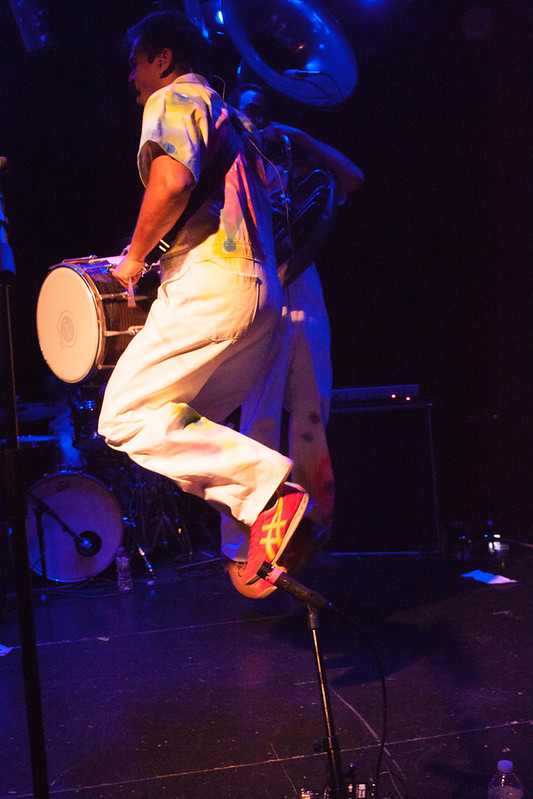
Now, throughout the course of this site’s eight year history, I’ve written quite a bit about the Brooklyn-based collective Red Baarat, and as you may recall, the act, which derives its name from baraat, a wild South Asian wedding procession that often features the groom riding a horse, an enormous group of extended friends and family, singing and dancing to music led by a brass band with drummers, and what the color red symbolizes in both Indian/South Asian and Western cultures — fiery, red-blooded passion. And with the band, they view it as the passion they have towards creating and playing music, as well as the passion they inspire and elicit from fans and others, who catch them live. Led by Rochester, NY-born, Brooklyn-based bandleader, dholi, drummer and composer Sunny Jain, and featuring John Altieri (sousaphone), Ernest Stuart (trombone), Jonathon Haffner (saxophone), Sonny Singh (trumpet), Chris Eddleton (drums), Rohin Khemani (drums), and their newest member Jonathan Goldberger (guitar), the collective originally formed in 2008 — although it wasn’t until the release of their critically applauded and commercially successful sophomore effort Shruggy Ji that the band received widespread attention for a seamless and genre defying sound that draws from Indian classical music, bhangra, hip-hop, rock, pop and New Orleans brass. And as a result of Shruggy Ji‘s critical and commercial success, the collective has made appearances at Bonnaroo, Austin City Limits, Hardly Strictly Bluegrass, New Orleans Jazz & Heritage Festival and Peter Gabriel’s WOMAD Festivals in Australia, New Zealand and the UK, have played sold out headlining shows at the Luxembourg Philharmonic, the Bowery Ballroom and have performed at the request of The White House, TED and the Olympic Games.

Slated for release at the end of the month through Rhyme & Reason Records, Red Baraat’s Little Shalimar and Sunny Jain co-produced Sound The People reportedly continues the band’s exploration of South Asian culture and music but while placing in within a larger context of an increasingly globalized generation, reflected by the diverse background of its individual members. Adding to the global focus, the album features guest spots from Pakistani singer and writer Ali Sethi, Das Racist’s Heems, American poet and activist Suheir Hammad and American humorist John Hodgman. “With the migration that’s happened, there is all this varied and expressive music that has erupted from the South Asian Diaspora,” says Jain. “Sound The People is a shoutout to, and celebration of this community around the world.”

Jain began writing Sound The People‘s material a few short weeks after Trump’s election victory, and as she says in press notes, “the record is a call to action against the various inequalities and injustices that we’re seeing. We desperately need citizen engagement in response to those injustices.” Earlier this month, I wrote about album single “Kala Mukhra,” which featured Ali Sethi contributing his sonorous baritone — but as Jain explains, the song is ” . . . our take on a Punjabi folk song called ‘Ghora Mukhra.’ I first heard this song a couple of years ago when Ali Sethi shared a 1950s recording with me, featuring the acclaimed ghazal singer Iqbal Bano, with a brass band. I’ve heard very few Punjabi brass band recordings featuring a vocalist and so when Red Baraat was gearing up to work on a new album, it seemed fitting to try and see what we could do with this song. The meaning of Ghora Mukhra literally means “white face.” There’s a fetishization in South Asian culture about being fair-skinned or light-skinned, something that is pressed upon women. It’s ridiculous, but this kind of nonsense is witnessed throughout the world to varying degrees. So while we loved the melody and brass band flavor of this song, we needed a different narrative. I asked Ali if he could come up with some lyrics that are more aligned with our beliefs and also reflective of the times we are living in.” And while being a propulsive and densely arranged song, the song manages to be a boldly and proudly defiant and danceable track that will remind listeners that music holds a profound and true power.

Album title track “Sound the People” which finds the acclaimed collective collaborating with Heems is a swaggering, hip-hop inflected take on their sound; but it’s also the most overt politically charged song they’ve released to date, as the song touches upon race, the connectedness of the South Asian Diaspora despite the age-old differences in religion, culture, regional or nationalistic identities and so on. The song brings up a key fact that despite the fact that the listener may be Pakistani, Indian, Sri Lankan, Nepalese, Bangladeshi, Afghani, Bhutanese, Muslim, Christian, Hindu and so on and so on, that in the age of Trump and other right wing nationalist/nativist movements, that they’re brown — and that unity and empathy among other people of color and other marginalized communities is the only way that to ensure survival in our dire and frightening times.  But along with that it’s an urgent call to arms that says “time to unite and fight through music, dance, art, love, humor, empathy and everything else you can throw. All hands on deck!”

“Heems and I met several years ago when he was still doing Das Racist,” Red Baraat’s Sunny Jain recalls. “When Red Baraat started working on the new album, there were various ideas I had about [the] South Asian Diaspora, migration and Trump’s disconcerting victory, but it hadn’t all been tied together just yet. I shared all of this with Heems and also sent him a couple of songs I had composed specifically thinking about his flow. The band was tracking for a few days at Studio G in Brooklyn and I asked Heems to come in and lay down a rap. He turned up in the studio and did his thing and that’s when we all realized, ‘Holy crap! This is the title track!’ He pulled the whole album concept together with those words.”

The members of Red Baraat have a long-held reputation for being relentless road warriors and they’re about to embark on a lengthy world tour that will include a June 8, 2018 stop at Flushing Town Hall. Check out the tour dates below.

TOUR DATES:
6/8 – Flushing, NY – Flushing Town Hall
6/11 – Camden, NJ – Sunset Jazz Series at Wiggins Waterfront Park
6/22 – Los Angeles, CA – The Satellite

6/25 – Mill Valley, CA – Sweetwater Music Hall

6/26 – Oakland, CA – The New Parish
6/28 – Saskatoon, SK – SaskTel Saskatchewan Jazz Festival
6/29 – Saskatoon, SK – SaskTel Saskatchewan Jazz Festival
6/30 – Victoria, BC – TD Victoria International JazzFest | Centennial Square
7/1 – Vancouver, BC – TD Victoria International JazzFest | David Lam – Park Main Stage
7/25 – Reno, NV – Artown
7/27 – Denver, CO – Clyfford Still Museum Summer Series

7/28 – Basalt, CO – The Temporary
8/11 – Greensboro, NC – Lebauer Park
8/13 – Asheville, NC – The Grey Eagle
8/16 – Madison, WI – The Central Park Sessions
8/17 – Detroit, MI – The Cube at the Max M. & Marjorie S. Fisher Music Center


Throughout the course of this site’s eight year history, I’ve written quite a bit about the Brooklyn-based collective Red Baarat, and as you may recall, the act, which derives its name from baraat, a wild South Asian wedding procession that often features the groom riding a horse, an enormous group of extended friends and family, singing and dancing to music led by a brass band with drummers, and what the color red symbolizes in both Indian/South Asian and Western cultures — fiery red-blooded passion; in the case of the band, the passion they have towards creating and playing music, as well as the passion they inspire and elicit from fans, who catch them live. Led by Rochester, NY-born, Brooklyn-based bandleader, dholi, drummer and composer Sunny Jain, and featuring John Altieri (sousaphone), Ernest Stuart (trombone), Jonathon Haffner (saxophone), Sonny Singh (trumpet), Chris Eddleton (drums), Rohin Khemani (drums), and their newest member Jonathan Goldberger (guitar), the collective formed in 2008 — although it wasn’t until the release of their critically applauded and commercially successful sophomore effort Shruggy Ji that the band received widespread attention for a seamless, genre defying sound that draws from Indian classical music, bhangra, hip-hop, rock, pop and New Orleans brass.

The band’s sound and aesthetic is centered around Jain’s utopian vision and faith in the power of music and art instilling empathy, creativity and love to anyone who accepts it with an open heart and mind. Of course, as a result of Shruggy Ji‘s critical and commercial success, the collective has made appearances at Bonnaroo, Austin City Limits, Hardly Strictly Bluegrass, New Orleans Jazz & Heritage Festival and Peter Gabriel’s WOMAD Festivals in Australia, New Zealand and the UK, have played sold out headlining shows at the Luxembourg Philharmonic, the Bowery Ballroom and have performed at the request of The White House, TED and the Olympic Games.

Slated for a June 29, 2018 release through Rhyme & Reason Records, Red Baraat’s Little Shalimar and Sunny Jain co-produced Sound The People reportedly finds the band managing to continue their exploration of South Asian culture while placing it within the context of a globalized generation,  reflected by the diverse backgrounds of its members. Interestingly, Jain began writing the album’s material a few short weeks after Trump’s election victory, and as he says in press notes, “the record is a call to action against the various inequalities and injustices that we’re seeing. We desperately need citizen engagement in response to those injustices.” Adding to the global focus, the album features guest spots from Pakistani singer and writer Ali Sethi, Das Racist’s Heems, American poet and activist Suheir Hammad and American humorist John Hodgman. “With the migration that’s happened, there is all this varied and expressive music that has erupted from the South Asian Diaspora,” says Jain. “Sound The People is a shoutout to, and celebration of this community around the world.”

Sounds The People‘s latest single “Kala Mukhra,” features Ali Sethi contributing his sonorous baritone and is as Jain explains, “. . . our take on a Punjabi folk song called ‘Ghora Mukhra.’ I first heard this song a couple of years ago when Ali Sethi shared a 1950s recording with me, featuring the acclaimed ghazal singer Iqbal Bano, with a brass band. I’ve heard very few Punjabi brass band recordings featuring a vocalist and so when Red Baraat was gearing up to work on a new album, it seemed fitting to try and see what we could do with this song. The meaning of Ghora Mukhra literally means “white face.” There’s a fetishization in South Asian culture about being fair-skinned or light-skinned, something that is pressed upon women. It’s ridiculous, but this kind of nonsense is witnessed throughout the world to varying degrees. So while we loved the melody and brass band flavor of this song, we needed a different narrative. I asked Ali if he could come up with some lyrics that are more aligned with our beliefs and also reflective of the times we are living in.” And while being a propulsive and densely arranged song, the song manages to be a boldly and proudly defiant and danceable track that will remind listeners that music holds a profound and true power.

The members of Red Baraat have a long-held reputation for being relentless road warriors and they’re about to embark on a lengthy world tour that will include a June 8, 2018 stop at Flushing Town Hall. Check out the tour dates below.

TOUR DATES:
5/7 – London, UK – Rich Mix
5/8 – Bristol, UK – The Louisiana
5/11 – Caceres, ES – WOMAD Caceres
5/12 – Madrid, ES – Sala Clamores
5/13 – Barcelona, ES – Club Marula
5/14 – San Sebastian, ES – Club Dabadaba
5/15 – Zaragoza, ES – Sala Las Armas
5/16 – Santander, ES – Sala BNS
5/17 – Bilbao, ES – Kafe Antzokia
5/18 – Paris, FR – New Morning Jazzclub
5/19 – Brussells, BE – Jam’in Jette Festival

5/20 – Nijmegen, NE – Music Meeting
5/22 – Wels, AT – Alter Schlachthof
5/24 – Vienna, AT – Wiener Konzerthaus
5/26 – Austin, TX – 3Ten @ Austin City Limits Live
5/27 – Dallas, TX – Soluna Intl Music & Arts Festival | Klyde Warren Park
6/8 – Flushing, NY – Flushing Town Hall
6/11 – Camden, NJ – Sunset Jazz Series at Wiggins Waterfront Park
6/22 – Los Angeles, CA – The Satellite

6/25 – Mill Valley, CA – Sweetwater Music Hall

6/26 – Oakland, CA – The New Parish
6/28 – Saskatoon, SK – SaskTel Saskatchewan Jazz Festival
6/29 – Saskatoon, SK – SaskTel Saskatchewan Jazz Festival
6/30 – Victoria, BC – TD Victoria International JazzFest | Centennial Square
7/1 – Vancouver, BC – TD Victoria International JazzFest | David Lam – Park Main Stage
7/25 – Reno, NV – Artown
7/27 – Denver, CO – Clyfford Still Museum Summer Series

7/28 – Basalt, CO – The Temporary
8/11 – Greensboro, NC – Lebauer Park
8/13 – Asheville, NC – The Grey Eagle
8/16 – Madison, WI – The Central Park Sessions
8/17 – Detroit, MI – The Cube at the Max M. & Marjorie S. Fisher Music Center


New Video: JOVM Mainstays Tinariwen Return with a Mournful Meditation on Time, Friendship, and the Tuareg Way of Life in Visuals for Album Single “Nannuflay”

Over the past few years, I’ve written quite a bit about the internationally renowned Algerian Tuareg pioneers of the Desert Blues, Tinariwen, and as you may recall the act can trace their origins back to the late 1970s when the band’s founding member, guitarist Ibrahim Ag Alhabib, joined a small group of Tuareg rebels living in refugee camps in Libya and Algeria. The group of rebels Ag Alhabib hooked up with had been influenced by radical chaabi protest music of Moroccan groups like Nass El Ghiwane and Jil Jilala, Algerian pop rai, and western artists like Elvis Presley, Led Zeppelin, Carlos Santana, Dire Straits, Jimi Hendrix, Boney M, and Bob Marley  — and they started writing music that meshed the traditional folk music of their people with Western rock, reggae and blues-leaning arrangements. Upon relocating to Tamanrasset, Algeria, Ag Alhabib started a band with Alhassane Ag Touhami and brothers Inteyeden Ag Ablil and Liya Ag Ablil that had played traditional Taureg music at various weddings, parties and other occasions across both Algeria and Libya. Interestingly, as the story goes, when the quartet had started, they didn’t have a name; but people across the region, who had seen them play had begun calling them Kel Tinariwen, which in the Tamashek language (the tongue of the Taureg people) translates roughly as “The People of the Deserts” or “The Desert Boys.”

In 1980, Libyan dictator, Muammar Gaddafi issued a decree inviting all young Tuareg men, who were living illegally in Libya to receive full military training, as part of his dream of forming a Saharan regiment, comprised of the best young Tuareg fighters to further his territorial ambitions in Chad, Niger, and elsewhere across Northern Africa. Al Alhabib and his bandmates answered the call and received military training. Whether or not the founding members of the band truly believed in Gaddafi’s military ambitions would be difficult to say — but on a practical level, a steady paycheck to support yourself and your family certainly is an enticement. Five years later, Ag Alhabib, Ag Touhami and the Ag Ablil brothers answered a similar call by leaders of the Libyan Tuareg movement, who desired an autonomous homeland for their people, and wound up meeting fellow musicians Keddou Ag Ossade, Mohammed Ag Itlale (a.k.a “Japonais”), Sweiloum Ag Alhousseyni, Abouhadid Ag Alhousseyni, and Abdallah Ag Alhousseyni — all who had sang and played guitar. At this point, the lineup of Tinariwen was completed and the members of the collective began writing songs about the issues and concerns of their people.

The members of the band built a makeshift studio and then vowed to record and distribute music for free for anyone who supplied them a blank cassette tape. And within a short period of time, their cassettes were a highly sought-after item, and were traded throughout Saharan Africa.

In 1989 the collective had left Libya and relocated to Ag Alhabib’s birthplace of Tessalit, Mali; but by the next year, Mail’s Tuareg population revolted against the Malian government — with some members of the collective participating as rebel fighters in that conflict. After the Tamanrasset Accords were reached and agreed upon in early 1991, the members of Tinariwen, who had fought in the conflict had left the military and devoted themselves to their music full-time. By 1992, some of the members of the band went to Abidjan, Ivory Coast to record a cassette at JBZ Studios, which they followed up with extensive gigs for their fellow Tuaregs across Saharan Africa, which helped furthered the reputation they had developed primarily by word-of-mouth.

A collaboration with renowned French, world music ensemble Lo’Jo helped the members of Tinariwen receive a growing international profile, which included their a live set at  Africa Oye, one of the UK’s largest African music/African Diaspora festival. Building on the increasing buzz, the band released their full-length debut The Radio Tisdas Sessions, which was their first recorded effort to be released outside of Saharan Africa. Since their formation, the collective has gone through a series of lineup changes, incorporating a younger generation of Tuareg musicians, who haven’t fought during the military conflicts of the elders, including bassist Eyadou Ag Leche, percussionist Said Ag Ayad, guitarist Elaga Ag Hamid, guitarist Abdallah Ag Lamida, and vocalists Wonou Walet Sidati and the Walet Oumar sisters.

Despite their lineup changes, Tinariwen has received international acclaim, particularly over the past decade, as they’ve regularly toured across the European Union, North America, Japan and Australia, frequently playing sets at some of the world’s biggest music festivals — including Glastonbury, Coachella, Roskilde, Les Vieilles Charrues, WOMAD, FMM Sines,  Printemps de Bourges and others, as well as some of the world’s best known music venues, as they continued with a sound that evokes the harsh and surreal beauty of their homeland, centered around the poetry and wisdom of a rough and tumble, proud and rebellious people, whose old-fashioned way of life is rapidly disappearing as a result of technology and encroaching Westernization. Along with that, a bloody and contentious series of religious and ethnic wars have splintered several nations across the region — including most recently Mali and Libya, where members of Tinariwen have proudly called home at various points of the band’s existence.  Unsurprisingly, Tinariwen’s latest album Elwan (which translates into English as The Elephants) thematically focuses on the impact of Westernization and technology has had on their people, the band’s life of forced exile, and their longing for their ancestral homeland.

Elwan’s latest single “Nannuflay” is an atmospheric and shuffling blues centered around a hypnotic groove and a gorgeous, looping guitar line that features the renowned pioneers of the Desert Blues collaborating with guitar god Kurt Vile and the imitable, grunge rock pioneer Mark Lanegan, that manages to be a powerful connection between Saharan Africa and the West, and a mournful longing for a past that the song’s narrator knows he cannot have back; but along with that, there’s a tacit acknowledgement that time is passing by — sometimes faster than anyone wants to admit.

Directed by Axel Digoix, the animated video for “Nannuflay” follows an older Tuareg man, who returns to the camp where he grew up for a party. The man remembers both the joys and torments of the nomadic life, he once lived with a friend, who has since died, including childhood memories of life in the sand dunes, the adventures they had as teenagers, the fights, dramas and responsibilities of their adult lives. Throughout the video, the two men’s friendship details the lives of the Tauregs and the duty and obligation they feel towards each other and to passing along as much of the old traditions as humanly possible.

New Audio: Sampha Shimmering, Dance Floor Friendly Remix of Legendary Malian Vocalist Oumou Sangare’s “Minata Waraba”

Oumou Sangare is a Bamako, Mail-born and-based, Grammy Award-winning,  singer/songwriter and musician, who comes from a deeply musical family, as her mother, Aminata Diakite was a renowned singer. When Sangare was young, her father had abandoned the family, and she helped her mother feed the family by singing; in fact, by the time she had turned five, Sangare had been well known as a highly gifted singer. After making it to the finals of a nursery school talent show, a very young Sangare performed in front of a crowd of 6,000 at Omnisport Stadium — and by the time she was 16, she had gone on tour with a nationally known percussion act, Djoliba.

Sangare’s 1989 debut effort, Moussoulou (which translates into English as “Women”) was recorded with renowned Malian music master Amadou Ba Guindo, and was a commercial success across Africa, as it sold over 200,000 copies. With the help of the world renowned Malian singer/songwriter and multi-instrumentalist Ali Farka Toure, the father of Vieux Farka Toure, Sangare signed with English record label World Circuit — and by the time she turned 21, she had received an internationally known profile. Interestingly, Sangare is considered both an ambassador of Mali and the Wassoulou region of the country, just south of the Niger River, lovingly referred to as “The Songbird of Wassoulou,” as her music draws from the music and traditional dances of the region while lyrically her work has been full of social criticism, focusing on the low status of women within Malian society and elsewhere, and the desire to have freedom of choice in all matters of one’s life, from who they can marry to being financially independent.

Interestingly, since 1990 Sangare has performed at some of the world’s most important venues and festivals including the Melbourne Opera, Roskilde Festival, Gnaoua World Music Festival, WOMAD, Oslo World Music Festival and the Opera de la Monnaie, while releasing several albums including — 1993’s Ko Sira, 1996’s Worotan and 2004’s 2 CD compilation Oumou. Adding to a growing profile, Sangare has toured with Baaba Mal, Femi Kuti and Boukman Eksperyans, and she has been named a Commander of the Order of Arts and Letters in 1998, won the UNESCO Prize in 2001 and was named an ambassador of the FAO in 2003.

Mogoya which translates into English as “People Today,” was Sangare’s first full-length effort in over 22 years, and it was released to critical praise from the likes of Dazed, The Fader, The Guardian while making the Best of 2017 Lists of Mojo, the BBC, the aforementioned The Guardian as well as Gilles Peterson — and the album found the renowned Malian artist collaboration with the legendary Tony Allen and French production team A.L.B.E.R.T. and pushing her sound in a new, direction; in fact album single “Minata Waraba” features  Sangare’s gorgeous and expressive voice with shimmering African instrumentation paired with a slick and hyper modern production that emphasizes a sinuous, electric bass line and shuffling, complex polyrhythm that reminds me of a 2013 Fela Kuti tribute compilation, Red Hot + Fela, which featured contemporary artists re-imagining some of the Afrobeat creator’s signature tunes.

Sangare will be releasing the Mogoya Remixed album through Nø Førmat Records today, and the album features remixes of the album’s material by contemporary artists and producers, who have been high profile fans of her work; in fact the album’s latest single is from the British-born and based producer and artist Sampha. Sampha has split his time between solo and collaborative work, and has worked with the likes of SBTRKT, FKA Twigs, Jesse Ware, Drake, Beyonce, Kanye West, Solange and Frank Ocean. His full-length debut Process won the Mercury Music Prize last year, and earned him a 2018 BRIT Award nomination for Best British Breakthrough.

Sampha has publicly mentioned his love of Oumou Sangare’s music, explain in press notes, “My dad had a copy of Oumou’s album Worotan and no other album has spoken to me quite like that. Her music has been a huge inspiration ever since and it’s a real honour to have remixed some of her music.” Sampha’s remix retains Sangare’s crystalline vocals but pairs it with a thumping production, featuring tribal house like beats and shimmering arpeggiated synths that while modern, still keeps the song rooted to Africa. Interestingly, Sangare has mentioned being bowled over by Sampha’s remix, saying  “When I first heard Sampha’s remix, I was amazed at the beat. Our rhythmic patterns are not always easy for Western people. But, wow, Sampha’s beat is definitely African, definitely. Listening to it I can tell that Sampha has African blood in his veins. I am really excited by this version, I play it again and again.”


Born in Zambia, raised in Botswana and currently based in Sydney, Australia, the 23 year old poet, visual artist, emcee, singer/songwriter and pop artist Sampa the Great, who publicly has cited Mos Def, Nina Simone, Lauryn Hill, Nneka, and others, as influences. And since the release of The Great Mixtape and collaborations with fellow Australians, pop artist Wallace on the skittering and jazzy single “Beauty” and internationally acclaimed Australian emcee Remi on the neo-soul and conscious hip-hop influenced “For Good,” the Sydney, Australia-based artist has quickly built up a growing internationally recognized profile as she’s opened for the likes of Kendrick Lamar, Thundercat, Hiatus Kaiyote, Ibeyi, Little Simz and Fat Freddy’s Drop, as well as played sets at Golden Plains, Sugar Mountain, Laneway, WOMAD and Vivid LIVE. However, 2017 may arguably be the Sampa the Great’s breakout year as her Rakhi-produced HERoes Act 2 was released yesterday through Red Bull Sound Select, and features the Sydney, Australia-based artist collaborating with Estelle. And while further cementing her reputation for a ridiculously dexterous flow that draws from spoken word performances, old school, hip-hop lyricism, with complex inner rhyme and multisyllabic rhyme schemes, old school soul and the blues and jazz, her latest single “The Plug” features Estelle and Sampa doing their thing with a swaggering, self-assuredness over a Timbaland-like production featuring futuristic bleeps and bloops, industrial clang and clatter, glitchy and shuffling beats and swirling electronics.

HERoes Act 2 is the second part of a two part narrative series of songs and genre-defying collaborative projects with Act being a spoken-world video, 2 track exploration into self-discovery and inner strength within a world that’s gone mad with uncertainty, racism and fear. “The Plug,” like the two other songs on the EP continue in a similar vein while continuing her reputation for crafting material based around her own personal experiences as an outsider, her desire and need to create, and the recognition that as individuals and as a society, that we need to value the strength and abilities of the individual; but in terms of this particular song, the song leans towards recognizing and championing the god-given talents of the individual, while brushing away haters and nay-sayers, with your desire to make a name for yourself at what you can do.


Founded by Ibrahim Ag Alhabib, Tinariwen can trace their origins back to the mid and late 1970s when Alhabib, who had been inspired to learn the guitar from an old Western film, in which a cowboy played a guitar, joined other Tuareg rebels living in refugee camps in Libya and Algeria, who were exploring the radical chaabi protest music of Moroccan groups like Nass El Ghiwane and Jil Jilala; Algerian pop rai; and western artists like Elvis PresleyLed ZeppelinCarlos SantanaDire StraitsJimi HendrixBoney M, and Bob Marley.

While in Tamanrasset, Algeria, Ag Alhabib started a band with Alhassane Ag Touhami and brothers Inteyeden Ag Ablil and Liya Ag Ablil, and they began playing the traditional sounds of the Taureg people at weddings and parties across Algeria and Libya. Interestingly, when they started, the band had no official name but people began calling them Kel Tinariwen, which in the Tamashek language translates roughly as “The People of the Deserts” or “The Desert Boys.”

In 1980, Libyan dictator, Muammar Gaddafi released a decree inviting all young Tuareg men, who were living illegally in Libya to receive full military training, as part of his dream of forming a Saharan regiment, comprised of the best young Tuareg fighters to further his territorial ambitions in Chad, Niger, and elsewhere across Northern Africa. Al Alhabib and his bandmates answered the call and received military training. They answered a similar call in 1985, by leaders of the Libyan Tuareg movement and wound up meeting fellow musicians Keddou Ag Ossade, Mohammed Ag Itlale (aka “Japonais”), Sweiloum Ag Alhousseyni, Abouhadid Ag Alhousseyni, and Abdallah Ag Alhousseyni — all who had sang and played guitar. The musicians joined together in a collective — now known across the world as Tinariwen — in order to write songs about the issues facing their people, built a makeshift stood and vowed to record music for free for anyone who supplied a blank cassette tape. And naturally, as a result their homemade cassette tape series  were highly sought after, and were traded throughout Saharan Africa. (It’s also incredibly punk — perhaps more punk, than anything most Western artists could ever come up with.)

In 1989. the members of the collective had left Libya and relocated to Ag Alhabib’s birthplace of Tessalit, Mali; however, by the next year Mail’s Tuareg population revolted against the Malian government, with some members of the collective participating as rebel fighters. After a peace agreement known as the Tamanrasset Accords were reached in early 1991, the  members of Tinariwen left the military and devoted themselves to music full-time — and by 1992, some of the members of the collective were to Abidjan, Ivory Coast to record a cassette at JBZ Studios, and they occasionally played gigs for far-flung Tuareg communities throughout Saharan Africa, which helped the band gain word-of-mouth popularity among their people.

Tinariwen started to receive international attention after they had began collaborating with the renowned French world music ensemble Lo’Jo — with the result being the highly acclaimed 2001 Festival au Desert in Essakane, Mali. Greater attention came to the band when the play their first UK performance at that country’s largest, free African festival, Africa Oye. And the year was topped by the release of their full-length debut, The Radio Tisdas Sessions, their first recording to be released outside of their native Northern Africa. Coincidentally, this has gone on as the collective has gone through some lineup changes, incorporating a younger generation of Tuareg musicians, musicians who didn’t live during some of the military conflicts of the older generation, including bassist Eyadou Ag Leche, percussionist Said Ag Ayad, guitarist Elaga Ag Hamid, guitarist Abdallah Ag Lamida, and vocalists Wonou Walet Sidati and the Walet Oumar sisters.

As the collective has started to see greater international attention, they’ve toured regularly across the European Union, North America, Japan and Australia, often playing at some of the world’s biggest and highly renowend music festivals including Glastonbury, Coachella, Roskilde, Les Vieilles Charrues, WOMAD, FMM Sines and Printemps de Bourges. And they’ve won over an incredible list of celebrity fans and champions including Carlos Santana, Led Zeppelin’s Robert Plant, U2‘s Bono and The Edge, Radiohead‘s Thom Yorke, Coldplay‘s Chris Martin, Henry Rollins, Brian Eno, and TV on the Radio, among others. And it shouldn’t be surprising because of their hauntingly gorgeous music rooted in the poetry and traditions of the tough, rebellious people of Northern Africa — and in some way, the material captures the vast expanse of the desert as their sound seems to arch heavenward . . .

At the end of last year, the members of Tinariwen played a show in Paris and invited the legendary grand dame of Tamashek culture, Lalla Badi, one of Tuareg culture’s beloved master of the tinde, which is both a percussive instrument covered by taut goatskin, played by women and a poetic repertoire sung at ceremonies and special and intimate occasions. Not only is she considered the paradigm of Tuareg femininity, she has also long been an outspoken advocate for Tuareg culture and causes, as well as being a mentor to the members of Tinariwen in their early incarnation. The end result was a live recording of their Paris show, Live in Paris slated for a November 20 release through Anti- Records.

The first single off the live album “Tinde Final Tinariwen” is a hauntingly gorgeous track that begins with droning guitar chords, propulsive percussion and a collection of male vocals crying and chanting before Badi’s regal vocals joining in on a composition that marries ancient traditions with contemporary sound. Indeed, there’s a forcefulness to the composition but it arches heavenward with lilting, trance inducing beauty that’s awe-inspiring.