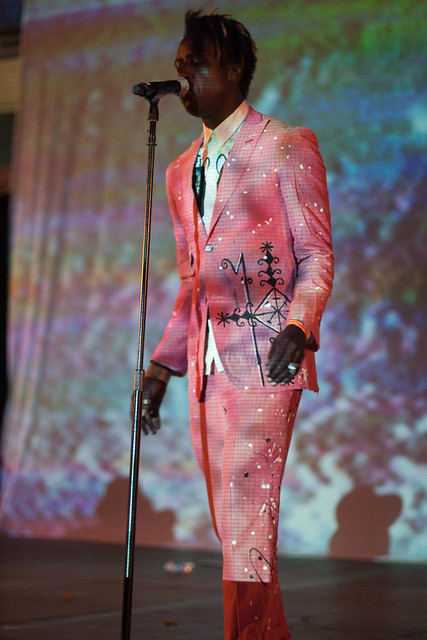
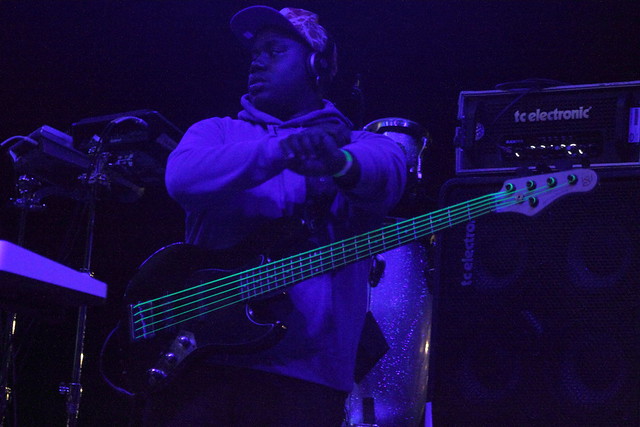
Currently comprised of founding members Tariq “Black Thought” Trotter (vocals), Ahmir “Questlove” Thompson (drums), along with Kamal Gray (keys), “Captain” Kirk Douglas (guitar), Damon Bryson, a.k.a. Tuba Gooding, Jr. (sousaphone, tuba), Mark Kelley (bass), James Poyster (keys), Stro Elliot (production, sampling), The Roots can trace their origins back to when its founding duo met while attending The Philadelphia High School of the Creative and Performing Arts. As the story goes, Trotter and Thompson would busk on street corners — with Thompson playing bucket drums and Trotter rhyming over Thompson’s rhythms, and by 1989, the played their first organized gig at their high school’s talent show under the name Radio Activity.
After a series of name changes including Black to the Future and The Square Roots, the duo eventually settled on The Roots, after discovering that a local folk group went by The Square Roots. As they were building up a local profile, the duo expanded into a full-fledged band with the addition of Josh “The Rubberband” Adams, who later went on to form The Josh Abrams Quartet; MC Malik Abdul “Malik B.” Basit-Smart, Leonard Nelson “Hub” Hubbard (bass); Scott Storch (keys); MC Kenyatta “Kid Crumbs” Warren, who was in the band for the recording sessions for Organix, the band’s full-length debut; and MC Dice Raw, who made cameos on later albums. And although the band has gone through a number of lineup changes since the release of their debut, The Roots throughout the course of their critically applauded, 10 independently released albums, two EPs and two collaborative albums have developed a reputation for a sound that effortlessly meshes live, organic instrumentation featuring a jazz, funk and soul approach with hip-hop, essentially becoming one of the genre’s first true bands. Additionally, throughout their lengthy history together, the members of The Roots have developed a long-held reputation for collaborating with a diverse and expanding list of artists across a wide array of genres and styles, revealing an effortless ability to play anything at any time.
Of course, unless you’ve been living in a remote Tibetan monastery or in a cave, The Roots have been the house band for NBC’s Late Night with Jimmy Fallon from 2009-2014 and for presently being the house band The Tonight Show Starring Jimmy Fallon, further expanding their profile into the national and international consciousness. And while being extraordinarily busy, the members of The Roots have been busy working on their 9th Wonder and Salaam Remi-produced 17th full-length album End Game, as well as contributing a politically charged track to the Detroit soundtrack, “It Ain’t Fair,” a collaboration with the renowned soul singer/songwriter Bilal.
Born Bilal Sayeed Oliver, Bilal is a Philadelphia, PA-born, New York-based soul singer/songwriter, best known by the mononym Bilal. Throughout his career, he’s received praise for his wide vocal range, work across multiple genres, his live performances and for collaborating with the likes of Kendrick Lamar, Common, Erykah Badu, Jay-Z, Beyonce, Guru, Kimbra, J. Dilla, Robert Glasper, Esperanza Spalding, the aforementioned The Roots and others with his full-length debut 1st Born Second, which featured contributions from Soulquarians and production from Dr. Dre and J. Dilla being a commercial and critical success, peaking at number 31 on the Billboard 200 charts and receiving comparisons to Marvin Gaye, Stevie Wonder, Sly & The Family Stone, Prince and Curtis Mayfield. Although since then, the renowned singer/songwriter has developed an increasing reputation for his work becoming much more avant-garde and genre-defying.
Interestingly enough, Ahmir “Questlove” Thompson, Tariq “Black Thought” Trotter and Damon Bryson, a.k.a. Tuba Gooding, Jr. of The Roots and Bilal, along with a horn section went down to NPR Tiny Desk in Washington, DC to perform “It Ain’t Fair,” a deeply reflective song that thematically and lyrically makes a thoughtful nod towards Marvin Gaye’s What’s Going On?, Syl Johnson’s Is It Because I’m Black? and others, as its creators unflinchingly and fearlessly call out a societal construct that denies a group of people the equality, dignity and decency that they too deserve. The song’s creators manage to empathetically offer a glimpse into the hearts and souls of those who love this country and would like to stand for the flag but simply can’t until the evils of inequality, racism and supremacy no longer exist — and when this great country actually lives up the ideals it claims it stands for.
As I mentioned on Facebook, I was recently in Philadelphia for business related to my day job, and as I walked from my hotel in Center City through Old City, past The Liberty Bell and Independence Hall, I recognized that I was walking on many of the streets that the Framers once walked on, as I’ve done several times before. I could picture ol’ Ben Franklin, Thomas Jefferson, George Washington, John Hancock, James Madison, Alexander Hamilton and so on, in their powered wigs and wool coats during that hot summer of 1776. And the song managed to remind me of the bitter and uneasy sadness I had begun to feel, remembering that the Framers, who could write about man’s inalienable rights given to him by God, didn’t see those same rights applying to anyone, who remotely looked like I do (or anyone, who wasn’t a man, or a property owner, etc.); that their independence, their revolution was never mine. The Declaration of Independence, the Constitution, the pledge allegiance to the flag just didn’t apply to me.
If I go back just five generations ago, my ancestors on both sides of my family were slaves. Five generations ago wasn’t that long ago in the overall scheme of things — we’re talking about the parents of my great-grandparents. And on the streets of the City of Independence, I thought of the unfathomable horror and suffering they went through to justify someone else’s desire to be superior — and naturally, the song reminds me quite a bit of a lifelong bitter pill that’s so very difficult to swallow.